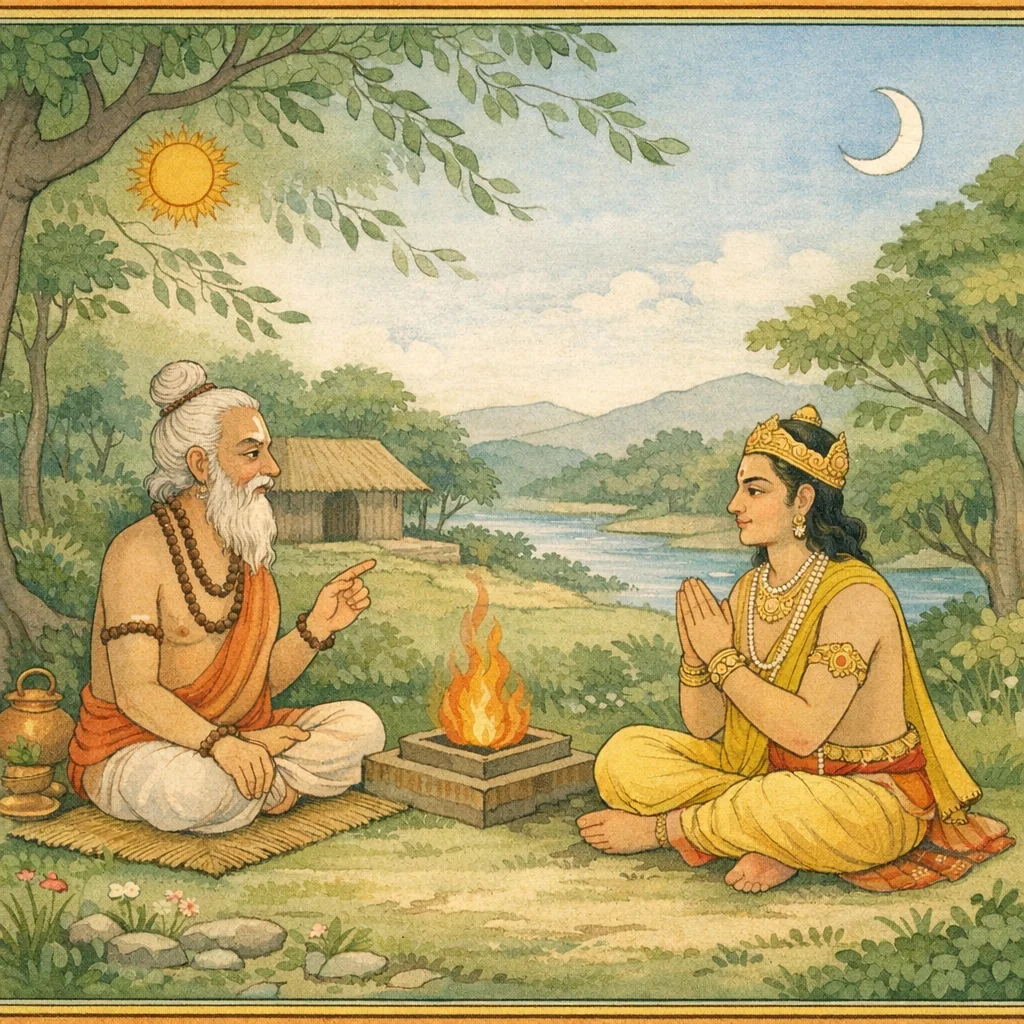
Adhyaya 206
Vyādha–Brāhmaṇa Saṃvāda: Śāpa, Vṛtta-Dharma, and Counsel Against Viṣāda (Grief)
Upa-parva: Vyādha-Dharma Upākhyāna (The Hunter’s Discourse on Dharma)
Chapter 206 records a structured ethical exchange. The vyādha recounts being cursed by a ṛṣi and seeking appeasement; the ṛṣi confirms the curse’s inevitability yet grants anugraha: the vyādha will be dharma-knowing even in a śūdra birth, attain excellence through devoted service to aged parents, retain memory of prior lives, and eventually regain dvija status after the curse’s exhaustion. A brāhmaṇa interlocutor generalizes the teaching: humans encounter pleasure and pain; one should not succumb to longing or despair, and karmic defects can drive harsh destinies. The discourse then pivots to a normative criterion of identity: a brāhmaṇa engaging in degrading actions becomes śūdra-like, while a śūdra established in restraint, truth, and dharma is to be regarded as brāhmaṇa by conduct. The vyādha offers practical psychology: mental suffering is countered by wisdom, bodily suffering by medicine; grief is likened to a potent poison that destroys the unreflective; effective action requires non-despair, seeking remedies without fixation. The chapter closes with mutual recognition of the vyādha’s steadiness, a benediction to remain vigilant in dharma, and Mārkaṇḍeya’s summative report to Yudhiṣṭhira, who expresses admiration and continued thirst for dharmic instruction.
Chapter Arc: युधिष्ठिर, मार्कण्डेय से विनयपूर्वक पूछते हैं—पतिव्रता स्त्रियों का ‘सूक्ष्म, धर्म्य, तत्त्वतः’ माहात्म्य क्या है, और वह कैसे संभव होता है। → मार्कण्डेय उत्तर को लोक-प्रत्यक्ष प्रमाणों से दृढ़ करते हैं—सूर्य, चन्द्र, वायु, पृथ्वी, अग्नि जैसे देवतत्त्व प्रत्यक्ष हैं; वैसे ही गृह-धर्म में गुरुजन और एकपत्नी/पतिव्रता स्त्रियाँ मान्य हैं। पर युधिष्ठिर की जिज्ञासा तीखी होती जाती है: क्रूर स्वभाव वाले पतियों की सेवा जैसी ‘दुष्कर’ साधना भी स्त्रियाँ कैसे निभाती हैं? → धर्म का तीक्ष्ण निष्कर्ष उभरता है—जो माता-पिता (और व्यापक अर्थ में आश्रित-गुरुजन) की आशा को सफल करता है, वही धर्मवित् है; और पतिव्रता-धर्म की कठिनता इसी में है कि वह प्रतिकूलता में भी शुश्रूषा, सत्य और एकनिष्ठता को नहीं छोड़ती। → मार्कण्डेय पतिव्रता-धर्म को सामाजिक आदर, कीर्ति और इह-पर कल्याण से जोड़कर स्थिर करते हैं—एकपत्नी, सत्यवती, सदाचारिणी स्त्रियाँ जो महान् कार्य करती हैं, वह अत्यन्त कठिन होते हुए भी धर्म का आधार है। → युधिष्ठिर की जिज्ञासा बनी रहती है—इस सिद्धान्त का कोई ठोस उपाख्यान/दृष्टान्त सुनने की अपेक्षा अगले प्रसंग की ओर संकेत करती है।
Shlokas
Verse 1
हू... #&< (9) #ध्टज आ£5-] > यह मार्कण्डेयजीका युधिष्ठिरके प्रति द्वापरके समय कहा हुआ वचन है। उन्होंने त्रेतामें हुए कुम्भकर्णकी उपमा दी है। पज्चाधिकद्विशततमो< ध्याय: पतिव्रता स्त्री तथा पिता-माताकी सेवाका माहात्म्य वैशम्पायन उवाच ततो युधिष्छिरो राजा मार्कण्डेयं महाद्युतिम् । पप्रच्छ भरतश्रेष्ठ धर्मप्रश्न॑ सुदुर्विदम्,वैशम्पायनजी कहते हैं--भरतश्रेष्ठ जनमेजय! तदनन्तर राजा युधिष्ठिरने महातेजस्वी मार्कण्डेय मुनिसे धर्मविषयक प्रश्न किया, जो समझनेमें अत्यन्त कठिन था
Vaiśampāyana said: Then King Yudhiṣṭhira questioned the radiant sage Mārkaṇḍeya, O best of the Bharatas, asking a subtle and difficult inquiry concerning dharma—one not easily understood.
Verse 2
श्रोतुमिच्छामि भगवन् स्त्रीणां माहात्म्यमुत्तमम् | कथ्यमानं त्वया विप्र सूक्ष्मं धर्म्य च तत्त्वत:,वे बोले--“भगवन्! मैं आपके मुखसे (पतिव्रता) स्त्रियोंके सूक्ष्म, धर्मसम्मत एवं उत्तम माहात्म्यका यथार्थ वर्णन सुनना चाहता हूँ
Vaiśampāyana said: “Revered sir, I wish to hear the supreme greatness of women—set forth by you, O brāhmaṇa—in a subtle manner, in harmony with dharma, and in accordance with the truth of the matter.”
Verse 3
प्रत्यक्षमिह विप्रषें देवा दृश्यन्ति सत्तम | सूर्याचन्द्रमसौ वायु: पृथिवी वदह्निरेव च,“भगवन! श्रेष्ठ ब्रह्मर्ष] इस जगत्में सूर्य, चन्द्रमा, वायु, पृथिवी, अग्नि, पिता, माता और गुरु--ये प्रत्यक्ष देवता दिखायी देते हैं। भूगुनन्दन! इसके सिवा अन्य जो देवतारूपसे स्थापित देवविग्रह हैं, वे भी प्रत्यक्ष देवताओंकी ही कोटियें हैं"
Vaiśampāyana said: “O best of the virtuous, O brahmarṣi—here in this very world the gods are seen directly: the Sun and the Moon, the Wind, the Earth, and Fire.” The statement frames dharma in concrete terms: reverence is due first to the immediately sustaining powers of life and order, not merely to remote or imagined divinities.
Verse 4
पिता माता च भगवन् गुरुरेव च सत्तम | यच्चान्यद् देवविहितं तच्चापि भूगुनन्दन,“भगवन! श्रेष्ठ ब्रह्मर्ष] इस जगत्में सूर्य, चन्द्रमा, वायु, पृथिवी, अग्नि, पिता, माता और गुरु--ये प्रत्यक्ष देवता दिखायी देते हैं। भूगुनन्दन! इसके सिवा अन्य जो देवतारूपसे स्थापित देवविग्रह हैं, वे भी प्रत्यक्ष देवताओंकी ही कोटियें हैं"
Vaiśampāyana said: “O venerable one, the father, the mother, and indeed the teacher—O best of the good—are to be regarded as manifest divinities. And whatever else is divinely ordained and established as a form of the gods, O delight of the Bhṛgus, that too belongs to the same class of visible divinity.”
Verse 5
मान्या हि गुरव: सर्वे एकपत्न्यस्तथा स्त्रिय: । पतिव्रतानां शश्रूषा दुष्करा प्रतिभाति मे,“समस्त गुरुजन और पतिव्रता नारियाँ भी समादरके योग्य हैं। पतिव्रता स्त्रियाँ अपने पतिकी जैसी सेवा-शुश्रूषा करती हैं; वह दूसरे किसीके लिये मुझे अत्यन्त कठिन प्रतीत होती है
Truly, all elders and teachers are worthy of honor, and so too are women faithful to a single husband. Devoted wives (pativratā) serve and tend their husbands as one would a deity; but to render such service for anyone else seems to me exceedingly hard.
Verse 6
पतिव्रतानां माहात्म्यं वक्तुमहसि न: प्रभो । निरुद्धय चेन्द्रियग्रामं मन: संरुध्य चानघ,'प्रभो! आप अब हमें पतिव्रता स्त्रियोंकी महिमा सुनावें। निष्पाप सहर्ष] जो अपनी इन्द्रियोंको संयममें रखती हुई मनको वशमें करके अपने पतिका देवताके समान ही चिन्तन करती रहती हैं, वे नारियाँ धन्य हैं। प्रभो! भगवन्! उनका वह त्याग और सेवाभाव मुझे तो अत्यन्त कठिन जान पड़ता है
Vaiśampāyana said: “O lord, you should tell us of the greatness of devoted wives. O sinless one, having restrained the whole host of the senses and having brought the mind under control—(tell us) the majesty of those women whose steadfast discipline and single-hearted devotion are directed toward their husbands as toward a deity.”
Verse 7
पतिं दैवतवच्चापि चिन्तयन्त्य: स्थिता हि या: । भगवन् दुष्करं त्वेतत् प्रतिभाति मम प्रभो,'प्रभो! आप अब हमें पतिव्रता स्त्रियोंकी महिमा सुनावें। निष्पाप सहर्ष] जो अपनी इन्द्रियोंको संयममें रखती हुई मनको वशमें करके अपने पतिका देवताके समान ही चिन्तन करती रहती हैं, वे नारियाँ धन्य हैं। प्रभो! भगवन्! उनका वह त्याग और सेवाभाव मुझे तो अत्यन्त कठिन जान पड़ता है
Vaiśampāyana said: “O Blessed one, O Lord, this seems exceedingly difficult to me: those women who, steady in self-restraint, keep their senses in check and their mind under control, and who continually contemplate their husband as though he were a deity—such women are truly fortunate. Their renunciation and spirit of service appear to me almost impossible to accomplish.”
Verse 8
मातापित्रोश्व शुश्रूषा स्त्रीणां भर्तरि च द्विज । स्त्रीणां धर्मात् सुघोराद्धि नान््यं पश्यामि दुष्करम्,“ब्रह्मन! पुत्रोंद्वारा माता-पिताकी सेवा तथा स्त्रियोंद्वारा की हुई पतिकी सेवा बहुत कठिन है। स्त्रियोंक इस कठोर धर्मसे बढ़कर और कोई दुष्कर कार्य मुझे नहीं दिखायी देता है
Vaiśampāyana said: “O brāhmaṇa, service and attentive care rendered to one’s mother and father—likewise a wife’s devoted service to her husband—are indeed arduous. I see no task more difficult than this severe duty that falls upon women.”
Verse 9
साध्वाचारा: स्त्रियो ब्रह्मन् यत् कुर्वन्ति सदा55दृता: । दुष्करं खलु कुर्वन्ति पितरं मातरं च वै
Vaiśampāyana said: “O Brāhmaṇa, women of good conduct, ever attentive and respectful, perform what they do as a truly difficult task—indeed, they bear and serve both father and mother as well.”
Verse 10
कुक्षिणा दश मासांश्व गर्भ संधारयन्ति या:
Vaiśampāyana said: “Those women who bear a child in the womb for ten months…”
Verse 11
संशयं परम॑ प्राप्प वेदनामतुलामपि,“भगवन्! अपनेको भारी प्राणसंकटमें डालकर और अतुल वेदनाको सहकर नारियाँ बड़े कष्टसे संतान उत्पन्न करती हैं! विप्रवर! फिर बड़े स्नेहले उनका पालन भी करती हैं
Vaiśampāyana said: Having fallen into the deepest doubt, (one reflects:) “Revered sir! Women, casting themselves into grave peril of life and enduring immeasurable pain, bring forth children with great hardship; and then, O best of Brahmins, they nurture them as well with profound affection.”
Verse 12
प्रजायते सुतान् नार्यो दुःखेन महता विभो । पुष्णन्ति चापि महता स्नेहेन द्विजपुज्रव,“भगवन्! अपनेको भारी प्राणसंकटमें डालकर और अतुल वेदनाको सहकर नारियाँ बड़े कष्टसे संतान उत्पन्न करती हैं! विप्रवर! फिर बड़े स्नेहले उनका पालन भी करती हैं
Vaiśampāyana said: “O mighty one, women bring forth sons only through great suffering. And, O best of Brahmins, they then nourish and raise them with immense affection.”
Verse 13
याक्ष क्र्रेषु सत्त्वेषु वर्तमाना जुगुप्सिता: | स्वकर्म कुर्वन्ति सदा दुष्करं तच्च मे मतम्,“जो सती-साध्वी स्त्रियाँ क्रूर स्वभावके पतियोंकी सेवामें रहकर उनके तिरस्कारका पात्र बनकर भी सदा अपने सती-धर्मका पालन करती रहती हैं, वह तो मुझे और भी अत्यन्त कठिन प्रतीत होता है
Vaiśampāyana said: “Those virtuous women who live with husbands of cruel disposition—though they become objects of contempt—yet continually perform their own duty (as faithful wives): that, in my view, is an even more difficult undertaking.”
Verse 14
क्षत्रधर्मसमाचारतत्त्वं व्याख्याहि मे द्विज । धर्म: सुदुर्लभो विप्र नृशंसेन महात्मनाम्,“ब्रह्म! आप मुझे क्षत्रियोंके धर्म और आचारका तत्त्व भी विस्तारपूर्वक बताइये। विप्रवर! जो क्रूर स्वभावके मनुष्य हैं, उनके लिये महात्माओंका धर्म अत्यन्त दुर्लभ है
“O Brahmin, explain to me in detail the true essence of kṣatriya-dharma and its proper conduct. O best of Brahmins, for a cruel man the dharma of great-souled ones is exceedingly hard to attain.”
Verse 15
एतदिच्छामि भगवनू प्रश्न॑ प्रश्नविदां वर | श्रीतुं भूुगुकुलश्रेष्ठ शुश्रूषे तव सुव्रत,भगवन्! भृूगुकुलशिरोमणे! आप उत्तम व्रतके पालक और प्रश्नका समाधान करनेवाले दिद्वानोंमें श्रेष्ठ हैं। मैंने जो प्रश्न आपके सम्मुख उपस्थित किया है, उसीका उत्तर मैं आपसे सुनना चाहता हूँ
Vaiśampāyana said: “O venerable one, best among those who know how to resolve questions; O foremost of the Bhṛgu lineage; O keeper of excellent vows—I wish to hear precisely this. I stand ready to listen and to serve you. O Blessed one, crest-jewel of the Bhṛgu clan, I desire to hear from you the answer to the very question I have placed before you.”
Verse 16
मार्कण्डेय उवाच हन्त ते5हं समाख्यास्ये प्रश्नमेतं सुदुर्वचम् । तत्त्वेन भरतश्रेष्ठ गदतस्तन्निबोध मे,मार्कण्डेयजी बोले--भरतश्रेष्ठ! तुम्हारे इस प्रश्चका विवेचन करना यद्यपि बहुत कठिन है, तो भी मैं अब इसका यथावत् समाधान करूँगा। तुम मेरे मुखसे सुनो
Mārkaṇḍeya said: “Very well—I shall explain to you this question, though it is exceedingly difficult to answer. O best of the Bharatas, understand from me, as I speak, the matter in its true essence.”
Verse 17
मातृस्तु गौरवादन्ये पितृनन्ये तु मेनिरे । दुष्करं कुरुते माता विवर्धयति या प्रजा:,कुछ लोग माताओंको गौरवकी दृष्टिसे बड़ी मानते हैं। दूसरे लोग पिताको महत्त्व देते हैं। परंतु माता जो अपनी संतानोंको पाल-पोसकर बड़ा बनाती है, वह उसका कठिन कार्य है
Mārkaṇḍeya said: Some regard the mother as the more venerable, while others assign greater importance to the father. Yet it is the mother—she who nurtures and raises her children to maturity—who performs the truly difficult work.
Verse 18
तपसा देवतेज्याभिवन्दनेन तितिक्षया । सुप्रशस्तैरुपायैश्वापीहन्ते पितर: सुतान्,माता-पिता तपस्या, देवपूजा, वन्दना, तितिक्षा तथा अन्य श्रेष्ठ उपायोंद्वारा भी पुत्रोंको प्राप्त करना चाहते हैं
Mārkaṇḍeya said: “By austerity, by worship of the gods and reverent salutations, and by patient endurance—indeed, by other highly praised means as well—parents strive to obtain sons.”
Verse 19
एवं कृष्छेण महता पुत्र प्राप्य सुदुर्लभम् । चिन्तयन्ति सदा वीर कीदृशो5यं भविष्यति,वीर! इस प्रकार बड़ी कठिनाईसे परम दुर्लभ पुत्रको पाकर लोग सदा इस चिन्तामें डूबे रहते हैं कि न जाने यह किस तरहका होगा
Mārkaṇḍeya said: “O son, having obtained with great hardship a son who is exceedingly hard to gain, people remain constantly absorbed in anxious reflection: ‘What sort of person will this one become, O hero?’”
Verse 20
आशंसते हि पुत्रेषु पिता माता च भारत । यश: कीर्तिमथैश्वर्य प्रजा धर्म तथैव च,भारत! पिता और माता अपने पुत्रोंके लिये यश, कीर्ति और ऐश्वचर्य, संतान तथा धर्मकी शुभकामना करते हैं
Mārkaṇḍeya said: “O Bhārata, a father and a mother, with regard to their sons, indeed cherish auspicious hopes—may they attain honor and renown, prosperity and lordly fortune, offspring, and likewise steadfastness in dharma.”
Verse 21
तयोराशां तु सफलां यः करोति स धर्मवित् । पिता माता च राजेन्द्र तुष्पतो यस्य नित्यश:
Markandeya said: “He alone is truly a knower of dharma who makes the hopes of those two bear fruit—whose father and mother, O best of kings, remain continually satisfied with him.”
Verse 22
नैव यज्ञक्रिया: क॒श्रिन्न श्राद्ध नोपवासकम्
Mārkaṇḍeya said: “Here, no one performs sacrificial rites; nor is there any offering of śrāddha for the departed, nor even the observance of fasting.”
Verse 23
या तु भर्तरि शुश्रूषा तया स्वर्ग जयत्युत । नारीके लिये किसी यज्ञकर्म, श्राद्ध और उपवासकी आवश्यकता नहीं है। वह जो पतिकी सेवा करती है, उसीके द्वारा स्वर्गलोकपर विजय प्राप्त कर लेती है ।। एतत् प्रकरणं राजन्नधिकृत्य युधिष्ठिर,राजा युधिष्छिर! इसी प्रकरणमें पतिव्रताओंके नियत धर्मका वर्णन किया जायगा। तुम सावधान होकर सुनो
Mārkaṇḍeya said: “A woman who renders devoted service to her husband thereby conquers heaven itself. For her, there is no separate necessity of sacrificial rites, śrāddha offerings, or austerities such as fasting; the merit of faithful attendance upon her husband becomes her direct means to the heavenly goal.”
Verse 24
पतिव्रतानां नियतं धर्म चावहित: शूणु,राजा युधिष्छिर! इसी प्रकरणमें पतिव्रताओंके नियत धर्मका वर्णन किया जायगा। तुम सावधान होकर सुनो
Mārkaṇḍeya said: “O King Yudhiṣṭhira, listen with full attention to the fixed and proper duty of devoted wives. In this section, the established dharma of pativratā women will be described; therefore, hear it carefully.”
Verse 106
नार्य: कालेन सम्भूय किमद्धभततरं ततः । 'स्त्रियाँ अपने उदरमें दस महीनेतक जो गर्भ धारण करती हैं और यथासमय उसको जन्म देती हैं, इससे अद्भुत कार्य और कौन होगा?
Vaiśampāyana said: “Women, in due course of time, conceive and bring forth life at the proper moment—what deed could be more wondrous than this?”
Verse 204
इस प्रकार श्रीमह्याभारत वनपवके अन्तर्गत मार्कण्डेयसमास्यापर्वमें धुन्धुमारोपाख्यानविषयक दो सौ चारवाँ अध्याय पूरा हुआ
Thus ends the two-hundred-and-fourth chapter of the Mahābhārata’s Vana Parva, within the Markandeya Summary Section, dealing with the episode of Dhundhumāra, as narrated by Sage Mārkaṇḍeya. This colophon marks the completion of this unit, a pause for reflection on the tale’s moral and exemplary import.
Verse 205
इति श्रीमहाभारते वनपर्वणि मार्कण्डेयसमास्यापर्वणि पतिव्रतोपाख्याने पज्चाधिकद्विशततमो 5 ध्याय:,इस प्रकार श्रीमहाभारत वनपर्वके अन्तर्गत मार्कण्डेययमास्यापर्वमें पतिव्रतोपाख्यानविषयक दो सौ पॉचवाँ अध्याय पूरा हुआ
Thus, in the Śrī Mahābhārata, within the Vana Parva—specifically in the Markandeya-samāsya section—ends the two-hundred-and-fifth chapter of the narrative known as the “Tale of the Chaste Wife (Pativratā)”. This colophon marks the completion of that chapter, closing a moral exemplum on wifely fidelity, self-restraint, and dharma taught through story.
Verse 216
इह प्रेत्य च तस्याथ कीर्तिर्धिर्मश्न शाश्वत: । राजेन्द्र! जो उन दोनोंकी आशाको सफल करता है, वही पुत्र धर्मज्ञ है। जिसके माता- पिता उससे सदा संतुष्ट रहते हैं, उसे इहलोक और परलोकमें भी अक्षय कीर्ति और शाश्वत धर्मकी प्राप्ति होती है
Markandeya said: “Here in this world and after death as well, for such a person there arise enduring fame and lasting righteousness. O best of kings, the son who truly understands dharma is the one who fulfills the hopes of both his parents. He whose mother and father remain continually satisfied with him attains imperishable renown and an abiding share in dharma, both in this life and in the next.”
Verse 963
एकपनन्न्यश्न या नार्यों याश्व॒ सत्यं वदन्त्युत । “ब्रह्मम! समाजमें सदा आदर पानेवाली सदाचारिणी स्त्रियाँ जो महान् कार्य करती हैं वह अत्यन्त कठिन है। जो लोग पिता-माताकी सेवा करते हैं उनका कर्म भी बहुत कठिन है। पतिव्रता तथा सत्यवादिनी स्त्रियाँ अत्यन्त कठोर धर्मका पालन करती हैं
Vaiśampāyana said: Women who live with strict restraint in food and conduct, and those who speak the truth, uphold a demanding discipline. Such virtuous women—honoured in society—accomplish what is exceedingly difficult, just as those who serve their father and mother undertake a hard duty. A devoted wife (pativratā) and a truthful woman, by steadfastly observing dharma, practice a rigorous moral path.
Frequently Asked Questions
The chapter interrogates whether ethical worth is anchored in birth-status or in lived conduct, while also addressing how one should respond to karmic suffering without collapsing into despair.
Dharma is operationalized as disciplined behavior—truth, restraint, duty, and service—while grief is treated as cognitively corrosive; wise agency seeks remedies and acts without fixation, accepting karma’s unfolding.
A direct phalaśruti is not stated; instead, the meta-commentary is embedded in Mārkaṇḍeya’s closing summary to Yudhiṣṭhira, presenting the episode as an exemplary dharma-upākhyāna whose comprehension supports steadiness and vigilance in dharma.