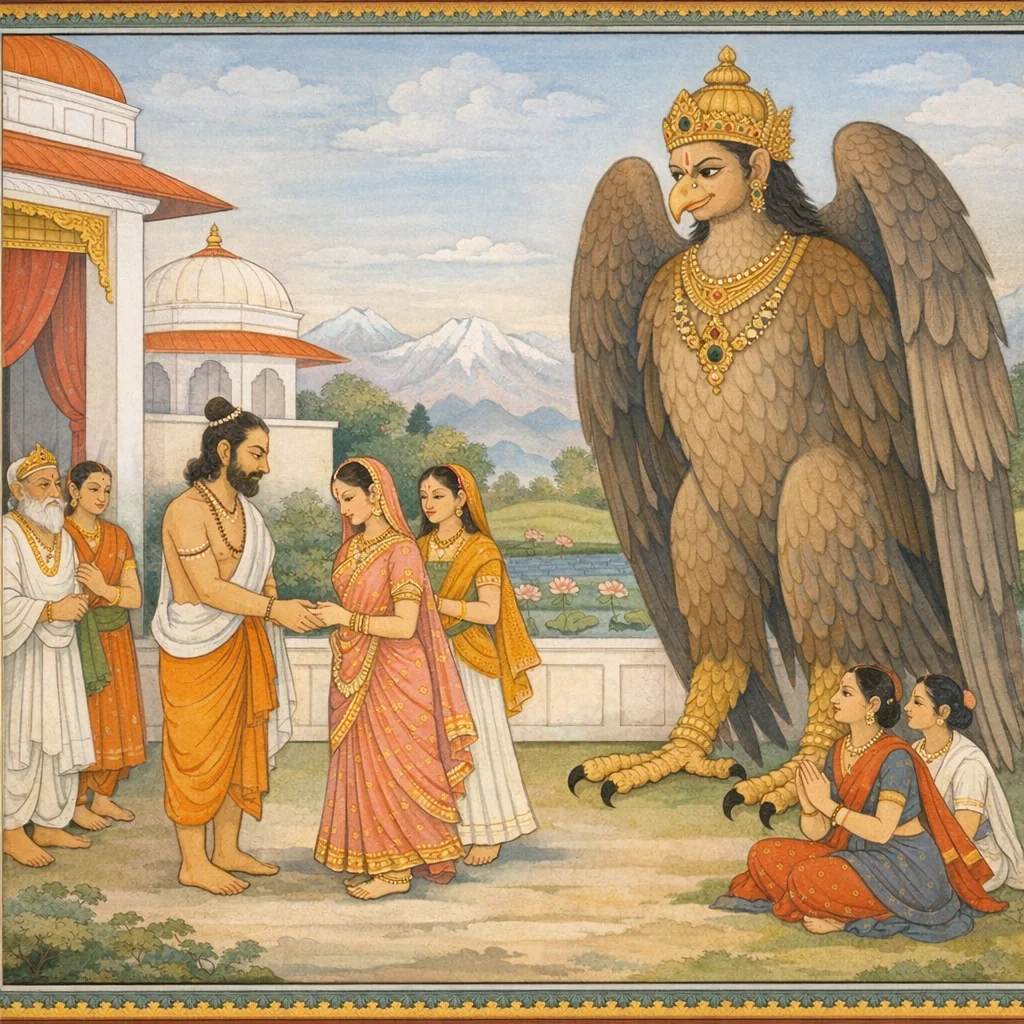
Adhyaya 114
Haryaśva’s Agreement with Gālava and the Birth of Vasumanā (Nārada’s narration)
Upa-parva: Gālava–Mādhavī Upākhyāna (embedded exemplum within Udyoga Parva)
Nārada recounts how King Haryaśva, reflecting with concern for progeny, evaluates Mādhavī’s auspicious qualities and requests that the sage specify an appropriate śulka (bride-price) consistent with his resources. Gālava stipulates a precise payment: eight hundred exceptional horses characterized as moon-white with dark ears, rare and region-bred. Haryaśva admits he possesses only two hundred of the required type, while additional horses are dispersed. He proposes to beget a single son through Mādhavī and asks Gālava to complete his objective by this partial fulfillment. Mādhavī then discloses a boon granted by a brahma-vādin: after each childbirth she will return to maidenhood; hence she can be given successively to multiple kings so that, from four rulers, the full complement of horses will be obtained, and she will bear four sons. Gālava accepts this plan and instructs Haryaśva to accept Mādhavī for one-quarter of the śulka. In due time, Haryaśva fathers a son, Vasumanā, described as radiant and generous. When Gālava returns, Haryaśva—committed to truth—hands Mādhavī back despite the scarcity of such horses. Mādhavī relinquishes royal splendor, resumes maidenhood by the boon, and departs with Gālava to approach the next king, Divodāsa, leaving the acquired horses temporarily with Haryaśva.
Chapter Arc: नारद गालव-चरित्र को आगे बढ़ाते हैं—गरुड़ (ताक्ष्य) गालव को यथार्थ का उपदेश देकर ययाति के द्वार तक ले आता है, जहाँ कन्या-दान की असाधारण शर्तें और ‘शुल्क’ का प्रश्न उठता है। → ययाति अपनी कीर्ति, यज्ञ-दान और प्रभुत्व के बावजूद स्वीकार करता है कि उसका धन क्षीण हो चुका है; फिर भी वह ‘याचक को निराश लौटाना’ पाप मानकर गालव की सहायता का मार्ग खोजता है। कन्या के ‘शुल्क’ की चर्चा होते ही यह स्पष्ट होता है कि यह मूल्य साधारण नहीं—राज्य तक देने को राजा तैयार हो सकते हैं, तो घोड़ों का मूल्य कितना भारी होगा। → ययाति निर्णायक रूप से अपनी कन्या को गालव को सौंप देता है और संकेत देता है कि इस कन्या के ‘शुल्क’ के बदले राजा लोग राज्य तक दे सकते हैं—यानी गालव का लक्ष्य (श्यामकर्ण अश्व) अब ‘दान’ से अधिक ‘राजनीतिक सौदे’ और ‘राज-प्रतिष्ठा’ की कसौटी बन जाता है। → गरुड़ के प्रस्थान के बाद गालव कन्या सहित विभिन्न राजाओं के पास ‘शुल्क’ के रूप में अपेक्षित साधन जुटाने निकल पड़ता है; वह अयोध्या-नरेश हर्यश्व के पास जाकर प्रस्ताव रखता है—कन्या को पत्नी रूप में स्वीकार करें, और बदले में निर्धारित ‘शुल्क’ दें। → हर्यश्व गालव के प्रस्ताव पर क्या निर्णय करेगा—क्या वह कन्या-स्वीकार कर ‘शुल्क’ देगा, या गालव को आगे और कठिन द्वारों पर भटकना पड़ेगा?
Shlokas
Verse 1
अपना छा अर: पञ्चदशाधिकशततमो< ध्याय: राजा ययातिका गालवको अपनी कन्या देना और गालवका उसे लेकर अयोध्यानरेशके यहाँ जाना नारद उवाच एवमुक्त: सुपर्णेन तथ्यं वचनमुत्तमम् । विमृश्यावहितो राजा निनश्चित्य च पुन: पुन:,नारदजी कहते हैं--गरुड़ने जब इस प्रकार यथार्थ और उत्तम बात कही, तब सहस्रों यज्ञोंका अनुष्ठान करनेवाले, दाता, दानपति, प्रभावशाली तथा राजोचित तेजसे प्रकाशित होनेवाले सम्पूर्ण नरेशोंके स्वामी महाराज ययातिने सावधानीके साथ बारंबार विचार करके एक निश्चयपर पहुँचकर इस प्रकार कहा
Narada said: When Garuḍa had thus spoken words that were both true and excellent, the king, attentive and composed, reflected carefully again and again, and then arrived at a firm decision.
Verse 2
यष्टा क्रतुसहस्राणां दाता दानपति: प्रभु: । ययाति: सर्वकाशीश इदं वचनमत्रवीत्,नारदजी कहते हैं--गरुड़ने जब इस प्रकार यथार्थ और उत्तम बात कही, तब सहस्रों यज्ञोंका अनुष्ठान करनेवाले, दाता, दानपति, प्रभावशाली तथा राजोचित तेजसे प्रकाशित होनेवाले सम्पूर्ण नरेशोंके स्वामी महाराज ययातिने सावधानीके साथ बारंबार विचार करके एक निश्चयपर पहुँचकर इस प्रकार कहा
Narada said: Then King Yayāti—renowned as the performer of thousands of sacrificial rites, a generous giver and lord of gifts, powerful and radiant with royal splendor, and sovereign among kings—having reflected carefully again and again and arrived at a firm resolve, spoke these words.
Verse 3
दृष्टवा प्रियसखं ताक्ष्य गालवं च द्विजर्षभम् । निदर्शनं च तपसो भिक्षां श्लाघ्यां च कीर्तिताम्,राजाने पहले अपने प्रिय मित्र गरुड़ तथा तपस्याके मूर्तिमान् स्वरूप विप्रवर गालवको अपने यहाँ उपस्थित देख और उनकी बतायी हुई स्पृहणीय भिक्षाकी बात सुनकर मनमें इस प्रकार विचार किया-- 'ये दोनों सूर्यवंशमें उत्पन्न हुए दूसरे अनेक राजाओंको छोड़कर मेरे पास आये हैं।' ऐसा विचारकर वे बोले---
Nārada said: Seeing his dear friend Tākṣya (Garuḍa) and also Gālava, the bull among Brahmins—who stood as a living embodiment of austerity—and hearing of the laudable alms (a worthy request) that had been spoken of, the king reflected within himself: “Leaving aside many other kings born in the Solar line, these two have come to me.” Having thus considered, he spoke.
Verse 4
अतीत्य च नृपानन्यानादित्यकुलसम्भवान् | मत्सकाशमनुप्राप्तावेतां बुद्धिमवेक्ष्य च,राजाने पहले अपने प्रिय मित्र गरुड़ तथा तपस्याके मूर्तिमान् स्वरूप विप्रवर गालवको अपने यहाँ उपस्थित देख और उनकी बतायी हुई स्पृहणीय भिक्षाकी बात सुनकर मनमें इस प्रकार विचार किया-- 'ये दोनों सूर्यवंशमें उत्पन्न हुए दूसरे अनेक राजाओंको छोड़कर मेरे पास आये हैं।' ऐसा विचारकर वे बोले---
Nārada said: “Having passed by other kings born in the Solar (Āditya) lineage, the two of them came to me. Observing this intention, the king reflected inwardly: ‘Leaving aside many other rulers of the Sūryavaṃśa, these two have come specifically to my presence.’ With that thought, he spoke.”
Verse 5
अद्य मे सफलं जन्म तारितं चाद्य मे कुलम् । अद्यायं तारितो देशो मम तार्क्ष्य त्वयानघ,“निष्पाप गरुड़| आज मेरा जन्म सफल हो गया। आज मेरे कुलका उद्धार हो गया और आज आपने मेरे इस सम्पूर्ण देशको भी तार दिया
Nārada said: “Today my birth has borne fruit; today my lineage has been redeemed. Today this whole land of mine has been delivered as well—O Tārkṣya (Garuda), O blameless one—by you.”
Verse 6
वक्तुमिच्छामि तु सखे यथा जानासि मां पुरा । न तथा वित्तवानस्मि क्षीणं वित्तं च मे सखे,'सखे! फिर भी मैं एक बात कहना चाहता हूँ। आप पहलेसे मुझे जैसा धनवान् समझते हैं, वैसा धनसम्पन्न अब मैं नहीं रह गया हूँ। मित्र! मेरा वैभव इन दिनों क्षीण हो गया है
Nārada said: “Friend, I still wish to tell you something. As you knew me formerly—as a man of wealth—so am I no longer. Friend, my resources have dwindled in these days.”
Verse 7
न च शक्तो5स्मि ते कर्तु मोघमागमनं खग । न चाशामस्य विदप्रर्षेवितथीकर्तुमुत्सहे,“आकाशचारी गरुड़! इस दशामें भी मैं आपके आगमनको निष्फल करनेमें असमर्थ हूँ और इन ब्रह्मर्षिकी आशाको भी मैं विफल करना नहीं चाहता
Nārada said: “O bird who moves through the sky! I am not able to let your coming here become fruitless; nor do I have the heart to thwart the hope of this sage. Even in these circumstances, I must honor both your purpose and the righteous expectation placed in me.”
Verse 8
तत् तु दास्यामि यत् कार्यमिदं सम्पादयिष्यति । अभिगम्य हताशो हि निवृत्तो दहते कुलम्,“अतः मैं एक ऐसी वस्तु दूँगा, जो इस कार्यका सम्पादन कर देगी। अपने पास आकर कोई याचक हताश हो जाय तो वह लौटनेपर आशा भंग करनेवाले राजाके समूचे कुलको दग्ध कर देता है
“But I will give you something that will accomplish this task. For if a supplicant comes to a king and, leaving his presence, returns disappointed and hope-broken, that very frustration burns down the king’s entire lineage.”
Verse 9
नात: परं वैनतेय किंचित् पापिष्ठमुच्यते । यथाशानाशनालल्लोके देहि नास्तीति वा वच:,“विनतानन्दन! लोकमें कोई “दीजिये” कहकर कुछ माँगे और उससे यह कह दिया जाय कि जाओ मेरे पास नहीं है, इस प्रकार याचककी आशाको भंग करनेसे जितना पाप लगता है, इससे बढ़कर पापकी दूसरी कोई बात नहीं कही जाती है
Nārada said: “O son of Vinatā (Garuḍa), nothing is described as more sinful than this: when, in the world, a person who has come hoping for food or help says, ‘Give,’ and he is answered, ‘Go—there is nothing with me.’ To shatter a supplicant’s hope in this way is counted as the gravest wrongdoing.”
Verse 10
हताशो हााकृतार्थ: सन् हतः सम्भावितो नर: । हिनस्ति तस्य पुत्रांश्व पौत्रांश्चाकुर्वतो हितम्,“कोई श्रेष्ठ मनुष्य जब कहीं याचना करके हताश एवं असफल होता है, तब वह मरे हुएके समान हो जाता है और अपना हित न करनेवाले धनीके पुत्रों तथा पौत्रोंका नाश कर डालता है
Narada said: “When a worthy man, having gone to seek help, returns despairing and unfulfilled, he becomes as good as dead—his honor crushed. In such a state, he turns destructive: he brings ruin upon the sons and grandsons of that wealthy man who failed to act for his welfare.”
Verse 11
तस्माच्चतुर्णा वंशानां स्थापयित्री सुता मम । इयं सुरसुतप्रख्या सर्वधर्मोपचायिनी,“अतः मेरी जो यह पुत्री है, यह चार कुलोंकी स्थापना करनेवाली है। इसकी कान्ति देवकन्याके समान है। यह सम्पूर्ण धर्मोंकी वृद्धि करनेवाली है
Therefore, this daughter of mine is destined to establish four lineages. She shines with the splendor of a celestial maiden, and she will foster the growth and flourishing of all forms of dharma.
Verse 12
सदा देवमनुष्याणामसुराणां च गालव । काड्क्षिता रूपतो बाला सुता मे प्रतिगृह्यताम्,“गालव! इसके रूप-सौन्दर्यसे आकृष्ट होकर देवता, मनुष्य तथा असुर सभी लोग सदा इसे पानेकी अभिलाषा रखते हैं; अतः आप मेरी इस पुत्रीको ही ग्रहण कीजिये
Nārada said: “O Gālava, drawn by her beauty, gods, humans, and even the asuras continually long to obtain this maiden. Therefore, please accept my daughter.”
Verse 13
अस्या: शुल्कं प्रदास्यन्ति नृपा राज्यमपि ध्रुवम् । कि पुन: श्यामकर्णानां हयानां द्वे चतु:ःशते,“इसके शुल्कके रूपमें राजालोग निश्चय ही अपना राज्य भी आपको दे देंगे; फिर आठ सौ श्यामकर्ण घोड़ोंकी तो बात ही क्या है?
Nārada said: “As her bride-price, kings will certainly offer even their kingdoms. How much more readily, then, would they give eight hundred horses with dark ears?”
Verse 14
स भवान प्रतिगृह्नातु ममैतां माधवीं सुताम् । अहं दौहित्रवान् स्यां वै वर एष मम प्रभो,“अतः प्रभो! आप मेरी इस पुत्री माधवीको ग्रहण करें और मुझे यह वर दें कि मैं दौहित्रवान् (नातियोंसे युक्त) होऊँ”
Nārada said: “O revered lord, please accept this daughter of mine, Mādhavī. Grant me this boon: that I may become one who has a daughter’s son (a grandson).”
Verse 15
प्रतिगृह्य च तां कन््यां गालव: सह पक्षिणा । पुनर्द्रक्ष्याव इत्युक्त्वा प्रतस्थे सह कन््यया
Having accepted the maiden, Gālava—together with the bird—set out, telling her, “We shall meet again,” and departed with the girl.
Verse 16
तब गरुड़सहित गालवने उस कन्याको लेकर कहा--“अच्छा, हम फिर कभी मिलेंगे।” राजासे ऐसा कहकर गालव मुनि कन्याके साथ वहाँसे चल दिये ।। उपलब्धमिदं द्वारमश्वानामिति चाण्डज: । उक्त्वा गालवमापृच्छय जगाम भवनं स्वकम्,तदनन्तर गरुड़ भी यह कहकर कि अब तुम्हें घोड़ोंकी प्राप्तिका यह द्वार प्राप्त हो गया, गालवसे विदा ले अपने घरको चले गये
Then, accompanied by Garuḍa, Galava took the maiden and said, “Very well; we shall meet again.” Having spoken thus to the king, the sage Galava departed from that place with the girl. Thereafter Garuḍa, the son of Vinatā, declared, “Now you have found the gateway to obtaining the horses,” and, taking leave of Galava, returned to his own abode.
Verse 17
गते पतगराजे तु गालव: सह कनन््यया । चिन्तयान: क्षमं दाने राज्ञां वै शुल्कतोडगमत्
When the king of birds had departed, Gālava, accompanied by the maiden, reflected on what would be acceptable as a gift from kings. Seeking a lawful and practicable means to meet the demanded bride-price, he went to Śulkatoḍa, intent on securing the required wealth without violating propriety.
Verse 18
पक्षिराज गरुड़के चले जानेपर गालव उस कनन््याके साथ यह सोचते हुए चल दिये कि राजाओंमेंसे कौन ऐसा नरेश है, जो इस कन्याका शुल्क देनेमें समर्थ हो ।। सो<गच्छन्मनसेक्ष्वाकुं हर्यश्नं राजसत्तमम् । अयोध्यायां महावीर्य चतुरड्रबलान्वितम्,वे मन-ही-मन विचार करके अयोध्यामें इक्ष्वाकुवंशी नृपतिशिरोमणि महापराक्रमी हर्यश्वके पास गये, जो चतुरंगिणी सेनासे सम्पन्न थे
When Garuḍa, the king of birds, had departed, Gālava set out with the maiden, reflecting on which among the kings might be capable of paying the bride-price required for her. As he journeyed, he resolved in his mind upon Haryaśva—foremost among the Ikṣvāku line—dwelling in Ayodhyā, a mighty warrior supported by a complete fourfold army.
Verse 19
कोशधान्यबलोपेतं प्रियपौरं द्विजप्रियम् । प्रजाभिकामं शाम्यन्तं कुर्वाणं तप उत्तमम्,वे कोष, धन-धान्य और सैनिकबल--सबसे सम्पन्न थे। पुरवासी प्रजा उन्हें बहुत ही प्रिय थी। ब्राह्मणोंके प्रति उनका अधिक प्रेम था। वे प्रजावर्गके हितकी इच्छा रखते थे। उनका मन भोगोंसे विरक्त एवं शान्त था। वे उत्तम तपस्यामें लगे हुए थे
Nārada said: “He was endowed with a full treasury, abundant grain, and strong military power. He was beloved of the townspeople and especially dear to the Brahmins. Ever wishing the welfare of his subjects, his mind was calm and free from attachment to pleasures, and he was engaged in the highest austerity.”
Verse 20
तमुपागम्य विप्र: स हर्यश्वंं गालवोडब्रवीत् । कन्येयं मम राजेन्द्र प्रसवैः: कुलवर्धिनी,राजा हर्यश्वके पास जाकर विप्रवर गालवने कहा--'राजेन्द्र! मेरी यह कन्या अपनी संतानोंद्वारा वंशकी वृद्धि करनेवाली है। तुम शुल्क देकर इसे अपनी पत्नी बनानेके लिये ग्रहण करो। हर्यश्व! मैं तुम्हें पहले इसका शुल्क बताऊँगा। उसे सुनकर तुम अपने कर्तव्यका निश्चय करो'
Approaching King Haryaśva, the Brahmin Gālava said: “O lord of kings, this maiden of mine will increase the lineage through her offspring. Accept her as your wife by paying the bride-price. First I shall state the fee for her; having heard it, decide your course of duty.”
Verse 21
इयं शुल्केन भार्यार्थ हर्यश्व प्रतिगृह्मताम् शुल्कं ते कीर्तयिष्यामि तच्छूत्वा सम्प्रधार्यताम्,राजा हर्यश्वके पास जाकर विप्रवर गालवने कहा--'राजेन्द्र! मेरी यह कन्या अपनी संतानोंद्वारा वंशकी वृद्धि करनेवाली है। तुम शुल्क देकर इसे अपनी पत्नी बनानेके लिये ग्रहण करो। हर्यश्व! मैं तुम्हें पहले इसका शुल्क बताऊँगा। उसे सुनकर तुम अपने कर्तव्यका निश्चय करो'
Nārada said: “O Haryaśva, accept this maiden as your wife by paying the bride-price. I shall first declare to you what that bride-price is; having heard it, decide with full deliberation what you ought to do.”
Verse 114
इस प्रकार श्रीमहाभारत उद्योगपर्वके अन्तर्गत भगवद्यानपर्वमें गालव चरित्रविषयक एक यौ चौदहवाँ अध्याय पूरा हुआ
Thus ends the one hundred and fourteenth chapter, concerning the story of Galava, within the Bhagavad-yāna section of the Udyoga Parva of the Śrī Mahābhārata. This closing colophon signals the completion of a narrative unit that frames ethical reflection through exemplary conduct and the consequences of choices made in the lead-up to war.
Verse 115
इति श्रीमहाभारते उद्योगपर्वणि भगवद्यानपर्वणि गालवचरिते पजञ्चदशाधिकशततमो< ध्याय:,इस प्रकार श्रीमहाभारत उद्योगपर्वके अन्तर्गत भगवद्यानपर्वमें गालवचरित्रविषयक एक सौ पंद्रहवाँ अध्याय पूरा हुआ
Thus, in the Śrī Mahābhārata, within the Udyoga Parva, in the section called the Bhagavad-yāna Parva, the one-hundred-and-fifteenth chapter—concerning the narrative of Gālava—comes to its close. The colophon signals the completion of the episode and frames it within the larger ethical movement of the Udyoga Parva, where counsel, diplomacy, and the testing of dharma precede the outbreak of war.
Frequently Asked Questions
Haryaśva faces the tension between limited resources and binding ethical exchange: he cannot immediately meet the full horse requirement yet must decide whether to enter an agreement that obligates him to return Mādhavī after securing progeny.
The chapter frames social order as sustained by truthful contracts and proportional solutions—partial fulfillment paired with continued effort—while showing how personal desire (for an heir) is ethically regulated by promises and intermediated consent.
No explicit phalaśruti is stated in these verses; the meta-significance is narrative-exemplary: the episode models how dharma operates through vows, negotiated exchange, and the reputational consequences of honoring agreements.