Adhyaya 7
Saṃsāra-mārga-vistaraḥ (Vidura’s Expanded Account of the Path)
Upa-parva: Vidura–Dhṛtarāṣṭra Saṃvāda (Mokṣa-oriented Nīti in Strī-parva)
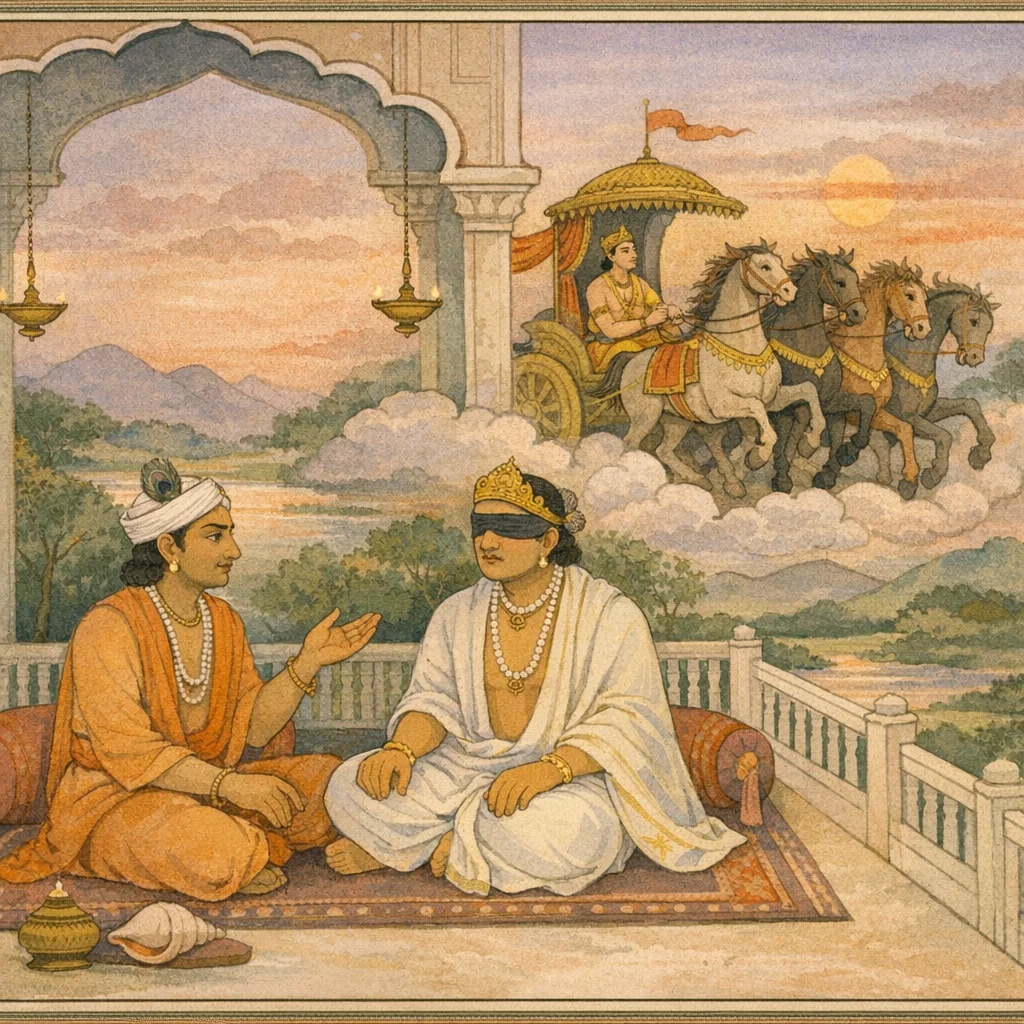
Chapter 7 presents Dhṛtarāṣṭra requesting to hear again the ‘nectar of speech’ from Vidura, who then elaborates a structured teaching on saṃsāra and release. Vidura compares worldly existence to a long journey with intermittent halts, and to a dense forest that the discerning do not cling to. He classifies bodily and mental diseases—seen and unseen—as predatory dangers, and adds aging as an inevitable force that erodes form. Sensory objects (sound, form, taste, touch, smell) are depicted as a mire in which beings sink without support. Time is itemized through year, seasons, months, fortnights, days, nights, and junctions, which progressively ‘plunder’ lifespan and appearance; beings are described as inscribed by karma. A chariot allegory then maps body as chariot, sattva as charioteer, senses as horses, and action/intellect as reins; uncontrolled pursuit perpetuates cyclic rotation, while intelligent restraint prevents return. The chapter closes by asserting that neither prowess, wealth, nor allies liberate like a stable, disciplined self, recommending maitri (benevolence), śīla (ethical character), and the triad of dama, tyāga, and apramāda, culminating in the claim that one established in this mental chariot transcends fear of death and attains Brahmaloka.
Chapter Arc: धृतराष्ट्र, शोक और विस्मय के बीच, विदुर से पूछते हैं—यह कैसा आख्यान है जो मनुष्य को संसार-चक्र से उबारने का मार्ग दिखाता है। → विदुर ‘मार्ग’ का विस्तार करते हैं: जीवन-यात्रा के थके पथिक का रूपक, और रथ-रूपक द्वारा इन्द्रिय-अश्वों की उच्छृंखलता, काल के चक्र (वर्ष, मास, पक्ष, दिन-रात, संध्याएँ) द्वारा आयु-क्षय, तथा तृष्णा से उपजते राज्य-नाश, सुहृद्-नाश और पुत्र-नाश का कठोर सत्य। → विदुर निर्णायक वचन देते हैं कि न पराक्रम, न धन, न मित्र-समूह—दुःख से वैसा मुक्त नहीं कर सकते जैसा ‘स्थिर आत्मा’ और ‘संयम’ कर सकता है; जो बुद्धि से इन्द्रिय-अश्वों को वश में रखते हैं, वे संसार में फिर नहीं भटकते। → संसार-भ्रमण का मूल दुःख पहचानकर विदुर उपाय बताते हैं—संयम, विवेक, वैराग्य और करुणा; और निष्कर्ष रखते हैं कि सभी प्राणियों के प्रति दया करना ही विपश्चित का आचरण है, क्योंकि प्रत्येक को अपना प्राण सर्वाधिक प्रिय है।
Shlokas
Verse 1
/ पम्प बछ। ्स:अ सप्तमो<्ध्याय: संसारचक्रका वर्णन और रथके रूपकसे संयम और ज्ञान आदिको मुक्तिका उपाय बताना धृतराष्ट्र रवाच अहो5भिह्ठितमाख्यानं भवता तत्त्वदर्शिना । भूय एव तु मे हर्ष: श्रुत्वा वागमृतं तव,धृतराष्ट्रने कहा--विदुर! तुमने अद्भुत आख्यान सुनाया। वास्तवमें तुम तत्त्वदर्शी हो। पुनः तुम्हारी अमृतमयी वाणी सुनकर मुझे बड़ा हर्ष होगा
Dhṛtarāṣṭra said: “Ah! You have narrated a truly wondrous account, for you are one who sees the truth. Indeed, my joy will only increase as I hear again your nectar-like speech.”
Verse 2
विदुर उवाच शृणु भूय: प्रवक्ष्यामि मार्गस्यैतस्य विस्तरम् । यच्छुत्वा विप्रमुच्यन्ते संसारेभ्यो विचक्षणा:,विदुरजीने कहा--राजन्! सुनिये। मैं पुनः विस्तार-पूर्वक इस मार्गका वर्णन करता हूँ, जिसे सुनकर बुद्धिमान् पुरुष संसार-बन्धनसे मुक्त हो जाते हैं
Vidura said: “Listen, O king. I shall once again describe in detail the full scope of this path; hearing it, discerning men are released from the bonds of worldly existence.”
Verse 3
यथा तु पुरुषो राजन् दीर्घमध्वानमास्थित: । क्वचित् क्वचिच्छूमाच्छान्त: कुरुते वासमेव वा,नरेश्वर! जिस प्रकार किसी लंबे रास्तेपर चलने-वाला पुरुष परिश्रमसे थककर बीचमें कहीं-कहीं विश्रामके लिये ठहर जाता है, उसी प्रकार इस संसारयात्रामें चलते हुए अज्ञानी पुरुष विश्रामके लिये गर्भवास किया करते हैं। भारत! किंतु विद्वान् पुरुष इस संसारसे मुक्त हो जाते हैं
Vidura said: “O King, just as a man who has set out on a long journey, when wearied by exertion, stops now and then to rest and make a temporary halt, so too, while moving along the journey of worldly existence, the ignorant take ‘rest’ by entering the womb again and again. But the wise are released from this world.”
Verse 4
एवं संसारपययि गर्भवासेषु भारत । कुर्वन्ति दुर्बुधा वासं मुच्यन्ते तत्र पण्डिता:,नरेश्वर! जिस प्रकार किसी लंबे रास्तेपर चलने-वाला पुरुष परिश्रमसे थककर बीचमें कहीं-कहीं विश्रामके लिये ठहर जाता है, उसी प्रकार इस संसारयात्रामें चलते हुए अज्ञानी पुरुष विश्रामके लिये गर्भवास किया करते हैं। भारत! किंतु विद्वान् पुरुष इस संसारसे मुक्त हो जाते हैं
Vidura says: “O Bhārata, in the course of this wandering journey called saṁsāra, the foolish make their ‘halts’ in womb-existences, as if stopping to rest along a long road. But the wise do not take such resting-places; they become released from saṁsāra itself.”
Verse 5
तस्मादध्वानमेवैतमाहु: शास्त्रविदो जना: । यत्तु संसारगहनं वनमाहुर्मनीषिण:,इसीलिये शास्त्रज्ञ पुरुषोंने गर्भवासको मार्गका ही रूपक दिया है और गहन संसारको मनीषी पुरुष वन कहा करते हैं
Therefore, those who know the scriptures describe this very condition as a ‘journey on the road’; and the wise also call the dense entanglement of worldly existence a ‘forest’—hard to traverse and easy to lose one’s way in.
Verse 6
इस प्रकार श्रीमह्या भारत स्त्रीपर्वके अन्तर्गत जलप्रदानिकपर्वमें धृतराष्ट्रके शोकका निवारणविषयक छठा अध्याय पूरा हुआ,सो<यं लोकसमावर्तों मर्त्यानां भरतर्षभ । चराणां स्थावराणां च न गृध्येत् तत्र पण्डित: भरतश्रेष्ठ! यही मनुष्यों तथा स्थावर-जंगम प्राणियोंका संसारचक्र है। विवेकी पुरुषको इसमें आसक्त नहीं होना चाहिये
“O bull among the Bharatas, this indeed is the revolving course of the world for mortals—and likewise for moving and unmoving beings. Therefore, a wise person should not cling to it with craving.”
Verse 7
शारीरा मानसाश्रैव मर्त्यानां ये तु व्याधय: । प्रत्यक्षाश्न परोक्षाश्न ते व्याला: कथिता बुधै:,मनुष्योंकी जो प्रत्यक्ष या अप्रत्यक्ष शारीरिक और मानसिक व्याधियाँ हैं, उन्हींको विद्वानोंने सर्प एवं हिंसक जीव बताया है इति श्रीमहाभारते स्त्रीपर्वणि जलप्रदानिकपर्वणि धृतराष्ट्रविशोककरणे सप्तमो<थध्याय:
The bodily and mental afflictions of mortals—whether evident or hidden—are what the wise have described as ‘serpents’ and other dangerous, predatory creatures.
Verse 8
क्लिश्यमानाश्ष तैर्नित्यं वार्यमाणाश्षु भारत । स्वकर्मभिर्महाव्यालैनोंद्विजन्त्यल्पबुद्धयः,भरतनन्दन! अपने कर्मरूपी इन महान् हिंसक जन्तुओंसे सदा सताये तथा रोके जानेपर भी मन्दबुद्धि मानव संसारसे उद्विग्न या विरक्त नहीं होते हैं
Vidura said: “O Bhārata, though they are continually tormented by those afflictions and repeatedly held back, people of little understanding do not become disenchanted with the world. Even when their own actions—like great, violent beasts—ceaselessly harry them, they still fail to feel true revulsion or wakefulness toward the cycle of worldly life.”
Verse 9
अथापि तैरविमुच्येत व्याधिभि: पुरुषो नृप । आवृणोत्येव तं पश्चाज्जरा रूपविनाशिनी
O king, even if a man were to escape those diseases, old age surely overtakes him afterward, destroying his beauty and outward form.
Verse 10
शब्दरूपरसस्पर्शर्गन्चैश्ष विविधैरपि । मज्जमांसमहापड्के निरालम्बे समन्ततः
Vidura says: Even amid the many varieties of sound, form, taste, touch, and smell, one finds oneself sunk in a vast mire of marrow and flesh—everywhere without support.
Verse 11
नरेश्वर! यदि शब्द, स्पर्श, रूप, रस और नाना प्रकारकी गन्धोंसे युक्त, मज्जा और मांसरूपी बड़ी भारी कीचड़से भरे हुए एवं सब ओरसे अवलम्बशून्य इस शरीररूपी कूपमें रहनेवाला मनुष्य इन व्याधियोंसे किसी तरह मुक्त हो जाय तो भी अन्तमें रूप-सौन्दर्यका विनाश करनेवाली वृद्धावस्था तो उसे घेर ही लेती है ।। संवत्सराश्ष मासाशक्ष पक्षाहोरात्रसंधय: । क्रमेणास्योपयुञ्जन्ति रूपमायुस्तथैव च
Vidura says: “O king, even if a man dwelling in this body—like a well filled with the heavy mire of marrow and flesh, propped up by nothing and driven by the lures of sound, touch, form, taste, and countless scents—somehow escapes these diseases, in the end old age still surrounds him, destroying beauty and charm. Years and months, fortnights, days and nights, and their junctions, in due order, steadily consume his form and his lifespan as well.”
Verse 12
एते कालस्य निधयो नैतान् जानन्ति दुर्बुधा: । धात्राभिलिखितान्याहु: सर्वभूतानि कर्मणा
These are the hidden stores of Time; the foolish do not recognize them. It is said that all beings, through their own deeds, are inscribed beforehand by the Ordainer—so events unfold as destiny shaped by karma.
Verse 13
वर्ष, मास, पक्ष, दिन-रात और संध्याएँ क्रमश: इसके रूप और आयुका शोषण करती ही रहती हैं। ये सब कालके प्रतिनिधि हैं। मूढ़ मनुष्य इन्हें इस रूपमें नहीं जानते हैं। श्रेष्ठ पुरुषोंका कथन है कि विधाताने सम्पूर्ण भूतोंके ललाटमें कर्मके अनुसार रेखा खींच दी है (प्रारब्धके अनुसार उनकी आयु और सुख-दुःखके भोग नियत कर दिये हैं) ।। रथ: शरीर भूतानां सत्त्वमाहुस्तु सारथिम् । इन्द्रियाणि हयानाहु: कर्मबुद्धिस्तु रश्मय:
Vidura says: The body is like a chariot; the inner clarity and steadiness (sattva) is declared to be its charioteer. The senses are the horses, and the discerning intelligence that directs action (karma-buddhi) is the reins. Thus a person’s life is carried forward by time and destiny, yet it is steered—toward restraint or ruin—by how one governs the senses through right understanding and disciplined choice.
Verse 14
तेषां हयानां यो वेगं धावतामनुधावति । स तु संसारचक्रे5स्मिं श्रक्रवत् परिवर्तते
Vidura said: “Whoever runs after the rushing speed of those horses—chasing them as they gallop—he keeps turning round and round in this wheel of worldly existence, like Śakra himself.”
Verse 15
विद्वान् पुरुष कहते हैं कि प्राणियोंका शरीर रथके समान है, सत्त्व (सत्त्वगुणप्रधान बुद्धि) सारथि है, इन्द्रियाँ घोड़े हैं और मन लगाम है। जो पुरुष स्वेच्छापूर्वक दौड़ते हुए उन घोड़ोंके वेगका अनुसरण करता है, वह तो इस संसारचक्रमें पहियेके समान घूमता रहता है ।। यस्तान् संयमते बुद्धया संयतो न निवर्तते । ये तु संसारचक्रेडस्मिं श्व॒क्रवत् परिवर्तिते
Vidura said: The wise declare that a living being’s body is like a chariot: the lucid, sattva-guided intellect is the charioteer, the senses are the horses, and the mind is the rein. A man who, of his own accord, runs after the speed of those horses—following wherever the senses pull—keeps revolving in the wheel of worldly existence. But one who restrains them through discernment remains self-controlled and does not fall back into that turning cycle.
Verse 16
संसारे भ्रमतां राजन् दुःखमेतद्धि जायते,राजन! संसारमें भटकनेवालोंको यह दु:ख प्राप्त होता ही है; अतः विज्ञ पुरुषको इस संसारबन्धनकी निवृत्तिके लिये अवश्य यत्न करना चाहिये। इस विषयमें कदापि उपेक्षा नहीं करनी चाहिये; नहीं तो यह संसार सैकड़ों शाखाओंमें फैलकर बहुत बड़ा हो जाता है
Vidura said: “O King, for those who wander in the round of worldly existence, this suffering inevitably arises. Therefore a discerning person must surely strive to be freed from the bondage of saṃsāra. In this matter one should never be negligent; otherwise this worldly entanglement spreads into hundreds of branches and grows vast.”
Verse 17
तस्मादस्य निवृत्त्यर्थ यत्नमेवाचरेद् बुध: । उपेक्षा नात्र कर्तव्या शतशाख: प्रवर्धते,राजन! संसारमें भटकनेवालोंको यह दु:ख प्राप्त होता ही है; अतः विज्ञ पुरुषको इस संसारबन्धनकी निवृत्तिके लिये अवश्य यत्न करना चाहिये। इस विषयमें कदापि उपेक्षा नहीं करनी चाहिये; नहीं तो यह संसार सैकड़ों शाखाओंमें फैलकर बहुत बड़ा हो जाता है
Therefore, a wise person should make earnest effort to bring about release from this bondage. One must not be negligent in this matter, O King; for if ignored, this worldly entanglement grows vast, branching out into a hundred offshoots.
Verse 18
यतेन्द्रियो नरो राजन् क्रोधलो भनिराकृतः । संतुष्ट: सत्यवादी यः स शान्तिमधिगच्छति,राजन! जो मनुष्य जितेन्द्रिय, क्रोध और लोभसे शून्य, संतोषी तथा सत्यवादी होता है, उसे शान्ति प्राप्त होती है
Vidura said: O King, the man who has mastered his senses, cast away anger and greed, and is contented and devoted to truth—such a one attains peace.
Verse 19
याम्यमाहू रथं होन॑ मुहान्ते येन दुर्बुधा: । स चैतत, प्राप्रुयाद् राजन् यत् त्वं प्राप्तो नराधिप,नरेश्वर! इस संसारको याम्य (यमलोककी प्राप्ति करानेवाला) रथ कहते हैं, जिससे मूर्ख मनुष्य मोहित हो जाते हैं। राजन! जो दुःख आपको प्राप्त हुआ है, वही प्रत्येक अज्ञानी पुरुषको उपलब्ध होता है
Vidura said: They call this world the “Yama-bound chariot”—a vehicle that carries one toward the realm of Death—yet the foolish, deluded by infatuation, grow attached to it. O King, the sorrow that has come upon you is the very same fate that befalls every ignorant man.
Verse 20
अनुतर्षुलमेवैतद् दुःखं भवति मारिष | राज्यनाशं सुहृन्नाश॑ सुतनाशं च भारत,माननीय भारत! जिसकी तृष्णा बढ़ी हुई है, उसीको राज्य, सुहृद् और पुत्रोंका नाशरूपी यह महान् दुःख प्राप्त होता है
Vidura said: O noble one, O Bhārata—this great sorrow comes only to the insatiably craving: the ruin of one’s kingdom, the loss of trusted friends, and the destruction of one’s sons.
Verse 21
साधु: परमदु:खानां दुःखभैषज्यमाचरेत् । ज्ञानौषधमवाप्येह दूरपारं महौषधम् | छिन्द्याद् दुः:खमहाव्याधिं नर: संयतमानस:,साधु पुरुषको चाहिये कि वह अपने मनको वशगमें करके ज्ञानरूपी महान् ओषधि प्राप्त करे, जो परम दुर्लभ है। उससे अपने बड़े-से-बड़े दुःखोंकी चिकित्सा करे। उस ज्ञानरूपी ओषधिसे दुःखरूपी महान् व्याधिका नाश कर डाले
Vidura said: A good person should practice the true remedy for even the deepest sorrows. Here in this world, having obtained the medicine of knowledge—an excellent cure that is hard to reach and rare—one should, with a disciplined mind, cut down the great disease of suffering itself.
Verse 22
न विक्रमो न चाप्यर्थों न मित्र न सुहृज्जन: । तथोन्मोचयते दुःखाद् यथा<55त्मा स्थिरसंयम:,पराक्रम, धन, मित्र और सुहृद् भी उस तरह दुःखसे छुटकारा नहीं दिला सकते, जैसा कि दृढ़तापूर्वक संयममें रहनेवाला अपना मन दिला सकता है
Vidura teaches that neither valor nor wealth, nor even friends and well-wishers, can release a person from sorrow as effectively as one’s own self—when it is steady and disciplined through firm self-control.
Verse 23
तस्मान्मैत्रं समास्थाय शीलमापद्य भारत | दमस्त्यागो<प्रमादश्न ते त्रयो ब्रह्मणो हया:,भरतनन्दन! इसलिये सर्वत्र मैत्रीभाव रखते हुए शील प्राप्त करना चाहिये। दम, त्याग और अप्रमाद--ये तीन परमात्माके धाममें ले जानेवाले घोड़े हैं। जो मनुष्य शीलरूपी लगामको पकड़कर इन तीनों घोड़ोंसे जुते हुए मनरूपी रथपर सवार होता है, वह मृत्युका भय छोड़कर ब्रह्मलोकमें चला जाता है
Therefore, O Bhārata, taking your stand in friendliness toward all, you should cultivate noble conduct. Self-restraint, renunciation, and vigilant heedfulness—these three are the steeds that carry one toward Brahman. The person who, holding the reins of good character, mounts the chariot of the mind yoked to these three horses, casts off the fear of death and proceeds to the world of Brahman.
Verse 24
शीलरश्मिसमायुक्त: स्थितो यो मानसे रथे । त्यक्त्वा मृत्युभयं राजन् ब्रह्मलोक॑ स गच्छति,भरतनन्दन! इसलिये सर्वत्र मैत्रीभाव रखते हुए शील प्राप्त करना चाहिये। दम, त्याग और अप्रमाद--ये तीन परमात्माके धाममें ले जानेवाले घोड़े हैं। जो मनुष्य शीलरूपी लगामको पकड़कर इन तीनों घोड़ोंसे जुते हुए मनरूपी रथपर सवार होता है, वह मृत्युका भय छोड़कर ब्रह्मलोकमें चला जाता है
Vidura says: O King, the person who stands firm upon the chariot of the mind, harnessed with the reins of good conduct, and who—holding that discipline—drives the three steeds of self-control, renunciation, and vigilant heedfulness, casts off the fear of death and attains the world of Brahman. Therefore one should cultivate character while maintaining friendliness toward all beings.
Verse 25
अभयं सर्वभूतेभ्यो यो ददाति महीपते । स गच्छति परं स्थानं विष्णो: पदमनामयम्,भूपाल! जो सम्पूर्ण प्राणियोंको अभयदान देता है, वह भगवान् विष्णुके अविनाशी परमधाममें चला जाता है
Vidura says: O king, whoever grants fearlessness to all living beings attains the highest state—the stainless, imperishable abode of Viṣṇu.
Verse 26
न तत् क्रतुसहस्रेण नोपवासै श्ष नित्यश: । अभयस्य च दानेन यत् फल प्राप्तुयान्नर:,अभयदानसे मनुष्य जिस फलको पाता है, वह उसे सहस्रों यज्ञ और नित्यप्रति उपवास करनेसे भी नहीं मिल सकता है
Vidura said: The reward a person gains by giving the gift of fearlessness cannot be obtained even through a thousand sacrificial rites, nor by performing daily fasts.
Verse 27
न हाात्मन: प्रियतरं किंचिद् भूतेषु निश्चितम् । अनिष्ट सर्वभूतानां मरणं नाम भारत
Vidura said: “For living beings, nothing is certainly dearer than one’s own self. And yet, O Bhārata, death—so named—is unwelcome to all creatures.”
Verse 28
नानामोहसमायुक्ता बुद्धिजालेन संवृता:
They are entangled in many kinds of delusion, and are enclosed—indeed hemmed in—by a net of misdirected intellect.
Verse 29
असूक्ष्मदृष्टयो मन्दा क्राम्यन्ते तत्र तत्र ह । जो मूढ़ नाना प्रकारके मोहमें डूबे हुए हैं, जिन्हें बुद्धिके जालने बाँध रखा है और जिनकी दृष्टि स्थूल है, वे भिन्न-भिन्न योनियोंमें भटकते रहते हैं |। २८ ई ।। सुसूक्ष्मदृष्टयो राजन् व्रजन्ति ब्रह्म शाश्वतम्,(एवं ज्ञात्वा महाप्राज्ञ स तेषामौर्ध्वदैहिकम् । कर्तुमर्हति तेनैव फल प्राप्स्यति वै भवान् ।।) राजन! महाप्राज्ञ! सूक्ष्मदर्शी ज्ञानी पुरुष सनातन ब्रह्मको प्राप्त होते हैं, ऐसा जानकर आप अपने मरे हुए सगे-सम्बन्धियोंका और्ध्वदैहिक संस्कार कीजिये। इसीसे आपको उत्तम फलकी प्राप्ति होगी
Vidura said: Those of dull understanding, whose vision is not subtle, wander here and there. Deluded in many ways, ensnared in the net of the intellect and limited to a gross outlook, they keep roaming through diverse wombs and forms of birth. But, O king, those whose insight is subtle attain the eternal Brahman. Knowing this, O greatly wise one, you should perform the post-funeral rites (aurdhvadaihika) for your departed kinsmen; by that very act you will obtain an excellent fruit.
Verse 156
भ्रममाणा न मुहान्ति संसारे न भ्रमन्ति ते । किंतु जो संयमशील होकर बुद्धिके द्वारा उन इन्द्रियरूपी अश्वोंको काबूमें रखते हैं, वे फिर इस संसारमें नहीं लौटते। जो लोग चक्रकी भाँति घूमनेवाले इस संसारचक्रमें घूमते हुए भी मोहके वशीभूत नहीं होते हैं, उन्हें फिर संसारमें नहीं भटकना पड़ता
Those who, though moving amid the whirl of worldly life, do not fall into delusion are not truly lost in saṃsāra. Rather, the self-controlled—who rein in the horse-like senses by the guidance of intellect—do not return again to this cycle. Even while living within the turning wheel of the world, if one is not mastered by moh (bewildering attachment), one need not wander again in repeated worldly roaming.
Verse 273
तस्मात् सर्वेषु भूतेषु दया कार्या विपश्चिता । भारत! यह बात निश्चितरूपसे कही जा सकती है कि प्राणियोंको अपने आत्मासे अधिक प्रिय कोई भी वस्तु नहीं है; इसीलिये मरना किसी भी प्राणीको अच्छा नहीं लगता; अतः विद्वान् पुरुषको सभी प्राणियोंपर दया करनी चाहिये
Therefore, the wise should cultivate compassion toward all beings. O Bhārata, it can be stated with certainty that no creature holds anything dearer than its own self; for this reason, death is pleasing to none. Hence, a learned person ought to show mercy and kindness to every living being.
Frequently Asked Questions
The implied dilemma is how a person should respond to inevitable suffering and loss: whether to cling to sensory and social supports that are unstable, or to adopt disciplined self-governance and ethical character as the primary means of resilience and release.
That liberation-oriented living depends on intelligent restraint: recognizing disease, aging, sensory entanglement, and time as structural pressures of embodied life, and countering them through śīla, maitri, and the triad of dama–tyāga–apramāda under steady self-control.
Yes in functional form: it asserts that one who is established in the ‘mental chariot’ with ethical reins abandons fear of death and attains Brahmaloka, presenting an explicit outcome claim tied to disciplined conduct.