Adhyaya 348
Adhyāya 348: Nāga–Nīgabhāryā Saṃvāda on Anger, Hope, and Ethical Response
Upa-parva: Didactic Dialogue on Restraint (Krodha-nigraha) in a Nāga Household Episode
This chapter presents a structured exchange. (1) The nāga questions who the brāhmaṇa-disguised visitor truly is—human or divine—and asserts nāga potency and their reputed role as guardians of wealth for humans (śl. 1–4). (2) The nāgabhāryā responds with measured discernment: she judges the visitor not as a deity but as devoted and not excessively wrathful; she frames his desire to see the nāga as persistent and sincere, and argues that no divine being would need to ‘guard’ the nāga, implying the visitor’s humble status and thus the appropriateness of granting audience (śl. 5–7). (3) She advances normative claims: abandon innate anger; do not ‘burn’ oneself by cutting off another’s hope; frustrating those who approach in hope is equated with grave moral fault, while silence, giving, and truthfulness yield knowledge, fame, and elevated standing (śl. 8–10). (4) She further links gift (including land) with spiritual progress and asserts that fulfilling an intended, non-harmful act prevents descent into suffering states (śl. 11–12). (5) The nāga concedes: pride and birth-based fault had generated anger, but her speech has extinguished it; he cites exempla of powerful figures destroyed by doṣa-driven anger, calling anger an enemy of tapas and welfare (śl. 13–18). (6) He praises his wife’s virtues and commits to go where the brāhmaṇa stands, ensuring the petitioner will not depart unfulfilled (śl. 19–20).
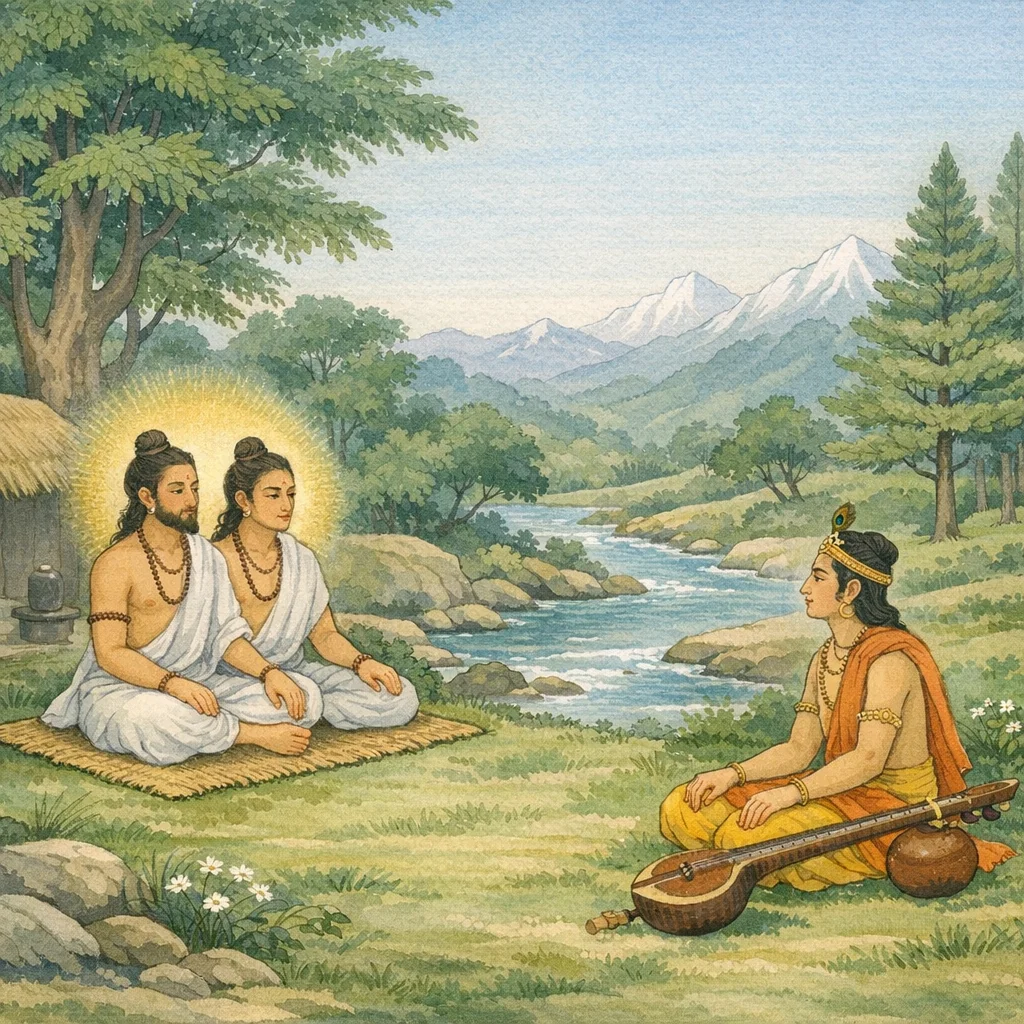
Chapter Arc: Vaishampayana relates to Janamejaya how, upon hearing the words and glory of Nara-Narayana, Devarshi Narada’s devotion to Bhagavan swells until it becomes exclusive and unwavering. → Narada abides for a long season at the Nara-Narayana ashrama, hearing the Bhagavad-akhyana and beholding the imperishable Hari; the narrative widens into a ‘rahasya-sahita dharma’ received from Narayana Himself, while stern warnings arise for those who harbor hatred toward Vishnu in thought, speech, or deed. → The teaching strikes its highest note: Vishnu-Narayana is to be known as the very Atman of all beings—this is the true situation; to hate Him is to ruin one’s own world and even drag one’s ancestors into darkness. → The Narayaniya account is declared fully told—spoken in response to the questions of Shaunaka and the Naimisharanya sages—affirming Narayana as the primal cause, the subtle refuge of moksha, the eternal, unmoving shelter, praised by self-controlled seekers of Sankhya and yoga.
Shlokas
Verse 1
वैशम्पायनजी कहते हैं--जनमेजय! नर-नारायणका वह कथन सुनकर भगवानके प्रति नारदजीकी भक्ति बहुत बढ़ गयी। वे उनके अनन्य भक्त हो गये
Vaiśampāyana said: “O Janamejaya, after hearing that statement of Nara and Nārāyaṇa, Nārada’s devotion to the Lord increased greatly. He became an exclusive, single-minded devotee of Him.”
Verse 2
प्रोष्य वर्षमहस्नं तु नरनारायणाश्रमे । श्रुत्वा भगवदाख्यानं दृष्टवा च हरिमव्ययम्
Vaiśampāyana said: After residing for a year in the hermitage of Nara and Nārāyaṇa, and after hearing the sacred account concerning the Blessed Lord, and also beholding Hari, the imperishable—(the narrative proceeds from that auspicious encounter).
Verse 3
तावपि ख्याततपसौ नरनारायणावृषी
Vaiśampāyana said: Those two sages too—Nara and Nārāyaṇa—renowned for their austerities, (are to be understood as present in this context).
Verse 4
तस्मिन्नेवा श्रमे रम्ये तेपतुस्तप उत्तमम् | तत्पश्चात् वे विख्यात तपस्वी नर-नारायण ऋषि भी पुनः उसी रमणीय आश्रममें रहते हुए उत्तम तपस्यामें संलग्न हो गये ।। ३ $ ।। त्वमप्यमितविक्रान्त: पाण्डवानां कुलोद्वह:
Vaiśampāyana said: In that very delightful hermitage, they performed the highest austerity. Thereafter, the renowned ascetics, the sages Nara and Nārāyaṇa, once again—dwelling in that charming āśrama—devoted themselves to supreme penance. And you too, of immeasurable prowess, are the upholder of the Pāṇḍava lineage.
Verse 5
नैव तस्यापरो लोको नायं पार्थिवसत्तम
Vaiśampāyana said: “For him there is neither a higher world hereafter, nor even this earthly good—O best of kings.”
Verse 6
मज्जन्ति पितरस्तस्य नरके शाश्वती: समा:
Vaiśampāyana said: “That person’s forefathers sink into hell for everlasting years.”
Verse 7
कथं नाम भवेद् द्वेष्प आत्मा लोकस्य कस्यचित्
Vaiśampāyana said: “How could one’s own self ever become an object of hatred to anyone in the world?”
Verse 8
य एष गुरुरस्माकमृषिर्गन्धवतीसुत:,तात! ये जो हमलोगोंके गुरु गन्धवतीपुत्र महर्षि व्यास बैठे हैं, इन्होंने ही भगवान्के परम उत्तम अविनाशी माहात्म्यका वर्णन किया है। निष्पाप! उन्हींसे मैंने यह सब सुना है और मेरेद्वारा तुमको भी कहा गया है
Vaiśampāyana said: “Dear child, this very sage—our teacher, the son of Gandhavatī (Satyavatī), Mahārṣi Vyāsa—has described the supremely excellent, imperishable greatness of the Lord. O sinless one, I heard all of this from him, and I have in turn related it to you as well.”
Verse 9
तेनैतत् कथितं तात माहात्म्यं परमव्ययम् । तस्माच्छुतं मया चेदं कथितं च तवानघ,तात! ये जो हमलोगोंके गुरु गन्धवतीपुत्र महर्षि व्यास बैठे हैं, इन्होंने ही भगवान्के परम उत्तम अविनाशी माहात्म्यका वर्णन किया है। निष्पाप! उन्हींसे मैंने यह सब सुना है और मेरेद्वारा तुमको भी कहा गया है
Vaiśampāyana said: “Dear child, this supreme and imperishable greatness has thus been declared. From that source I have heard all this, and, O sinless one, I have now recounted it to you as well.”
Verse 10
नारदेन तु सम्प्राप्त: सरहस्य: ससंग्रह: । एष धर्मो जगन्नाथात् साक्षान्नारायणान्नूप,नरेश्वर! देवर्षि नारदने तो रहस्य और संग्रह-सहित इस धर्मको साक्षात् जगदीश्वर नारायणसे ही प्राप्त किया था
Vaiśampāyana said: “O king, best of men, this teaching on dharma—complete with its inner secret and its systematic compendium—was received by the divine sage Nārada directly from Nārāyaṇa, the Lord of the universe Himself.”
Verse 11
एवमेष महान् धर्म: स ते पूर्व नृपोत्तम । कथितो हरिगीतासु समासविधिकल्पित:,नृपश्रेष्ठट इस प्रकार यह महान धर्म मैंने तुम्हें पहले हरिगीतामें संक्षेपसे बताया है
Vaiśampāyana said: “Thus, O best of kings, this great teaching on dharma has already been conveyed to you earlier—set forth within the ‘songs of Hari’ and deliberately arranged in a concise, methodical summary.”
Verse 12
कृष्णद्वैपायनं व्यासं विद्धि नारायणं भुवि । को हान्य: पुरुषव्याप्र महाभारतकृद् भवेत्,पुरुषसिंह! तुम कृष्णद्वैपायन व्यासको इस भूतलपर नारायणका ही स्वरूप समझो। भला, भगवानके सिवा दूसरा कौन महाभारतका कर्ता हो सकता है?
Vaiśampāyana said: “Know Kṛṣṇa Dvaipāyana Vyāsa to be Nārāyaṇa Himself upon this earth. For who else, O tiger among men, O lion among men, could be the maker of the Mahābhārata except the Lord?”
Verse 13
धर्मान् नानाविधांश्वैव को ब्रूयात् तमृते प्रभुम्,भगवानके सिवा दूसरा कौन ऐसा है, जो नाना प्रकारके धर्मोका वर्णन कर सके? तुम्हारा यह महान् यज्ञ, जैसा कि तुमने संकल्प कर रकक््खा है, निरन्तर चालू रहे। तुमने अश्वमेध-यज्ञ करनेका संकल्प लिया है और सब धर्मोका यथार्थ रूपसे श्रवण किया है
Vaiśampāyana said: “Who, other than that Lord alone, could expound the many and varied forms of dharma? May this great sacrifice of yours—undertaken with firm resolve—continue without interruption. You have vowed to perform the Aśvamedha, and you have heard the true teaching of dharma in its proper form.”
Verse 14
वर्ततां ते महायज्ञों यथा संकल्पितस्त्वया । संकल्पिताश्वमेधस्त्वं श्रुतधर्मश्न॒ तत्त्वतः,भगवानके सिवा दूसरा कौन ऐसा है, जो नाना प्रकारके धर्मोका वर्णन कर सके? तुम्हारा यह महान् यज्ञ, जैसा कि तुमने संकल्प कर रकक््खा है, निरन्तर चालू रहे। तुमने अश्वमेध-यज्ञ करनेका संकल्प लिया है और सब धर्मोका यथार्थ रूपसे श्रवण किया है
Vaiśampāyana said: “Let your great sacrifice proceed, just as you have resolved. You have resolved upon the Aśvamedha, and you have truly heard and understood dharma in its real essence.”
Verse 15
सौतिर्वाच एतत् तु महदाख्यानं श्रुत्वा पार्थिवसत्तम: । ततो यज्ञसमाप्यर्थ क्रिया: सर्वा: समारभत्,सूतपुत्र कहते हैं--शौनक! वैशम्पायनजीके मुखसे यह महान् उपाख्यान सुनकर राजाओंमें श्रेष्ठ जनमेजयने अपने यज्ञको पूर्ण करनेका सारा कार्य आरम्भ किया
Sauti said: “O Śaunaka, having heard this great narrative from the mouth of Vaiśampāyana, Janamejaya—the best among kings—then set in motion all the required rites and arrangements to bring his sacrifice to its proper completion.”
Verse 16
नारायणीयमाख्यानमेतत् ते कथितं मया । पृष्टेन शौनकाद्येह नैमिषारण्यवासिषु,शौनक! आज तुम्हारे प्रश्नके अनुसार इन नैमिषा-रण्यनिवासी मुनियोंके समीप मैंने यहाँ यह नारायणका माहात्म्य-सम्बन्धी उपाख्यान तुम्हें सुनाया है
Vaiśampāyana said: “At your request, O Śaunaka, here in the presence of the sages dwelling in the Naimiṣa Forest, I have narrated to you this Nārāyaṇīya account—an episode proclaiming the greatness of Nārāyaṇa.”
Verse 17
नारदेन पुरा राजन् गुरवे मे निवेदितम् । ऋषीणां पाण्डवानां च शृण्वतो: कृष्णभीष्मयो:,राजन! पूर्वकालमें नारदजीने ऋषियों, पाण्डवों, श्रीकृष्ण तथा भीष्मके सुनते हुए यह प्रसंग मेरे गुरु व्यासजीको बताया था
Vaiśaṃpāyana said: “O King, long ago this account was reported to my teacher (Vyāsa) by Nārada, while the sages and the Pāṇḍavas listened, with Kṛṣṇa and Bhīṣma also hearing.”
Verse 18
स हि परमगुरुर्जनभुवनपति: पृथुधरणिधर: श्रुतिविनयनिधि: । शमनियमनिधिर्द्धिजपरमहित- स्तव भवतु गतिहरिरमरहित:,वे परम गुरु, जनपति, भुवनपति, विशाल पृथ्वीको धारण करनेवाले, वेदज्ञान और विनयके भण्डार, शम और नियमकी निधि, ब्राह्मणोंके परम हितैषी तथा देवताओंके हितचिन्तक श्रीहरि तुम्हारे आश्रय हों
For he is the supreme teacher—the lord of peoples and of the world, the mighty bearer of the broad earth; a treasury of Vedic wisdom and disciplined conduct; a storehouse of self-restraint and sacred observances; the highest well-wisher of the twice-born and a benefactor of the gods. May that Hari be your refuge and your guiding course.
Verse 19
असुरवधकरस्तपसां निधि: सुमहतां यशसां च भाजनम् | मधुकैटभहा कृतधर्मविदां गतिदो- 5भयदो मखभागहरोडस्तु शरणं स ते,असुरोंका वध करनेवाले, तपस्याकी निधि, विशाल यशके भाजन, मधु और कैटभके हन्ता, सत्ययुगके धर्मोका ज्ञान रखकर उनका पालन करनेवालोंको सदगति प्रदान करनेवाले, अभयदाता तथा यज्ञका भाग ग्रहण करनेवाले भगवान् नारायण तुम्हें शरण दें
Vaiśampāyana said: May Nārāyaṇa be your refuge—He who destroys the Asuras, who is the treasury of austerity, the worthy abode of the great and of glory; the slayer of Madhu and Kaiṭabha; the giver of the highest path to those who know and uphold established dharma; the bestower of fearlessness; and the receiver of the sacrificial share.
Verse 20
त्रिगुणो विगुण श्षतुरात्मधर: पूर्तेष्टयोश्न फलभागहर: । विदधातु नित्यमजितो5तिचलो गतिमात्मगां सुकृतिनामृषीणाम्,जो तीनों गुणोंसे विशिष्ट होते हुए भी निर्गुण हैं, वासुदेव, संकर्षण, प्रद्युम्म और अनिरुद्ध नामक चार विग्रहोंको धारण करनेवाले हैं, इष्ट (यज्ञ-याग आदि), आपूर्त (वापी, कूप, तड़ाग-निर्माण आदि) के फलभागको ग्रहण करनेवाले हैं, जो कभी किसीसे पराजित नहीं होते तथा धैर्य या मर्यादासे विचलित नहीं होते, वे भगवान् श्रीहरि पुण्यात्मा ऋषियोंको आत्मज्ञानजन्य सदगति प्रदान करें
Vaiśampāyana said: Though associated with the three guṇas, yet truly beyond them, bearing the fourfold form and receiving the share of the fruits of sacrifice and public benefaction—may that ever-unconquered Lord, never swerving from steadfastness, continually grant the righteous sages the highest inward course born of Self-knowledge (the destiny of liberation).
Verse 21
त॑ लोकसाक्षिणमजं पुरुष॑ पुराणं रविवर्णमीश्वरं गतिं बहुश: । प्रणमध्वमेकमनसो यतः सलिलोद्धवो5पि तमृषिं प्रणत:
Vaiśampāyana said: “Bow again and again, with minds made one-pointed, to that unborn, primeval Person—the Lord, radiant like the sun—who is the witness of the world and the supreme refuge. Even the sage who arose from the waters has bowed to Him.”
Verse 22
जो सम्पूर्ण जगत्के साक्षी, अजन्मा, अन्तर्यामी, पुराणपुरुष, सूर्यके समान तेजस्वी, ईश्वर और सब प्रकारसे सबकी गति हैं, उन परमेश्वरको तुम सब लोग एकाग्रचित्त होकर प्रणाम करो; क्योंकि उन वासुदेवस्वरूप नारायण ऋषिको शेषशायी भी प्रणाम करते हैं २१ ।। स हि लोकयोनिरमृतस्य पद सूक्ष्मं परायणमचलं हि पदम् | तत्सांख्ययोगिभिरुदारवृतं बुद्धया यतात्मभिरिदं सनातनम्
He indeed is the source-womb of the worlds and the subtle, deathless state—the supreme refuge, the truly unmoving abode. That eternal reality is comprehended and upheld by Sāṅkhya and Yoga practitioners, by disciplined souls whose insight is refined; therefore, with collected mind, one should bow to that Lord who is the inner ruler and the ultimate course of all beings.
Verse 26
हिमवन्तं जगामाशु यत्रास्य स्वक आश्रम: । नर-नारायणके आश्रममें भगवानकी कथा सुनते और प्रतिदिन अविनाशी श्रीहरिका दर्शन करते हुए जब नारदजीके एक हजार दिव्य वर्ष पूरे हो गये तब वे शीघ्र ही हिमालयपर्वतके उस भागमें चले गये, जहाँ उनका अपना आश्रम था
Vaiśampāyana said: When Nārada had completed a thousand divine years listening to the Lord’s sacred discourse in the hermitage of Nara and Nārāyaṇa and beholding the imperishable Śrī Hari each day, he swiftly departed for that region of the Himālaya where his own hermitage was located.
Verse 43
पावितात्माद्य संवृत्त: श्रुत्वेमामादित: कथाम् | जनमेजय! तुम पाण्डवोंके कुलभूषण और अत्यन्त पराक्रमी हो। तुम भी प्रारम्भसे ही इस कथाको सुनकर आज परम पवित्र हो गये हो
Vaiśampāyana said: “O Janamejaya, having heard this narrative from the very beginning, you have today become purified in spirit. You are the ornament of the Pāṇḍava lineage and exceedingly valiant; and you too, by listening to this account from its outset, have now become supremely pure.”
Verse 53
कर्मणा मनसा वाचा यो द्विष्याद् विष्णुमव्ययम् । नृपश्रेष्ठ! जो मन, वाणी, और क्रियाद्वारा अविनाशी भगवान् विष्णुके साथ द्वेष रखता है, उसका न इस लोकमें ठिकाना है और न परलोकमें
Vaiśampāyana said: “O best of kings, whoever bears hatred toward the imperishable Lord Viṣṇu—by deed, by mind, or by speech—finds no secure place either in this world or in the next.”
Verse 63
यो द्विष्याद् विबुधश्रेष्ठ देवं नारायणं हरिम् । जो देवश्रेष्ठ भगवान् नारायण हरिसे द्वेष करता है, उसके पितर सदाके लिये नरकमें डूब जाते हैं
Vaiśampāyana said: “O best among the wise, whoever bears hatred toward the god Nārāyaṇa—Hari—brings ruin upon his own line: his ancestors are said to sink into hell for all time.”
Verse 73
आत्मा हि पुरुषव्याप्र ज्ञेयो विष्णुरिति स्थिति: । पुरुषसिंह! भगवान् विष्णुको सबका आत्मा जानना चाहिये। यही वास्तविक स्थिति है। कोई भी मनुष्य भला अपने आत्माके साथ द्वेष कैसे कर सकता है?
Vaiśampāyana said: “The Self that pervades all persons is to be understood as Viṣṇu—this is the true state of things. O lion among men, one should recognize the Blessed Lord Viṣṇu as the inner Self of all. This alone is the reality. How could any human being possibly bear hatred toward his own Self?”
Verse 346
वे इस जगत्के आदिकारण, अमृतपद (मोक्षके आश्रय) सूक्ष्मस्वरूप, दूसरोंको शरण देनेवाले, अविचल और सनातन पद हैं। उदार शौनक! अपने मनको वशमें रखनेवाले सांख्ययोगी बुद्धिके द्वारा उन्हींका वरण करते हैं ।। इति श्रीमहाभारते शान्तिपर्वणि मोक्षधर्मपर्वणि नारायणीये षट्चत्वारिंशदधिकत्रिशततमो<ध्याय:
Vaiśampāyana said: “He is the primal cause of this world—the deathless state that is the refuge of liberation—subtle in essence, a shelter granted to others, unmoving and eternal as the supreme abode. O noble Śaunaka, those Sāṅkhya-yogins who have mastered their minds choose Him alone through the discernment of the intellect.”
Frequently Asked Questions
Whether a powerful being should act from pride and suspicion—refusing audience to a brāhmaṇa petitioner—or restrain innate anger and respond ethically, recognizing the moral burden of denying a request made in hope.
Anger is framed as a self-damaging force that destroys discernment and undermines tapas; ethical speech and conduct—truthfulness, measured silence, and generosity—are presented as stabilizing virtues that protect both social order and personal flourishing.
Yes in a normative form: the text asserts beneficial results for restraint, truth, and giving (knowledge, fame, elevated standing, progress through land-gift), and claims that completing an intended, non-harmful act prevents descent into suffering states—functioning as an outcome-oriented validation of the teaching.