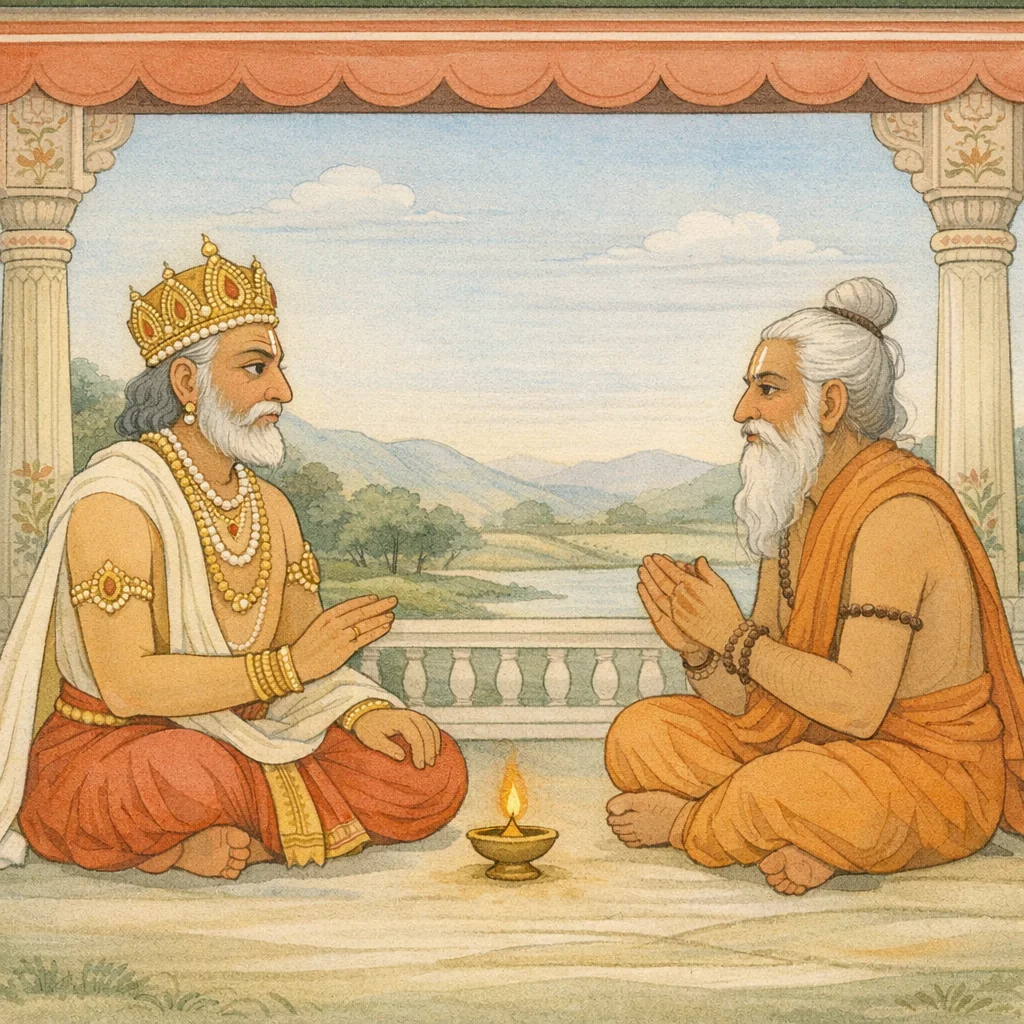
Adhyaya 306
अव्यक्त–पुरुष–विवेकः (Discrimination of Avyakta/Prakṛti and Puruṣa) — Yājñavalkya’s Anvīkṣikī to Viśvāvasu
Upa-parva: Mokṣa-dharma (Liberation Discourse) — Yājñavalkya–Viśvāvasu Dialogue Unit
Chapter 306 presents a multi-stage didactic narrative. Yājñavalkya first recounts how, through austerity, he obtained Yajurvedic materials from Āditya and how Sarasvatī, embodied as speech, entered him, enabling the composition and stabilization of the Śatapatha tradition and the establishment of multiple śākhās. The discourse then shifts to a technical interrogation by the Gandharva king Viśvāvasu, who poses a sequence of paired concepts (e.g., viśvā/aviśva, mitra/varuṇa, jñāna/jñeya, vedyā/avedya, cala/acala, akṣaya/kṣayya). Yājñavalkya interprets these pairs via a Sāṃkhya–Yoga ontology: prakṛti/avyakta is characterized as causal and guṇa-based, while puruṣa is the knower and to be discerned as distinct. He introduces a hierarchy in which the “twenty-fifth” principle (often aligned with puruṣa) and a “twenty-sixth” witnessing standpoint are discussed, emphasizing that liberation arises from correct seeing (viveka) rather than from ritual or textual accumulation alone. The chapter closes with endorsements of knowledge as the means to transcend repeated birth and death, and with narrative notes on the listener’s reverence and subsequent renunciatory orientation.
Chapter Arc: मिथिलेश्वर जनक के समक्ष वसिष्ठ (कराल-परम्परा के प्रसंग सहित) पुरुष–प्रकृति के रहस्य को खोलते हैं—कैसे अज्ञान पुरुष की चैतन्य-आनन्द-स्वरूपता पर जड़ प्रकृति का आवरण डाल देता है। → जनक की बुद्धि बार-बार अटकती है: ज्ञानी और अज्ञानी दोनों जिस तत्त्व को अलग-अलग ढंग से कहते हैं, वह प्रत्यक्ष क्यों नहीं होता? ‘क्षर’ और ‘अक्षर’ की व्याख्याएँ भी अस्थिर बुद्धि में मानो खो जाती हैं; सत्य समझ में आता हुआ भी फिसल जाता है। → वसिष्ठ निर्णायक रूप से ब्रह्म-तत्त्व का संकेत देते हैं: वह ‘अणु से भी अणु’ और ‘महान से भी महान’ है, सर्वभूतों में स्थित होकर भी दृष्टि का विषय नहीं बनता; योगी स्थाणु-सा अचल, गिरि-सा निश्चल होकर इन्द्रिय-मन को वश में कर ‘मनोमय दीपक’ से तम का नाश करता है—यही तत्त्व-प्रत्यभिज्ञा का शिखर है। → अव्यक्त प्रकृति को ‘सर्व’ और उससे भिन्न पचीसवें तत्त्व परमात्मा को ‘असर्व’ कहकर वसिष्ठ ज्ञान का मानचित्र स्थिर करते हैं; जो इसे जान लेते हैं, उनके लिए भय का क्षय हो जाता है—ज्ञान का फल अभय और निर्मलता है।
Shlokas
Verse 1
पीना त++ बछ। न - पुरुष प्रकृतिकी जडताको आच्छादित करके उसके दुःखका आश्रय लेता है तथा प्रकृति पुरुषके आनन्दगुणको आच्छादित करके उसके चैतन्य गुणका आश्रय लेती है। तात्पर्य यह कि प्रकृतिके संयोगसे पुरुष आनन्दसे वंचित हो दुःखका भागी होता है और प्रकृति पुरुषके संगसे अपनी जडताको भुलाकर चेतनकी भाँति कार्य करने लगती है। घडधिकत्रिशततमो< ध्याय: योग और सांख्यके स्वरूपका वर्णन तथा आत्मज्ञानसे मुक्ति जनक उवाच नानात्वैकत्वमित्युक्त त्वयैतदृषिसत्तम | पश्याम्येतद्धि संदिग्धमेतयोर्व निदर्शनम्,जनकने पूछा--मुनिश्रेष्ठ! आपने क्षरको अनेक रूप और अक्षरको एकरूप बताया; किंतु इन दोनोंके तत्त्वका जो निर्णय किया गया है, उसे मैं अब भी संदेहकी दृष्टिसे ही देखता हूँ
Janaka said: “O best of sages, you have declared that the perishable (kṣara) is manifold and the imperishable (akṣara) is one. Yet I still regard the settled conclusion about these two with doubt, for I do not clearly see a decisive illustration that distinguishes them.”
Verse 2
तथा बुद्धप्रबुद्धा भ्यां बुद्धघयमानस्य चानघ । स्थूलबुद्धया न पश्यामि तत्त्वमेतन्न संशय:,निष्पाप महर्षे! जिसे अज्ञानी पुरुष (अनेक रूपमें) और ज्ञानी पुरुष एक रूपमें जानते हैं, उस परमात्माका तत्त्व मैं अपनी स्थूल बुद्धिके कारण समझ नहीं पाता हूँ। मेरे इस कथनमें तनिक भी संशय नहीं है
Janaka said: “O sinless sage, I do not perceive this truth—this reality of the Supreme Self—which the ignorant apprehend in many forms and the wise know as one. Because my understanding is still gross and outward-turned, I cannot grasp it; of this there is no doubt in my statement.”
Verse 3
अक्षरक्षरयोरुक्त त्ववा यदपि कारणम् । तदप्यस्थिरबुद्धित्वात् प्रणष्टमिव मेडनघ,अनघ! यद्यपि आपने क्षर और अक्षरको समझानेके लिये अनेक प्रकारकी युक्तियाँ बतायी हैं तथापि मेरी बुद्धि अस्थिर होनेके कारण मैं उन सारी युक्तियोंको मानो भूल गया हूँ
Janaka said: “O blameless one, even the reasoning you have given about the imperishable and the perishable seems to have slipped away from me, as though lost, because my understanding is unsteady. Though you have explained the perishable and the imperishable through many lines of argument, my wavering mind makes me feel as if I have forgotten them all.”
Verse 4
तदेतच्छोतुमिच्छामि नानात्वैकत्वदर्शनम् । बुद्ध चाप्रतिबुद्धं च बुध्यमानं च तत्त्वतः,इसलिये इस नानात्व और एकत्व-रूप दर्शनको मैं पुनः सुनना चाहता हूँ। बुद्ध (ज्ञानवान्) क्या है? अप्रतिबुद्ध (ज्ञानहीन) क्या है? तथा बुद्धयमान (ज्ञेय) क्या है? यह ठीक-ठीक बताइये
Therefore I wish to hear again that vision which beholds both diversity and oneness. Tell me truly and with precision: what is “buddha” (the knowing one)? what is “apratibuddha” (the unknowing)? and what is “budhyamāna” (that which is to be known)?
Verse 5
विद्याविद्ये च भगवन्नक्षरं क्षरमेव च । साड्ख्यं योगं च कार्त्स्न्येन पृथक् चैवापूथक् च ह,भगवन! मैं विद्या, अविद्या, अक्षर और क्षर तथा सांख्य और योगको पृथक्-पृथक् पूर्णरूपसे समझना चाहता हूँ
O venerable one, I wish to understand fully—both distinctly and also in their deeper non-separation—knowledge and ignorance, the imperishable (akṣara) and the perishable (kṣara), and likewise Sāṅkhya and Yoga.
Verse 6
वसिष्ठ उवाच हन्त ते सम्प्रवक्ष्यामि यदेतदनुपृच्छसि । योगकृत्यं महाराज पृथगेव शृणुष्व मे
Vasiṣṭha said: “Very well—what you have asked, I shall now explain to you. O great king, listen to me carefully and distinctly as I set forth the proper discipline and duties of Yoga.”
Verse 7
वसिष्ठजीने कहा--महाराज! तुम जो-जो बातें पूछ रहे हो, मैं उन सबका भलीभाँति उत्तर दूँगा। इस समय योगसम्बन्धी कृत्यका पृथक् ही वर्णन कर रहा हूँ, सुनो ।। योगकृत्यं तु योगानां ध्यानमेव परं बलम् | तच्चापि द्विविध॑ ध्यानमाहुर्विद्याविदों जना:,योगियोंके लिये प्रधान कर्तव्य है ध्यान। वही उनका परम बल है। योगके विद्वान् उस ध्यानको दो प्रकारका बतलाते हैं--एक तो मनकी एकाग्रता और दूसरा प्राणायाम। प्राणायामके भी दो भेद हैं--सगुण और निर्मुण। इनमेंसे जिस प्राणायाममें मनका सम्बन्ध सगुणके साथ रहता है, वह सगुण प्राणायाम है और जिसमें मनका सम्बन्ध निर्गुणके साथ रहता है, वह निर्गुण प्राणायाम है
Vasiṣṭha said: “O great king, whatever matters you are asking about, I will answer them all clearly. Now I will describe, separately, the disciplines connected with Yoga—listen. For yogins, the foremost duty is meditation; it is their highest strength. Those who truly know the science declare that this meditation is of two kinds.”
Verse 8
एकाग्रता च मनस: प्राणायामस्तथैव च । प्राणायामस्तु सगुणो निर्गुणो मनसस्तथा,योगियोंके लिये प्रधान कर्तव्य है ध्यान। वही उनका परम बल है। योगके विद्वान् उस ध्यानको दो प्रकारका बतलाते हैं--एक तो मनकी एकाग्रता और दूसरा प्राणायाम। प्राणायामके भी दो भेद हैं--सगुण और निर्मुण। इनमेंसे जिस प्राणायाममें मनका सम्बन्ध सगुणके साथ रहता है, वह सगुण प्राणायाम है और जिसमें मनका सम्बन्ध निर्गुणके साथ रहता है, वह निर्गुण प्राणायाम है
These two forms are: (1) one-pointedness of the mind (ekāgratā) and (2) regulation of the vital breath (prāṇāyāma). Prāṇāyāma, in turn, is of two kinds—qualified (saguṇa) and unqualified (nirguṇa). When the mind remains connected with the qualified aspect, it is saguṇa prāṇāyāma; when the mind is connected with the unqualified, it is nirguṇa prāṇāyāma.
Verse 9
मृत्रोत्सर्गपुरीषे च भोजने च नराधिप । त्रिकालं नाभियुञ्जीत शेषं युज्जीत तत्पर:,नरेश्वर! मलत्याग, मूत्रत्याग और भोजन--इन तीन कार्योंमें जो समय लगता है, उसमें योगका अभ्यास न करे। शेष समयमें तत्परतापूर्वक योगका अभ्यास करना चाहिये
Vasiṣṭha said: “O king, one should not apply oneself to yogic practice during the three occasions occupied by urination, evacuation, and eating. In the remaining time, however, one should practice yoga with steady earnestness.”
Verse 10
इन्द्रियाणीन्द्रियार्थेभ्यो निवर्त्य मनसा शुचि: । दशद्वादशभिर्वापि चतुर्विशात् परं तत:,बुद्धिमान योगीको चाहिये कि पवित्र हो मनके द्वारा श्रोत्र आदि इन्द्रियोंको शब्द आदि विषयोंसे हटावे एवं बाईस- प्रकारकी प्रेरणाओंद्वारा उस जरारहित जीवात्माको, जिसे मनीषी पुरुषोंने आत्मस्वरूप बताया है, चौबीस तत्त्वोंके समुदायरूप प्रकृतिसे परे परम पुरुष परमात्माकी ओर प्रेरित करे
Vasiṣṭha said: Having become pure in mind, the wise yogin should withdraw the senses from their objects. Then, by the disciplines taught as the ten and the twelve (modes of inner prompting), he should direct that ageless self—known by the discerning as one’s true nature—beyond the aggregate of the twenty‑four principles (prakṛti and its evolutes), toward the Supreme Person, the highest Self.
Verse 11
संचोदनाभिमीतिमानात्मानं चोदयेदथ । तिष्ठन्तमजरं तं तु यत् तदुक्तं मनीषिभि:,बुद्धिमान योगीको चाहिये कि पवित्र हो मनके द्वारा श्रोत्र आदि इन्द्रियोंको शब्द आदि विषयोंसे हटावे एवं बाईस- प्रकारकी प्रेरणाओंद्वारा उस जरारहित जीवात्माको, जिसे मनीषी पुरुषोंने आत्मस्वरूप बताया है, चौबीस तत्त्वोंके समुदायरूप प्रकृतिसे परे परम पुरुष परमात्माकी ओर प्रेरित करे
Vasiṣṭha said: Therefore, let the wise yogin—endowed with discerning resolve—impel his own self. Let him direct his inner being toward that ageless Reality which stands unmoving, the very Self spoken of by the sages. With a purified mind, withdrawing the senses from their objects, he should turn his striving away from the aggregate of material principles and toward the supreme Person beyond Nature.
Verse 12
तैश्वात्मा सततं ज्ञेय इत्येवमनुशुश्रुम । व्रतं हुहीनमनसो नान्यथेति विनिश्चय:,हमने गुरुजनोंके मुखसे सुना है कि जो लोग इस प्रकार प्राणायाम करते हैं, वे सदा ही परब्रह्म परमात्माके जाननेके अधिकारी होते हैं। जिसका मन सदा ध्यानमें संलग्न रहता है, ऐसे योगीके ही योग्य यह व्रत है अन्यथा बहिर्मुख चित्तवाले पुरुषके लिये यह नहीं है। यह निश्चितरूपसे जानना चाहिये
Vasiṣṭha said: “We have heard from the mouths of venerable teachers that, by such disciplined practice, one becomes ever fit to know the Supreme Self. This observance is meant for the yogin whose mind is steadily gathered in contemplation; it is not for one whose mind is deficient in inwardness and turned outward. This should be understood as a settled conclusion.”
Verse 13
विमुक्त: सर्वसड्भेभ्यो लघ्वाहारो जितेन्द्रिय: । पूर्वरात्रेडपररात्रे धारयीत मनो55त्मनि,योगी सब प्रकारकी आसक्तियोंसे मुक्त हो मिताहारी और जितेन्द्रिय बने तथा रात्रिके पहले और पिछले भागमें मनको आत्मामें एकाग्र करे
Vasiṣṭha said: Freed from every kind of attachment, the yogin should live on light, measured food and keep the senses under control. In the early and the latter watches of the night, he should steady and hold the mind fixed in the Self—thus cultivating inner discipline and detachment as the basis of spiritual clarity.
Verse 14
स्थिरीकृत्येन्द्रियग्रामं मनसा मिथिलेश्वर । मनो बुद्धया स्थिरं कृत्वा पाषाण इव निश्चल:,मिथिलेश्वर! जब योगी मनके द्वारा सम्पूर्ण इन्द्रियोंको और बुद्धिके द्वारा मनको स्थिर करके पत्थरकी भाँति अविचल हो जाय, सूखे काठकी भाँति निष्कम्य और पर्वतकी तरह स्थिर रहने लगे तभी शास्त्रके विधानको जाननेवाले विद्वान् पुरुष अपने अनुभवसे ही उसको योगयुक्त कहते हैं
Vasiṣṭha said: “O lord of Mithilā, when a yogin, by means of the mind, steadies the entire ‘community’ of the senses, and then—by means of the intellect—makes the mind itself firm, becoming motionless like a stone, then the learned who know the rule of the śāstras recognize him, from direct experience, as truly established in yoga.”
Verse 15
स्थाणुवच्चाप्यकम्प: स्याद् गिरिवच्चापि निश्चल: । बुद्धवा विधिविधानज्ञास्तदा युक्तं प्रचक्षते,मिथिलेश्वर! जब योगी मनके द्वारा सम्पूर्ण इन्द्रियोंको और बुद्धिके द्वारा मनको स्थिर करके पत्थरकी भाँति अविचल हो जाय, सूखे काठकी भाँति निष्कम्य और पर्वतकी तरह स्थिर रहने लगे तभी शास्त्रके विधानको जाननेवाले विद्वान् पुरुष अपने अनुभवसे ही उसको योगयुक्त कहते हैं
Vasiṣṭha said: “Let him become unshaken like a pillar and immovable like a mountain. When, by the mind, he restrains all the senses, and by the intellect he steadies the mind—becoming motionless like a stone, desireless like dry wood, and firm like a mountain—then those wise men who know the scriptural disciplines declare, from their own realization, that he is truly established in Yoga, O Lord of Mithilā.”
Verse 16
न शृणोति न चाप्राति न रंस्यति न पश्यति । न च स्पर्श विजानाति न संकल्पयते मन:,जिस समय वह न तो सुनता है, न सूँघता है, न स्वाद लेता है, न देखता है और न स्पर्शका ही अनुभव करता है, जब उसके मनमें किसी प्रकारका संकल्प नहीं उठता तथा काठकी भाँति स्थित होकर वह किसी भी वस्तुका अभिमान या सुध-बुध नहीं रखता, उसी समय मनीषी पुरुष उसे अपने शुद्धस्वरूपको प्राप्त एवं योगयुक्त कहते हैं
Vasiṣṭha said: When a person neither hears nor smells, neither tastes nor sees, and does not even register touch—when the mind raises no intention or construction at all—then, remaining like a piece of wood, free from possessive self-identification and ordinary self-awareness toward any object, the wise declare that he has reached his own pure nature and is established in yoga.
Verse 17
न चाभिमन्यते किंचिन्न च बुध्यति काषठवत् । तदा प्रकृतिमापन्नं युक्तमाहुर्मनीषिण:,जिस समय वह न तो सुनता है, न सूँघता है, न स्वाद लेता है, न देखता है और न स्पर्शका ही अनुभव करता है, जब उसके मनमें किसी प्रकारका संकल्प नहीं उठता तथा काठकी भाँति स्थित होकर वह किसी भी वस्तुका अभिमान या सुध-बुध नहीं रखता, उसी समय मनीषी पुरुष उसे अपने शुद्धस्वरूपको प्राप्त एवं योगयुक्त कहते हैं
Vasiṣṭha said: When a person neither lays claim to anything nor even registers awareness—remaining like a piece of wood—then the wise declare that he has returned to his own original nature and is truly yoked in yoga. In this state, the mind raises no intention or construction, and the senses do not run outward; the teaching points to ethical freedom from possessiveness and ego, where inner steadiness replaces reactive grasping.
Verse 18
निर्$वाते हि यथा दीप्यन् दीपस्तद्वत् प्रकाशते । निर्लिड्रोडविचलश्नोर्ध्व न तिर्यग् गतिमाप्रुयात्,उस अवस्थामें वह वायुरहित स्थानमें रखे हुए निश्चलभावसे प्रज्वलित दीपककी भाँति प्रकाशित होता है। लिंग शरीरसे उसका कोई सम्बन्ध नहीं रहता। वह ऐसा निश्चल हो जाता है कि उसकी ऊपर-नीचे अथवा मध्यमें कहीं भी गति नहीं होती
Vasiṣṭha said: Just as a lamp, when kindled in a windless place, shines steadily, so too does the self shine forth in stillness. It no longer clings to the subtle body (liṅga-śarīra) and becomes unmoving—without any tendency to rise, sink, or drift sideways. The ethical point is that true freedom is not a new action in the world but the cessation of inner agitation: when desire and restlessness are stilled, clarity and self-luminosity manifest naturally.
Verse 19
तदा तमनुपश्येत यस्मिन् दृष्टे न कथ्यते । हृदयस्थो<न्तरात्मेति ज्ञेयो ज्ञस्तात मद्धिधै:,जिनका साक्षात्कार कर लेनेपर मनुष्य कुछ बोल नहीं पाता, योगकालमें योगी उसी परमात्माको देखे। वत्स! मुझ-जैसे लोगोंको अपने-अपने हृदयमें स्थित सबके ज्ञाता अन्तरात्माका ही ज्ञान प्राप्त करना उचित है
Then one should behold That—upon seeing which speech falls silent. That Inner Self, abiding in the heart, is to be known as the indwelling Ātman, the all-knower. Dear child, for people like me it is fitting to seek and attain the knowledge of that inner witness who knows all and resides in each one’s heart—especially in the time of yoga, when the yogin directly perceives the Supreme within.
Verse 20
विधूम इव सप्तार्चिरादित्य इव रश्मिमान् | वैद्युतो 5ग्निरिवाकाशे दृश्यते55त्मा तथा55त्मनि,ध्याननिष्ठ योगीको अपने हृदयमें उसी प्रकार परमात्माका साक्षात् दर्शन होता है जैसे धूमरहित अग्निका, किरणमालाओंसे मण्डित सूर्यका तथा आकाशमें विद्युतके प्रकाशका दर्शन होता है
Vasiṣṭha said: “As a smokeless, seven-tongued fire; as the sun adorned with its rays; and as lightning’s flame seen in the open sky—so, within the Self, the Self is directly beheld. In the same way, the yogin established in meditation gains immediate vision of the Supreme Self within the heart.”
Verse 21
ये पश्यन्ति महात्मानो धृतिमन्तो मनीषिण: । ब्राह्मणा ब्रह्म॒योनिस्था ह्योनिममृतात्मकम्,धैर्यवान्, मनीषी, ब्रह्मबोधक शास्त्रोंमें निष्ठा रखनेवाले और महात्मा ब्राह्मण ही उस अजन्मा एवं अमृतस्वरूप ब्रह्मका दर्शन कर पाते हैं
Vasiṣṭha said: Only those great-souled Brāhmaṇas—steadfast in fortitude, endowed with discerning wisdom, and firmly established in the Brahman-centered way of life—are able to behold that source which is unborn and of the nature of immortality.
Verse 22
तदेवाहुरणुभ्योडणु तन््महदभ्यो महत्तरम् । तत् तत्त्वं सर्वभूतेषु श्रुव॑ं तिष्ठन्ू न दृश्यते,वह ब्रह्म अणुसे भी अणु और महानसे भी महान् कहा गया है। सम्पूर्ण प्राणियोंके भीतर वह अन्तर्यामीरूपसे अवश्य स्थिर रहता है तथापि किसीको दिखायी नहीं देता है
Vasiṣṭha said: “That Reality is declared to be subtler than the subtlest and greater than the greatest. Firmly abiding as the inner ruler within all beings, it nevertheless is not seen by anyone.”
Verse 23
बुद्धिद्रव्येण दृश्येत मनोदीपेन लोककृत् महतस्तमसस्तात पारे तिष्ठन्नतामस:,सूक्ष्म बुद्धिरूप धन-सम्पन्न पुरुष ही मनोमय दीपकके द्वारा उस लोकस्रष्टा परमात्माका साक्षात्कार कर सकते हैं। वह परमात्मा महान् अन्धकारसे परे और तमोगुणसे रहित है; इसलिये वेदके पारगामी सर्वज्ञ पुरुषोंने उसे तमोनुद (अज्ञान नाशक) कहा है। वह निर्मल, अज्ञानरहित, लिंगहीन और अलिंग नामसे प्रसिद्ध (उपाधिशून्य) है। यही योगियोंका योग है। इसके सिवा योगका और क्या लक्षण हो सकता है। इस तरह साधना करनेवाले योगी सबके द्रष्टा अजर-अमर परमात्माका दर्शन करते हैं
Vasiṣṭha said: The Maker of the worlds can be directly perceived by the subtle substance of intelligence, using the mind as a lamp. O dear one, that Supreme stands beyond the vast darkness and is free from tamas; therefore the all-knowing seers who have crossed beyond the Veda call Him the dispeller of darkness (ignorance). Pure, free from ignorance, without marks or limiting signs, He is known as ‘aliṅga’—devoid of adjuncts. This is the very yoga of yogins; what other defining mark of yoga could there be? Practising in this way, the yogin beholds the unborn, deathless Supreme Self, the seer of all.
Verse 24
स तमोनुद इत्युक्त: सर्वज्ञैर्वेंदपारगै: | विमलो वितमस्कक्न निर्लिड्रोडलिड्भरसंज्ञित:,सूक्ष्म बुद्धिरूप धन-सम्पन्न पुरुष ही मनोमय दीपकके द्वारा उस लोकस्रष्टा परमात्माका साक्षात्कार कर सकते हैं। वह परमात्मा महान् अन्धकारसे परे और तमोगुणसे रहित है; इसलिये वेदके पारगामी सर्वज्ञ पुरुषोंने उसे तमोनुद (अज्ञान नाशक) कहा है। वह निर्मल, अज्ञानरहित, लिंगहीन और अलिंग नामसे प्रसिद्ध (उपाधिशून्य) है। यही योगियोंका योग है। इसके सिवा योगका और क्या लक्षण हो सकता है। इस तरह साधना करनेवाले योगी सबके द्रष्टा अजर-अमर परमात्माका दर्शन करते हैं
Vasiṣṭha said: The all-knowing sages who have crossed to the far shore of the Vedas call Him “Tamonuda,” the dispeller of darkness (ignorance). He is pure, beyond the gloom of tamas, free from all defiling obscuration; He is without any mark or limiting sign, and yet is spoken of as “the unmarked.” Thus, through subtle, inward contemplation, the yogin comes to the direct vision of the unborn and deathless Witness of all.
Verse 25
योग एष हि योगानां किमन्यद् योगलक्षणम् । एवं पश्यं प्रपश्यन्ति आत्मानमजरं परम्,सूक्ष्म बुद्धिरूप धन-सम्पन्न पुरुष ही मनोमय दीपकके द्वारा उस लोकस्रष्टा परमात्माका साक्षात्कार कर सकते हैं। वह परमात्मा महान् अन्धकारसे परे और तमोगुणसे रहित है; इसलिये वेदके पारगामी सर्वज्ञ पुरुषोंने उसे तमोनुद (अज्ञान नाशक) कहा है। वह निर्मल, अज्ञानरहित, लिंगहीन और अलिंग नामसे प्रसिद्ध (उपाधिशून्य) है। यही योगियोंका योग है। इसके सिवा योगका और क्या लक्षण हो सकता है। इस तरह साधना करनेवाले योगी सबके द्रष्टा अजर-अमर परमात्माका दर्शन करते हैं
Vasiṣṭha said: “This indeed is the very essence of all yogas—what other defining mark of yoga could there be? By seeing in this way, the disciplined seers behold the Supreme Self: unborn, undecaying, and transcendent. Such vision is not mere theory but an ethical and contemplative realization in which ignorance is dispelled and the inner light of awareness reveals the stainless, attributeless Reality.”
Verse 26
योगदर्शनमेतावदुक्तं ते तत्त्वतो मया । सांख्यज्ञानं प्रवक्ष्यामि परिसंख्यानदर्शनम्,यहाँतक मैंने तुम्हें यथार्थरूपसे योग-दर्शनकी बात बतायी है, अब सांख्यका वर्णन करता हूँ; यह विचारप्रधान दर्शन है
Vasiṣṭha said: “So far I have explained to you, in accordance with reality, the philosophical vision of Yoga. Now I shall set forth the knowledge of Sāṅkhya—the ‘vision of discernment and enumeration’ that analyzes principles with reflective clarity.”
Verse 27
अव्यक्तमाहु: प्रकृतिं परां प्रकृतिवादिन: । तस्मान्महत् समुत्पन्नं द्वितीयं राजसत्तम,नृपश्रेष्ठ! प्रकृतिवादी विद्वान् मूल प्रकृतिको अव्यक्त कहते हैं। उससे दूसरा तत्त्व प्रकट हुआ, जिसे महत्तत्त्व कहते हैं
Vasiṣṭha said: “The exponents of Prakṛti declare the supreme Prakṛti to be the Unmanifest. From that Unmanifest there arises the second principle, the Great (Mahat). O best of kings, O foremost of rulers, this is how the knowers of Prakṛti describe the origin of the first evolute.”
Verse 28
अहड्कारस्तु महतस्तृतीयमिति न: श्रुतम् पज्चभूतान्यहड्कारादाहु: सांख्यात्मदर्शिन:,महत्तत्त्व्से अहंकार प्रकट हुआ, जो तीसरा तत्त्व है। ऐसा हमारे सुननेमें आया है। अहंकारसे पाँच सूक्ष्म भूतोंकी अर्थात् पञ्चतन्मात्राओंकी उत्पत्ति हुई; यह सांख्यात्मदर्शी विद्वानोंका कथन है
Vasiṣṭha said: “We have heard that from Mahat (the Great Principle) arises Ahaṅkāra, the third principle. From Ahaṅkāra, the Sāṅkhya seers who discern the Self declare the emergence of the five elemental principles (the subtle bases of the elements). In this teaching, the ethical point is that bondage begins when the ‘I’-sense crystallizes; discernment (viveka) loosens its grip by seeing it as a produced principle rather than the true Self.”
Verse 29
एता: प्रकृतयश्चाष्टी विकाराश्चापि षोडश | पज्च चैव विशेषा वै तथा पउ्चेन्द्रियाणि च,ये आठ प्रकृतियाँ हैं। इनसे सोलह तत्त्वोंकी उत्पत्ति होती है, जिन्हें विकार कहते हैं। पाँच ज्ञानेन्द्रियाँ, पाँच कर्मन्द्रियाँ एक मन और पाँच स्थूलभूत--ये सोलह विकार हैं। इनमेंसे आकाश आदि पाँच तत्त्व और पाँच ज्ञानेन्द्रियों--से विशेष कहलाते हैं
Vasiṣṭha said: “These are the eight primordial principles (prakṛtis), and there are also sixteen evolutes (vikāras). Further, there are five ‘particularized’ entities (viśeṣas), and likewise the five sense-faculties. Thus the teaching classifies reality into foundational causes and their manifest products, so that one may discern the self from the field of nature and loosen attachment to what is merely compounded.”
Verse 30
एतावदेव तत्त्वानां सांख्यमाहुर्मनीषिण: । सांख्ये विधिविधानज्ञा नित्यं सांख्यपथे रता:,सांख्यशास्त्रीय विधि-विधानके ज्ञाता और सदा सांख्यमार्गमें ही अनुरक्त रहनेवाले मनीषी पुरुष इतनी ही सांख्यसम्मत तत्त्वोंकी संख्या बतलाते हैं। अर्थात् अव्यक्त, महत्तत्त्व, अहंकार तथा पज्चतन्मात्रा--इन आठ प्रकृतियोंसहित उपर्युक्त सोलह विकार मिलकर कुल चौबीस तत्त्व सांख्यशास्त्रके विद्वानोंने स्वीकार किये हैं
Vasiṣṭha said: “This much alone is the Sāṅkhya enumeration of principles, so declare the wise. Those who know the proper method and discipline of Sāṅkhya, and who remain ever devoted to its path, state precisely this count of realities.”
Verse 31
यस्माद् यदभिजायेत तत् तत्रैव प्रलीयते । लीयन्ते प्रतिलोमानि सृज्यन्ते चान्तरात्मना,जो तत्त्व जिससे उत्पन्न होता है, वह उसीमें लीन भी होता है। अनुलोमक्रमसे उन तत्त्वोंकी उत्पत्ति होती है (जैसे प्रकृतिसे महत्तत्त्व, महत्तत््वसे अहंकार, अहंकारसे सूक्ष्म भूत आदिके कमसे सृष्टि होती है); परंतु उनका संहार विलोमक्रमसे होता है (अर्थात् पृथ्वीका जलमें, जलका तेजमें और तेजका वायुमें लय होता है। इस तरह सभी तत्त्व अपने-अपने कारणमें लीन होते हैं)। ये सभी तत्त्व अन्तरात्माद्वारा ही रचे जाते हैं
Vasiṣṭha said: Whatever is born from something, into that very source it dissolves again. Dissolution proceeds in the reverse order, while creation unfolds in the forward order; and all these principles are fashioned by the Inner Self. The teaching emphasizes a moral vision of reality: the world’s processes of arising and passing are orderly, and recognizing their source in the inner ruler steadies the mind toward detachment and right understanding.
Verse 32
अनुलोमेन जायन्ते लीयन्ते प्रतिलोमत: । गुणा गुणेषु सततं सागरस्योर्मयो यथा,जैसे समुद्रसे उठी हुई लहरें फिर उसीमें शान्त हो जाती हैं, उसी प्रकार सम्पूर्ण गुण (तत्त्व) सदा अनुलोमक्रमसे उत्पन्न होते और विलोमक्रमसे अपने कारणभूत गुणों (तत्त्व) में ही लीन हो जाते हैं
“In the forward order they are born, and in the reverse order they dissolve. The guṇas ever merge back into the guṇas that are their causes, like the waves of the sea, which rise from the ocean and grow still within it again.”
Verse 33
सर्गप्रलय एतावानू प्रकृतेर्नुपसत्तम । एकत्वं प्रलये चास्य बहुत्वं च यदासृजत्,नृपश्रेष्ठ) इतना ही प्रकृतिके सर्ग और प्रलयका विषय है। प्रलयकालमें इसका एकत्व है और जब रचना होती है, तब इसके बहुत भेद हो जाते हैं। राजेन्द्र! ज्ञाननिपुण पुरुषोंको इसी प्रकार प्रकृतिका एकत्व और नानात्व जानना चाहिये। अव्यक्त प्रकृति ही अधिष्ठाता पुरुषको सृष्टिकालमें नानात्वकी ओर ले जाती है। यही पुरुषके एकत्वका निदर्शन है
Vasiṣṭha said: “O best of kings, this much is the account of Nature’s creation and dissolution: at the time of dissolution it is one, and when it brings forth creation it becomes manifold. Thus should the wise understand Nature as both unity and diversity. The unmanifest Nature itself, at the time of creation, draws the presiding Person toward multiplicity—yet this very process also points to the underlying oneness of the Person.”
Verse 34
एवमेव च राजेन्द्र विज्ञेयं ज्ञानकोविदै: । अधिष्ठातारमव्यक्तमस्याप्येतन्निदर्शनम्,नृपश्रेष्ठ) इतना ही प्रकृतिके सर्ग और प्रलयका विषय है। प्रलयकालमें इसका एकत्व है और जब रचना होती है, तब इसके बहुत भेद हो जाते हैं। राजेन्द्र! ज्ञाननिपुण पुरुषोंको इसी प्रकार प्रकृतिका एकत्व और नानात्व जानना चाहिये। अव्यक्त प्रकृति ही अधिष्ठाता पुरुषको सृष्टिकालमें नानात्वकी ओर ले जाती है। यही पुरुषके एकत्वका निदर्शन है
Vasiṣṭha said: “So too, O best of kings, this is to be understood by those skilled in true knowledge: the unmanifest (Prakṛti) is the governing basis—this very point serves as an illustration even here. In dissolution it is apprehended as one; when creation proceeds, it appears as many. Thus should the wise discern both the unity and the multiplicity of Prakṛti; and it is the unmanifest that, at the time of creation, leads the presiding Person toward the experience of plurality—thereby indicating the Person’s underlying oneness.”
Verse 35
एकत्वं च बहुत्वं च प्रकृतेरर्थतत्त्ववान् । एकत्वं प्रलये चास्य बहुत्वं च प्रवर्तनात्
Vasiṣṭha said: “One who truly understands the reality and purpose of Prakṛti recognizes both its oneness and its multiplicity. In dissolution it is one, gathered back into unity; but when the process of manifestation begins, it appears as many.”
Verse 36
अर्थतत्त्वके ज्ञाता पुरुषको यह जानना चाहिये कि प्रलयकालमें प्रकृतिमें भी एकता और सृष्टिकालमें अनेकता रहती है। इसी प्रकार पुरुष भी प्रलयकालमें एक ही रहता है; किंतु सृष्टिकालमें प्रकृतिका प्रेरक होनेके कारण उसमें नानात्वका आरोप हो जाता है ।। बहुधा5>त्मा प्रकुर्वीत प्रकृतिं प्रसवात्मिकाम् । तच्च क्षेत्र महानात्मा पठचविंशोडथधितिछति,परमात्मा ही प्रसवात्मिका प्रकृतिको नाना रूपोंमें परिणत करता है। प्रकृति और उसके विकारको क्षेत्र कहते हैं। चौबीस तत्त्वोंसे भिन्न जो पचीसवाँ तत्त्व महान् आत्मा है, वह क्षेत्रमें अधिष्ठातारूपसे निवास करता है
Vasiṣṭha said: One who knows the truth of reality should understand this: at the time of dissolution, even Prakṛti is in a state of unity, while at the time of creation it appears as multiplicity. In the same way, the Puruṣa remains one during dissolution; but during creation, because he impels Prakṛti, diversity is superimposed upon him. The Self, as it were, sets forth Prakṛti whose nature is to bring forth. That field—Prakṛti together with its transformations—is called the kṣetra; and within that field the great Self, the twenty-fifth principle distinct from the twenty-four, abides as the presiding witness.
Verse 37
अधिष्ठातेति राजेन्द्र प्रोच्यते यतिसत्तमै: । अधिष्ठानादधिष्ठाता क्षेत्राणामिति न: श्रुतम्,राजेन्द्र! इसीलिये यतिशिरोमणि उसे अधिष्ठाता कहते हैं। क्षेत्रोंका अधिष्ठान होनेके कारण वह अधिष्ठाता है, ऐसा हमने सुन रखा है
Vasiṣṭha said: “O king, the foremost of ascetics call him ‘Adhiṣṭhātā’ (the Presiding Lord). We have heard, O ruler of men, that because he is the very support and seat (adhiṣṭhāna) of all the ‘fields’ (kṣetras), he is therefore known as the Presider over the fields.”
Verse 38
क्षेत्र जानाति चाव्यक्तं क्षेत्रज्ञ इति चोच्यते । आव्यक्तिके पुरे शेते पुरुषश्वेति कथ्यते,वह अव्यक्तसंज्ञक क्षेत्र (प्रकृति) को जानता है, इसलिये क्षेत्रज्ष कहलाता है और प्राकृत शरीररूपी पुरोंमें अन्तर्यामीरूपसे शयन करनेके कारण उसे “पुरुष' कहते हैं
Vasiṣṭha said: “He knows the field called the unmanifest (avyakta), namely Prakṛti; therefore he is called kṣetrajña, the Knower of the Field. And because he lies within the ‘cities’—the natural bodies—as the Inner Ruler (antaryāmin), he is spoken of as ‘Puruṣa’.”
Verse 39
अन्यदेव च क्षेत्र स्थादन्य: क्षेत्रज्ञ उच्यते । क्षेत्रमव्यक्तमित्युक्त ज्ञाता वै पजचविंशक:,वास्तवमें क्षेत्र अन्य वस्तु है और क्षेत्रज्ञ अन्य। क्षेत्र अव्यक्त कहा गया है और क्षेत्रज्ञ उसका ज्ञाता पचीसवाँ तत्त्व आत्मा है
Vasiṣṭha said: “The ‘field’ (kṣetra) is indeed one thing, and the ‘knower of the field’ (kṣetrajña) is another. The field is described as unmanifest (avyakta), while its knower is the twenty-fifth principle—the Self (Ātman)—who truly understands it.”
Verse 40
अन्यदेव च ज्ञानं स्यादन्यज्ज्ञेयं तदुच्यते ज्ञानमव्यक्तमित्युक्त ज्ञेयो वै पजचविंशक:,ज्ञान अन्य वस्तु है और ज्ञेय उससे भिन्न कहा जाता है। ज्ञान- अव्यक्त कहा गया है और ज्ञेय पचीसवाँ तत्त्व आत्मा है
Vasiṣṭha said: “Knowledge and the object to be known are spoken of as distinct. ‘Knowledge’ is described as the Unmanifest (avyakta), while the ‘knowable’ is the twenty-fifth principle—namely the Self (Ātman). Thus one should discern the difference between the means of knowing and the ultimate reality to be realized.”
Verse 41
अव्यक्तं क्षेत्रमित्युक्ते तथा सत्त्वं तथेश्वर: । अनीश्वरमतत्त्वं च तत्त्व तत् पजचविंशकम्
Vasiṣṭha said: “When the unmanifest (avyakta) is spoken of as the ‘field’ (kṣetra), then along with it are also spoken of sattva and the Lord. Yet that which is without a Lord is non-reality; the reality is that twenty-fifth principle.”
Verse 42
अव्यक्तको क्षेत्र कहा गया है। उसीको सत्त्व (बुद्धि) और शासककी भी संज्ञा दी गयी है; परंतु पचीसवाँ तत्त्व परमपुरुष परमात्मा जड तत्त्व और ईश्वरसे रहित भिन्न है ।। सांख्यदर्शनमेतावत् परिसंख्यानुदर्शनम् । सांख्या: प्रकुर्वते चैव प्रकृतिं च प्रचक्षते
Vasiṣṭha said: “The unmanifest (avyakta) is declared to be the ‘field’ (kṣetra). That same principle is also spoken of as sattva—namely the discerning intellect (buddhi)—and as the inner governor. Yet the twenty-fifth principle, the Supreme Person (Paramapuruṣa), the Supreme Self (Paramātman), stands distinct: different from inert matter and not to be reduced to a Godless material principle. This much is the Sāṅkhya vision—an analysis by enumeration: the Sāṅkhyas set forth the categories and identify the fundamental source as Prakṛti.”
Verse 43
इतना ही सांख्यदर्शन है। सांख्यके विद्वान् तत्त्वोंकी संख्या (गणना) करते और प्रकृतिको ही जगत्का कारण बताते हैं। इसीलिये इस दर्शनका नाम सांख्यदर्शन है ।। तत्त्वानि च चतुर्विशत् परिसंख्याय तत्त्वतः । सांख्या: सह प्रकृत्या तु निस्तत्त्वः: पडचविंशक:,सांख्यवेत्ता पुरुष प्रकृतिसहित चौबीस तत्त्वोंकी परिगणना करके परमपुरुषको जड तत्त्वोंसे भिन्न पचीसवाँ निश्चित करते हैं
Vasiṣṭha said: “This is precisely what is meant by the Sāṅkhya teaching. The Sāṅkhyas are so called because they ‘enumerate’ the principles: they count the twenty-four constituents together with Prakṛti as the basis of the manifest world, and then determine a twenty-fifth—Puruṣa, the conscious principle—distinct from those inert categories. Thus, by discrimination between the insentient and the sentient, they point to the higher Self as separate from material nature.”
Verse 44
पज्चविंशो<प्रकृत्यात्मा बुध्यमान इति स्मृत:ः । यदा तु बुध्यते55त्मानं तदा भवति केवल:,वह पचीसवाँ प्रकृतिरूप नहीं है। उससे सर्वथा भिन्न ज्ञानस्वरूप माना गया है। जब वह अपने-आपको प्रकृतिसे भिन्न नित्यचिन्मय जान लेता है, उस समय केवल हो जाता है अर्थात् अपने विशुद्ध परब्रह्मरूपमें स्थित हो जाता है
Vasiṣṭha said: “The twenty-fifth principle—the Self—is remembered as the ‘knower’ and is not of the nature of Prakṛti. But when it truly awakens to itself, recognizing its complete difference from Prakṛti, then it becomes ‘kevala’—standing alone in its own pure reality, established in the stainless state of the supreme Brahman.”
Verse 45
सम्यग्दर्शनमेतावद् भाषितं तव तत्त्वतः । एवमेतद् विजानन्त: साम्यतां प्रति यान्त्युत,इस प्रकार मैंने तुमसे यह सम्यग्दर्शन (सांख्य) का यथावत््रूपसे वर्णन किया है। जो इसे इस प्रकार जानते हैं, वे शान्तस्वरूप ब्रह्मको प्राप्त होते हैं
Vasiṣṭha said: “Thus far I have explained to you, in accordance with reality, the doctrine of right vision (the Sāṅkhya insight). Those who understand it in this very way indeed proceed toward equanimity—attaining the peace of Brahman.”
Verse 46
सम्यड्निदर्शन नाम प्रत्यक्ष॑ प्रकृतेस्तथा । गुणतत्त्वान्यथैतानि निर्गुणो<न्यस्तथा भवेत्,प्रकृति-पुरुषका प्रत्यक्ष-दर्शन (अपरोक्ष-अनुभव) ही सम्यग्दर्शन है। ये जो गुणमय तत्त्व हैं, इनसे भिन्न परमपुरुष परमात्मा निर्गुण हैं
Vasiṣṭha said: “True vision is that direct, immediate realization of Prakṛti as it actually is. These principles that appear as ‘tattvas’ are constituted by the guṇas; yet distinct from them there is another— the Supreme Person—who is without guṇas.”
Verse 47
न त्वेवं वर्तमानानामावृत्तिर्विद्यते पुन: । विद्यते$क्षरभावत्वादपरं परमव्ययम्,इस दर्शनके अनुसार ज्ञान प्राप्त करनेवालोंकी इस संसारमें पुनरावृत्ति नहीं होती; क्योंकि वे अविनाशी ब्रह्मभावको प्राप्त हो जाते हैं, अतः परापरस्वरूप निर्विकार परब्रह्मरूपसे ही उनकी स्थिति होती है
Vasiṣṭha said: “But for those who abide in this way, there is no return again to worldly recurrence. For, by attaining the state of the Imperishable, they come to what is beyond the perishable— the supreme, undecaying Reality. Thus their standing is in the changeless Brahman itself.”
Verse 48
पश्येरन्नैकमतयो न सम्यक् तेषु दर्शनम् । ते व्यक्त प्रतिपद्यन्ते पुनः: पुनररिंदम,शत्रुदमन नरेश! जिनकी बुद्धि नानात्वका दर्शन करती है, उन्हें सम्यक्-ज्ञानकी प्राप्ति नहीं होती। ऐसे लोगोंको बारंबार शरीर धारण करना पड़ता है
Vasiṣṭha said: “Those whose understanding is not one-pointed do not gain a clear and correct vision of reality. Such people, O subduer of foes, O king who tames enemies, repeatedly fall back into embodied existence again and again.”
Verse 49
सर्वमेतद् विजानन्तो नासर्वस्य प्रबोधनात् | व्यक्ती भूता भविष्यन्ति व्यक्तस्य वशवर्तिन:,जो इस सारे प्रपंचको ही जानते हैं, वे इससे भिन्न परमात्माका तत्त्व न जाननेके कारण निश्चय ही शरीरधारी होंगे और शरीर तथा काम-क्रोध आदि दोषोंके वशवर्ती बने रहेंगे
Vasiṣṭha said: “Those who know only this entire manifest expanse, yet—because they have not been awakened to the Supreme that transcends the all—will certainly remain embodied beings. Bound to the realm of the manifest, they will continue under its control, becoming subject to the compulsions and defects that accompany embodiment, such as desire and anger.”
Verse 50
सर्वमव्यक्तमित्युक्तमसर्व: पजचविंशक: । य एनमभिजानन्ति न भयं तेषु विद्यते,'सर्व” नाम है अव्यक्त प्रकृतिका और उससे भिन्न पचीसवें तत्त्व परमात्माको असर्व कहा गया है। जो उन्हें इस प्रकार जानते हैं, उन्हें आवागमनका भय नहीं होता है
Vasiṣṭha said: “All that is called ‘the unmanifest’—the primordial Prakṛti. Distinct from it is the twenty-fifth principle, the Supreme Self, termed ‘Asarva’. Those who truly recognize these realities as they are are no longer haunted by fear—especially the fear of repeated coming and going in saṁsāra.”
Verse 305
इस प्रकार श्रीमहाभारत शान्तिपर्वके अन्तर्गत गोक्षधर्म पर्वमें वसिष्ठटकरालजनकसंवादविषयक तीन सौ पाँचवाँ अध्याय पूरा हुआ
Thus ends the three-hundred-and-fifth chapter of the Śānti Parva of the Śrī Mahābhārata, within the section known as the Gokṣadharma Parva, dealing with the dialogue among Vasiṣṭha, Ṭakarāla, and Janaka.
Verse 306
इति श्रीमहाभारते शान्तिपर्वणि मोक्षधर्मपर्वणि वसिष्ठकरालजनकसंवादे षडधिकत्रिशततमो<ध्याय:
Thus, in the Śrī Mahābhārata, within the Śānti Parva—specifically the Mokṣa-dharma section—ends the dialogue involving Vasiṣṭha, Karāla, and Janaka: the three-hundred-and-sixth chapter.
Frequently Asked Questions
The problem is how to interpret and rank paired metaphysical terms (e.g., knowable/unknowable, moving/unmoving, perishable/imperishable) so that inquiry leads to liberation-oriented discernment rather than to conceptual confusion.
Correct discrimination between prakṛti/avyakta (causal, guṇa-structured) and puruṣa (the knower to be discerned) is presented as the decisive insight; without it, study can become mere “burden-bearing” rather than transformative knowledge.
Yes. It repeatedly asserts that liberation is grounded in knowledge (jñāna) and realized seeing, while ritual and extensive recitation without understanding are depicted as insufficient for crossing the ‘difficult passage’ of repeated birth and death.