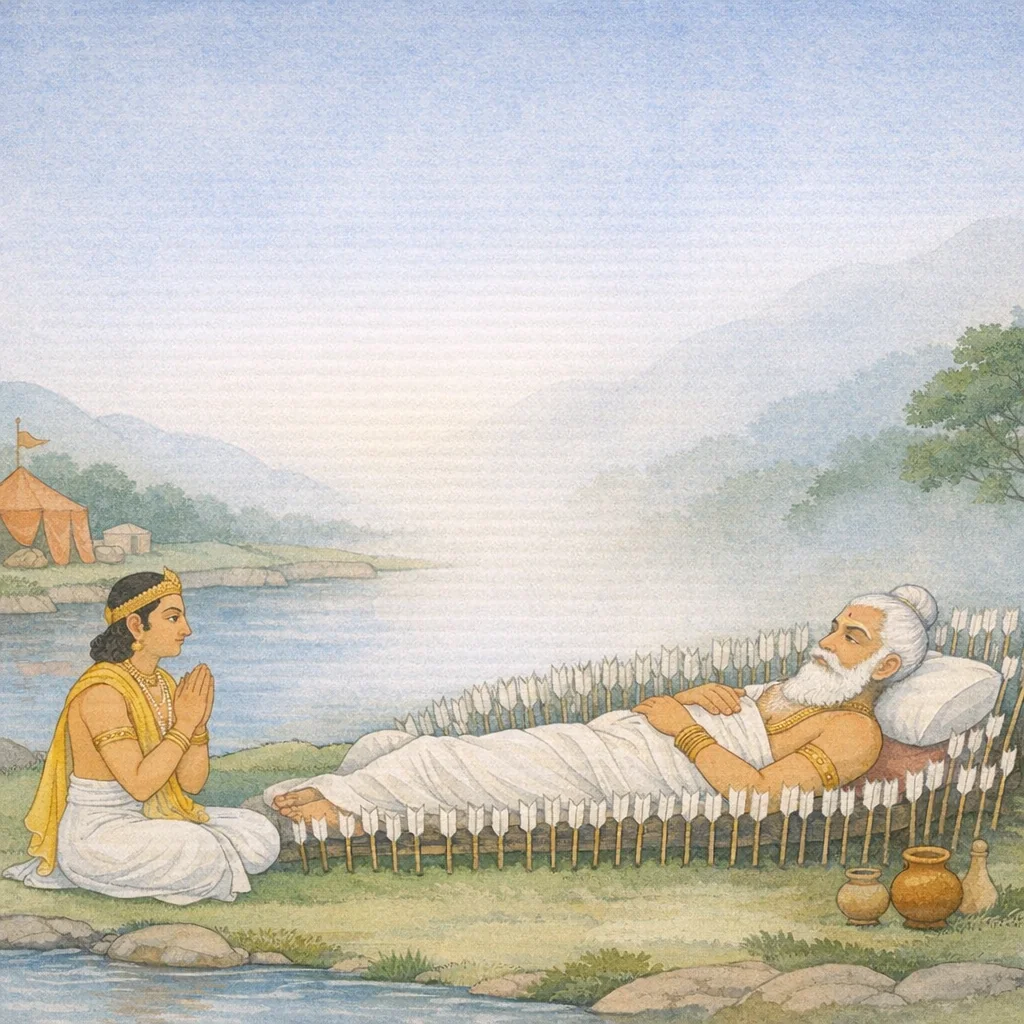
Adhyaya 217
बलीन्द्रसंवादः — Kāla, Anityatā, and the Limits of Agency (Mahābhārata 12.217)
Upa-parva: Mokṣa-dharma (Liberation-Discourse) — Bali–Śakra Saṃvāda Context
Bhīṣma narrates a dialogue where Śakra addresses Bali, mocking his fallen state and contrasting it with his earlier grandeur. Bali responds with a sustained philosophical argument: bodies and lives are finite; birth and dissolution proceed together; suffering arises from ignorance of the nature of change. He identifies kāla (time) as the universal force that takes and gives, overturning strength, beauty, knowledge, and fortune without partiality. Bali denies ultimate doership for himself or Indra, presenting worldly outcomes as cyclically “enjoyed” in turn. He warns Indra against pride, noting that royal prosperity (śrī) does not remain in one place and that many Indras have risen and passed. The chapter broadens into metaphysical reflection on brahman as deep and unfathomable, and on the inadequacy of sensory grasp. The instructional thrust is practical and contemplative: interpret reversals without despair or arrogance, cultivate steady intelligence (naiṣṭhikī buddhi), and recognize the governance of kāla over status and power.
Chapter Arc: भीष्म युधिष्ठिर के सामने धर्म के दो मार्गों—प्रवृत्ति और निवृत्ति—का द्वार खोलते हैं, और बताते हैं कि दृश्य जगत् मृत्यु-मुख है, जबकि अव्यक्त अमृत-पद है। → राजा के मन में प्रश्न उभरता है: यदि कर्म-धर्म (प्रवृत्ति) भी शास्त्रसम्मत है, तो फिर उससे पुनरावृत्ति क्यों? भीष्म क्रमशः प्रकृति (अव्यक्त) और पुरुष (जीव) के भेद, तथा उनसे भी परे ‘महत्तर’ तत्त्व की ओर संकेत करते हुए साधक की बुद्धि को सूक्ष्मतम विवेक तक ले जाते हैं। → निर्णायक बिंदु यह प्रतिपादन है कि प्रवृत्ति पुनरावृत्ति का कारण है और निवृत्ति परम गति; त्रैलोक्य सचराचर उसी अव्यक्त में स्थित है—अतः मोक्ष का लक्ष्य दृश्य नहीं, अव्यक्त-ब्रह्म की ओर निवर्तन है। → भीष्म साधना-नीति को स्थिर करते हैं: देह-त्याग तक अप्रमाद (अवधान) रहे तो देहान्त के बाद विमुक्ति; नारायण-ऋषि ने करुणा से यह अमृत-प्रकाश जीवों के हितार्थ कहा—और विवेकी को पहले अव्यक्त और पुरुष का ज्ञान, फिर उससे परे तत्त्व का अनुसंधान करना चाहिए।
Shlokas
Verse 1
इस प्रकार श्रीमह्याभारत शान्तिपर्वके अन्तर्गत मोक्षधर्मपर्वमें श्रीकृष्णसम्बन्धी अध्यात्मका कथनविषयक दो सौ सोलहवाँ अध्याय पूरा हुआ ॥/ २१६ ॥ अपना बछ। सं: सप्तदर्शाधिकद्विशततमो< ध्याय: सच्चिदानन्दघन परमात्मा, दृश्यवर्ग प्रकृति और पुरुष (जीवात्मा) उन चारोंके ज्ञानसे मुक्तिका कथन तथा परमात्मप्राप्तिके अन्य साधनोंका भी वर्णन भीष्म उवाच नस वेद पर ब्रह्म यो न वेद चतुष्टयम् । व्यक्ताव्यक्त च यत् तत्त्वं सम्प्रोक्ते परमर्षिणा,भीष्मजी कहते हैं--राजन! जो मनुष्य सच्चिदानन्दघन परमात्मा, दृश्यवर्ग तथा प्रकृति और पुरुष--इन चारोंको नहीं जानता है, वह परब्रह्म परमात्माको नहीं जानता है। परम ऋषि नारायणने जिस व्यक्त और अव्यक्त तत्त्वका प्रतिपादन किया है, उसमें व्यक्त (दृश्यवर्ग) को मृत्युके मुखमें पड़नेवाला जाने और अव्यक्तको अमृतपद समझे तथा नारायण ऋषिने जिस प्रवृत्तिरूप धर्मका प्रतिपादन किया है, उसीपर चराचर प्राणियोंसहित समस्त त्रिलोकी प्रतिष्ठित है। निवृत्तिरूप जो धर्म है, वह अव्यक्त सनातन ब्रह्मस्वरूप है
Bhishma said: O King, one who does not understand the fourfold reality—the Supreme Self, dense with being-consciousness-bliss (sat-cit-ānanda), the manifest world, Prakṛti, and Puruṣa (the individual self)—does not truly know the Supreme Brahman. The great seer has taught the principle of the manifest and the unmanifest; without grasping these fundamental categories, one’s knowledge of the Highest remains incomplete.
Verse 2
व्यक्तं मृत्युमुखं विद्यादव्यक्तममृतं पदम् | प्रवृत्तिलक्षणं धर्ममृषि्नारायणो<ब्रवीत्,भीष्मजी कहते हैं--राजन! जो मनुष्य सच्चिदानन्दघन परमात्मा, दृश्यवर्ग तथा प्रकृति और पुरुष--इन चारोंको नहीं जानता है, वह परब्रह्म परमात्माको नहीं जानता है। परम ऋषि नारायणने जिस व्यक्त और अव्यक्त तत्त्वका प्रतिपादन किया है, उसमें व्यक्त (दृश्यवर्ग) को मृत्युके मुखमें पड़नेवाला जाने और अव्यक्तको अमृतपद समझे तथा नारायण ऋषिने जिस प्रवृत्तिरूप धर्मका प्रतिपादन किया है, उसीपर चराचर प्राणियोंसहित समस्त त्रिलोकी प्रतिष्ठित है। निवृत्तिरूप जो धर्म है, वह अव्यक्त सनातन ब्रह्मस्वरूप है
Bhishma said: One should understand the manifest (vyakta) as the very mouth of death, and the unmanifest (avyakta) as the deathless state. The sage Nārāyaṇa declared a dharma marked by engagement in action (pravṛtti); upon that dharma the entire threefold world, with all moving and unmoving beings, stands established.
Verse 3
तत्रैवावस्थितं सर्व त्रैलोक्यं सचराचरम् । निवृत्तिलक्षणं धर्ममव्यक्त ब्रह्म शाश्वतम्,भीष्मजी कहते हैं--राजन! जो मनुष्य सच्चिदानन्दघन परमात्मा, दृश्यवर्ग तथा प्रकृति और पुरुष--इन चारोंको नहीं जानता है, वह परब्रह्म परमात्माको नहीं जानता है। परम ऋषि नारायणने जिस व्यक्त और अव्यक्त तत्त्वका प्रतिपादन किया है, उसमें व्यक्त (दृश्यवर्ग) को मृत्युके मुखमें पड़नेवाला जाने और अव्यक्तको अमृतपद समझे तथा नारायण ऋषिने जिस प्रवृत्तिरूप धर्मका प्रतिपादन किया है, उसीपर चराचर प्राणियोंसहित समस्त त्रिलोकी प्रतिष्ठित है। निवृत्तिरूप जो धर्म है, वह अव्यक्त सनातन ब्रह्मस्वरूप है
Bhishma said: There itself the entire threefold world is established, with all that moves and all that does not. The dharma whose mark is withdrawal (nivṛtti) is the unmanifest, eternal Brahman.
Verse 4
प्रवृत्तिलक्षणं धर्म प्रजापतिरथाब्रवीत् | प्रवृत्ति: पुनरावृत्तिर्निवृत्ति: परमा गति:,प्रजापति ब्रह्माजीने प्रवृत्तिरूप धर्मका उपदेश दिया है; परंतु प्रवृत्तिरूप धर्म पुनरावृत्तिका कारण है। उसके आचरणसे संसारमें बारंबार जन्म लेना पड़ता है और निवृत्तिरूप धर्म परमगतिकी प्राप्ति करानेवाला है
Bhishma said: Prajāpati declared a dharma characterized by engagement in action (pravṛtti). Yet that very path of engagement leads to return again and again—repeated recurrence in worldly existence. The dharma of withdrawal and renunciation (nivṛtti), however, is the supreme course, leading to the highest goal.
Verse 5
तां गतिं परमामेति निवृत्तिपरमो मुनि: । ज्ञानतत्त्वपरो नित्यं शुभाशुभनिदर्शक:,जो सदा ज्ञानतत्त्वके चिन्तनमें संलग्न रहनेवाला, शुभ और अशुभको (ज्ञाननेत्रोंके द्वारा तत््वसे) देखनेवाला तथा निवृत्तिपरायण मुनि है, वही उस परमगतिको प्राप्त होता है
Bhishma said: The sage who is devoted to renunciation, who is ever intent on the true principle of knowledge, and who discerns the auspicious and the inauspicious with the eye of wisdom—he attains that supreme goal.
Verse 6
तदेवमेतौ विज्ञेयावव्यक्तपुरुषावुभौ । अव्यक्तपुरुषाभ्यां तु यत् स्थादन्यन्महत्तरम्
Thus, these two are to be understood as the Unmanifest and the Person, each in its own status. Yet beyond the Unmanifest and the Person, there is that which stands as something other and greater.
Verse 7
अनाद्यन्तावुभावेतावलिज्री चाप्युभावपि,ये प्रकृति और पुरुष (जीवात्मा) दोनों ही अनादि और अनन्त हैंः। दोनों ही अलिंग निराकार हैं तथा दोनों ही नित्य, अविचल और महानसे भी महान हैं। ये सब बातें इन दोनोंमें समानरूपसे पायी जाती हैं; परंतु इनमें जो अन्तर या वैलक्षण्य है, वह दूसरा ही है, जिसे बताया जाता है
Bhishma said: Both of these—Prakriti and Purusha (the individual self)—are without beginning and without end. Both are unmarked and formless; both are eternal, unmoving, and greater than even the great. In these respects they appear alike. Yet the true distinction between them—their specific difference—is something else, and that is what is to be explained.
Verse 8
उभौ नित्यावविचलौ महदृभ्यश्न महत्तरौ । सामान्यमेतदुभयोरेवं हान्यद्विशेषणम्,ये प्रकृति और पुरुष (जीवात्मा) दोनों ही अनादि और अनन्त हैंः। दोनों ही अलिंग निराकार हैं तथा दोनों ही नित्य, अविचल और महानसे भी महान हैं। ये सब बातें इन दोनोंमें समानरूपसे पायी जाती हैं; परंतु इनमें जो अन्तर या वैलक्षण्य है, वह दूसरा ही है, जिसे बताया जाता है
Bhishma said: Both (Prakriti and Purusha) are eternal and unmoving, and each is greater than the great. These qualities are common to them both; yet the distinguishing difference between them is something else, which is then to be explained.
Verse 9
प्रकृत्या सर्गधर्मिण्या तथा त्रिगुणधर्मया । विपरीतमतो विद्यात् क्षेत्रज्ञस्य स्वलक्षणम्,प्रकृति त्रिगुणमयी है। ब्रह्मके सकाशसे सृष्टि करना उसका सहज धर्म है, किंतु क्षेत्रज्ष अथवा पुरुषके स्वरूपको प्रकृतिसे सर्वथा विपरीत (विलक्षण) जानना चाहिये
Bhīṣma said: Since Prakṛti’s innate law is to project creation, and since she is constituted by the three guṇas, one should therefore understand the essential mark of the kṣetrajña (the conscious knower) to be the complete opposite of Prakṛti—distinct from her changing, guṇa-bound activity.
Verse 10
प्रकृतेश्न विकाराणां द्रष्टारमगुणान्वितम् । अग्राह्मौ पुरुषावेतावलिड्रत्वादसंहतौ,वह स्वयं गुणोंसे रहित तथा प्रकृतिके विकारों (कार्यों) का द्रष्टा है। ये दोनों प्रकृति और पुरुष सम्पूर्णत: इन्द्रियोंके विषय नहीं हैं। दोनों ही आकाररहित तथा एक-दूसरेसे विलक्षण हैं
Bhishma explains that the Self (puruṣa) is the witness of the transformations of nature (prakṛti) while itself remaining beyond the guṇas. Both prakṛti and puruṣa are not objects of sensory grasp; they are formless, subtle, and mutually distinct. The ethical implication is that one should cultivate discernment between the changing field of nature and the unchanging witness, thereby loosening attachment and moving toward inner freedom.
Verse 11
संयोगलक्षणोत्पत्ति: कर्मणा गृह्ते यथा । करणै: कर्मनिर्वृत्ति: कर्ता यद् यद् विचेष्टते । कीर्त्यते शब्दसंज्ञाभि: को5हमेषो5प्यसाविति,प्रकृति और पुरुषके संयोगसे चराचर जगत्की उत्पत्ति होती है, जो कर्मसे ही जानी जाती है। जीव मन-इन्द्रियोंद्वारा कर्म करता है। वह जिस-जिस कर्मको करता है, उस-उसका कर्ता कहलाता है। 'कौन' “मैं' “यह” और “वह'--इन शब्दों एवं संज्ञाओंद्वारा उसीका वर्णन किया जाता है
Bhishma said: The arising of the moving and unmoving world, marked by the conjunction of Prakriti and Purusha, is understood through action and its effects. Through the instruments—mind and senses—this embodied being carries out deeds; and whatever deed he undertakes, by that very deed he is spoken of as its agent. Thus, by conventional words and labels—“who?”, “I”, “this”, and “that”—people describe him, assigning identity and responsibility in the sphere of action.
Verse 12
उष्णीषवान् यथा वस्त्रैस्त्रिभिर्भवति संवृतः । संवृतो5यं तथा देही सत्त्वराजसतामसै:,जैसे पगड़ी बाँधनेवाला पुरुष तीन वस्त्रों (पगड़ी, ऊर्ध्ववस्त्र, अधोवस्त्र) से परिवेष्टित होता है, उसी प्रकार यह देहाभिमानी जीव सत्त्व, रज और तम--तीन गुणोंसे आवृत होता है
Bhīṣma said: “Just as a man who wears a turban is wrapped in three garments, so too this embodied self—mistaking itself for the body—is enveloped by the three guṇas: sattva, rajas, and tamas.”
Verse 13
तस्माच्चतुष्टयं वेद्यमेतै्हेतुभिरावृतम् । यथासंज्ञो हायं सम्यगन्तकाले न मुह्ृति,अतः इन्हीं हेतुओंसे आवृत हुई इन चार वस्तुओं (सच्चिदानन्दघन परमात्मा, दृश्यवर्ग, प्रकृति और पुरुष) को जानना चाहिये। इन्हें भलीभाँति तत्त्वसे जान लेनेपर मनुष्य मृत्युके समय मोहमें नहीं पड़ता है
Bhishma said: Therefore one should know this fourfold reality, though it is veiled by these causal factors. When a person understands it rightly and with clear discernment, he does not fall into delusion at the time of death, but meets the end with steadiness of mind.
Verse 14
श्रियं दिव्यामभिप्रेप्सुर्वर्ष्मान् मनसा शुचि: । शारीरैनियमैश्ग्रैक्षरेन्नरिष्कल्मषं तप:,जो दिव्य सम्पत्ति अर्थात् ब्रह्मज्ञान प्राप्त करना चाहे, उस देहधारी पुरुषको अपना मन शुद्ध रखना चाहिये और शरीरसे कठोर नियमोंका पालन करते हुए निर्दोष तपका अनुष्ठान करना चाहिये
Bhīṣma said: “One who longs to attain the divine glory—supreme spiritual excellence—should keep the mind pure. While living in the body, he should observe rigorous bodily disciplines and practice austerity that is free from blemish, so that it becomes a faultless means toward higher realization.”
Verse 15
त्रैलोक्यं तपसा व्याप्तमन्तर्भूतेन भास्वता । सूर्यश्च चन्द्रमाश्नैव भासतस्तपसा दिवि,आन्तरिक तप चैतन्यमय प्रकाशसे युक्त है। उसके द्वारा तीनों लोक व्याप्त हैं। आकाशमें सूर्य और चन्द्रमा भी तपसे ही प्रकाशित हो रहे हैं
Bhishma said: The three worlds are pervaded by tapas—an inner, luminous spiritual heat that abides within. In the sky, even the sun and the moon shine by the power of tapas.
Verse 16
प्रकाशस्तपसो ज्ञानं लोके संशब्दितं तप: । रजस्तमोघ्नं यत् कर्म तपसस्तत् स्वलक्षणम्,लोकमें तप शब्द विख्यात है। उस तपका फल है, ज्ञानस्वरूप प्रकाश। रजोगुण और तमोगुणका नाश करनेवाला जो निष्काम कर्म है, वही तपस्याका स्वरूपबोधक लक्षण है
Bhishma said: In the world, austerity (tapas) is spoken of as that whose outcome is illumination—namely, knowledge. That action which destroys passion (rajas) and darkness (tamas), performed without selfish motive, is the defining mark by which true austerity is recognized.
Verse 17
ब्रह्मचर्यमहिंसा च शारीरं तप उच्यते । वाड्मनोनियम: सम्यड्मानसं तप उच्यते,ब्रह्मचर्थय और अहिंसाको शारीरिक तप कहते हैं। मन और वाणीका भलीभाँति किया हुआ संयम मानसिक तप कहलाता है
Bhishma said: Celibate discipline and non-violence are called bodily austerity. Proper restraint of speech and mind is called mental austerity.
Verse 18
विधिज्ञेभ्यो द्विजातिभ्यो ग्राह्ममन्नं विशिष्यते | आहारनियमेनास्य पाप्मा शाम्यति राजस:,वैदिक विधिको जानने और उनके अनुसार चलनेवाले द्विजातियोंसे ही अन्न ग्रहण करना उत्तम माना गया है। ऐसे अन्नका नियमपूर्वक भोजन करनेसे रजोगुणसे उत्पन्न होनेवाला पाप शान्त हो जाता है
Bhishma said: It is held best to accept food from the twice-born who know the Vedic ordinances and live by them. By eating such food under a disciplined rule of diet, the sin that arises from rajas is calmed.
Verse 19
वैमनस्यं च विषये यान्त्यस्य करणानि च । तस्मात् तन्मात्रमादद्याद् यावदत्र प्रयोजनम्,उससे साधककी इन्द्रियाँ भी विषयोंकी ओरसे विरक्त हो जाती हैं। इसलिये उतना ही अन्न ग्रहण करना चाहिये, जितना जीवन-रक्षाके लिये वाउ्छनीय हो
Bhishma said: By this, the practitioner’s senses also turn away from sense-objects in dispassion. Therefore one should take only as much food as is necessary for the preservation of life.
Verse 20
अन्तकाले बलोत्कर्षाच्छनै: कुर्यादनातुर: । एवं युक्तेन मनसा ज्ञानं यदुपपद्यते,इस प्रकार योगयुक्त मनके द्वारा जो ज्ञान प्राप्त होता है, उसे जीवनके अन्त समयतक पूरी शक्ति लगाकर धीरे-धीरे प्राप्त ही कर लेना चाहिये। इस कार्यमें धैर्य नहीं छोड़ना चाहिये
Bhishma said: At the final stage of life, one who is not overwhelmed should, by a steady exertion of strength, proceed gradually. Thus, with a mind disciplined by Yoga, whatever true knowledge becomes attainable should be secured—slowly, persistently, and without abandoning patience until life’s end.
Verse 21
रजोवर्ज्यो5प्ययं देही देहवाउछब्दवच्चरेत् । कार्यरव्याहतमतिर्वैराग्यात् प्रकृती स्थित:,योगपरायण योगीकी बुद्धि कार्योद्वारा व्याहत नहीं होती। वह वैराग्यवश अपने स्वभावमें स्थित रहता है, रजोगुणसे रहित होता है तथा देहथधारी होकर भी शब्दकी भाँति अबाध गतिसे सर्वत्र विचरण करता है
Bhishma said: Even while embodied, this yogin—wholly devoted to Yoga—is free from the agitation of rajas. Like sound, he moves unobstructed everywhere. His understanding is not struck down or disturbed by the demands of action; through dispassion he remains established in his own nature.
Verse 22
आ देहादप्रमादाच्च देहान्ताद् विप्रमुच्यते । हेतुयुक्त: सदा सर्गो भूतानां प्रलयस्तथा,देह-त्यागपर्यन्त प्रमाद न होनेपर योगी देहावसानके पश्चात् मोक्ष प्राप्त कर लेता है और जो बन्धनके कारणभूत अज्ञानसे युक्त होते हैं, उन प्राणियोंके सदा जन्म और मरण होते रहते हैं
Bhishma said: From the very time one takes up a body, if one remains vigilant and free from negligence, then at the body’s end one is released. But for beings who are joined to the cause (of bondage)—ignorance—there is continual arising (birth) and likewise dissolution (death).
Verse 23
परप्रत्ययसर्गे तु नियतिननिवर्तते । भावान्तप्रभवप्रज्ञा आसते ये विपर्ययम्,जिनको ब्रह्मज्ञान प्राप्त हो गया है, उनका प्रारब्ध अनुसरण नहीं करता है अर्थात् वे प्रारब्धके बन्धनसे मुक्त हो जाते हैं। परंतु जो इसके विपरीत स्थितिमें हैं अर्थात् जिनका अज्ञान दूर नहीं हुआ है, वे प्रारब्धवश जन्म-मृत्युके चक्करमें पड़े रहते हैं
Bhishma said: In the course of existence shaped by dependence on what is ‘other’—external supports and notions—destiny does not turn back. But those whose insight is born from a transformation of being, established in true knowledge, do not remain in the contrary condition; whereas those who abide in the opposite state, with ignorance unremoved, are driven by their allotted fate and revolve in the cycle of birth and death.
Verse 24
धृत्या देहान् धारयन्तो बुद्धिसंक्षिप्तचेतस: । स्थानेभ्यो ध्वंसमानाश्र सूक्ष्मत्वात् तदुपासते,कुछ योगीजन बुद्धिके द्वारा अपने चित्तको विषयोंकी ओरसे हटाकर आसनकी दृढ़तासे स्थिरता-पूर्वक देहको धारण करते हुए इन्द्रिय-गोलकोंसे सम्बन्ध त्यागकर सूक्ष्म बुद्धि होनेके कारण ब्रह्मकी उपासना करते हैं.
Bhishma said: Some yogins, steady through inner fortitude, sustain the body while drawing the mind—gathered and refined by discernment—away from sense-objects. Withdrawing their dependence from the bodily and sensory stations that are liable to perish, and because their intellect has become subtle, they worship That—the Supreme Brahman.
Verse 25
यथागमं च गत्वा वै बुद्धया तत्रैव बुद्धयते । देहान्तं कश्चिदन्वास्ते भावितात्मा निराश्रयम्,कोई-कोई शास्त्रमें बताये हुए क्रमसे (उत्तरोत्तर उत्कृष्ट तत्त्वका ज्ञान प्राप्त करते हुए पराकाष्ठातक पहुँचकर वहीं) बुद्धिके द्वारा ब्रह्मका अनुभव करते हैं। जिसने योगके द्वारा अपनी बुद्धिको शुद्ध कर लिया है, ऐसा कोई-कोई योगी ही देहस्थितिपर्यन्त आश्रयरहित--अपनी ही महिमामें प्रतिष्ठित ब्रह्ममें स्थित रहता है
Bhishma said: Following the discipline taught in the scriptures, some rare seekers advance step by step and, by the purified power of intellect, awaken to direct realization of Brahman there itself. Such a yogin—whose inner being has been cultivated and refined—abides without dependence on external supports, established in that self-sufficient Reality, remaining so until the end of the body’s life.
Verse 26
युक्ते धारणया सम्यक् सतः केचिदुपासते । अभ्यस्यन्ति परं देवं विद्युत्संशब्दिताक्षरम्,इसी तरह कोई तो योगधारणाके द्वारा सगुण ब्रह्मकी उपासना करते हैं और कोई उस परम देवका चिन्तन करते हैं, जो विद्युतके समान ज्योतिर्मय और अविनाशी कहा गया है
Bhishma said: Some, being properly disciplined, worship the Real through steady concentration (dhāraṇā). Others practice contemplation of the Supreme Lord—described as imperishable and radiant like lightning—seeking the highest good through different but sincere paths of spiritual discipline.
Verse 27
अन्तकाले हुपासन्ते तपसा दग्धकिल्विषा: । सर्व एते महात्मानो गच्छन्ति परमां गतिम्,कुछ लोग तपस्यासे अपने पापोंको दग्ध करके अन्तकालनमें ब्रह्मकी प्राप्ति करते हैं। इन सभी महात्माओंको उत्तम गतिकी प्राप्ति होती है
Bhīṣma said: “At the final hour, those whose sins have been burned away by austerity devote themselves (to the Supreme). All these great-souled ones attain the highest state.”
Verse 28
सूक्ष्मं विशेषणं तेषामवेक्षेच्छास्त्रचक्षुषा । देहान्तं परमं विद्याद् विमुक्तमपरिग्रहम् । अन्तरिक्षादन्यतरं धारणासक्तमानसम्,शास्त्रीय दृष्टिसे उन महात्माओंकी सूक्ष्म विशेषताको देखे। देहत्यागपर्यन्त नित्यमुक्त, अपरिग्रह, आकाशसे भी विलक्षण उस परब्रह्मका ज्ञान प्राप्त करे, जिसमें योगधारणाद्वारा मनको स्थापित किया जाता है
Bhishma said: With the eye of scripture one should discern the subtle distinguishing mark of those great souls. One should know the Supreme as that which is realized up to the very end of the body (until the final casting off), ever free, without possessions or grasping, and more subtle than even space—That in which the mind is steadily placed through yogic concentration (dhāraṇā).
Verse 29
मर्त्यलोकाद् विमुच्यन्ते विद्यासंसक्तचेतस: । ब्रह्म भूता विरजसस्ततो यान्ति परां गतिम्,जिनका मन ज्ञानके साधनमें लगा हुआ है, वे मर्त्यलोकके बन्धनसे छूट जाते हैं और रजोगुणसे रहित एवं ब्रह्मस्वरूप हो परम गतिको प्राप्त कर लेते हैं
Bhīṣma said: Those whose minds are firmly absorbed in the means of true knowledge are released from the bondage of the mortal world. Becoming stainless—free from the dust of passion—and established in Brahman, they then attain the highest destination.
Verse 30
एवमेकायन धर्ममाहुर्वेदविदो जना: । यथाज्ञानमुपासन्त: सर्वे यान्ति परां गतिम्,वेदके ज्ञाता विद्वान् पुरुषोंने इस प्रकार एकमात्र ब्रह्मकी प्राप्ति करानेवाले साधनरूप धर्मका वर्णन किया है। अपने-अपने ज्ञानके अनुसार उपासना करनेवाले सभी साधक परम गतिको प्राप्त होते हैं
Thus do those who know the Veda describe the ‘one-way’ dharma—the discipline that leads to the single highest goal. Practising worship and contemplation according to their own measure of understanding, all seekers attain the supreme state.
Verse 31
कषायवर्जिति ज्ञानं येषामुत्पद्यते चलम् । यान्ति ते5पि परॉल्लोकान् विमुच्यन्ते यथाबलम्,जिन्हें राग आदि दोषोंसे रहित अस्थायी ज्ञान प्राप्त होता है, वे भी उत्तम लोकोंको प्राप्त होते हैं। तदनन्तर साधन-बलसे पूर्ण ज्ञान प्राप्त करके वे मोक्ष प्राप्त कर लेते हैं
Those in whom knowledge arises—though still unsteady—yet free from stains such as passion and attachment, they too attain the higher worlds. Thereafter, by the strength of their discipline, they gain full knowledge and win liberation.
Verse 32
भगवन्न्तमजं दिव्यं विष्णुमव्यक्तसंज्ञितम् । भावेन यान्ति शुद्धा ये ज्ञानतृप्ता निराशिष:,जो सम्पूर्ण ऐश्वर्योंसे युक्त, अजन्मा, दिव्य एवं अव्यक्त नामवाले भगवान् विष्णुकी भक्तिभावसे शरण लेते हैं, वे ज्ञानानन्दसे तृप्त, विशुद्ध और कामनारहित हो जाते हैं
Those who, with the spirit of devotion, take refuge in Bhagavān Viṣṇu—endowed with all lordly powers, unborn, divine, and known as the Unmanifest—become satisfied in the bliss of knowledge, purified, and free from desire.
Verse 33
ज्ञात्वा55त्मस्थं हरिं चैव न निवर्तन्ति तेडव्यया: । प्राप्प तत् परमं स्थान मोदन्ते$क्षरमव्ययम्,वे अपने अन्तःकरणमें श्रीहरिको स्थित जानकर अव्यय-स्वरूप हो जाते हैं। उन्हें फिर इस संसारमें नहीं आना पड़ता। वे उस अविनाशी और अविकारी परमपदको पाकर परमानन्दमें निमग्न हो जाते हैं
Bhīṣma said: Knowing Hari as abiding within the Self, they become established in the imperishable. They do not return again to this world. Having attained that supreme state—indestructible and unchanging—they rejoice, immersed in the highest bliss.
Verse 34
एतावदेतद् विज्ञानमेतदस्ति च नास्ति च । तृष्णाबद्धं जगत् सर्व चक्रवत् परिवर्तते,इतना ही यह विज्ञान है-यह जगत् है भी और नहीं भी है (अर्थात् व्यावहारिक अवस्थामें यह जगत् है और पारमार्थिक अवस्थामें नहीं है)। सम्पूर्ण जगत तृष्णामें बँधकर चक्रके समान घूम रहा है
This much is the whole of true discernment: this world both is and is not. (In the realm of ordinary dealings it exists; in the highest truth it does not.) The entire universe, bound by craving, turns round like a wheel.
Verse 35
बिसतन्तुर्ययैवायमन्तःस्थ: सर्वतो बिसे | तृष्णातन्तुरनाद्यन्तस्तथा देहगत: सदा,जैसे कमलकी नालमें रहनेवाला तन्तु उसके सभी अंशोंमें फैला रहता है, उसी प्रकार अनादि एवं अनन्त वृष्णातन्तु सदा देहधारीके चित्तमें स्थित रहता है
Bhishma said: Just as the fine filament that dwells within a lotus-stalk spreads throughout the entire lotus-fibre, so too the filament of craving—without beginning and without end—ever abides within the embodied being, pervading the mind and inner life.
Verse 36
सूच्या सूत्र यथा वस्त्रे संसारयति वायक: । तद्वत् संसारसूत्र हि तृष्णासूच्या निबद्धयते,जैसे कपड़ा बुननेवाला बुनकर सूईसे वस्त्रमें सूतको पिरो देता है, उसी प्रकार तृष्णारूपी सूईसे संसाररूपी सूत्र ग्रथित होता है
Bhishma said: “Just as a weaver, using a needle, threads the yarn through a cloth, so too the ‘thread’ of worldly existence is fastened and woven by the needle of craving. It is desire that stitches beings into saṃsāra and keeps the fabric of repeated birth and suffering intact.”
Verse 37
विकार प्रकृतिं चैव पुरुषं च सनातनम् । यो यथावद् विजानाति स वितृष्णो विमुच्यते,जो प्रकृतिको, उसके कार्यको, पुरुष (जीवात्मा) को और सनातन परमात्माको यथार्थ रूपसे जानता है, वह तृष्णासे रहित होकर मोक्ष प्राप्त कर लेता है
Bhishma said: One who truly understands transformation and primordial Nature (Prakṛti), and also the eternal Person (Puruṣa), as they really are—becomes free from craving and is released.
Verse 38
प्रकाशं भगवानेतदृषिर्नातयणो5मृतम् । भूतानामनुकम्पार्थ जगाद जगतो गति:,संसारको शरण देनेवाले ऋषिश्रेष्ठ भगवान् नारायणने जीवोंपर दया करनेके लिये ही इस अमृतमय ज्ञानको प्रकाशित किया
Bhishma said: The Blessed sage Nārāyaṇa—who is the refuge of the world and its guiding course—made this immortal teaching manifest, speaking it out of compassion for all beings.
Verse 63
त॑ विशेषमवेक्षेत विशेषेण विचक्षण: । इस प्रकार विचारशील पुरुषको चाहिये कि वह पहले अव्यक्तः (प्रकृति) और पुरुष (जीवात्मा)--इन दोनोंका ज्ञान प्राप्त करे; फिर इन दोनोंसे श्रेष्ठ जो परम महान् पुरुषोत्तम तत्त्व है, उसका विशेषरूपसे ज्ञान प्राप्त करे
Bhishma said: A discerning person should examine that Supreme Distinction with special care. Thus, the thoughtful seeker ought first to gain clear knowledge of the Unmanifest (Avyakta, Prakṛti) and the Puruṣa (the individual self); then, transcending both, one should realize in a distinct and focused way the highest, exceedingly great Reality—the Supreme Person (Puruṣottama).
Verse 217
इति श्रीमहाभारते शान्तिपर्वणि मोक्षधर्मपर्वणि वार्ष्णेया ध्यात्मक थने सप्तदशाधिकद्विशततमो<ध्याय:
Thus ends the two-hundred-and-seventeenth chapter in the Mokṣadharma section of the Śānti Parva of the Śrī Mahābhārata, in the portion concerning the Vārṣṇeyas and the teaching on the Self. This is a colophon marking the close of the chapter as Bhīṣma continues his instruction on liberation-oriented dharma.
Frequently Asked Questions
The tension is how to interpret victory and defeat ethically: whether to claim personal credit/blame for outcomes, or to adopt a disciplined view that recognizes kāla and cyclic order while still maintaining responsible conduct.
Bali instructs Indra to abandon pride and cultivate steady intelligence, recognizing that time reallocates power and prosperity; composure is appropriate in both ascent and decline.
No explicit phalaśruti formula appears in this chapter segment; its meta-function is pedagogical—embedding a philosophical model of kāla and non-attachment within Bhīṣma’s broader mokṣa-dharma instruction.