Adhyaya 215
Prahlāda–Indra Saṃvāda: Kartṛtva (Agency) and Svabhāva (Nature) in the Causation of Karma
Upa-parva: Mokṣa-dharma (Philosophical Discourses on Liberation)
Yudhiṣṭhira asks Bhīṣma whether the person is truly the agent responsible for auspicious and inauspicious acts and their results (ślokas 1–2). Bhīṣma responds by citing an ancient narrative: Indra approaches Prahlāda, who is portrayed as disciplined, ego-free, even-minded toward praise/blame and wealth/trifles, and established in knowledge of welfare (ślokas 3–8). Indra questions how Prahlāda remains untroubled despite bondage and loss of prosperity, probing whether this stability arises from wisdom or fortitude (ślokas 9–13). Prahlāda argues that beings proceed and withdraw according to svabhāva; when personal effort is absent as an ultimate determinant, pride and self-authorship claims are philosophically defective (ślokas 14–23). He reframes karma’s fruit as ‘karma-born’ yet expressive of svabhāva, warning against mistaking surface modifications (vikāra) for ultimate nature (prakṛti) (ślokas 24–27). Prahlāda grounds non-grief in the recognition of impermanence and the rise-and-fall of beings, describing non-possessiveness, non-ego, and freedom from reactive desire (ślokas 28–32). Indra asks for the method by which such wisdom and peace are obtained; Prahlāda lists straightforward disciplines—candor, heedfulness, clarity of mind, self-possession, and service to elders—while reiterating svabhāva as the pervasive basis (ślokas 33–35). Bhīṣma concludes that Indra honors Prahlāda’s teaching and departs (ślokas 36–37).
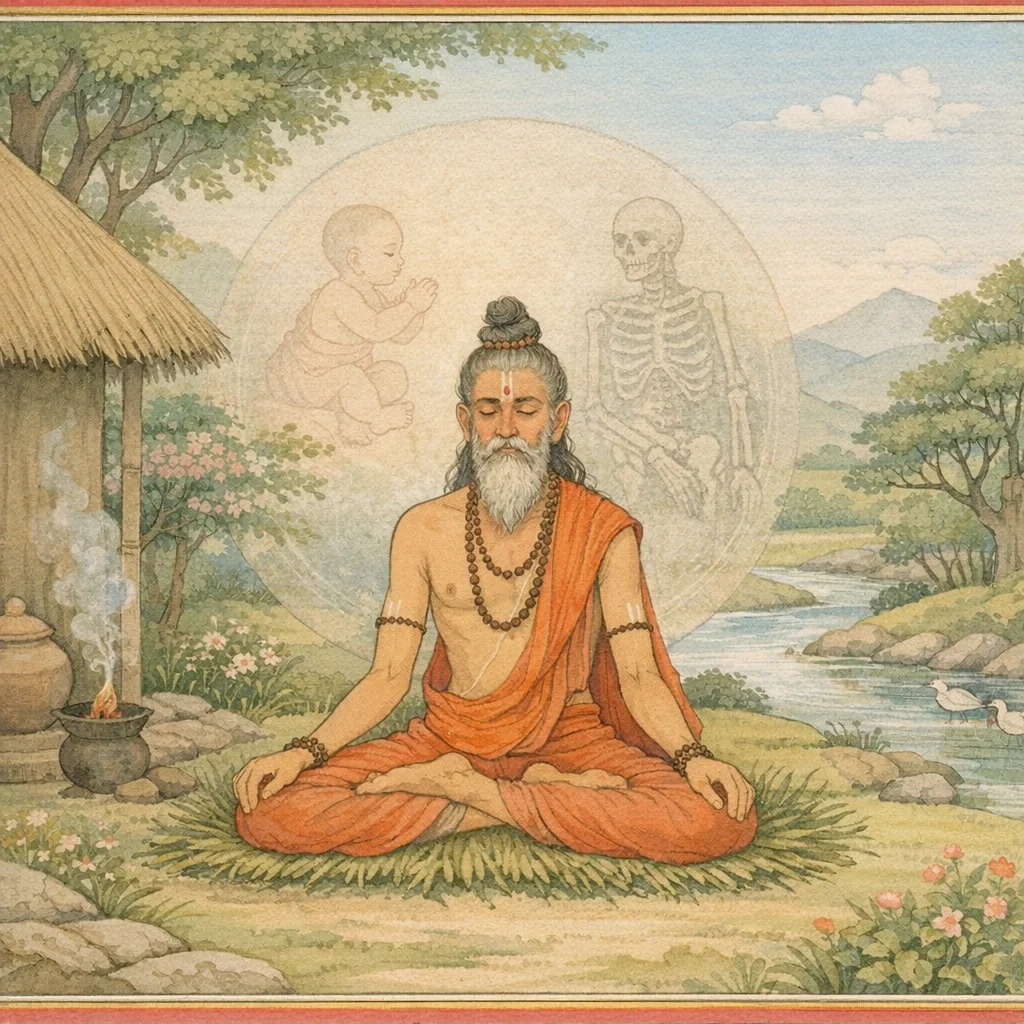
Chapter Arc: मोक्ष की चाह रखने वाला बुद्धिमान मनुष्य संसार को जन्म–मृत्यु–जरा, रोग और मानसिक क्लेशों से निरन्तर ग्रस्त देखकर भीतर ही भीतर प्रश्न उठाता है—इस चक्र से निकलने का उपाय क्या है? → उपाय के रूप में कठोर अनुशासन सामने आता है: प्रायश्चित्त-रूप ‘प्राजापत्य कृच्छ्र’ जैसे व्रत, मन–वाणी–शरीर की शुचिता, अहंकार-शून्यता, भिक्षु-धर्म, और विषयों पर क्रमशः नियंत्रण; परन्तु साधक के लिए सबसे कठिन गाँठ वाणी और मन की चंचलता है, जिनसे ही संसार का व्यवहार बँधा है। → निर्णायक उपदेश यह है कि रजस्–तमस् से प्रेरित कर्मों को वैसे ही त्याग देना चाहिए जैसे डाकू चोरी का बोझ फेंककर सुरक्षित दिशा में भागता है—और बुद्धि से मन को, मन से विषयों को, तथा आत्मसंयम से समस्त प्रवृत्तियों को निग्रह में लेना चाहिए। → देश–काल के अनुसार सात्त्विक आहार-नियम, क्रमिक साधना, वैराग्य और अपवर्ग-ज्ञान से वीतराग साधक मुक्त होता है; जीव–परमात्मा के पृथकत्व/संप्रयोग के शास्त्रीय विवेचन को समझकर वह सनातन ब्रह्म को जानता है और अक्षर-अव्यय अमृतत्व को प्राप्त होता है।
Shlokas
Verse 1
नफमजान- () असड अत ३. “कृच्छृ” शब्दसे प्राजापत्यकृच्छुका ग्रहण किया जाता है। प्राजापत्यकृच्छुका विधान इस प्रकार है-- त्यहं प्रातरूयहं सायं तयहमद्यादयाचितम् । त्र्यहं परं च नाश्नीयात् प्राजापत्योड्यमुच्यते ।। (मनुस्मृति ११२१२) तीन दिन केवल प्रातःकाल, तीन दिन केवल सायंकाल तथा तीन दिनतक केवल अयाचित अन्नका भोजन करे। फिर तीन दिनतक उपवास रखे। इसे प्राजापत्यकृच्छु कहा जाता है। २. अधमर्षणसूक्त निम्नलिखित है-- ऋतज्च सत्यज्चाभीद्धात्तपसो&ध्यजायत । ततो रात्र्यजायत ततः समुद्रो अर्णव:। समुद्रादर्णवादधिसंवत्सरो अजायत । अहोरात्राणि विदधद्विश्वस्य मिषतो वशी । सूर्याचन्द्रमसौ धाता यथापूर्वमकल्पयत् | दिवं च पृथिवीज्चान्तरिक्षमथो स्व: । पज्चदर्शाधिकद्विशततमो< ध्याय: आसक्ति छोड़कर सनातन ब्रह्नाकी प्राप्तिके लिये प्रयत्न करनेका उपदेश भीष्म उवाच दुरन्तेष्विन्द्रियार्थेषु सक्ता: सीदन्ति जन्तव: । ये त्वसक्ता महात्मानस्ते यान्ति परमां गतिम्,भीष्मजी कहते हैं--युधिष्ठिर! इन्द्रियोंके विषयोंका पार पाना बहुत कठिन है। जो प्राणी उनमें आसक्त होते हैं वे दुःख भोगते रहते हैं; और जो महात्मा उनमें आसक्त नहीं होते वे परम गतिको प्राप्त होते हैं
Bhīṣma said: “O Yudhiṣṭhira, the objects of the senses are exceedingly hard to overcome. Creatures who cling to them sink into suffering again and again; but the great-souled who remain unattached to them attain the highest goal.”
Verse 2
जन्ममृत्युजरादु:खैव्याधिभिमानसक्लमै: | दृष्टवैव संततं लोकं घटेन्मोक्षाय बुद्धिमान्,यह जगत् जन्म, मृत्यु और वृद्धावस्थाके दु:खों, नाना प्रकारके रोगों तथा मानसिक चिन्ताओंसे व्याप्त है; ऐसा समझकर बुद्धिमान् पुरुषको मोक्षके लिये ही प्रयत्न करना चाहिये
Bhīṣma said: Seeing that this world is continually pervaded by the sufferings of birth, death, and old age—along with diseases of many kinds and the weariness of mental afflictions—a wise person should direct his effort toward liberation alone.
Verse 3
वाड्मनोभ्यां शरीरेण शुचि: स्यथादनहंकृत: । प्रशान्तो ज्ञानवान् भिक्षुर्निरिपेक्षश्वरेत् सुखम्,वह मन, वाणी और शरीरसे पवित्र रहकर अहंकारशून्य, शान्तचित्त, ज्ञानवान् एवं निःस्पृह होकर भिक्षावृत्तिसे निर्वाह करता हुआ सुखपूर्वक विचरे
Bhīṣma said: “A mendicant should remain pure in speech, mind, and body; free from ego; inwardly calm and possessed of discernment. Without dependence on anything and without craving, he should sustain himself by alms and move about contentedly.”
Verse 4
अथवा मनस: सड़ू पश्येद् भूतानुकम्पया । तत्राप्युपेक्षां कुर्वीत ज्ञात्वा कर्मफलं जगत्,अथवा प्राणियोंपर दया करते रहनेसे भी मोहवश उनके प्रति मनमें आसक्ति हो जाती है। इस बातपर दृष्टिपात करे और यह समझकर कि सारा जगत् अपने-अपने कर्मोंका फल भोग रहा है, सबके प्रति उपेक्षाभाव रखे
Bhishma said: Alternatively, if through compassion for living beings one notices attachment arising in the mind, even there one should cultivate detachment. Understanding that the world is experiencing the results of its own actions, one should maintain an attitude of equanimous non-interference toward all.
Verse 5
यत् कृतं स्याच्छुभं कर्म पापं वा यदि वाश्षुते । तस्माच्छुभानि कर्माणि कुर्याद् वा बुद्धिकर्मभि:,मनुष्य शुभ या अशुभ जैसा भी कर्म करता है उसका फल उसे स्वयं ही भोगना पड़ता है; इसलिये मन, बुद्धि और क्रियाके द्वारा सदा शुभ कर्मोंका ही आचरण करे
Bhīṣma said: Whatever deed a person performs—whether auspicious or sinful—its result is what he himself must inevitably experience. Therefore, with mind, intellect, and outward action, one should consistently choose and practice only auspicious deeds.
Verse 6
अहिंसा सत्यवचन सर्वभूतेषु चार्जवम् । क्षमा चैवाप्रमादश्न यस्यैते स सुखी भवेत्,अहिंसा, सत्यभाषण, समस्त प्राणियोंके प्रति सरलतापूर्ण बर्ताव, क्षमा तथा प्रमादशून्यता--ये गुण जिस पुरुषमें विद्यमान हों, वही सुखी होता है
Bhīṣma said: Non-violence, truthfulness in speech, straightforward conduct toward all living beings, forgiveness, and vigilant freedom from negligence—whoever possesses these virtues becomes truly happy.
Verse 7
यश्चैनं परमं धर्म सर्वभूतसुखावहम् । दुःखान्नि:सरणं वेद सर्वज्ञ: स सुखी भवेत्,जो मनुष्य इस अहिंसा आदि परम धर्मको समस्त प्राणियोंके लिये सुखद और दुःखनिवारक जानता है, वही सर्वज्ञ है और वही सुखी होता है
Bhishma said: He who understands this as the highest dharma—bringing happiness to all beings and providing a way out of suffering—such a person is truly all-knowing in the moral sense, and he alone becomes happy.
Verse 8
तस्मात् समाहित बुद्धया मनो भूतेषु धारयेत् । नापध्यायेन्न स्पृहयेन्नाबद्धं चिन्तयेदसत्
Therefore, with a well-collected and steady understanding, one should hold the mind upon all beings with composure. One should not brood in harmful ways, should not crave, and should not let the mind run after what is unreal and ungrounded.
Verse 9
अथामोघप्रयत्नेन मनो ज्ञाने निवेशयेत् । वाचामोघप्रयासेन मनोज्ञं तत् प्रवर्तते
Bhīṣma said: “With effort that does not go to waste, one should place the mind in true knowledge. And with speech whose striving is not futile, one should set in motion what is pleasing and beneficial to the mind.”
Verse 10
इसलिये बुद्धिके द्वारा मनको समाहित करके समस्त प्राणियोंमें स्थित परमात्मामें लगावे। किसीका अहित न सोचे, असम्भव वस्तुकी कामना न करे, मिथ्या पदार्थोंकी चिन्ता न करे और सफल प्रयत्न करके मनको ज्ञानके साधनमें लगा दे। वेदान्त-वाक्योंके श्रवण तथा सुदृढ़ प्रयत्नसे उत्तम ज्ञानकी प्राप्ति होती है ।। विवक्षता च सद्दाक्यं धर्म सूक्ष्ममवेक्षता | सत्यां वाचमहिंस्रां च वदेदनपवादिनीम्,जो सूक्ष्म धर्मको देखता और उत्तम वचन बोलना चाहता हो, उसको ऐसी बात कहनी चाहिये जो सत्य होनेके साथ ही हिंसा और परनिन्दासे रहित हो। जिसमें शठता, कठोरता, क्रूरता और चुगली आदि दोषोंका सर्वथा अभाव हो, ऐसी वाणी भी बहुत थोड़ी मात्रामें और सुस्थिर चित्तसे बोलनी चाहिये
Bhishma said: Therefore, steady the mind through discernment and fix it upon the Supreme Self who abides in all beings. Do not entertain thoughts of harming anyone; do not desire what is impossible; do not brood over unreal objects; and, with purposeful effort, yoke the mind to the means of knowledge. By listening to the utterances of Vedanta and by firm striving, the highest knowledge is attained. And one who wishes to speak well, and who can perceive the subtlety of dharma, should speak words that are true, yet free from violence and free from slander. Speech should be devoid of deceit, harshness, cruelty, and tale-bearing; even such faultless speech should be measured and spoken with a steady mind.
Verse 11
कल्कापेतामपरुषामनृशंसामपैशुनाम् । ईदृगल्पं च वक्तव्यमविक्षिप्तेन चेतसा,जो सूक्ष्म धर्मको देखता और उत्तम वचन बोलना चाहता हो, उसको ऐसी बात कहनी चाहिये जो सत्य होनेके साथ ही हिंसा और परनिन्दासे रहित हो। जिसमें शठता, कठोरता, क्रूरता और चुगली आदि दोषोंका सर्वथा अभाव हो, ऐसी वाणी भी बहुत थोड़ी मात्रामें और सुस्थिर चित्तसे बोलनी चाहिये
Bhīṣma said: One should speak words that are free from impurity, not harsh, not cruel, and not tainted by slander. Even such speech should be uttered only in small measure, and with a mind that is steady and undistracted—especially by one who perceives the subtlety of dharma and wishes to speak what is truly beneficial.
Verse 12
वाकृप्रबद्धो हि संसारो विरागाद् व्याहरेद् यदि । बुद्धयाप्यनुगृहीतेन मनसा कर्म तामसम्,संसारका सारा व्यवहार वाणीसे ही बँधा हुआ है, अतः सदा उत्तम वाणी ही बोले और यदि वैराग्य हो तो बुद्धिके द्वारा मनको वशमें करके अपने किये हुए हिंसादि तामस कर्मोंको भी लोगोंसे कह दे (क्योंकि प्रकाशित कर देनेसे पापकी मात्रा घट जाती है)
Bhishma said: Worldly bondage is indeed fastened by speech and conduct; therefore one should always speak what is noble. And if one has attained dispassion, then—having brought the mind under control with the aid of the discerning intellect—one should even disclose one’s own tamasic deeds such as acts of violence; for when wrongdoing is brought into the open, its burden is diminished and the path to purification is strengthened.
Verse 13
रजोभूतैर्हि करणै: कर्मणि प्रतिपद्यते । स दु:खं प्राप्प लोकेडस्मिन् नरकायोपपद्यते | तस्मान्मनोवाक्शरीरैराचरेद् धैर्यमात्मन:,रजोगुणसे प्रभावित हुई इन्द्रियोंकी प्रेरणासे मनुष्य विषयभोगरूप कर्मामें प्रवृत्त होता है और इस लोकमें दुःख भोगकर अन्तमें नरकगामी होता है। अतः मन, वाणी और शरीरद्वारा ऐसा कार्य करे जिससे अपनेको धैर्य प्राप्त हो
Bhishma said: When a person’s faculties are driven by the quality of rajas, he is propelled into actions aimed at sense-enjoyment. Having reaped suffering in this very world, he finally becomes fit for hell. Therefore, by mind, speech, and body one should practice such conduct as brings steadiness and self-control to oneself.
Verse 14
प्रकीर्णमेष भारं हि यद्वद् धार्येत दस्युभि: । प्रतिलोमां दिशं बुद्ध्वा संसारमबुधास्तथा,जैसे चोर या लुटेरे किसीकी भेड़को मारकर उसे कंधेपर उठाये हुए जबतक भागते हैं तबतक उन्हें सारी दिशाओंमें पकड़े जानेका भय बना रहता है; और जब मार्गको प्रतिकूल समझकर उस भेड़के बोझको अपने कंधेसे उतार फेंकते हैं तब अपनी अभीष्ट दिशाको सुखपूर्वक चले जाते हैं। उसी प्रकार अज्ञानी मनुष्य जबतक सांसारिक कर्मरूप बोझको ढोते हैं तबतक उन्हें सर्वत्र भय बना रहता है; और जब उसे त्याग देते हैं, तब शान्तिके भागी हो जाते हैं
Bhishma said: Just as bandits, having killed a sheep, flee with that burden on their shoulders and fear capture from every direction; but when they see the road has turned against them and cast the load away, they go at ease toward the direction they desire. So too the ignorant, so long as they bear the burden of worldly action, are beset by fear on all sides; but when they abandon it, they become entitled to peace.
Verse 15
तमेव च यथा दस्युः क्षिप्त्वा गच्छेच्छिवां दिशम् । तथा रजस्तम: कर्माप्युत्सृज्य प्राप्तुयाच्छुभम्,जैसे चोर या डाकू जब उस चोरीके मालका बोझ उतार फेंकता है तब जहाँ उसे सुख मिलनेकी आशा होती है, उस दिशामें अनायास चला जाता है। उसी प्रकार मनुष्य राजस और तामस कर्मोको त्यागकर शुभ गति प्राप्त कर लेता है
Bhishma said: Just as a thief, after throwing off the burden of stolen goods, goes without hindrance toward the direction where he expects safety and well-being, so too a person, abandoning actions driven by rajas (passion) and tamas (darkness), attains an auspicious state and higher good.
Verse 16
निः:संदिग्धमनीहो वै मुक्त: सर्वपरिग्रहै: । विविक्तचारी लघ्वाशी तपस्वी नियतेन्द्रिय:,जो सब प्रकारके संग्रहसे रहित, निरीह, एकान्त-वासी, अल्पाहारी, तपस्वी और जितेन्द्रिय है, जिसके सम्पूर्ण क्लेश ज्ञानाग्निसे दग्ध हो गये हैं; तथा जो योगानुष्ठानका प्रेमी और मनको वशमें रखनेवाला है, वह अपने निश्चल चित्तके द्वारा उस परब्रह्म परमात्माको नि:संदेह प्राप्त कर लेता है
Bhishma says: One who is free from doubt and free from restless striving, who has renounced all possessions and attachments; who lives in seclusion, eats lightly, practices austerity, and keeps the senses under discipline—such a person, with a steady and unwavering mind, attains the Supreme Brahman without uncertainty.
Verse 17
ज्ञानदग्धपरिक्लेश: प्रयोगरतिरात्मवान् | निष्प्रचारेण मनसा परं तदधिगच्छति,जो सब प्रकारके संग्रहसे रहित, निरीह, एकान्त-वासी, अल्पाहारी, तपस्वी और जितेन्द्रिय है, जिसके सम्पूर्ण क्लेश ज्ञानाग्निसे दग्ध हो गये हैं; तथा जो योगानुष्ठानका प्रेमी और मनको वशमें रखनेवाला है, वह अपने निश्चल चित्तके द्वारा उस परब्रह्म परमात्माको नि:संदेह प्राप्त कर लेता है
Bhīṣma said: One whose afflictions have been burned away by the fire of true knowledge, who delights in disciplined yogic practice, and who is self-possessed—such a person, with a mind withdrawn from outward wandering, attains that Supreme Reality.
Verse 18
धृतिमानात्मवान् बुद्धि निगृह्लीयादसंशयम् । मनो बुद्धया निगृह्लीयाद् विषयान्मनसा55त्मन:,बुद्धिमान् एवं धीर पुरुषको चाहिये कि वह बुद्धिको निश्चय ही अपने वशमें करे; फिर बुद्धिके द्वारा मनको और मनके द्वारा अपनी इन्द्रियोंको विषयोंकी ओरसे रोककर अपने अधीन करे
A wise and steadfast person, possessed of self-mastery, should without doubt bring the buddhi (intellect) under control; then, by the buddhi, restrain the manas (mind), and by the mind restrain the senses from their objects, making them obedient to the self.
Verse 19
निगृहीतेन्द्रियस्यास्य कुर्वाणस्य मनो वशे । देवतास्तत् प्रकाशन्ते हृष्टा यान्ति तमीश्वरम्,इस प्रकार जिसने इन्द्रियोंको वशमें करके मनको अपने अधीन कर लिया है, उस अवस्थामें उसकी इन्द्रियोंके अधिष्ठातृदेवता प्रसन्नतासे प्रकाशित होने लगते हैं; और ईश्वरकी ओर प्रवृत्त हो जाते हैं
Bhīṣma said: When a person has restrained the senses and brought the mind under control, the deities who preside over those senses become radiant with joy; pleased, they turn that person’s course toward the Lord. The ethical point is that inner discipline is not mere suppression but a harmonizing of the faculties, so that one’s powers naturally align with the highest good.
Verse 20
ताभि: संयुक्तमनसो ब्रह्म तत् सम्प्रकाशते । शनैश्वोपगते सच्चे ब्रह्मभूयाय कल्पते,उन इन्द्रिययेवताओंसे जिसका मन संयुक्त हो गया है, उसके अन्तःकरणमें परब्रह्म परमात्मा प्रकाशित हो उठता है; फिर धीरे-धीरे सत्त्वगुण प्राप्त होनेपर वह मनुष्य ब्रह्मभावको प्राप्त हो जाता है
Bhishma said: When a person’s mind becomes harmonized with those presiding powers of the senses, the Supreme Brahman shines forth clearly within the inner being. Then, as purity (sattva) gradually arises, that person becomes fit to attain the state of Brahman—freedom from delusion and steady establishment in the highest reality.
Verse 21
अथवा न प्रवर्तेत योगतनन््त्रैरुपक्रमेत् येन तन्त्रयतस्तन्त्रं वृत्ति: स्थात् तत् तदाचरेत्,अथवा यदि पूर्वोक्तरूपसे उसके भीतर ब्रह्म प्रकाशित न हो तो वह योगी योगप्रधान उपायोंद्वारा अभ्यास आरम्भ करे। जिस हेतुसे योगाभ्यास करते हुए योगीकी ब्रह्ममें ही स्थिति हो, वह उसी-उसीका अनुष्ठान करे
Bhishma said: If one does not naturally enter into that state, then one should begin through the disciplines of yoga. Whatever method, when practiced as a disciplined system, steadies the mind’s activity and establishes one in Brahman—one should undertake precisely that practice. If the previously described form does not reveal Brahman within, the yogin should commence sustained practice by yoga-centered means, adopting those observances that keep the yogin firmly established in Brahman.
Verse 22
कणकुल्माषपिण्याकशाकयावकसक्तव: | तथा मूलफल भैक्ष्यं पर्यायेणोपयोजयेत्,अन्नके दाने, उड़द, तिलकी खली, साग, जौकी लप्सी, सत्तू, मूल और फल जो कुछ भी भिक्षामें मिल जाय, क्रमश: उसी अन्नसे योगी अपने जीवनका निर्वाह करे
Bhishma said: A yogin should sustain his life by accepting, in due rotation, whatever simple foods come to him by alms—such as grains, pulses, oil-cake, leafy vegetables, barley preparations, parched-flour, and likewise roots and fruits. The ethical emphasis is on restraint, non-indulgence, and contentment with what is obtained without craving or selectiveness.
Verse 23
आहारनियमं चैव देशे काले च सात्विकम् । तत् परीक्ष्यानुवर्तेत तत्प्रवृत्त्यनुपूर्वकम्,देश और कालके अनुसार सात्त्विक आहार ग्रहण करनेका नियम रखे। उस आहारके दोष-गुणकी परीक्षा करके यदि वह योगसिद्धिके अनुकूल हो तो उसे उपयोगमें ले
Bhīṣma said: “Let one adopt a disciplined rule of food that is sāttvika and suited to the place and the season. Having examined that diet—its merits and faults—one should follow it step by step, in due order, taking up only what supports one’s spiritual practice and attainment.”
Verse 24
प्रवृत्त नोपरुन्धेत शनैरग्निमिवेन्धयेत् । ज्ञानान्वितं तथा ज्ञानमर्कवत् सम्प्रकाशते
Bhishma said: One should not forcibly obstruct what has already begun; rather, one should nourish it gradually, as one tends a fire with fuel. In the same way, knowledge—when supported by understanding and right discernment—shines forth clearly, like the sun.
Verse 25
साधन आरम्भ कर देनेपर उसे बीचमें न रोके। जैसे आग धीरे-धीरे तेज की जाती है, उसी प्रकार ज्ञानके साधनको शनैः-शनै: उद्दीपित करे। ऐसा करनेसे ज्ञान सूर्यके समान प्रकाशित होने लगता है ।। ज्ञानाधिष्ठानमज्ञानं त्रींललोकानधितिष्ठति । विज्ञानानुगतं ज्ञानमज्ञानेनापकृष्यते,अज्ञानका अधिष्ठान भी ज्ञान ही है जो तीनों लोकोंमें व्याप्त है। अज्ञानके द्वारा विज्ञानयुक्त ज्ञानका हास होता है
Bhīṣma says: Once a discipline has been undertaken, one should not interrupt it midway. Just as fire is gradually intensified, so too should the means of knowledge be kindled little by little; when done in this way, knowledge begins to shine like the sun. Even ignorance rests upon knowledge, which pervades and upholds the three worlds; yet through ignorance, knowledge that is guided by discernment is diminished and drawn away.
Verse 26
पृथक्त्वात् सम्प्रयोगाच्च नासूयुरवेद शाश्वतम् । स तयोरपवर्गज्ञो वीतरागो विमुच्यते,शास्त्रोंमें कहीं जीवात्मा और परमात्माकी पृथक्ताका प्रतिपादन करनेवाले वचन उपलब्ध होते हैं और कहीं उनकी एकताका। यह परस्पर विरोध देखकर दोषदृष्टि न करते हुए सनातन ज्ञानको प्राप्त करे। जो उन दोनों प्रकारके वचनोंका तात्पर्य समझकर मोक्षके तत्त्वको जान लेता है, वह वीतराग पुरुष संसारबन्धनसे मुक्त हो जाता है
Bhīṣma said: Because the scriptures speak in two ways—sometimes of the soul’s separateness and sometimes of its union—one should not fall into fault-finding on seeing this apparent contradiction, but should grasp the eternal wisdom. The person who understands the intended purport of both kinds of statements and thereby knows the principle of liberation becomes free from attachment and is released from worldly bondage.
Verse 27
ततो वीतजरामृत्युर्ज्ञात्वा ब्रह्म सनातनम् । अमृतं तदवाप्रोति यत् तदक्षरमव्ययम्,ऐसा पुरुष जरा और मृत्युका उल्लंघनकर सनातन ब्रह्मको जानकर उस अक्षर, अविकारी एवं अमृत ब्रह्मको प्राप्त कर लेता है
Bhishma said: Thereafter, having risen beyond the sway of old age and death, a person who realizes the eternal Brahman attains that immortal Brahman—imperishable and unchanging.
Verse 215
इति श्रीमहाभारते शान्तिपर्वणि मोक्षधर्मपर्वणि वार्ष्णेया ध्यात्मक थने पजञ्चदशाधिकद्वधिशततमो< ध्याय:,इस प्रकार श्रीमह्ाभारत शान्तिपर्वके अन्तर्गत गोक्षधर्मपर्वमें श्रीकृष्णसम्बन अध्यात्मतत्त्वका वर्णनविषयक दो सौ पंद्रहवाँ अध्याय पूरा हुआ
Thus, in the Śrī Mahābhārata, within the Śānti Parva and specifically the Mokṣa-dharma section, the two-hundred-and-fifteenth chapter concludes—its subject being an exposition of spiritual truth in connection with Vārṣṇeya (Śrī Kṛṣṇa).
Frequently Asked Questions
Yudhiṣṭhira asks whether the individual person is the real ‘doer’ (kartā) of good and bad actions and therefore responsible for their results, or whether causality lies elsewhere.
Prahlāda teaches that pride in self-authorship is unstable because qualities and outcomes arise within broader causal conditions (svabhāva/guṇas); peace is sustained by understanding impermanence and cultivating non-attachment, humility, and even-sightedness.
No explicit phalaśruti is stated in these verses; the chapter’s meta-function is doctrinal—embedding an authoritative precedent-dialogue to clarify causality, reduce egoic doership, and orient the listener toward śānti and mokṣa.