Adhyaya 62
Adhyāya 62: Sañjaya’s Admonition to Dhṛtarāṣṭra on Rāja-dharma and Consequence
Upa-parva: Dhṛtarāṣṭra-śoka–Sañjaya-upadeśa (Counsel to Dhṛtarāṣṭra amid lamentation)
Sañjaya addresses Dhṛtarāṣṭra with a corrective report that reframes the king’s lamentation as ineffective once causal decisions have matured into outcomes. He asserts the inevitability of fate-like consequence (kṛtānta-vidhi) while simultaneously enumerating concrete points where intervention was possible: restraining Yudhiṣṭhira from the dice episode, preventing escalation at the onset of war, and disciplining Duryodhana’s disobedience. Sañjaya predicts reputational judgment by the Pāṇḍavas, Pañcālas, Vṛṣṇis, and other elites, emphasizing that Dhṛtarāṣṭra abandoned sanātana-dharma by following Duryodhana, Karṇa, and Śakuni. He further notes Kṛṣṇa’s diminished estimation of Dhṛtarāṣṭra due to deviation from rāja-dharma and indifference to harsh speech against the Pārthas. The discourse then shifts to a realistic assessment of battlefield dynamics: kṣatriyas do not preserve life in combat, and the Pāṇḍava side—protected by Kṛṣṇa, Arjuna, Sātyaki, and Bhīma—presents a formidable force. Sañjaya closes by preparing Dhṛtarāṣṭra to hear a precise account of the severe engagement between Kurus and Pāṇḍavas.
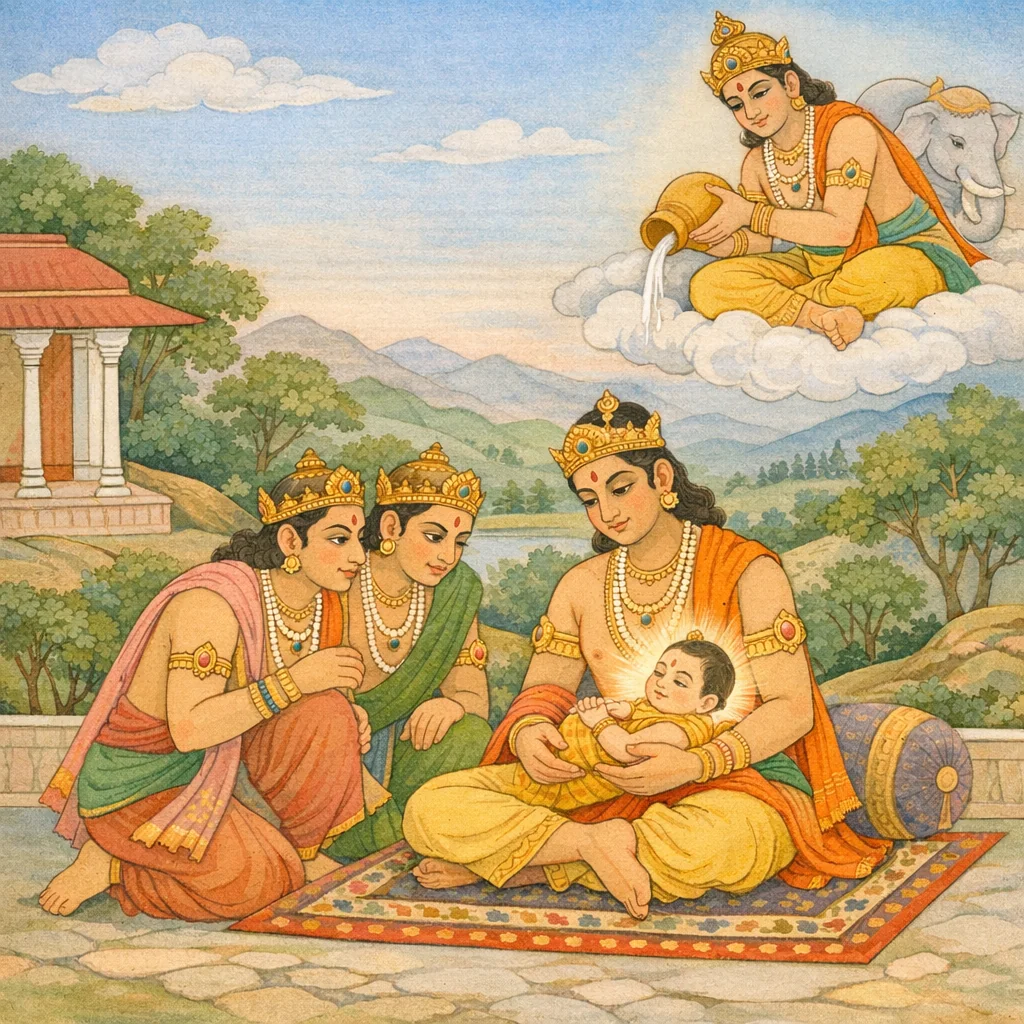
Chapter Arc: रण-धूलि और शोक के बीच कथा अचानक प्राचीन राजवंशों की ओर मुड़ती है—युवनाश्व के गर्भ से देव-प्रेरित अद्भुत शिशु का प्राकट्य, और प्रश्न उठता है: यह बालक किसका दूध पियेगा? → अश्विनीकुमार गर्भ से बालक को निकालते हैं; देवता तेजस्वी शिशु को पिता की गोद में देखते हैं और पालन-पोषण की असंभवता सामने आती है। फिर बालक का असाधारण विकास—बारह दिनों में बारह वर्ष का—और एक ही दिन में पृथ्वी-विजय का संकेत कथा को महाविस्तार देता है। → इन्द्र करुणावश अपनी अंगुलियों से अमृतमय दूध प्रकट करते हैं और वचन-ध्वनि से नाम-निर्णय होता है—‘मां धास्यति’ से ‘मान्धाता’; उसी क्षण बालक का दैवी-राजकीय भाग्य स्थिर हो जाता है। → मान्धाता के सार्वभौम सामर्थ्य का वर्णन फैलता है—जहाँ सूर्य उदय-अस्त होता है, वह समस्त क्षेत्र उसका कहा जाता है; उसके राज्य में समृद्धि, अन्न-राशियाँ, मधु-क्षीर-प्रवाहिनी नदियाँ और धर्म-आधारित व्यवस्था का चित्र उभरता है। → यह आदर्श-राज्य और दैवी-उत्पत्ति का आख्यान वर्तमान युद्ध-प्रसंग में किस नीति/उपदेश के रूप में लौटेगा—यह संकेत देकर कथा आगे के अध्याय की ओर धकेलती है।
Shlokas
Verse 1
इस प्रकार श्रीमह्ाभारत द्रोणपर्वके अन्तर्गत अभिमन्युवधपर्वमें षोडशराजकीयोपाख्यानविषयक इकसठवाँ अध्याय पूरा हुआ ॥/ ६१ ॥ #+>ञी>स हु ना > यज्ञीय यूप या स्तम्भके ऊपर लगाये जानेवाले काठके छल्लेको “चषाल' कहते हैं, इसीका उत्कृष्ट रूप 'प्रचषाल' है। द्विषष्टितमो< ध्याय: राजा मान्धाताकी महत्ता नारद उवाच मान्धाता चेद्यौवनाश्वो मृत: सृञ्जय शुश्रुम देवासुरमनुष्याणां त्रैलोक्यविजयी नृप:,नारदजी कहते हैं--सूंजय! युवनाश्वके पुत्र राजा मान्धाता भी मरे थे, यह सुना गया है। वे देवता, असुर और मनुष्य--तीनों लोकोंमें विजयी थे इस प्रकार श्रीमहाभारत द्रोणपर्वके अन्तर्गत अभिमन्युवधपर्वमें षोडशराजकीयोपाख्यानविषयक बासठवाँ अध्याय पूरा हुआ ॥/ ६२ ॥। #द१-3८5>> हम # त्रिषप्टितमो5 ध्याय: राजा ययातिका उपाख्यान नारद उवाच ययातिं नाहुष॑ चैव मृतं सृज्जय शुश्रुम । राजसूयशतैरिष्टवा सो5श्वमेधशतेन च
Nārada said: “Sṛñjaya, we have heard that Māndhātā, the son of Yuvanāśva, also met death. Yet he was a king who had conquered the three worlds—among gods, asuras, and humans.” The verse underscores a moral contrast: even the most universally victorious ruler remains subject to mortality, reminding listeners that worldly supremacy does not exempt one from the law of impermanence.
Verse 2
य॑ं देवावश्चिनौ गर्भात् पितुः पूर्व चकर्षतु: । मृगयां विचरन् राजा तृषितः क्लान्तवाहन:,पूर्वकालमें दोनों अश्विनीकुमार नामक देवताओंने उन्हें पिताके पेटसे निकाला था। एक समयकी बात है, राजा युवनाश्व वनमें शिकार खेलनेके लिये विचर रहे थे। वहाँ उनका घोड़ा थक गया और उन्हें भी प्यास लग गयी
Nārada said: “He whom the two Aśvin gods had formerly drawn forth from his father’s womb—once, King Yuvanāśva, while roaming in the forest on a hunt, became thirsty, and his mount too was worn out.”
Verse 3
धूमं दृष्टवागमत् सत्र पृषदाज्यमवाप स: | त॑ दृष्टवा युवनाश्वस्य जठरे सूनुतां गतम्
Nārada said: “Seeing the smoke, he came to that sacrificial session and obtained the oblation of ghee. Then, beholding that (oblation) lodged in Yuvanāśva’s belly, it came to assume the state of offspring.”
Verse 4
त॑ं दृष्टवा पितुरुत्सज़े शयानं देववर्चसम्,देवताके समान तेजस्वी उस शिशुको पिताकी गोदमें शयन करते देख देवता आपसमें कहने लगे, यह किसका दूध पीयेगा? यह सुनकर इन्द्रने कहा--यह पहले मेरा ही दूध पीये
Seeing that radiant, godlike infant lying asleep in his father’s lap, the gods spoke among themselves: “Whose milk will he drink?” Hearing this, Indra declared, “Let him first drink my milk alone.”
Verse 5
अन्योन्यमन्रुवन् देवा: कमयं धास्यतीति वै । मामेवायं धयत्वग्रे इति ह स्माह वासव:,देवताके समान तेजस्वी उस शिशुको पिताकी गोदमें शयन करते देख देवता आपसमें कहने लगे, यह किसका दूध पीयेगा? यह सुनकर इन्द्रने कहा--यह पहले मेरा ही दूध पीये
Nārada said: Seeing that radiant infant lying in his father’s lap, the gods spoke among themselves, “Whose milk will this child drink?” Hearing this, Vāsava (Indra) declared, “Let him first drink my milk alone.”
Verse 6
ततो<ड्गुलिभ्यो हीन्द्रस्य प्रादुरासीत् पयो5मृतम् । मां धास्यतीति कारुण्याद् यदिन्द्रो हन्वकम्पयत्
Then, from Indra’s very fingers there manifested milk-like nectar. For, moved by compassion—thinking, “He will suckle me”—Indra caused his jaw to tremble.
Verse 7
ततस्तु धारां पयसो घृतस्य च महात्मन:,तत्पश्चात् महामना मान्धाताके मुखमें इन्द्रके हाथने दूध और घीकी धारा बहायी। वह बालक इन्द्रका हाथ पीने लगा और एक ही दिनमें बहुत बढ़ गया
Then, by the power of that great-souled one, a stream of milk and ghee flowed forth. After this, the noble Indra, with his own hand, poured a current of milk and clarified butter into Māndhātā’s mouth. The child drank from Indra’s hand and, within a single day, grew remarkably.
Verse 8
तस्यास्ये यौवनाश्व॒स्य पाणिरिन्द्रस्य चास्रवत् । अपिबत् पाणिमिन्द्रस्य स चाप्यल्वाभ्यवर्धत,तत्पश्चात् महामना मान्धाताके मुखमें इन्द्रके हाथने दूध और घीकी धारा बहायी। वह बालक इन्द्रका हाथ पीने लगा और एक ही दिनमें बहुत बढ़ गया
Nārada said: From the mouth of Yauvanāśva’s child there flowed a stream from Indra’s hand. The infant drank from Indra’s hand, and in a single day he grew greatly.
Verse 9
सो5भवद् द्वादशसमो द्वादशाहेन वीर्यवान् । इमां च पृथिवीं कृत्स्नामेकाह्नला स व्यजीजयत्,वह पराक्रमी राजकुमार बारह दिनोंमें ही बारह वर्षोकी अवस्थावाले बालकके समान हो गया। (राजा होनेपर) मान्धाताने एक ही दिनमें इस सारी पृथ्वीको जीत लिया
Nārada said: “That mighty one became, within twelve days, equal to a twelve-year-old in strength and maturity. And in a single day he conquered this entire earth.”
Verse 10
धर्मात्मा धृतिमान् वीर: सत्यसंधो जितेन्द्रिय: । जनमेजयं सुधन्वानं गयं पूरुं बृहद्रथम्
Nārada said: “He was righteous in spirit, steadfast in resolve, a true hero—firm in his pledge to truth and master of his senses. From him were born/descended Janamejaya, Sudhanvā, Gaya, Pūru, and Bṛhadratha.”
Verse 11
उदेति च यतः सूर्यो यत्र च प्रतितिष्ठति
Nārada said: “From where the sun rises, and where it comes to rest (sets).”
Verse 12
सो<श्वमेधशतैरिष्टवा राजसूयशतेन च,राजन! उन्होंने सौ अश्वमेध और सौ राजसूय-यज्ञोंका अनुष्ठान करके सौ योजन विस्तृत रोहितक, मत्स्य तथा हिरण्यमय (सोनेकी खानोंसे युक्त) जनपदोंको, जो लोगोंमें ऊँची भूमिके रूपमें प्रसिद्ध थे, ब्राह्मणोंको दे दिया
Nārada said: “O King, having performed a hundred Aśvamedha sacrifices and likewise a hundred Rājasūya rites, he then bestowed upon the Brāhmaṇas vast provinces—Rohitaka, Matsya, and the gold-rich (Hiraṇyamaya) lands—each spread over a hundred yojanas, famed among people as ‘upland regions.’ The account highlights royal power being ethically redirected into dāna (gift-giving) and support of the sacred order.”
Verse 13
अदददू रोहितान् मत्स्यान् ब्राह्मणेभ्यो विशाम्पते । हैरण्यान् यो जनोत्सेधानायतान् शतयोजनम्,राजन! उन्होंने सौ अश्वमेध और सौ राजसूय-यज्ञोंका अनुष्ठान करके सौ योजन विस्तृत रोहितक, मत्स्य तथा हिरण्यमय (सोनेकी खानोंसे युक्त) जनपदोंको, जो लोगोंमें ऊँची भूमिके रूपमें प्रसिद्ध थे, ब्राह्मणोंको दे दिया
Narada said: “O lord of the people, he bestowed upon the Brahmanas the Rohitaka and Matsya territories, and also the gold-rich provinces—those famed as elevated and prosperous lands—each extending a hundred yojanas. Having performed a hundred Aśvamedha sacrifices and a hundred Rājasūya rites, he gave away such vast realms as gifts.”
Verse 14
बहुप्रकारान् सुस्वादून् भक्ष्यभोज्यान्नपर्वतान् । अतिरिक्तं ब्राह्मणे भ्यो भुज्जानो हीयते जन:,अनेक प्रकारके सुस्वादु भक्ष्य-भोज्य पदार्थोंके पर्वत भी उन्होंने ब्राह्मणोंको दे दिये। ब्राह्मणोंक भोजनसे भी जो अन्न बच गया, उसे दूसरे लोगोंको दिया गया। उस अन्नको खानेवाले लोगोंकी ही वहाँ कमी रहती थी। अन्न कभी नहीं घटता था
Nārada said: “He provided mountains, as it were, of many kinds of delicious foods—both snacks and full meals. After the Brāhmaṇas had eaten, whatever remained was given to others; yet those who ate that remainder seemed to diminish in number there, while the food itself never ran short.”
Verse 15
भक्ष्यानज्नपाननिचया: शुशुभुस्त्वन्नपर्वता: । घृतह्दा: सूपकूपा: दधिफेना गुडोदका:
Nārada said: “There appeared splendid heaps of delicacies and drink, like mountains of food. There were lakes of ghee, wells of soup, foam of curds, and waters sweetened with jaggery.”
Verse 16
देवासुरा नरा यक्षा गन्धर्वोरगपक्षिण:,वहाँ देवता, असुर, मनुष्य, यक्ष, गन्धर्व, नाग, पक्षी तथा वेद-वेदांगोंके पारंगत विद्वान् ब्राह्मण एवं ऋषि भी पधारे थे; किंतु वहाँ कोई मनुष्य ऐसे नहीं थे जो विद्वान न हों
Narada said: “There were present gods and asuras, human beings, yakṣas, gandharvas, nāgas, and birds. Indeed, even Brahmins and ṛṣis thoroughly versed in the Vedas and the Vedāṅgas had assembled there. Yet among those gathered, there was no human who was not learned.”
Verse 17
विप्रास्तत्रागताश्चासन् वेदवेदाड़पारगा: । ब्राह्मणा ऋषयश्चापि नासंस्तत्राविपश्चित:,वहाँ देवता, असुर, मनुष्य, यक्ष, गन्धर्व, नाग, पक्षी तथा वेद-वेदांगोंके पारंगत विद्वान् ब्राह्मण एवं ऋषि भी पधारे थे; किंतु वहाँ कोई मनुष्य ऐसे नहीं थे जो विद्वान न हों
Nārada said: “There too had arrived learned Brahmins—masters of the Vedas and the Vedāṅgas. Sages and Brahmins were present in abundance; indeed, in that assembly there was no one who was unwise.”
Verse 18
समुद्रान्तां वसुमतीं वसुपूर्णा तु सर्वतः । सतां ब्राह्मणसात्कृत्वा जगामास्तं तदा नृप:,उस समय राजा मान्धाता सब ओरसे धन-धान्यसे सम्पन्न समुद्रपर्यन्त पृथ्वीको ब्राह्मणोंके अधीन करके सूर्यके समान अस्त हो गये
Nārada said: “Having made the earth—bounded by the ocean and filled everywhere with wealth—subject to the righteous brāhmaṇas, King Māndhātṛ then passed into setting, like the sun.”
Verse 19
गत: पुण्यकृतां लोकान् व्याप्य स्ववशसा दिश: । स चेन्ममार सृज्जय चतुर्भद्रतरस्त्वया,उन्होंने अपने सुयशसे सम्पूर्ण दिशाओंको व्याप्त करके पुण्यात्माओंके लोकोंमें पदार्पण किया। श्वैत्य सूंजय! वे पूर्वोक्त चारों कल्याणकारी गुणोंमें तुमसे बहुत बढ़े-चढ़े थे और तुम्हारे पुत्रसे भी अधिक पुण्यात्मा थे। जब वे भी मर गये तब औरोंकी क्या बात है। अतः तुम यज्ञ और दान-दक्षिणासे रहित अपने पुत्रके लिये शोक न करो। ऐसा नारदजीने कहा
Nārada said: “He has departed to the worlds attained by the doers of merit, having filled the quarters with his fame and influence. O Sṛñjaya, even one who was endowed with four auspicious excellences—surpassing you—has died; what then is there to be said of others? Therefore do not grieve for your son, who was without sacrifice and without gifts and priestly fees.”
Verse 20
पुत्रात् पुण्यतरस्तुभ्यं मा पुत्रमनुतप्यथा: । अयज्वानमदाक्षिण्यमश्रि श्रैत्येत्युदाहरत्,उन्होंने अपने सुयशसे सम्पूर्ण दिशाओंको व्याप्त करके पुण्यात्माओंके लोकोंमें पदार्पण किया। श्वैत्य सूंजय! वे पूर्वोक्त चारों कल्याणकारी गुणोंमें तुमसे बहुत बढ़े-चढ़े थे और तुम्हारे पुत्रसे भी अधिक पुण्यात्मा थे। जब वे भी मर गये तब औरोंकी क्या बात है। अतः तुम यज्ञ और दान-दक्षिणासे रहित अपने पुत्रके लिये शोक न करो। ऐसा नारदजीने कहा
Nārada said: “There are those more meritorious than your own son—do not grieve for him. One who does not perform sacrifices and who gives no gifts or priestly fees is spoken of as falling into misfortune. Therefore, do not sink into sorrow for your son who was devoid of sacrifice and generosity.”
Verse 36
गर्भाद्धि जह्वतुर्देवावश्वचिनौ भिषजां वरौ | इतनेमें दूरसे उठता हुआ धूआँ देखकर वे उसी ओर चले और एक यज्ञमण्डपमें जा पहुँचे। वहाँ एक पात्रमें रखे हुए घृतमिश्रित अभिमन्त्रित जलको उन्होंने पी लिया। उस जलको युवनाश्वके पेटमें पुत्ररूपमें परिणत हुआ देख वैद्योंमें श्रेष्ठ अश्विनीकुमार नामक देवताओंने उसे पिताके गर्भसे बाहर निकाला
Narada said: The two divine Ashvins, foremost among physicians, were present there. Just then, seeing smoke rising from afar, they went in that direction and arrived at a sacrificial pavilion. There they drank consecrated, mantra-charged water mixed with ghee that had been kept in a vessel. When they saw that this water had transformed into a son within King Yuvanashva’s belly, the Ashvinikumara deities—best of healers—brought the child forth from the father’s womb.
Verse 62
इति श्रीमहा भारते द्रोणपर्वणि अभिमन्युवधपर्वणि षोडशराजकीये द्विषष्टितमो5 ध्याय:
Thus ends the sixty-second chapter in the Droṇa Parva of the Śrī Mahābhārata, within the section concerning the slaying of Abhimanyu, in the sub-episode known as the “Sixteen Kings.” This concluding colophon marks the close of the chapter and situates the narrative within the ethical gravity of wartime conduct and its consequences.
Verse 103
असितं च नृगं चैव मान्धाता मनुजो5जयत् | वे धर्मात्मा, धैर्यवान, शूरवीर, सत्यप्रतिज्ञ और जितेन्द्रिय थे। मानव मान्धाताने जनमेजय, सुधन्वा, गय, पूरु, बृहद्रथ, असित और नृगको भी जीत लिया
Nārada said: The human king Māndhātṛ also conquered Asita and Nṛga. The passage presents Māndhātṛ as a paradigmatic ruler—steadfast in dharma, courageous, self-controlled, and true to his vows—whose victories are framed not merely as military success but as the outward sign of disciplined kingship and ethical resolve.
Verse 116
तत् सर्व यौवनाश्चस्य मान्धातु: क्षेत्रमुच्यते । सूर्य जहाँसे उदय होते थे और जहाँ जाकर अस्त होते थे, वह सारा-का-सारा प्रदेश युवनाश्वपुत्र मान्धाताका क्षेत्र (राज्य) कहलाता था
Nārada said: All that expanse was known as the realm of Māndhātṛ, the son of Yuvanāśva. The entire region—from where the sun is seen to rise to where it goes to set—was spoken of as Māndhātṛ’s domain, evoking the ideal of a king whose sovereignty is measured not merely by conquest but by the ordered protection of the world entrusted to him.
Verse 153
रुरुधु: पर्वतान् नद्यो मधुक्षीरवहा: शुभा: । वहाँ भक्ष्य-भोज्य अन्न और पीनेयोग्य पदार्थोंकी अनेक राशियाँ संचित थीं। अन्नके तो पहाड़ों-जैसे ढेर सुशोभित होते थे। उन पर्वतोंको मधु और दूधकी सुन्दर नदियाँ घेरे हुए थीं। पर्वतोंके चारों ओर घीके कुण्ड और दालके कुएँ भरे थे। वहाँ कई नदियोंमें फेनकी जगह दही और जलके स्थानमें गुड़के रस बहते थे
Nārada said: Auspicious rivers flowed there, encircling the mountain-like heaps—streams carrying honey and milk. In that wondrous place, vast stores of edible and drinkable provisions were amassed: grain piled up like mountains, with pools of ghee and wells of lentils all around. In several rivers, curd replaced foam, and in place of water flowed the sweet juice of jaggery—an image of extraordinary abundance that underscores the power of merit and divine favor to transform the very landscape into nourishment.
Verse 636
तस्मात्तु मान्धातेत्येवं नाम तस्याद्भधुतं कृतम् । तदनन्तर इन्द्रकी अंगुलियोंसे अमृतमय दूध प्रकट हो गया; क्योंकि इन्द्रने करूणावश 'मां धास्यति” (मेरा दूध पीयेगा) ऐसा कहकर उसपर कृपा की थी, इसलिये उसका 'मान्धाता' यह अद्भुत नाम निश्चित कर दिया गया
Therefore he was given the wondrous name “Māndhātā.” After this, nectar-like milk manifested from Indra’s finger; for Indra, moved by compassion, had shown him favor saying, “He will drink my milk” (māṃ dhāsyati). Hence the remarkable name “Māndhātā” was firmly established.
Frequently Asked Questions
The dilemma of sovereign responsibility: whether a ruler’s grief can be ethically meaningful after repeated failures to restrain harmful policy and kin-driven partiality, especially when earlier intervention could have prevented escalation.
Ethical governance requires timely corrective action; delayed recognition of wrongdoing does not undo causal outcomes. Adherence to rāja-dharma and independent judgment must override attachment to factional counsel.
No explicit phalaśruti is stated; the chapter’s meta-function is diagnostic—positioning the war narrative as an ethically conditioned consequence of prior decisions, thereby guiding interpretation rather than promising ritual merit.