Adhyaya 18
कर्मनाशाभावः, गर्भे जीवप्रवेशः, आचारधर्मोपदेशः (Karma’s Non-Extinction, Jīva’s Entry into the Embryo, and Instruction on Conduct-Dharma)
Upa-parva: Āśvamedhika-parva — Adhyāya 18 (Karma, Garbha-praveśa, and Sādhu-ācāra Upadeśa)
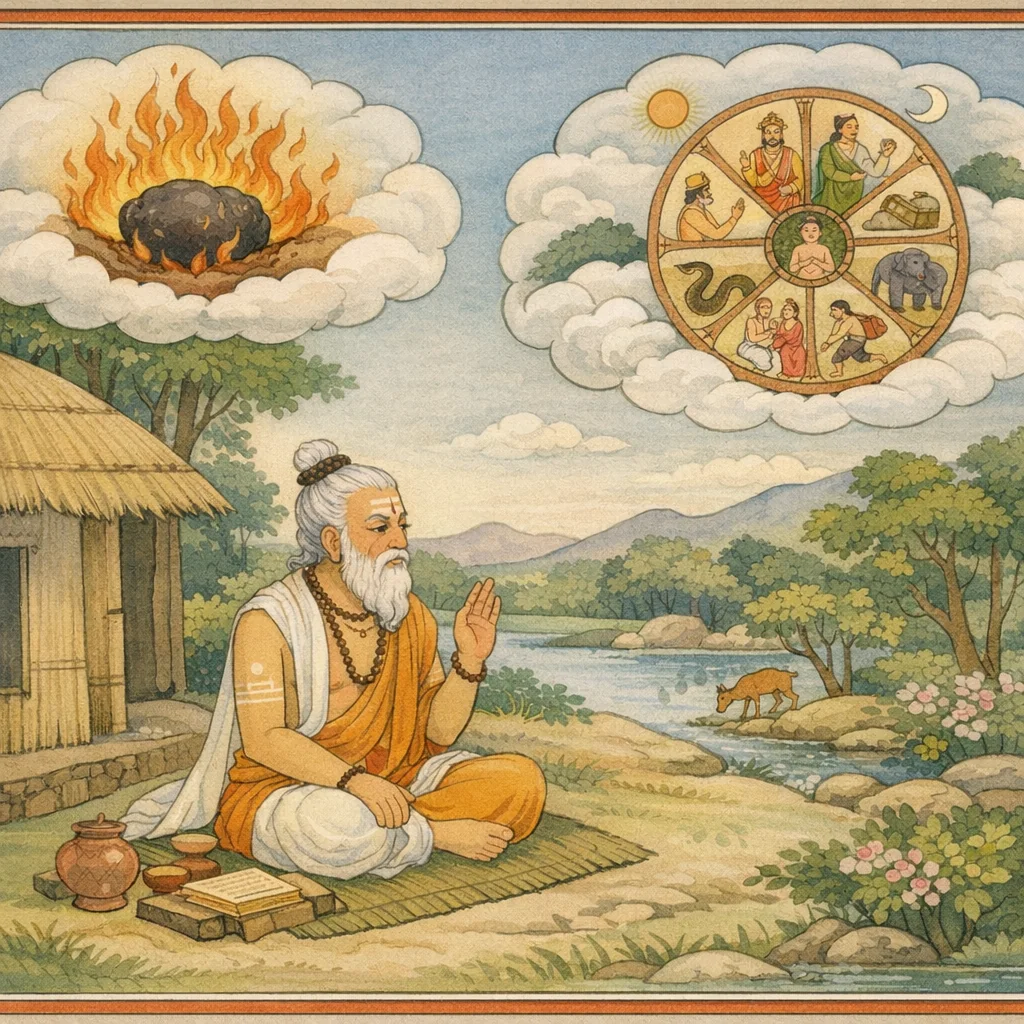
A Brahmin speaker argues that neither auspicious nor inauspicious actions are destroyed; their results mature repeatedly across “fields” (kṣetra), i.e., successive embodiments. Merit and demerit are intensified by the purity or impurity of intention (śuddha/pāpa manas), with mind presented as the proximate driver of action. The discourse then shifts to embryology in a doctrinal register: mixed semen and blood reach the womb, and the being attains a karmically appropriate “field”; consciousness/jīva enters and organizes the embryo, illustrated through analogies (molten metal taking form, fire pervading iron, a lamp illuminating a dwelling). The speaker reiterates inevitability of experiencing prior-body karma, followed by accumulation and depletion until one comprehends mokṣa-oriented dharma. A prescriptive catalog follows—charity, vows, brahmacarya, restraint, calmness, compassion, non-cruelty, non-theft, truthfulness, service to parents, honoring deities and guests, teacher-veneration, cleanliness, and sense-control—culminating in the claim that ācāra reveals dharma and that alignment with sanātana-dharma prevents “durgati.” The chapter concludes by distinguishing the yogin/liberated type and introducing a further cosmological account (Brahmā’s creation, pradhāna, kṣara/akṣara) and the contemplative insight that enables crossing saṃsāra.
Chapter Arc: एक ब्राह्मण उपदेश-स्वर में जीव के गर्भ-प्रवेश का रहस्य खोलता है और कहता है कि शुभ-अशुभ कर्मों का फल इस लोक में अनिवार्य है—कोई भी उससे बच नहीं सकता। → वह बताता है कि जैसे फलने के समय वृक्ष बहुत फल देता है, वैसे ही शुद्ध मन से किया पुण्य विपुल फल देता है; और कलुषित मन से किया पाप भी बढ़कर फलित होता है—मन ही कर्म का अग्रदूत है। फिर वह जीव के गर्भ में प्रवेश की तीव्र, दाहक प्रक्रिया का दृष्टांत देता है—अग्नि जैसे लोहे में प्रवेश कर उसे तपाती है, वैसे ही जीव गर्भ में स्थित होकर देह-बंधन की तपन भोगता है। → उपदेश का शिखर तब आता है जब ब्राह्मण ‘सनातन धर्म’ को कर्म-आधारित, लोक-नियामक नियम के रूप में प्रतिष्ठित करता है: दान आदि सत्कर्मों में ही वह धर्म स्थित है; जो उसे अपनाता है, दुर्गति नहीं पाता। साथ ही वह संकेत करता है कि योगी/मुक्त पुरुष इस सामान्य बंधन-चक्र से भिन्न स्थिति को प्राप्त करता है। → अध्याय का निष्कर्ष वैराग्य और समदर्शन की ओर मुड़ता है: जन्म-मृत्यु-रोग से घिरे हुए भी जो पुरुष प्रधान-तत्त्व को जानकर समस्त चेतन प्राणियों में एक-सा चैतन्य देखता है, वह संसार से ऊबकर परम पद का मार्ग खोजता है—और ब्राह्मण उसके लिए ‘यथातथ्य’ उपदेश देने का वचन देता है। → ब्राह्मण कहता है—‘मैं अब उसका उपदेश बताऊँगा’—और आगे आने वाले अध्याय के लिए मुक्ति-मार्ग की विस्तृत शिक्षा का द्वार खोल देता है।
Shlokas
Verse 1
भीकम (2 अमान अष्टादशो< ध्याय: जीवके गर्भ-प्रवेश, आचार-धर्म, कर्म-फलकी अनिवार्यता तथा संसारसे तरनेके उपायका वर्णन ब्राह्मण उवाच शुभानामशुभानां च नेह नाशो<5स्ति कर्मणाम् । प्राप्य प्राप्पानुपच्यन्ते क्षेत्र क्षेत्र तथा तथा,सिद्ध ब्राह्मण बोले--काश्यप! इस लोकमें किये हुए शुभ और अशुभ कर्मोंका फल भोगे बिना नाश नहीं होता। वे कर्म वैसा-वैसा कर्मानुसार एकके बाद एक शरीर धारण कराकर अपना फल देते रहते हैं
The Brahmin said: “O Kāśyapa, in this world the deeds one has done—whether auspicious or inauspicious—do not perish without being experienced. Again and again they ripen, taking effect in one field after another, in just the corresponding ways.”
Verse 2
यथा प्रसूयमानस्तु फली दद्यात् फलं बहु । तथा स्याद् विपुलं पुण्यं शुद्धेन मनसा कृतम्,जैसे फल देनेवाला वृक्ष फलनेका समय आनेपर बहुत-से फल प्रदान करता है, उसी प्रकार शुद्ध हृदयसे किये हुए पुण्यका फल अधिक होता है
Just as a fruit-bearing tree, when it comes into season, yields abundant fruit, so too merit (puṇya) performed with a purified mind becomes exceedingly fruitful.
Verse 3
पापं चापि तथैव स्यात् पापेन मनसा कृतम् | पुरोधाय मनो हीदं कर्मण्यात्मा प्रवर्तते,इसी तरह कलुषित चित्तसे किये हुए पापके फलमें भी वृद्धि होती है; क्योंकि जीवात्मा मनको आगे करके ही प्रत्येक कार्यमें प्रवृत्त होता है
So too, sin committed with a sinful, tainted mind becomes intensified in its consequence; for in every action here, the self sets the mind in front and proceeds, making the mind the leader of the deed.
Verse 4
यथा कर्मसमाविष्ट: काममन्युसमावृतः । नरो गर्भ प्रविशति तच्चापि शृणु चोत्तरम्,काम-क्रोधसे घिरा हुआ मनुष्य जिस प्रकार कर्मजालमें आबद्ध होकर गर्भमें प्रवेश करता है, उसका भी उत्तर सुनो
The Brāhmaṇa said: “Just as a man, entangled in the momentum of his own deeds and veiled by desire and anger, enters the womb (to be born again), so too hear the further answer about this.”
Verse 5
शुक्रे शोणितसंसूष्टं स्त्रिया गर्भाशयं गतम् । क्षेत्र कर्मजमाप्रोति शुभं वा यदि वाशुभम्,जीव पहले पुरुषके वीर्यमें प्रविष्ट होता है, फिर स्त्रीके गर्भाशयमें जाकर उसके रजमें मिल जाता है। तत्पश्चात् उसे कर्मानुसार शुभ या अशुभ शरीरकी प्राप्ति होती है
The jīva first enters the man’s semen; then, reaching the woman’s womb, it mingles with her menstrual blood. Thereafter, according to its karma, it attains a body that is auspicious or inauspicious.
Verse 6
सौक्ष्म्यादव्यक्तभावाच्च न च क्वचन सज्जति | सम्प्राप्य ब्राह्मण: काम तस्मात् तद् ब्रह्म शाश्वतम्,जीव अपनी इच्छाके अनुसार उस शरीरमें प्रवेश करके सूक्ष्म और अव्यक्त होनेके कारण कहीं आसक्त नहीं होता है; क्योंकि वास्तवमें वह सनातन परब्रह्म-स्वरूप है
The jīva enters that body according to its own will; yet, being subtle and unmanifest, it clings nowhere. For in truth it is the eternal Brahman.
Verse 7
तद् बीजं सर्वभूतानां तेन जीवन्ति जन्तव: । स जीव: सर्वगात्राणि गर्भस्याविश्य भागश:,वह जीवात्मा सम्पूर्ण भूतोंकी स्थितिका हेतु है, क्योंकि उसीके द्वारा सब प्राणी जीवित रहते हैं। वह जीव गर्भके समस्त अंगमें प्रविष्ट हो उसके प्रत्येक अंशमें तत्काल चेतनता ला देता है और वही प्राणोंके स्थान--वक्षःस्थलमें स्थित हो समस्त अंगोंका संचालन करता है। तभी वह गर्भ चेतनासे सम्पन्न होता है
That is the seed of all beings; by it creatures live. Entering the embryo limb by limb, the jīva pervades every part and brings immediate sentience, becoming the inner cause by which the body is animated and sustained.
Verse 8
दधाति चेतसा सद्यः प्राणस्थानेष्ववस्थित: । ततः स्पन्दयतेड5ड्रानि स गर्भशक्षेतनान्वित:,वह जीवात्मा सम्पूर्ण भूतोंकी स्थितिका हेतु है, क्योंकि उसीके द्वारा सब प्राणी जीवित रहते हैं। वह जीव गर्भके समस्त अंगमें प्रविष्ट हो उसके प्रत्येक अंशमें तत्काल चेतनता ला देता है और वही प्राणोंके स्थान--वक्षःस्थलमें स्थित हो समस्त अंगोंका संचालन करता है। तभी वह गर्भ चेतनासे सम्पन्न होता है
The Brāhmaṇa said: “Abiding in the seats of the vital breaths (prāṇa), the indwelling self at once bestows consciousness by its own awareness. Thereafter it sets the limbs in motion; thus the embryo becomes endowed with sentience. For this living self is the cause of the complete functioning of beings, since through it all creatures remain alive; having entered every part of the embryo, it immediately awakens each portion with consciousness, and, stationed in the vital region (the chest), it governs the activity of all the limbs.”
Verse 9
यथा लोहस्य निःस्यन्दो निषिक्तो बिम्बविग्रहम् । उपैति तद् विजानीहि गर्भ जीवप्रवेशनम्,जैसे तपाये हुए लोहेका द्रव जैसे साँचेमें ढाला जाता है उसीका रूप धारण कर लेता है, उसी प्रकार गर्भमें जीवका प्रवेश होता है, ऐसा समझो (अर्थात् जीव जिस प्रकारकी योनिमें प्रविष्ट होता है, उसी रूपमें उसका शरीर बन जाता है)
The Brāhmaṇa said: “Just as the molten flow of iron, when poured into a mould, takes on the very form of that mould, so too should you understand the entry of the living being into the womb: according to the kind of womb it enters, a corresponding bodily form is fashioned.”
Verse 10
लोहपिण्डं यथा वल्रि: प्रविश्य हतितापयेत् । तथा त्वमपि जानीहि गर्भे जीवोपपादनम्,जैसे आग लोहपिण्डमें प्रविष्ट होकर उसे बहुत तपा देती है, उसी प्रकार गर्भमें जीवका प्रवेश होता है और वह उसमें चेतनता ला देता है। इस बातको तुम अच्छी तरह समझ लो
As fire, entering a lump of iron, heats it with fierce intensity, so understand this: when the living self enters the womb, it establishes life there and brings sentience to what was inert. Grasp this clearly.
Verse 11
यथा च दीप: शरणे दीप्यमान: प्रकाशते । एवमेव शरीराणि प्रकाशयति चेतना,जिस प्रकार जलता हुआ दीपक समूचे घरमें प्रकाश फैलाता है, उसी प्रकार जीवकी चैतन्य शक्ति शरीरके सब अवयवोंको प्रकाशित करती है
As a lamp, when kindled within a house, illumines the whole interior, so consciousness—the living principle—illumines the body, making all its limbs and functions manifest and operative. This teaching declares that the body’s activity and awareness depend upon an inner sentience, not upon inert matter alone.
Verse 12
यद् यच्च कुरुते कर्म शुभं वा यदि वाशुभम् | पूर्वदेहकृतं सर्वमवश्यमुपभुज्यते,मनुष्य शुभ अथवा अशुभ जो-जो कर्म करता है, पूर्व-जन्मके शरीरसे किये गये उन सब कर्मोंका फल उसे अवश्य भोगना पड़ता है
The Brahmin said: Whatever action a person performs—whether auspicious or inauspicious—he must inevitably experience its result, for all of it was done by him in a former embodiment. The verse proclaims moral causality: present experience is not chance, but the ripening of prior deeds, urging restraint and responsibility.
Verse 13
ततस्तु क्षीयते चैव पुनश्चान्यत् प्रचीयते । यावत् तन्मोक्षयोगस्थं धर्म नैवावबुध्यते,उपभोगसे प्राचीन कर्मका तो क्षय होता है और फिर दूसरे नये-नये कर्मोका संचय बढ़ जाता है। जबतक मोक्षकी प्राप्तिमें सहायक धर्मका उसे ज्ञान नहीं होता, तबतक यह कर्मोकी परम्परा नहीं टूटती है
Then, as one continues to indulge in experience, the store of earlier deeds is indeed exhausted, yet another stock of fresh deeds is accumulated again. So long as one does not truly understand the dharma that abides in the discipline of liberation (mokṣa-yoga), this succession of karma does not come to an end.
Verse 14
तत्र कर्म प्रवक्ष्यामि सुखी भवति येन वै | आवर्तमानो जातीषु यथान्योन्यासु सत्तम,साधुशिरोमणे! इस प्रकार भिन्न-भिन्न योनियोंमें भ्रमण करनेवाला जीव जिनके अनुष्ठानसे सुखी होता है, उन कर्मोका वर्णन सुनो
Now I shall declare those deeds by which one truly becomes happy. O best of the good, O crest-jewel among the virtuous: as the embodied self keeps revolving through various births, passing from one form of life to another, listen to the actions whose observance brings well-being amid this wandering.
Verse 15
दानं व्रतं ब्रह्मचर्य यथोक्तं ब्रह्मुधारणम् । दम: प्रशान्तता चैव भूतानां चानुकम्पनम्,दान, व्रत, ब्रह्मचर्य, शास्त्रोक्त रीतिसे वेदाध्ययन, इन्द्रियनिग्रह, शान्ति, समस्त प्राणियोंपर दया, चित्तका संयम, कोमलता, दूसरोंके धन लेनेकी इच्छाका त्याग, संसारके प्राणियोंका मनसे भी अहित न करना, माता-पिताकी सेवा, देवता, अतिथि और गुरुओंकी पूजा, दया, पवित्रता, इन्द्रियोंको सदा काबूमें रखना तथा शुभ कर्मोंका प्रचार करना--यह सब श्रेष्ठ पुरुषोंका बर्ताव कहलाता है। इनके अनुष्ठानसे धर्म होता है, जो सदा प्रजावर्गकी रक्षा करता है
The Brāhmaṇa said: “Charity, the observance of vows, celibate discipline, and the upholding of sacred knowledge as prescribed; self-restraint, inner calm, and compassion toward all living beings—these constitute the conduct of the truly excellent. By practicing such disciplines, dharma is established, and dharma, in turn, continually protects and sustains the people.”
Verse 16
संयमाश्चानृशंस्यं च परस्वादानवर्जनम् व्यलीकानामकरणं भूतानां मनसा भुवि,दान, व्रत, ब्रह्मचर्य, शास्त्रोक्त रीतिसे वेदाध्ययन, इन्द्रियनिग्रह, शान्ति, समस्त प्राणियोंपर दया, चित्तका संयम, कोमलता, दूसरोंके धन लेनेकी इच्छाका त्याग, संसारके प्राणियोंका मनसे भी अहित न करना, माता-पिताकी सेवा, देवता, अतिथि और गुरुओंकी पूजा, दया, पवित्रता, इन्द्रियोंको सदा काबूमें रखना तथा शुभ कर्मोंका प्रचार करना--यह सब श्रेष्ठ पुरुषोंका बर्ताव कहलाता है। इनके अनुष्ठानसे धर्म होता है, जो सदा प्रजावर्गकी रक्षा करता है
The brāhmaṇa said: “Self-restraint and non-cruelty; refraining from taking what belongs to others; not engaging in deceit; and not harming any living being even in thought while dwelling on earth—along with charity, vows, celibate discipline, Veda-study according to scriptural rule, control of the senses, inner peace, compassion toward all creatures, mastery of the mind, gentleness, renouncing the desire to seize another’s wealth, serving one’s mother and father, honoring the gods, guests, and teachers, maintaining purity, keeping the senses continually subdued, and promoting auspicious conduct—this is called the way of the noble. By practicing these, dharma arises, and that dharma ever protects the community of subjects.”
Verse 17
इस प्रकार श्रीमहाभारत आश्वमेधिकपर्वके अन्तर्गत अनुगीतापर्वमें सत्रहवाँ अध्याय पूरा हुआ,मातापित्रोश्व शुश्रूषा देवतातिथिपूजनम् । गुरुपूजा घृणा शौचं नित्यमिन्द्रियसंयम: दान, व्रत, ब्रह्मचर्य, शास्त्रोक्त रीतिसे वेदाध्ययन, इन्द्रियनिग्रह, शान्ति, समस्त प्राणियोंपर दया, चित्तका संयम, कोमलता, दूसरोंके धन लेनेकी इच्छाका त्याग, संसारके प्राणियोंका मनसे भी अहित न करना, माता-पिताकी सेवा, देवता, अतिथि और गुरुओंकी पूजा, दया, पवित्रता, इन्द्रियोंको सदा काबूमें रखना तथा शुभ कर्मोंका प्रचार करना--यह सब श्रेष्ठ पुरुषोंका बर्ताव कहलाता है। इनके अनुष्ठानसे धर्म होता है, जो सदा प्रजावर्गकी रक्षा करता है
The Siddha declares that the conduct of the truly noble consists in a disciplined life of service and restraint: attending upon one’s mother and father, honoring the gods and guests, revering the teacher, maintaining compassion and purity, and keeping the senses continually under control. Along with these are charity, vows, celibate self-restraint, study of the Veda according to scriptural method, inner peace, kindness toward all beings, mastery of the mind, gentleness, renouncing any desire for another’s wealth, and not harming any creature even in thought—together with encouraging the spread of wholesome deeds. By practicing these observances, dharma arises; and that dharma, in turn, ever protects the community of subjects.
Verse 18
प्रवर्तनं शुभानां च तत् सतां वृत्तमुच्यते । ततो धर्म: प्रभवति य: प्रजा: पाति शाश्वती:,दान, व्रत, ब्रह्मचर्य, शास्त्रोक्त रीतिसे वेदाध्ययन, इन्द्रियनिग्रह, शान्ति, समस्त प्राणियोंपर दया, चित्तका संयम, कोमलता, दूसरोंके धन लेनेकी इच्छाका त्याग, संसारके प्राणियोंका मनसे भी अहित न करना, माता-पिताकी सेवा, देवता, अतिथि और गुरुओंकी पूजा, दया, पवित्रता, इन्द्रियोंको सदा काबूमें रखना तथा शुभ कर्मोंका प्रचार करना--यह सब श्रेष्ठ पुरुषोंका बर्ताव कहलाता है। इनके अनुष्ठानसे धर्म होता है, जो सदा प्रजावर्गकी रक्षा करता है इति श्रीमहा भारते आश्वमेधिके पर्वणि अनुगीतापर्वणि अष्टादशोडध्याय:
The promotion and active encouragement of what is good—this is said to be the conduct of the virtuous. From such conduct arises dharma, the enduring principle that continually protects and sustains living beings and society. In this context, the Brahmin explains that dharma is generated and strengthened by disciplined, compassionate, and scripturally guided living—such as generosity, vows, celibate self-restraint, study of the Veda, control of the senses, inner peace, kindness to all creatures, purity, service to parents, and reverence toward gods, guests, and teachers—together forming the exemplary way of the noble.
Verse 19
एवं सत्सु सदा पश्येत् तत्राप्येषा ध्रुवा स्थिति: । आचारो धर्ममाचष्टे यस्मिन् शान्ता व्यवस्थिता:,सत्पुरुषोंमें सदा ही इस प्रकारका धार्मिक आचरण देखा जाता है। उन्हींमें धर्मकी अटल स्थिति होती है। सदाचार ही धर्मका परिचय देता है। शान्तचित्त महात्मा पुरुष सदाचारमें ही स्थित रहते हैं
Thus, among the truly good one should always observe this: even there, this is the steadfast condition—right conduct reveals what dharma is. The tranquil-minded noble persons remain established in such good conduct, and in them dharma stands firm and unshaken.
Verse 20
तेषु तत् कर्म निक्षिप्तं यः स धर्म: सनातन: । यस्तं समभिपद्येत न स दुर्गतिमाप्रुयात्,उन्हींमें पूर्वोक्त दान आदि कर्मोकी स्थिति है। वे ही कर्म सनातन धर्मके नामसे प्रसिद्ध हैं। जो उस सनातन धर्मका आश्रय लेता है, उसे कभी दुर्गति नहीं भोगनी पड़ती है
Among those virtues and disciplines rests the practice of the deeds spoken of earlier—such as giving. That established course of action is known as the eternal Dharma. Whoever truly takes refuge in that eternal Dharma does not fall into misfortune or a degraded end.
Verse 21
अतो नियम्यते लोक: प्रच्यवन् धर्मवर्त्मसु । यश्च योगी च मुक्तश्चन स एतेभ्यो विशिष्यते,इसीलिये धर्ममार्गसे भ्रष्ट होनेवाले लोगोंका नियन्त्रण किया जाता है। जो योगी और मुक्त है, वह अन्य धर्मात्माओंकी अपेक्षा श्रेष्ठ होता है
Therefore society restrains those who slip away from the pathways of dharma. As for one who is a yogin and also liberated, he is not to be ranked merely among ordinary righteous men—he stands apart by virtue of inner freedom and realized discipline.
Verse 22
वर्तमानस्य धर्मेण शुभं यत्र यथा तथा । संसारतारणं हास्य कालेन महता भवेत्
The Brahmin said: “By adhering to the duty appropriate to one’s present condition, one should pursue what is auspicious—wherever and however it is rightly possible. In time, and over a long course, this becomes a means of crossing beyond worldly existence.”
Verse 23
जो धर्मके अनुसार बर्ताव करता है, वह जहाँ जिस अवस्थामें हो, वहाँ उसी स्थितिमें उसको अपने कर्मानुसार उत्तम फलकी प्राप्ति होती है और वह धीरे-धीरे अधिक काल बीतनेपर संसार-सागरसे तर जाता है ।। एवं पूर्वकृतं कर्म नित्यं जन्तु: प्रपद्यते । सर्व तत्कारणं येन विकृतोडयमिहागत:,इस प्रकार जीव सदा अपने पूर्वजन्मोंमें किये हुए कर्मॉंका फल भोगता है। यह आत्मा निर्विकार ब्रह्म होनेपर भी विकृत होकर इस जगत्में जो जन्म धारण करता है, उसमें कर्म ही कारण है
One who acts in accordance with dharma, wherever he may be and in whatever condition, receives in that very station the finest result according to his deeds; and gradually, as long time passes, he crosses the ocean of worldly existence. Thus the living being continually encounters the consequences of actions performed in the past. Indeed, it is karma that stands as the cause by which this self—though in truth the changeless Brahman—appears altered and comes to take birth here in the world, undergoing experience according to its deeds.
Verse 24
शरीरग्रहणं चास्य केन पूर्व प्रकल्पितम् । इत्येवं संशयो लोके तच्च वक्ष्याम्पत: परम्,आत्माके शरीर धारण करनेकी प्रथा सबसे पहले किसने चलायी है, इस प्रकारका संदेह प्रायः लोगोंके मनमें उठा करता है, अतः उसीका उत्तर दे रहा हूँ
“And by whom was this practice first instituted—of the Self taking up a body? Such a doubt commonly arises in the world. Therefore I shall now state the answer to it in due order.”
Verse 25
शरीरमात्मन: कृत्वा सर्वलोकपितामह: । त्रैलोक्यमसृजद् ब्रह्मा कृत्स्नं स्थावरजड्रमम्,सम्पूर्ण जगत॒के पितामह ब्रह्माजीने सबसे पहले स्वयं ही शरीर धारण करके स्थावर- जंगमरूप समस्त त्रिलोकीकी (कर्मानुसार) रचना की
The Brāhmaṇa said: “Having first assumed a body for himself, Brahmā—the grandsire of all worlds—brought forth the entire threefold universe, complete with everything immobile and mobile.”
Verse 26
ततः प्रधानमसृजत् प्रकृतिं स शरीरिणाम् | यया सर्वमिदं व्याप्तं यां लोके परमां विदु:,उन्होंने प्रधान नामक तत्त्वकी उत्पत्ति की, जो देहधारी जीवोंकी प्रकृति कहलाती है। जिसने इस सम्पूर्ण जगत्को व्याप्त कर रखा है तथा लोकमें जिसे मूल प्रकृतिके नामसे जानते हैं
Then he created the Pradhāna, the Prakṛti of embodied beings, by which all this is pervaded; and in the world it is known as the supreme, primordial Nature.
Verse 27
इदं तत्क्षरमित्युक्त परं त्वमृतमक्षरम् | त्रयाणां मिथुनं सर्वमेकेकस्य पृथक् पृथक्
The Brahmin said: “This is called the perishable (kṣara); but beyond it is the imperishable, deathless (akṣara). All that exists is a pairing among the three, and yet each of them also stands distinct, each in its own separate nature.”
Verse 28
यह प्राकृत जगत् क्षर कहलाता है, इससे भिन्न अविनाशी जीवात्माको अक्षर कहते हैं। (इनसे विलक्षण शुद्ध परब्रह्म हैं)--इन तीनोंमेंसे जो दो तत्त्व--क्षर और अक्षर हैं, वे सब प्रत्येक जीवके लिये पृथक्-पृथक होते हैं ।। असृजत् सर्वभूतानि पूर्वदृष्ट: प्रजापति: । स्थावराणि च भूतानि इत्येषा पौर्विकी श्रुति:,श्रुतिमें जो सृष्टिके आरम्भमें सत्रूपसे निर्दिष्ट हुए हैं, उन प्रजापतिने समस्त स्थावर भूतों और जंगम प्राणियोंकी सृष्टि की है, यह पुरातन श्रुति है
The Brahmin said: “This manifest, material world is called the perishable (kṣara). Distinct from it, the imperishable individual self is called the imperishable (akṣara). Beyond both stands the pure Supreme Brahman, different in kind from them. Of these two principles—perishable and imperishable—each living being relates to them in its own distinct way. Thus the ancient Vedic tradition declares: ‘The Creator, Prajāpati, foreseeing the primordial order, brought forth all beings—both the immobile and the moving.’”
Verse 29
तस्य कालपरीमाणमकरोत् स पितामह: । भूतेषु परिवृत्तिं च पुनरावृत्तिमेव च,पितामहने जीवके लिये नियत समयतक शरीर धारण किये रहनेकी, भिन्न-भिन्न योनियोंमें भ्रमण करनेकी और परलोकसे लौटकर फिर इस लोकमें जन्म लेने आदिकी भी व्यवस्था की है
For that embodied being, the Grandsire (the Creator) fixed the measure of time—how long one should bear a body—and also ordained the turning about among living forms, and indeed the return again: coming back from the other world to be born once more here.
Verse 30
यथात्र कश्रिन्मेधावी दृष्टात्मा पूर्वजन्मनि । यत् प्रवक्ष्यामि तत् सर्व यथावदुपपद्यते,जिसने पूर्वजन्ममें अपने आत्माका साक्षात्कार कर लिया हो, ऐसा कोई मेधावी अधिकारी पुरुष संसारकी अनित्यताके विषयमें जैसी बात कह सकता है, वैसी ही मैं भी कहूँगा। मेरी कही हुई सारी बातें यथार्थ और संगत होंगी
Just as a wise man—one who realized the Self in a former birth—might speak here of the world’s impermanent nature, so too will I speak. Whatever I am about to declare will be wholly sound, coherent, and in accordance with reason.
Verse 31
सुखदु:खे यथा सम्यगनित्ये य: प्रपश्यति । कायं चामेध्यसंघातं विनाशं कर्मसंहितम्,जो मनुष्य सुख और दु:ख दोनोंको अनित्य समझता है, शरीरको अपवित्र वस्तुओंका समूह समझता है और मृत्युको कर्मका फल समझता है तथा सुखके रूपमें प्रतीत होनेवाला जो कुछ भी है वह सब दुःख-ही-दुःख है, ऐसा मानता है, वह घोर एवं दुस्तर संसार-सागरसे पार हो जायगा
The brāhmaṇa said: Whoever clearly sees pleasure and pain as truly impermanent, regards the body as a heap of impure constituents, and understands death as the outcome shaped by one’s deeds—such a person loosens attachment to worldly appearances and becomes capable of crossing the dreadful, hard-to-cross ocean of saṃsāra.
Verse 32
यच्च किंचित्सुखं तच्च दुःखं सर्वमिति स्मरन् | संसारसागरं घोरं तरिष्यति सुदुस्तरम्,जो मनुष्य सुख और दु:ख दोनोंको अनित्य समझता है, शरीरको अपवित्र वस्तुओंका समूह समझता है और मृत्युको कर्मका फल समझता है तथा सुखके रूपमें प्रतीत होनेवाला जो कुछ भी है वह सब दुःख-ही-दुःख है, ऐसा मानता है, वह घोर एवं दुस्तर संसार-सागरसे पार हो जायगा
The brāhmaṇa said: “Remembering that whatever appears as pleasure is, in truth, entirely suffering, a person will cross the terrifying, hard-to-cross ocean of worldly existence.”
Verse 33
जातीमरणरोगैश्व समाविष्ट: प्रधानवित् | चेतनावत्सु चैतन्यं सम॑ भूतेषु पश्यति
The Brāhmaṇa said: Though beings are beset by birth, death, and disease, the knower of the Pradhāna (the fundamental principle of nature) perceives the same consciousness present in all conscious creatures, seeing an equal inner awareness across all beings.
Verse 34
निर्विद्यते ततः कृत्स्नं मार्गमाण: परं पदम् | तस्योपदेशं वक्ष्यामि याथातथ्येन सत्तम
Then, becoming disenchanted with the whole of worldly pursuit, he seeks the supreme state. O best of the virtuous, I shall now declare to you the instruction for that—truthfully, exactly as it is.
Verse 35
जन्म, मृत्यु एवं रोगोंसे घिरा हुआ जो पुरुष प्रधान तत्त्व (प्रकृति)-को जानता है और समस्त चेतन प्राणियोंमें चैतन्यको समानरूपसे व्याप्त देखता है, वह पूर्ण परमपदके अनुसंधानमें संलग्न हो जगत्के भोगोंसे विरक्त हो जाता है। साधुशिरोमणे! उस वैराग्यवान् पुरुषके लिये जो हितकर उपदेश है, उसका मैं यथार्थरूपसे वर्णन करूँगा ।। शाश्वतस्याव्ययस्याथ यदस्य ज्ञानमुत्तमम् । प्रोच्यमानं मया विप्र निबोधेदमशेषत:,उसके लिये जो सनातन अविनाशी परमात्माका उत्तम ज्ञान अभीष्ट है, उसका मैं वर्णन करता हूँ। विप्रवर! तुम सारी बातोंको ध्यान देकर सुनो
The Brahmin said: A man hemmed in by birth, death, and disease—who understands the primal principle (Prakriti) and perceives the same consciousness pervading all living beings alike—becomes intent on the quest for the supreme, perfect state and grows detached from the enjoyments of the world. O foremost among the virtuous, I shall now state truthfully the beneficial instruction meant for that man of renunciation. Now I will expound the highest knowledge of the eternal, imperishable Supreme Self; O best of Brahmins, listen to this in full attention, without omission.
Frequently Asked Questions
It asserts that śubha and aśubha karmas do not perish; their fruits mature repeatedly across appropriate “fields” (kṣetra), implying continuity across lives and inevitability of experiencing prior actions.
Dharma is operationalized as disciplined conduct—charity, restraint, compassion, service, purity, and sense-control—with ācāra (the settled practice of ethical exemplars) presented as a reliable indicator of sanātana-dharma.
Yes; it frames karmic cycling as continuing until one understands mokṣa-yoga-oriented dharma, and it marks the yogin/liberated person as distinct, introducing cosmological categories (kṣara/akṣara, pradhāna, Brahmā’s creation) to support that trajectory.