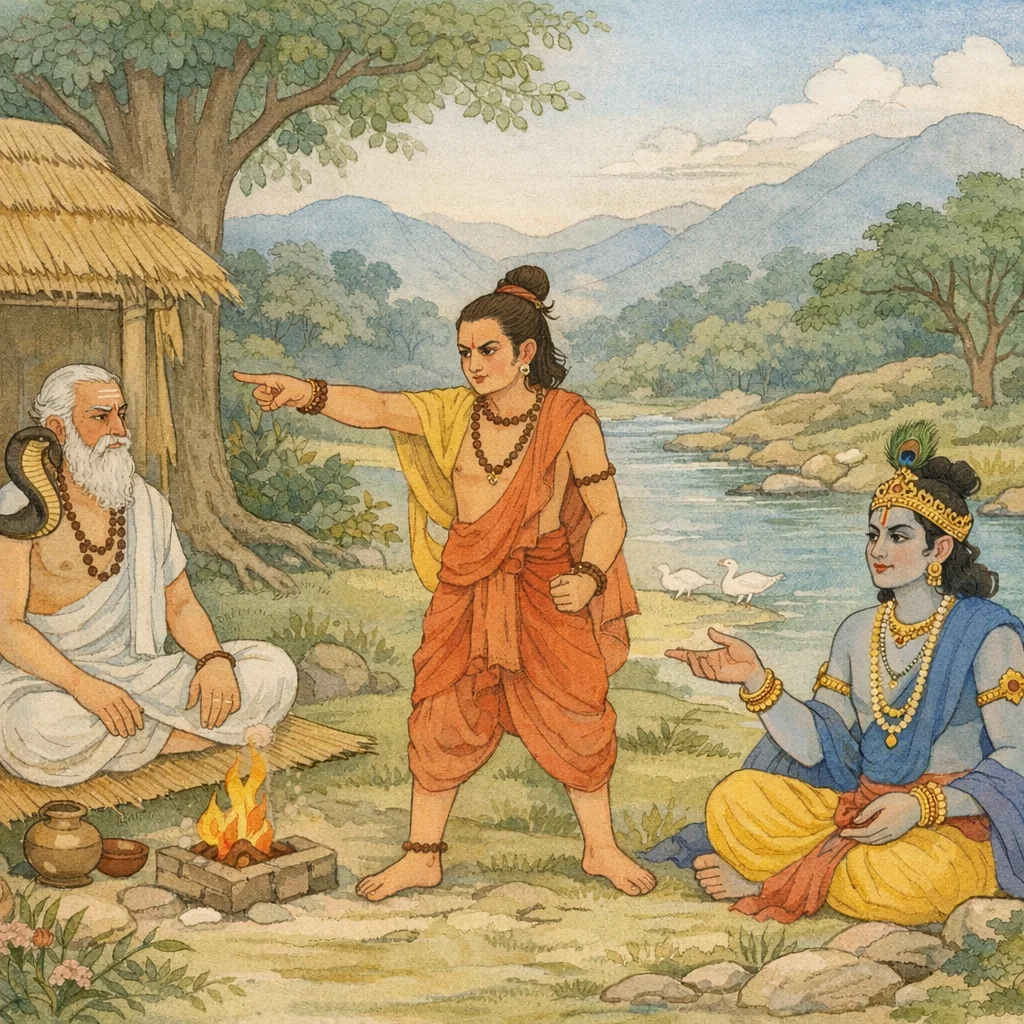
Adhyaya 41
Jaradkāru Encounters the Pitṛs (Jaratkāru-Pitṛdarśana)
Upa-parva: Jaratkāru-Upākhyāna (Episode of Jaratkāru and the Pitṛs)
Sauti narrates that the ascetic Jaratkāru, practicing a severe wandering discipline and visiting sacred fords, subsists with extreme restraint. He witnesses pitṛs suspended upside down in a pit, clinging to a single remaining fiber/root associated with a vīraṇa plant; a rat steadily gnaws at it. Moved by compassion, Jaratkāru questions their identity and offers to rescue them by transferring the merit of his austerities, partially or wholly. The pitṛs decline, explaining that austerity cannot remedy their condition: they have fallen due to saṃtāna-prakṣaya (loss/exhaustion of descendants). They identify Jaratkāru—learned, disciplined, yet without wife or child—as the last remaining ‘thread’ of their lineage. The rat is allegorized as Kāla (Time), eroding the remaining support. They instruct the messenger to tell Jaratkāru to take a wife and beget offspring, asserting that continuity of progeny surpasses other purificatory acts for sustaining ancestral welfare and preventing further descent.
Chapter Arc: वन-आश्रम की शान्ति में एक अशुभ समाचार उतरता है—कृश, शृंगी को बताता है कि राजा परीक्षित् शिकार के पीछे दौड़ते हुए उसके पिता शमीक के आश्रम तक आया और अपमानजनक कृत्य कर गया। → कृश के वर्णन से शृंगी के भीतर बाल-क्रोध भड़क उठता है; वह तपस्वी कुल की मर्यादा भूलकर प्रतिशोध को ही न्याय मानने लगता है। शमीक को कंधे पर मृत सर्प (राजा द्वारा रखा गया) सहित देखकर उसका रोष और तीव्र हो जाता है। → क्रोध-वेग से आविष्ट शृंगी आचमन कर तेजस्वी वाणी से राजा परीक्षित् को शाप देता है—राजा का अंत निकट निश्चित कर देता है। → शमीक शाप सुनकर पुत्र को रोकता/डाँटता है और कहता है कि राजा ने पूर्व में धर्मतः रक्षा की है; ऐसे राजा को बालक द्वारा शाप देना अनुचित है। वह शृंगी के आवेग को ‘दुष्कृत’ बताकर शाप-प्रवृत्ति की निन्दा करता है। → शाप उच्चरित हो चुका है—अब प्रश्न यह रह जाता है कि अपरिवर्तनीय वचन का फल राजा पर कैसे और कब घटेगा, और यह घटना आगे जनमेजय के सर्पयज्ञ तक कैसे पहुँचेगी।
Shlokas
Verse 1
अपन काल बा | अ-#-#कत एकचत्वारिशो< ध्याय: शृंगी ऋषिका राजा परीक्षित्को शाप देना और शमीकका अपने पुत्रको शान्त करते हुए शापको अनुचित बताना सौतिर्वाच एवमुक्त: स तेजस्वी शृज्धी कोपसमन्वित: । मृतधारं गुरु श्रुत्वा पर्यतप्पत मन्युना,उग्रश्रवाजी कहते हैं--शौनकजी! कृशके ऐसा कहनेपर तेजस्वी शृंगी ऋषिको बड़ा क्रोध हुआ। अपने पिताके कंधेपर मृतक (सर्प) रखे जानेकी बात सुनकर वह रोष और शोकसे संतप्त हो उठा
Sauti said: When Kr̥śa had spoken thus, the radiant sage Śṛṅgī, seized by anger, was inflamed with indignation. Hearing that his revered father had been burdened with a dead creature (placed upon his shoulder), he burned with wrath—his mind agitated by grief and outrage.
Verse 2
स तं कृशमभिप्रेक्ष्य सूनृतां वाचमुत्सूजन् । अपृच्छत् तं कथं तात: स मे5द्य मृतथारक:,उसने कृशकी ओर देखकर मधुर वाणीमें पूछा--'भैया! बताओ तो, आज मेरे पिता अपने कंधेपर मृतक कैसे धारण कर रहे हैं?
Seeing Kṛśa, he addressed him in gentle, truthful words and asked: “Brother, tell me—how is it that my father today is bearing a dead body upon his shoulder?”
Verse 3
कृश उवाच राज्ञा परिक्षिता तात मृगयां परिधावता । अवसक्तः पितुस्तेड्द्य मृत: स्कन्धे भुजड्रम:,कृशने कहा--तात! आज राजा परीक्षित् अपने शिकारके पीछे दौड़ते हुए आये थे। उन्होंने तुम्हारे पिताके कंधेपर मृतक साँप रख दिया है
Kṛśa said: “Dear child, today King Parīkṣit, while running about in pursuit of the hunt, has fastened a dead snake upon your father’s shoulder.”
Verse 4
शुंग्युवाच किं मे पित्रा कृतं तस्य राज्ञोअनिष्टं दुरात्मन: । ब्रूहि तत् कृश तत्त्वेन पश्य मे तपसो बलम्,शृंगी बोला--कृश! ठीक-ठीक बताओ. मेरे पिताने उस दुरात्मा राजाका क्या अपराध किया था? फिर मेरी तपस्याका बल देखना
Śṛṅgī said: “What wrong did my father do to that wicked king—what offense that displeased him? Tell me the truth, Kṛśa. Then you shall witness the power of my austerities.”
Verse 5
कृश उवाच स राजा मृगयां यात: परिक्षिदभिमन्युज: । ससार मृगमेकाकी विद्ध्वा बाणेन शीघ्रगम्,कृशने कहा--अभिमम्युपुत्र राजा परीक्षित् अकेले शिकार खेलने आये थे। उन्होंने एक शीघ्रगामी हिंसक मृग (पशु)-को बाणसे बींध डाला; किंतु उस विशाल वनमें विचरते हुए राजाको वह मृग कहीं दिखायी न दिया। फिर उन्होंने तुम्हारे मौनी पिताको देखकर उसके विषयमें पूछा
Kṛśa said: King Parīkṣit, the son of Abhimanyu, once went out hunting. Alone, he pursued a swift-moving deer and struck it with an arrow; yet as he roamed through that vast forest, the wounded animal could not be seen. Then, seeing your silent, vow-observing father, the king asked him about it.
Verse 6
न चापश्यन्मृगं राजा चरंस्तस्मिन् महावने । पितरं ते स दृष्टवैव पप्रच्छानभि भाषिणम्,कृशने कहा--अभिमम्युपुत्र राजा परीक्षित् अकेले शिकार खेलने आये थे। उन्होंने एक शीघ्रगामी हिंसक मृग (पशु)-को बाणसे बींध डाला; किंतु उस विशाल वनमें विचरते हुए राजाको वह मृग कहीं दिखायी न दिया। फिर उन्होंने तुम्हारे मौनी पिताको देखकर उसके विषयमें पूछा
As the king wandered through that vast forest, he did not see the deer. Then, on noticing your father—who was observing silence—he questioned him. The episode frames a moral tension: a ruler’s urgency and frustration in the hunt meets the discipline of a sage’s vow of silence, setting the stage for an ethical lapse born of impatience.
Verse 7
त॑ स्थाणुभूतं तिष्ठन्तं क्षुत्पिपासाश्रमातुर: । पुनः पुनर्मगं नष्ट पप्रच्छ पितरं तव,राजा भूख-प्यास और थकावटसे व्याकुल थे। इधर तुम्हारे पिता काठकी भाँति अविचल भावसे बैठे थे। राजाने बार-बार तुम्हारे पितासे उस भागे हुए मृगके विषयमें प्रश्न किया, परंतु मौन-व्रतावलम्बी होनेके कारण उन्होंने कुछ उत्तर नहीं दिया। तब राजाने धनुषकी नोकसे एक मरा हुआ साँप उठाकर उनके कंधेपर डाल दिया
Tormented by hunger, thirst, and fatigue, the king repeatedly questioned your father about the deer that had fled and been lost. But your father, remaining motionless like a post and bound by silence, gave no reply. This scene sets the ethical tension: a ruler, driven by bodily distress and frustration, confronts an ascetic’s vow of restraint—an encounter that will soon turn from impatience to wrongdoing.
Verse 8
स च मौनव्रतोपेतो नैव तं॑ प्रत्यभाषत । तस्य राजा धनुष्कोट्या सर्प स्कन्धे समासजत्,राजा भूख-प्यास और थकावटसे व्याकुल थे। इधर तुम्हारे पिता काठकी भाँति अविचल भावसे बैठे थे। राजाने बार-बार तुम्हारे पितासे उस भागे हुए मृगके विषयमें प्रश्न किया, परंतु मौन-व्रतावलम्बी होनेके कारण उन्होंने कुछ उत्तर नहीं दिया। तब राजाने धनुषकी नोकसे एक मरा हुआ साँप उठाकर उनके कंधेपर डाल दिया
And he, observing a vow of silence, did not reply to him at all. Then the king, with the tip of his bow, lifted a dead snake and placed it upon the sage’s shoulder. The episode highlights how a ruler’s fatigue and frustration can cloud judgment, and how a rigid observance of a vow—when it withholds timely guidance—may provoke harm and set in motion grave consequences.
Verse 9
शड्विंस्तव पिता सो5पि तथैवास्ते यतव्रत: । सो<पि राजा स्वनगरं प्रस्थितो गजसाह्दयम्,शंंगिन! संयमपूर्वक व्रतका पालन करनेवाले तुम्हारे पिता अभी उसी अवस्थामें बैठे हैं और वे राजा परीक्षित् अपनी राजधानी हस्तिनापुरको चले गये हैं
“Your father too—now in his twenty-sixth year—remains seated in the same disciplined state, steadfast in his vow. And the king as well has departed for his own city, Hastināpura, O bearer of the bow, having a heart as mighty as an elephant.”
Verse 10
सौतिर्वाच श्र॒त्वैवमृषिपुत्रस्तु शवं कन्धे प्रतिक्ठितम् कोपसंरक्तनयन: प्रज्वलन्निव मन्युना,उग्रश्रवाजी कहते हैं--शौनकजी! इस प्रकार अपने पिताके कंधेपर मृतक सर्पके रखे जानेका समाचार सुनकर ऋषिकुमार शंगी क्रोधसे जल उठा। कोपसे उसकी आँखें लाल हो गयीं
Sauti said: “O Śaunaka, on hearing that his father had been made to bear a dead serpent upon his shoulder, the sage’s son Śṛṅgin blazed up in anger. His eyes reddened with wrath, as though he were aflame with indignation.”
Verse 11
आविष्ट: स हि कोपेन शशाप नृपतिं तदा । वार्युपस्पृश्य तेजस्वी क्रोधवेगबलात्कृत:,वह तेजस्वी बालक रोषके आवेशमें आकर प्रचण्ड क्रोधके वेगसे युक्त हो गया था। उसने जलसे आचमन करके हाथमें जल लेकर उस समय राजा परीक्षितको इस प्रकार शाप दिया
Overpowered by anger, the radiant boy then pronounced a curse upon the king. Having first ritually sipped water, he took water in his hand and—driven by the force and momentum of wrath—uttered the imprecation against King Parīkṣit.
Verse 12
शुंग्युवाच योडसौ वृद्धस्य तातस्य तथा कृच्छुगतस्य ह । स्कन्धे मृतं समास्राक्षीत् पन्नगं राजकिल्बिषी,शृंगी बोला--जिस पापात्मा नरेशने वैसे धर्म-संकटमें पड़े हुए मेरे बूढ़े पिताके कंधेपर मरा साँप रख दिया है, ब्राह्मगोंका अपमान करनेवाले उस कुरुकुलकलंक पापी परीक्षित्को आजसे सात रातके बाद प्रचण्ड तेजस्वी पन्नगोत्तम तक्षक नामक विषैला नाग अत्यन्त कोपमें भरकर मेरे वाक्यबलसे प्रेरित हो यमलोक पहुँचा देगा
Śṛṅgī said: “That sinful king—who, when my aged father was in distress, placed a dead serpent upon his shoulder—shall, for this offense and his contempt for a brāhmaṇa, be driven by the force of my utterance. After seven nights from today, the mighty serpent-king Takṣaka, blazing with wrath, will send Parīkṣit to the realm of Yama.”
Verse 13
त॑ं पापमतिसंक्रुद्धस्तक्षक: पन्नगेश्वर: | आशीविषस्तिग्मतेजा मद्धाक्यबलचोदित:,शृंगी बोला--जिस पापात्मा नरेशने वैसे धर्म-संकटमें पड़े हुए मेरे बूढ़े पिताके कंधेपर मरा साँप रख दिया है, ब्राह्मगोंका अपमान करनेवाले उस कुरुकुलकलंक पापी परीक्षित्को आजसे सात रातके बाद प्रचण्ड तेजस्वी पन्नगोत्तम तक्षक नामक विषैला नाग अत्यन्त कोपमें भरकर मेरे वाक्यबलसे प्रेरित हो यमलोक पहुँचा देगा
Enraged beyond measure, Takṣaka—the lord of serpents, a deadly venomous snake of blazing power—impelled by the force of my words, will send that sinful Parīkṣit to the realm of Yama.
Verse 14
सप्तरात्रादितो नेता यमस्य सदन प्रति । द्विजानामवमन्तारं कुरूणामयशस्करम्,शृंगी बोला--जिस पापात्मा नरेशने वैसे धर्म-संकटमें पड़े हुए मेरे बूढ़े पिताके कंधेपर मरा साँप रख दिया है, ब्राह्मगोंका अपमान करनेवाले उस कुरुकुलकलंक पापी परीक्षित्को आजसे सात रातके बाद प्रचण्ड तेजस्वी पन्नगोत्तम तक्षक नामक विषैला नाग अत्यन्त कोपमें भरकर मेरे वाक्यबलसे प्रेरित हो यमलोक पहुँचा देगा
“From today, after seven nights, he shall be led to the abode of Yama. That man—who has insulted the twice-born and brought disgrace upon the Kurus—will be sent there.”
Verse 15
सौतिरुवाच इति शतप्त्वातिसंक्रुद्ध: शृंगी पितरमभ्यगात् । आसीनं गोव्रजे तस्मिन् वहन्तं शवपन्नगम्,उग्रश्रवाजी कहते हैं--इस प्रकार अत्यन्त क्रोधपूर्वक शाप देकर शृंगी अपने पिताके पास आया, जो उस गोष्ठमें कंधेपर मृतक सर्प धारण किये बैठे थे
Sauti said: Having thus pronounced the curse in a fit of intense anger, Śṛṅgī went to his father. There, in that cow-pen settlement, he saw him seated, bearing upon his shoulder a dead serpent.
Verse 16
स तमालक्ष्य पितरं शृूज्गी स्कन्धगतेन वै । शवेन भुजगेनासीद् भूय: क्रोधसमाकुल:,कंधेपर रखे हुए मुर्दे साँपसे संयुक्त पिताको देखकर शुंगी पुनः क्रोधसे व्याकुल हो उठा
Seeing his father with a dead snake placed upon his shoulder, Śṛṅgī was once again overwhelmed by anger. The sight inflamed his indignation.
Verse 17
दुःखाच्चाश्रूणि मुमुचे पितरं चेदमब्रवीत् । श्र॒ुत्वेमां धर्षणां तात तव तेन दुरात्मना,वह दुःखसे आँसू बहाने लगा। उसने पितासे कहा--“'तात! उस दुरात्मा राजा परीक्षितके द्वारा आपके इस अपमानकी बात सुनकर मैंने उसे क्रोधपूर्वक जैसा शाप दिया है, वह कुरुकुलाधम वैसे ही भयंकर शापके योग्य है। आजके सातवें दिन नागराज तक्षक उस पापीको अत्यन्त भयंकर यमलोकमें पहुँचा देगा।” ब्रह्मन्! इस प्रकार क्रोधमें भरे हुए पुत्रसे उसके पिता शमीकने कहा
Overcome with grief, he burst into tears and said to his father: “Father, having heard of the outrage done to you by that wicked man, I have, in anger, pronounced a curse upon him.”
Verse 18
राज्ञा परिक्षिता कोपादशपं तमहं नृपम् यथाहति स एवोग्रं शापं कुरुकुलाधम: । सप्तमे5हनि त॑ पापं तक्षकः पन्नगोत्तम:,वह दुःखसे आँसू बहाने लगा। उसने पितासे कहा--“'तात! उस दुरात्मा राजा परीक्षितके द्वारा आपके इस अपमानकी बात सुनकर मैंने उसे क्रोधपूर्वक जैसा शाप दिया है, वह कुरुकुलाधम वैसे ही भयंकर शापके योग्य है। आजके सातवें दिन नागराज तक्षक उस पापीको अत्यन्त भयंकर यमलोकमें पहुँचा देगा।” ब्रह्मन्! इस प्रकार क्रोधमें भरे हुए पुत्रसे उसके पिता शमीकने कहा
He said: “Enraged at King Parīkṣit, I cursed that king as he deserved. That base man of the Kuru line was fit only for a dreadful curse. On the seventh day from now, Takṣaka—the foremost of serpents—will carry that sinner to the realm of Yama.” Thus spoke the son, inflamed with anger, and his father Śamīka replied to him.
Verse 19
वैवस्वतस्यथ सदनं नेता परमदारुणम् | तमब्रवीत् पिता ब्रह्मंंस्तथा कोपसमन्वितम्,वह दुःखसे आँसू बहाने लगा। उसने पितासे कहा--“'तात! उस दुरात्मा राजा परीक्षितके द्वारा आपके इस अपमानकी बात सुनकर मैंने उसे क्रोधपूर्वक जैसा शाप दिया है, वह कुरुकुलाधम वैसे ही भयंकर शापके योग्य है। आजके सातवें दिन नागराज तक्षक उस पापीको अत्यन्त भयंकर यमलोकमें पहुँचा देगा।” ब्रह्मन्! इस प्रकार क्रोधमें भरे हुए पुत्रसे उसके पिता शमीकने कहा
Then, in fierce anger, he spoke of the exceedingly dreadful realm of Vaivasvata (Yama), the grim guide who leads beings there. Addressing his father, the brahmin, he declared—still inflamed with wrath—that the curse he had pronounced upon King Parīkṣit for the insult was fitting, and that on the seventh day Takṣaka, lord of serpents, would carry that sinner to Yama’s terrible domain. Thus the son spoke, overcome by anger; and his father Śamīka responded.
Verse 20
शमीक उवाच न मे प्रियं कृतं तात नैष धर्मस्तपस्विनाम् | वयं तस्य नरेनन््द्रस्य विषये निवसामहे,शमीक बोले--वत्स! तुमने शाप देकर मेरा प्रिय कार्य नहीं किया है। यह तपस्वियोंका धर्म नहीं है। हमलोग उन महाराज परीक्षितके राज्यमें निवास करते हैं और उनके द्वारा न्यायपूर्वक हमारी रक्षा होती है। अतः उनको शाप देना मुझे पसंद नहीं है। हमारे-जैसे साधु पुरुषोंको तो वर्तमान राजा परीक्षितके अपराधको सब प्रकारसे क्षमा ही करना चाहिये। बेटा! यदि धर्मको नष्ट किया जाय तो वह मनुष्यका नाश कर देता है, इसमें संशय नहीं है। यदि राजा रक्षा न करे तो हमें भारी कष्ट पहुँच सकता है
Śamīka said: “My son, what you have done does not please me. This is not the way of ascetics. We dwell within the realm of that king of men, and under his just rule we are protected. Therefore it does not please me that he has been cursed.”
Verse 21
न्यायतो रक्षितास्तेन तस्य शापं न रोचये । सर्वथा वर्तमानस्य राज्ञो हास्मद्विधैः सदा,शमीक बोले--वत्स! तुमने शाप देकर मेरा प्रिय कार्य नहीं किया है। यह तपस्वियोंका धर्म नहीं है। हमलोग उन महाराज परीक्षितके राज्यमें निवास करते हैं और उनके द्वारा न्यायपूर्वक हमारी रक्षा होती है। अतः उनको शाप देना मुझे पसंद नहीं है। हमारे-जैसे साधु पुरुषोंको तो वर्तमान राजा परीक्षितके अपराधको सब प्रकारसे क्षमा ही करना चाहिये। बेटा! यदि धर्मको नष्ट किया जाय तो वह मनुष्यका नाश कर देता है, इसमें संशय नहीं है। यदि राजा रक्षा न करे तो हमें भारी कष्ट पहुँच सकता है
Śamīka said: “Since we are protected by him in accordance with justice, I do not approve of a curse against that king. For men like us—ascetics living under the rule of the present monarch—it is always proper to show forbearance. To repay rightful protection with a curse is not the way of tapasvins; rather, the king’s fault should be forgiven, lest the order of dharma be harmed and the realm become unsafe for those who live by restraint.”
Verse 22
क्षन्तव्यं पुत्र धर्मो हि हतो हन्ति न संशय: । यदि राजा न संरक्षेत् पीडा न: परमा भवेत्,शमीक बोले--वत्स! तुमने शाप देकर मेरा प्रिय कार्य नहीं किया है। यह तपस्वियोंका धर्म नहीं है। हमलोग उन महाराज परीक्षितके राज्यमें निवास करते हैं और उनके द्वारा न्यायपूर्वक हमारी रक्षा होती है। अतः उनको शाप देना मुझे पसंद नहीं है। हमारे-जैसे साधु पुरुषोंको तो वर्तमान राजा परीक्षितके अपराधको सब प्रकारसे क्षमा ही करना चाहिये। बेटा! यदि धर्मको नष्ट किया जाय तो वह मनुष्यका नाश कर देता है, इसमें संशय नहीं है। यदि राजा रक्षा न करे तो हमें भारी कष्ट पहुँच सकता है
“It should be forgiven, my son. For Dharma, when struck down, strikes back—of this there is no doubt. If the king does not protect (his subjects), then the suffering that comes upon us would be extreme.”
Verse 23
न शक््नुयाम चरितुं धर्म पुत्र यथासुखम् । रक्ष्यममाणा वयं तात राजभिर्धथर्मदृष्टिभि:,पुत्र! हम राजाके बिना सुखपूर्वक धर्मका अनुष्ठान नहीं कर सकते। तात! धर्मपर दृष्टि रखनेवाले राजाओंके द्वारा सुरक्षित होकर हम अधिक-से-अधिक धर्मका आचरण कर पाते हैं। अतः हमारे पुण्यकर्मोंमें धर्मतः उनका भी भाग है। इसलिये वर्तमान राजा परीक्षितके अपराधको तो क्षमा ही कर देना चाहिये
Śamīka said: “O son, we cannot practice dharma in comfort as we wish. Protected, dear child, by kings who look upon dharma, we are able to pursue righteousness to the fullest. Therefore, in our meritorious acts, they too have a rightful share. For this reason, the present king Parīkṣit’s offense should indeed be forgiven.”
Verse 24
चरामो विपुलं धर्म तेषां भागो<$स्ति धर्मत: । सर्वथा वर्तमानस्य राज्ञ: क्षन्तव्यमेव हि,पुत्र! हम राजाके बिना सुखपूर्वक धर्मका अनुष्ठान नहीं कर सकते। तात! धर्मपर दृष्टि रखनेवाले राजाओंके द्वारा सुरक्षित होकर हम अधिक-से-अधिक धर्मका आचरण कर पाते हैं। अतः हमारे पुण्यकर्मोंमें धर्मतः उनका भी भाग है। इसलिये वर्तमान राजा परीक्षितके अपराधको तो क्षमा ही कर देना चाहिये
Śamīka said: “We are able to practice dharma in abundance, and by the very logic of dharma a share of that merit belongs to those (kings) as well. Therefore, my son, the offense of the present king should certainly be forgiven in every way. Without a king we cannot perform our religious duties in peace; protected by kings who keep their eyes on dharma, we are able to live and act righteously. Hence, by right, they partake in the fruit of our virtuous deeds—so King Parīkṣit’s fault ought to be pardoned.”
Verse 25
परिक्षित्तु विशेषेण यथास्य प्रपितामह: । रक्षत्यस्मांस्तथा राज्ञा रक्षितव्या: प्रजा विभो,परीक्षित् तो विशेषरूपसे अपने प्रपितामह युधिष्ठिर आदिकी भाँति हमारी रक्षा करते हैं। शक्तिशाली पुत्र! प्रत्येक राजाको इसी प्रकार प्रजाकी रक्षा करनी चाहिये
“O Parīkṣit, in a special measure you protect us, just as your great-grandfather once did. Therefore, O mighty one, a king must likewise protect his subjects.”
Verse 26
तेनेह क्षुधितेनाद्य श्रान्तेन च तपस्विना । अजानता कृतं मन्ये व्रतमेतदिदं मम,वे आज भूखे और थके-माँदे यहाँ आये थे। वे तपस्वी नरेश मेरे इस मौन-व्रतको नहीं जानते थे; मैं समझता हूँ इसीलिये उन्होंने मेरे साथ ऐसा बर्ताव कर दिया
“I believe that what was done here today was done unknowingly by that hungry and weary ascetic. He did not know of this vow of silence of mine; therefore, I think he behaved toward me in that manner.”
Verse 27
अराजके जनपदे दोषा जायन्ति वै सदा | उद्वृत्तं सततं लोकं राजा दण्डेन शास्ति वै,जिस देशमें राजा न हो वहाँ अनेक प्रकारके दोष (चोर आदिके भय) पैदा होते हैं। धर्मकी मर्यादा त्यागकर उच्छुंखल बने हुए लोगोंको राजा अपने दण्डके द्वारा शिक्षा देता है
Śamīka said: “In a kingdom without a ruler, faults and disorders inevitably arise—such as the fear of thieves and other harms. When people cast aside the boundaries of dharma and become continually unruly, it is the king who restrains and corrects them through the instrument of punishment.”
Verse 28
दण्डात् प्रतिभयं भूय: शान्तिरुत्पद्यते तदा । नोडिग्नश्वरते धर्म नोद्विग्नश्वरते क्रियामू,दण्डसे भय होता है, फिर भयसे तत्काल शान्ति स्थापित होती है। जो चोर आदिके भयसे उद्विग्न है, वह धर्मका अनुष्ठान नहीं कर सकता। वह उद्विग्न पुरुष यज्ञ, श्राद्ध आदि शास्त्रीय कर्मोका आचरण भी नहीं कर सकता
Śamīka said: “From punishment arises fear; and from that fear, peace is quickly established. A man who is agitated by fear cannot properly abide in dharma, nor can an anxious man carry out prescribed rites and duties.”
Verse 29
राज्ञा प्रतिष्ठितो धर्मों धर्मात् स्वर्ग: प्रतिष्ठित: । राज्ञो यज्ञक्रिया: सर्वा यज्ञाद् देवा: प्रतिष्ठिता:,राजासे धर्मकी स्थापना होती है और धर्मसे स्वर्गलोककी प्रतिष्ठा (प्राप्ति) होती है। राजासे सम्पूर्ण यज्ञकर्म प्रतिष्ठित होते हैं और यज्ञसे देवताओंकी प्रतिष्ठा होती है
“It is through the king that dharma is firmly established; and upon dharma, heaven itself is secured. From the king depend all sacrificial rites, and from sacrifice the gods are sustained and upheld.”
Verse 30
देवाद् वृष्टि: प्रवर्तेत वृष्टरोषधय: स्मृता: । ओषधिभ्यो मनुष्याणां धारयन् सततं हितम्,देवताके प्रसन्न होनेसे वर्षा होती है, वर्षसि अन्न पैदा होता है और अन्नसे निरन्तर मनुष्योंके हितका पोषण करते हुए राज्यका पालन करनेवाला राजा मनुष्योंके लिये विधाता (धारण-पोषण करनेवाला) है। राजा दस श्रोत्रियके समान है, ऐसा मनुजीने कहा है
Śamīka says: When the gods are pleased, rain is set in motion; from rain, plants and food are understood to arise. From those plants, sustaining human beings and continually promoting their welfare, the king—by upholding and nourishing the realm—functions as their very ordainer and support.
Verse 31
मनुष्याणां च यो धाता राजा राज्यकर: पुन: । दशश्रोत्रियसमो राजा इत्येवं मनुरब्रवीत्,देवताके प्रसन्न होनेसे वर्षा होती है, वर्षसि अन्न पैदा होता है और अन्नसे निरन्तर मनुष्योंके हितका पोषण करते हुए राज्यका पालन करनेवाला राजा मनुष्योंके लिये विधाता (धारण-पोषण करनेवाला) है। राजा दस श्रोत्रियके समान है, ऐसा मनुजीने कहा है
Śamīka said: “The king who upholds and sustains human society and, again, properly administers the kingdom is a ‘dhātā’—a supporter and maintainer—for people. Manu has declared that such a king is equal in worth to ten śrotriyas (learned Vedic householders).”
Verse 32
तेनेह क्षुधितेनाद्य श्रान्तेन च तपस्विना । अजानता कृतं मन्ये व्रतमेतदिदं मम,वे तपस्वी राजा यहाँ भूखे-प्यासे और थके-माँदे आये थे। उन्हें मेरे इस मौन-व्रतका पता नहीं था, इसलिये मेरे न बोलनेसे रुष्ट होकर उन्होंने ऐसा किया है
“I think this was done today by that hungry and exhausted ascetic—done in ignorance, because he did not know of this vow of silence of mine. Therefore, taking offense at my not speaking, he acted as he did.”
Verse 33
कस्मादिदं त्वया बाल्यात् सहसा दुष्कृतं कृतम् । न हाहति नृप: शापमस्मत्त: पुत्र सर्वथा,तुमने मूर्खतावश बिना विचारे क्यों यह दुष्कर्म कर डाला? बेटा! राजा हमलोगोंसे शाप पानेके योग्य नहीं हैं
Śamīka said: “Why, out of childishness, did you suddenly commit this wrongdoing? My son, the king is in no way deserving of a curse from us.”
Verse 40
इस प्रकार श्रीमह्याभारत आदिपव॑के अन्तर्गत आस्तीकपर्वमें परीक्षित्-उपाख्यानविषयक चालीसवाँ अध्याय पूरा हुआ
Thus ends the fortieth chapter of the Parīkṣit episode within the Āstīka section of the Ādi Parva of the revered Mahābhārata.
Verse 41
इति श्रीमहाभारते आदिपर्वणि आस्तीकपर्वणि परिक्षिच्छापे एकचत्वारिंशो5ध्याय:
Thus ends the forty-first chapter in the Ādi Parva of the Śrī Mahābhārata, within the Āstīka section, in the episode concerning the curse upon King Parīkṣit.
Frequently Asked Questions
The chapter presents a dharma-sankat between exclusive ascetic pursuit (tapas-centered renunciation) and the ethically binding duty to sustain lineage for ancestral welfare, framing marriage/progeny as a responsibility rather than a distraction.
Merit from austerity is not portrayed as universally substitutable; certain harms are structurally tied to social and generational obligations. The episode teaches that dharma is role-sensitive and that continuity (saṃtāna) can be a primary instrument of order and care.
No explicit phalaśruti is stated here; the meta-commentary functions through symbolism (the rat as Kāla and the root as lineage-support), emphasizing interpretive recognition that understanding duty toward ancestors is integral to the epic’s broader mokṣa-and-dharma framework.