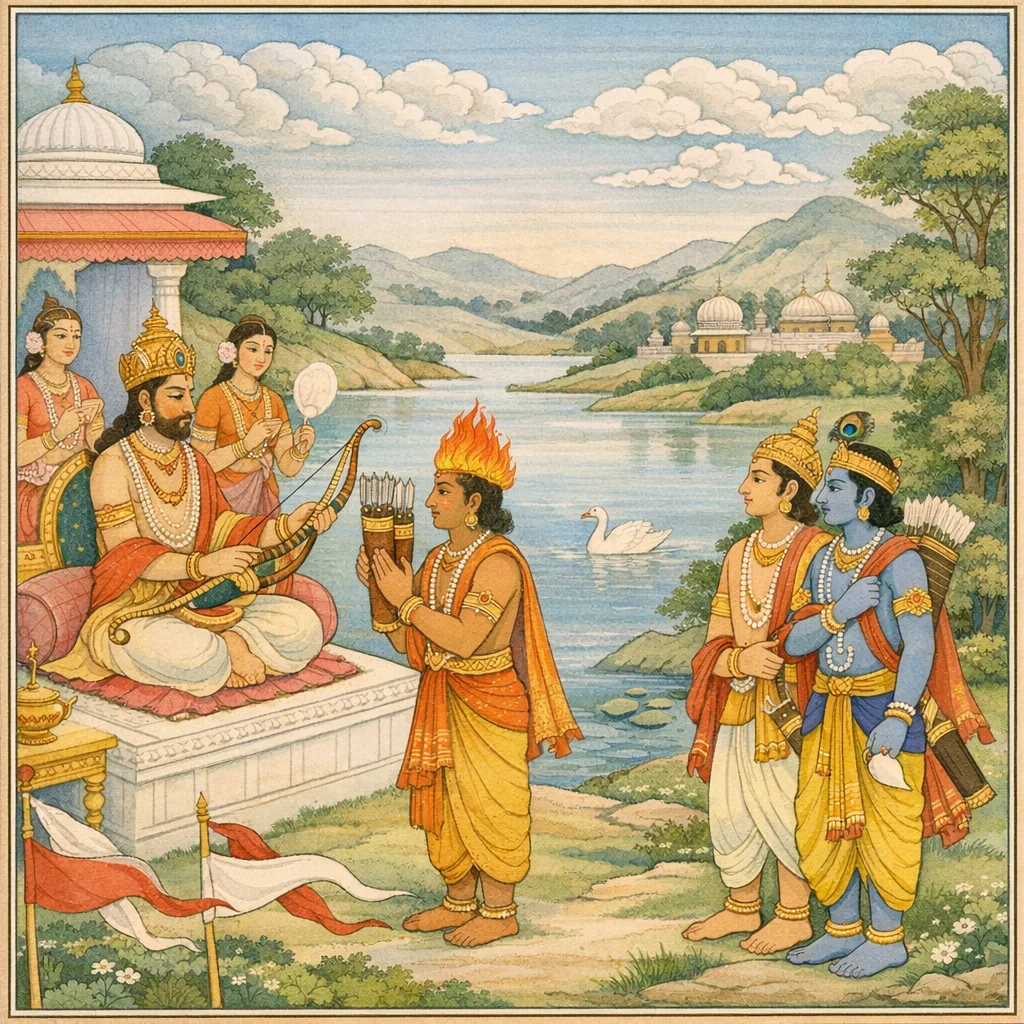
Adhyaya 224
अग्निभय-प्रसङ्गे मन्दपालस्य शोकः (Mandapāla’s Lament amid the Threat of Fire)
Upa-parva: Jaratā-Upākhyāna (Mandapāla–Jaratā Episode)
Vaiśaṃpāyana narrates Mandapāla’s distress as a forest fire intensifies and wind accelerates its spread. Mandapāla laments his sons’ inability to escape and fears their mother’s helplessness. He names the children (Jarītāri, Sārisṛkva, Stambamitra, Droṇa) and worries over their fate. Lapitā responds with pointed reproach, asserting that Mandapāla had earlier sought assurances from ṛṣis and from Agni and therefore should not panic; she reframes his anguish as attachment to Jaratā rather than to the children. Mandapāla counters by defending his concern as oriented to progeny and condemns the present scene of burning as a source of inner torment. After the fire passes, Jaratā urgently searches and finds the children safe, repeatedly embracing them in disbelief. Mandapāla approaches, but the sons do not welcome him or speak; he questions their birth order, and Jaratā challenges his entitlement after abandonment, prompting Mandapāla to generalize about distrust in marital relations and to cite an exemplum (Arundhatī’s suspicion of Vasiṣṭha). The chapter closes with the children finally approaching and Mandapāla beginning to console them, marking a partial, ethically charged reconciliation.
Chapter Arc: खाण्डव-दाह की पृष्ठभूमि में देवताओं की योजना साकार होने लगती है—अग्नि, अर्जुन और कृष्ण के लिए दिव्य साधनों की व्यवस्था करता है, ताकि वन-दहन का महाकर्म निर्बाध हो। → अग्नि जल-निवासी लोकपाल वरुण के पास जाकर ‘चिन्तित’ अभिप्राय प्रकट करता है; वरुण दिव्य गाण्डीव, अक्षय तरकस, दिव्य रथ और ध्वज-चिह्नों सहित युद्धोपकरण प्रदान करता है। दिव्य धनुष का कूजन और अस्त्र-सम्पदा का तेज़ वातावरण को असामान्य बना देता है—मानो प्रकृति स्वयं किसी महान् अनिष्ट/अनिवार्य कर्म के लिए काँप रही हो। → अर्जुन उस अलौकिक रथ पर आरूढ़ होता है; ध्वज पर स्थित वानर-चिह्न (कपिध्वज) शत्रु-सैन्य की संज्ञा हर लेने वाले नाद से दिशाएँ भर देता है। कृष्ण को भी प्रिय दिव्य चक्र प्राप्त होता है—दोनों का युगल-पराक्रम अब ‘अमानुष’ विरोधियों पर भी विजय-निश्चित कर देता है। → दिव्य आयुधों का दान पूर्ण होता है: गाण्डीव, अक्षय तरकस, रथ-ध्वज और चक्र—सब अपने-अपने स्वामियों के हाथों में स्थिर हो जाते हैं। खाण्डव वन को घेरने और अग्नि के दाह-कर्म को सफल करने हेतु आवश्यक सामर्थ्य स्थापित हो जाती है। → अब जब साधन सिद्ध हैं, अग्नि का मेघ-गर्जन-सा घोष समस्त प्राणियों को कम्पित करता है—अगला क्षण खाण्डव के भीतर फँसे जीवों और देव-दानव प्रतिरोध के लिए निर्णायक होने वाला है।
Shlokas
Verse 1
ऑपन--माज बछ। ्-ज्:डि् चतुर्विशर्त्याधेकद्विशततमो<ध्याय: अग्निदेवका अर्जुन और श्रीकृष्णको दिव्य धनुष, अक्षय तरकस, दिव्य रथ और चक्र आदि प्रदान करना तथा उन दोनोंकी सहायतासे खाण्डववनको जलाना वैशम्पायन उवाच एवमुक्त: स भगवान् धूमकेतुर्हुताशन: । चिन्तयामास वरुणं लोकपाल दिदृक्षया,वैशम्पायनजी कहते हैं--जनमेजय! अर्जुनके ऐसा कहनेपर धूमरूपी ध्वजासे सुशोभित होनेवाले भगवान् हुताशनने दर्शनकी इच्छासे लोकपाल वरुणका चिन्तन किया
Vaiśampāyana said: When Arjuna had spoken thus, the blessed Fire-god Hutaśana—whose banner is smoke—began to contemplate Varuṇa, the guardian of the world, desiring to behold him (and seek his aid).
Verse 2
आदित्यमुदके देवं निवसन्तं जलेश्वरम् । सच तच्चिन्तितं ज्ञात्वा दर्शयामास पावकम्,अदितिके पुत्र, जलके स्वामी और सदा जलमें ही निवास करनेवाले उन वरुणदेवने, अग्निदेवने मेरा चिन्तन किया है, यह जानकर तत्काल उन्हें दर्शन दिया
Vaiśampāyana said: Varuṇa—the divine lord of the waters, dwelling in the waters—understood that Agni had been thinking of him, and therefore immediately revealed himself to the Fire-god.
Verse 3
तमब्रवीद् धूमकेतु: प्रतिगृह जलेश्वरम् । चतुर्थ लोकपालानां देवदेव॑ सनातनम्,चौथे लोकपाल सनातन देवदेव जलेश्वर वरुणका स्वागत-सत्कार करके धूमकेतु अग्निने उनसे कहा--
Vaiśampāyana said: Dhūmaketu addressed Jaleśvara Varuṇa—everlasting Lord of lords and the fourth among the guardians of the worlds—inviting him to accept the hospitality and reception that had been offered.
Verse 4
सोमेन राज्ञा यद् दत्तं धनुश्वैवेषुधी च ते । तत् प्रयच्छोभयं शीघ्रं रथं च कपिलक्षणम्,“वरुणदेव! राजा सोमने आपको जो दिव्य धनुष और अक्षय तरकस दिये हैं, वे दोनों मुझे शीघ्र दीजिये। साथ ही कपियुक्त ध्वजासे सुशोभित रथ भी प्रदान कीजिये”
Vaiśampāyana said: “O Varuṇa-deva, quickly grant me both—the divine bow and the inexhaustible quivers that King Soma bestowed upon you; and also bestow the chariot distinguished by the emblem of a monkey.”
Verse 5
कार्य च सुमहत् पार्थो गाण्डीवेन करिष्यति | चक्रेण वासुदेवश्च तन्ममाद्य प्रदीयताम्,“आज कुन्तीपुत्र अर्जुन गाण्डीव धनुषके द्वारा और भगवान् वासुदेव चक्रके द्वारा मेरा महान् कार्य सिद्ध करेंगे; अतः वह सब आज मुझे दे दीजिये”
Vaiśampāyana said: “Today the son of Kuntī, Arjuna, will accomplish my great undertaking with the Gāṇḍīva bow, and Vāsudeva with his discus. Therefore, let that be handed over to me today.”
Verse 6
ददानीत्येव वरुण: पावकं प्रत्यभाषत । तदद्भुतं महावीर्य यशः:कीर्तिविवर्धनम्
Vaiśampāyana said: Varuṇa replied to Pāvaka, saying, “I will give it.” That act was wondrous—an exhibition of great power—and it became a cause for the increase of fame and renown.
Verse 7
सर्वशस्त्रैरनाधृष्यं सर्वशस्त्रप्रमाथि च । सर्वायुधमहामात्र परसैन्यप्रधर्षणम्
Vaiśampāyana said: He was unassailable by any weapon, and a destroyer of every weapon’s power. A great commander over all arms, he could crush the enemy’s host—an embodiment of martial mastery before which opposing force and pride fall away.
Verse 8
एकं शतसहस्रेण सम्मितं राष्ट्रवर्धनम् । चित्रमुच्चावचैर्वर्णै: शोभितं श्लक्ष्णममवत्रणम्
Vaiśaṃpāyana said: “There was a single object, valued at a hundred thousand, that enhanced the kingdom’s prosperity. It was wondrous—adorned with many kinds of colors, radiant with beauty, smooth to the touch, and furnished with a covering.”
Verse 9
देवदानवगन्धर्व: पूजितं शाश्वती: समा: । प्रादाच्चैव धनूरत्नमक्षय्ये च महेषुधी
Vaiśampāyana said: “Honoured by gods, Dānavas, and Gandharvas for countless years, he also bestowed a jewel-like bow, along with two inexhaustible great quivers—gifts that signify enduring favour and the conferral of martial responsibility.”
Verse 10
तब वरुणने अग्निदेवसे “अभी देता हूँ” ऐसा कहकर वह धनुषोंमें रत्नके समान गाण्डीव तथा बाणोंसे भरे हुए दो अक्षय एवं बड़े तरकस भी दिये। वह धनुष अद्भुत था। उसमें बड़ी शक्ति थी और वह यश एवं कीर्तिको बढ़ानेवाला था। किसी भी अस्त्र-शस्त्रसे वह टूट नहीं सकता था और दूसरे सब शस्त्रोंको नष्ट कर डालनेकी शक्ति उसमें मौजूद थी। उसका आकार सभी आयुधोंसे बढ़कर था। शत्रुओंकी सेनाको विदीर्ण करनेवाला वह एक ही धनुष दूसरे लाख धनुषोंके बराबर था। वह अपने धारण करनेवालेके राष्ट्रको बढ़ानेवाला एवं विचित्र था। अनेक प्रकारके रंगोंसे उसकी शोभा होती थी। वह चिकना और छिठ्रसे रहित था। देवताओं, दानवों और गन्धर्वोने अनन्त वर्षोतक उसकी पूजा की थी || ६-- ९।| रथं च दिव्याश्वयुजं कपिप्रवरकेतनम् । उपेतं राजतैरश्लै्गान्धर्वै्हिममालिभि:,इसके सिवा वरुणने दिव्य घोड़ोंसे जुता हुआ एक रथ भी प्रस्तुत किया, जिसकी ध्वजापर श्रेष्ठ कपि विराजमान था। उसमें जुते हुए अश्वोंका रंग चाँदीके समान सफेद था। वे सभी घोड़े गन्धर्वदेशमें उत्पन्न तथा सोनेकी मालाओंसे विभूषित थे
Vaiśampāyana said: “Then Varuṇa, saying to Agni, ‘I give it now,’ bestowed the Gāṇḍīva—like a jewel among bows—and also two great inexhaustible quivers filled with arrows. That bow was wondrous, mighty in power, and an increaser of fame and renown. No weapon could break it, and within it dwelt the strength to destroy all other weapons. Its form surpassed every implement of war. That single bow, able to cleave an enemy host, was equal to a hundred thousand bows. Strange and splendid, it made the bearer’s realm grow; it shone with many colors, was smooth and without flaw. The gods, the Dānavas, and the Gandharvas had worshipped it for endless years. Besides this, Varuṇa presented a celestial chariot yoked with divine horses, bearing on its banner the foremost of monkeys as its emblem. The horses were silver-white, born in the land of the Gandharvas, and adorned with garlands bright as snow.”
Verse 11
पाण्डुराभ्रप्रतीकाशैर्मनोवायुसमैर्जवे । सर्वोपकरणैर्युक्तमजय्यं देवदानवै:,उनकी कान्ति सफेद बादलोंकी-सी जान पड़ती थी। वे वेगमें मन और वायुकी समानता करते थे। वह रथ सम्पूर्ण आवश्यक वस्तुओंसे युक्त तथा देवताओं और दानवोंके लिये भी अजेय था
Vaiśampāyana said: “Its radiance resembled pale white clouds. In speed it matched the mind and the wind. Fully furnished with every requisite, that chariot was unconquerable even by the gods and the Dānavas.”
Verse 12
भानुमन्तं महाघोषं सर्वरत्नमनोरमम् । ससर्ज यं सुतपसा भौमनो भुवनप्रभु:,उससे तेजोमयी किरणें छिटकती थीं। उसके चलनेपर सब ओर बड़े जोरकी आवाज गूँज उठती थी। वह रथ सब प्रकारके रत्नोंसे जटित होनेके कारण बड़ा मनोरम जान पड़ता था। सम्पूर्ण जगतके स्वामी प्रजापति विश्वकर्माने बड़ी भारी तपस्याके द्वारा उस रथका निर्माण किया था। उस सूर्यके समान तेजस्वी रथका “इदमित्थम्' रूपसे वर्णन नहीं हो सकता था। पूर्वकालमें शक्तिशाली सोम (चन्द्रमा)-ने उसी रथपर आरूढ़ हो दानवोंपर विजय पायी थी
Vaiśampāyana said: “That chariot was radiant like the sun, thunderous in its roar, and delightful to behold, being adorned with every kind of jewel. The Lord of the worlds—Prajāpati Viśvakarman—fashioned it through intense austerity. Its splendor was beyond ordinary description; in former times the mighty Soma (the Moon) mounted that very chariot and won victory over the Dānavas.”
Verse 13
प्रजापतिरनिर्देश्यं यस्य रूपं॑ रवेरिव । यं सम सोम: समारुह्ु दानवानजयत् प्रभु:,उससे तेजोमयी किरणें छिटकती थीं। उसके चलनेपर सब ओर बड़े जोरकी आवाज गूँज उठती थी। वह रथ सब प्रकारके रत्नोंसे जटित होनेके कारण बड़ा मनोरम जान पड़ता था। सम्पूर्ण जगतके स्वामी प्रजापति विश्वकर्माने बड़ी भारी तपस्याके द्वारा उस रथका निर्माण किया था। उस सूर्यके समान तेजस्वी रथका “इदमित्थम्' रूपसे वर्णन नहीं हो सकता था। पूर्वकालमें शक्तिशाली सोम (चन्द्रमा)-ने उसी रथपर आरूढ़ हो दानवोंपर विजय पायी थी
Vaiśampāyana said: “That chariot—whose form, like the Sun’s, lay beyond precise description—had been fashioned by Prajāpati (Viśvakarman), lord of the whole world, through immense austerity. Mounted upon that very chariot, the mighty Soma (the Moon), sovereign in power, once overcame the Dānavas.”
Verse 14
नवमेघप्रतीकाशं ज्वलन्तमिव च श्रिया । अश्रितौ त॑ रथश्रेष्ठ शक्रायुधसमावुभौ,वह रथ नूतन मेघके समान प्रतीत होता था और अपनी दिव्य शोभासे प्रज्वलित-सा हो रहा था। इन्द्र-धनुषके समान कान्तिवाले श्रीकृष्ण और अर्जुन उस श्रेष्ठ रथके समीप गये
Vaiśampāyana said: “The foremost chariot appeared like a fresh rain-cloud and seemed to blaze with splendor. Both of them—Kṛṣṇa and Arjuna—approached that excellent chariot, radiant like Indra’s weapon (the rainbow).”
Verse 15
तापनीया सुरुचिरा ध्वजयष्टिरनुत्तमा । तस्यां तु वानरो दिव्य: सिंहशार्दूलकेतन:,उस रथका ध्वजदण्ड बड़ा सुन्दर और सुवर्णमय था। उसके ऊपर सिंह और व्याप्रके समान भयंकर आकृतिवाला दिव्य वानर बैठा था
Vaiśampāyana said: “The chariot’s flagstaff was exquisitely beautiful, fashioned of refined gold and unsurpassed in splendor. Upon it sat a divine monkey, bearing an emblem of lion-and-tiger-like ferocity.”
Verse 16
दिधक्षत्रिव तत्र सम संस्थितो मूर्थ््यशोभत । ध्वजे भूतानि तत्रासन् विविधानि महान्ति च
Vaiśampāyana said: “There, standing firmly in place, he shone with a commanding presence like a mighty kṣatriya. Upon the banner were displayed many great and varied figures—portents and emblems that proclaimed power and inspired awe.”
Verse 17
स तं नानापताकाभि: शोभितं रथसत्तमम्,आरुरोह तदा पार्थों विमान सुकृती यथा । वह श्रेष्ठ रथ भाँति-भाँतिकी पताकाओंसे सुशोभित हो रहा था। अर्जुनने कमर कस ली, कवच और तलवार बाँध ली, दस्ताने पहन लिये तथा रथकी परिक्रमा और देवताओंको प्रणाम करके वे उसपर आरूढ़ हुए, ठीक वैसे ही, जैसे कोई पुण्यात्मा विमानपर बैठता है
Vaiśampāyana said: “That finest of chariots was splendid with many kinds of banners. Then Pārtha (Arjuna) mounted it, ascending as a meritorious man would ascend a celestial aerial car.”
Verse 18
प्रदक्षिणमुपावृत्य दैवतेभ्य: प्रणम्य च । संनद्ध:ः कवची खड्गी बद्धगोधाड्गुलित्रक:
Having circumambulated in reverence and bowed to the deities, he turned back fully prepared—armoured, sword in hand, and with the protective iguana-skin guard and finger-protector fastened—showing disciplined readiness and respect for sacred order even at the threshold of action.
Verse 19
तच्च दिव्यं धनु: श्रेष्ठ ब्रह्मणा निर्मितं पुरा
Vaiśampāyana said: “That supreme, divine bow had been fashioned long ago by Brahmā.”
Verse 20
गाण्डीवमुपसंगृहा बभूव मुदितो<र्जुन: । हुताशनं पुरस्कृत्य ततस्तदपि वीर्यवान्
Vaiśampāyana said: Having taken up the bow Gāṇḍīva, Arjuna became filled with joy. Then that mighty hero, placing Agni (the Fire-god) in the forefront, proceeded onward—acting in accord with the divine purpose and with disciplined resolve.
Verse 21
जग्राह बलमास्थाय ज्यया च युयुजे धनु: । मौर्व्या तु योज्यमानायां बलिना पाण्डवेन ह
Vaiśampāyana said: Relying on his strength, the mighty Pāṇḍava took up the bow and fitted it with the bowstring. And as he set the bowstring in place, he did so with powerful effort—signaling resolve, readiness, and disciplined control rather than mere display of force.
Verse 22
येडशृण्वन् कूजितं तत्र तेषां वै व्यथितं मन: । तदनन्तर, पूर्वकालमें ब्रह्माजीने जिसका निर्माण किया था, उस दिव्य एवं श्रेष्ठ गाण्डीव धनुषको हाथमें लेकर अर्जुन बड़े प्रसन्न हुए। पराक्रमी धनंजयने अग्निदेवको सामने रखकर उस धनुषको हाथमें उठाया और बल लगाकर उसपर प्रत्यंचा चढ़ा दी। महाबली पाण्डुकुमारके उस धनुषपर प्रत्यंचा चढ़ाते समय जिन लोगोंने उसकी टंकार सुनी, उनका हृदय व्यथित हो उठा || १९--२१ $ ।। लब्ध्वा रथं धनुश्वैव तथाक्षय्ये महेषुधी,वह रथ, धनुष तथा अक्षय तरकस पाकर कुन्तीनन्दन अर्जुन अत्यन्त प्रसन्न हो अग्निकी सहायता करनेमें समर्थ हो गये। तदनन्तर पावकने भगवान् श्रीकृष्णको एक चक्र दिया, जिसका मध्यभाग वज्धके समान था
Vaiśampāyana said: Those who heard the twang of that bow there felt their hearts shaken with distress. The sound of Arjuna’s newly strung divine weapon was so formidable that it signaled irresistible power, unsettling all who perceived it and foreshadowing the overwhelming force about to be unleashed in aid of Agni.
Verse 23
बभूव कल्प: कौन्तेय: प्रहृष्ट: साहकर्मणि । वज्नाभं ततश्नक्रं ददौ कृष्णाय पावक:,वह रथ, धनुष तथा अक्षय तरकस पाकर कुन्तीनन्दन अर्जुन अत्यन्त प्रसन्न हो अग्निकी सहायता करनेमें समर्थ हो गये। तदनन्तर पावकने भगवान् श्रीकृष्णको एक चक्र दिया, जिसका मध्यभाग वज्धके समान था
Vaiśampāyana said: Kuntī’s son Arjuna became fully capable and delighted in rendering assistance. Thereupon Pāvaka (Agni), as a token of divine support for their undertaking, bestowed upon Kṛṣṇa a discus whose hub was like a thunderbolt—an emblem of irresistible power placed in the service of their righteous purpose.
Verse 24
आग्नेयमस्त्रं दयितं स च कल्यो5भवत् तदा । अब्रवीत् पावकश्चैवमेतेन मधुसूदन,उस अभम्निप्रदत्त प्रिय अस्त्र चक्रको पाकर भगवान् श्रीकृष्ण भी उस समय सहायताके लिये समर्थ हो गये। उनसे अग्निदेवने कहा--“मधुसूदन! इस चक्रके द्वारा आप युद्धमें अमानव प्राणियोंको भी जीत लेंगे, इसमें संशय नहीं है। इसके होनेसे आप युद्धमें मनुष्यों, देवताओं, राक्षसों, पिशाचों, दैत्यों और नागोंसे भी अधिक शक्तिशाली होंगे तथा इन सबका संहार करनेमें भी निःसंदेह सर्वश्रेष्ठ सिद्ध होंगे
Vaiśampāyana said: “The beloved Agneya weapon became ready at that time. Then Pāvaka (Agni) spoke thus to Madhusūdana (Kṛṣṇa): ‘With this, you will prevail in battle even over non-human beings; there is no doubt. Possessing it, you will be mightier in war than humans, gods, rākṣasas, piśācas, daityas, and nāgas, and you will assuredly prove the foremost in bringing about their destruction.’”
Verse 25
अमानुषानपि रणे जेष्यसि त्वमसंशयम् । अनेन तु मनुष्याणां देवानामपि चाहवे,उस अभम्निप्रदत्त प्रिय अस्त्र चक्रको पाकर भगवान् श्रीकृष्ण भी उस समय सहायताके लिये समर्थ हो गये। उनसे अग्निदेवने कहा--“मधुसूदन! इस चक्रके द्वारा आप युद्धमें अमानव प्राणियोंको भी जीत लेंगे, इसमें संशय नहीं है। इसके होनेसे आप युद्धमें मनुष्यों, देवताओं, राक्षसों, पिशाचों, दैत्यों और नागोंसे भी अधिक शक्तिशाली होंगे तथा इन सबका संहार करनेमें भी निःसंदेह सर्वश्रेष्ठ सिद्ध होंगे
Vaiśampāyana said: “Without doubt, you will conquer even non-human beings in battle. And by possessing this, you will be superior in combat even to human warriors and to the gods themselves.” In context, the passage underscores the extraordinary, divinely sanctioned power of a bestowed weapon, while also hinting at the grave ethical weight that accompanies such irresistible force in war.
Verse 26
रक्ष:पिशाचदैत्यानां नागानां चाधिकस्तथा । भविष्यसि न संदेह: प्रवरोडपि निबर्हणे,उस अभम्निप्रदत्त प्रिय अस्त्र चक्रको पाकर भगवान् श्रीकृष्ण भी उस समय सहायताके लिये समर्थ हो गये। उनसे अग्निदेवने कहा--“मधुसूदन! इस चक्रके द्वारा आप युद्धमें अमानव प्राणियोंको भी जीत लेंगे, इसमें संशय नहीं है। इसके होनेसे आप युद्धमें मनुष्यों, देवताओं, राक्षसों, पिशाचों, दैत्यों और नागोंसे भी अधिक शक्तिशाली होंगे तथा इन सबका संहार करनेमें भी निःसंदेह सर्वश्रेष्ठ सिद्ध होंगे
Vaiśampāyana said: “You will surpass even the rākṣasas, piśācas, daityas, and the nāgas; of this there is no doubt. Indeed, in the work of subduing and destroying them, you will prove to be the foremost.” The statement underscores the extraordinary, almost superhuman efficacy of the divine weaponry being granted, and frames its use as a decisive power meant for overcoming hostile, non-human forces.
Verse 27
क्षिप्तं क्षिप्तं रणे चैतत् त्वया माधव शशत्रुषु । हत्वाप्रतिहतं संख्ये पाणिमेष्यति ते पुनः:,“माधव! युद्धमें आप जब-जब इसे शत्रुओंपर चलायेंगे, तब-तब यह उन्हें मारकर और स्वयं किसी अस्त्रसे प्रतिहत न होकर पुनः आपके हाथमें आ जायगा”
Vaiśampāyana said: “Mādhava, whenever you hurl this weapon in battle against your enemies, each time it will slay them and—remaining unstruck and unharmed by any counter-weapon in the fight—will return again into your hand.”
Verse 28
वरुणश्न ददौ तस्मै गदामशनिनि:स्वनाम् | दैत्यान्तकरणीं घोरां नाम्ना कौमोदकीं प्रभु:,तत्पश्चात् भगवान् वरुणने भी बिजलीके समान कड़कड़ाहट पैदा करनेवाली कौमोदकी नामक गदा भगवानको भेंट की, जो दैत्योंका विनाश करनेवाली और भयंकर थी
Vaiśampāyana said: Then Varuṇa presented him a mighty mace named Kaumodakī, whose roar was like a thunderbolt. Terrible in power and famed as a destroyer of the Dāityas, this weapon signified divine sanction and the righteous use of force against oppressive, unruly powers.
Verse 29
तत: पावकमन्रूतां प्रहष्टावर्जुनाच्युतौ । कृतास्त्रौ शस्त्रसम्पन्नो रथिनौ ध्वजिनावपि,इसके बाद अस्त्रविद्याके ज्ञाता एवं शस्त्रसम्पन्न अर्जुन और श्रीकृष्णने प्रसन्न होकर अग्निदेवसे कहा--“भगवन्! अब हम दोनों रथ और ध्वजासे युक्त हो सम्पूर्ण देवताओं तथा असुरोंसे भी युद्ध करनेमें समर्थ हो गये हैं; फिर तक्षक नागके लिये युद्धकी इच्छा रखनेवाले अकेले वज्रधारी इन्द्रसे युद्ध करना क्या बड़ी बात है?”
Then Arjuna and Acyuta (Kṛṣṇa), delighted, addressed Agni. Having become fully equipped with consecrated weapons and complete in martial gear—mounted on a chariot and bearing a banner—they declared that they were now capable of fighting even all the gods and the asuras; therefore, what great difficulty could there be in battling Indra alone, the wielder of the thunderbolt, who was eager to fight on behalf of Takṣaka? The verse underscores the surge of confidence that follows divine empowerment, while hinting at the ethical tension of confronting a deity in pursuit of a vowed objective.
Verse 30
कल्यौ स्वो भगवन् योद्धुमपि सर्व: सुरासुरै: । कि पुनर्वज्रिणैकेन पन्नगार्थे युयुत्मता,इसके बाद अस्त्रविद्याके ज्ञाता एवं शस्त्रसम्पन्न अर्जुन और श्रीकृष्णने प्रसन्न होकर अग्निदेवसे कहा--“भगवन्! अब हम दोनों रथ और ध्वजासे युक्त हो सम्पूर्ण देवताओं तथा असुरोंसे भी युद्ध करनेमें समर्थ हो गये हैं; फिर तक्षक नागके लिये युद्धकी इच्छा रखनेवाले अकेले वज्रधारी इन्द्रसे युद्ध करना क्या बड़ी बात है?”
Vaiśampāyana said: “O Blessed One, now we are fully prepared to fight—even against all the gods and the asuras together. How much less, then, is it a great matter to fight the single thunderbolt-bearing Indra, who is eager to battle for the sake of the serpent (Takṣaka)?” In context, the statement conveys confident resolve and loyalty to Agni’s cause, while also foreshadowing a confrontation where personal duty and divine opposition collide.
Verse 31
अजुन उवाच चक्रपाणि््षीकेशो विचरन् युधि वीर्यवान् । चक्रेण भस्मसात् सर्व विसृष्टेन तु वीर्यवान् | त्रिषु लोकेषु तन्नास्ति यज्ञ कुर्याज्जनार्दन:,अर्जुन बोले--अग्निदेव! सबकी इन्द्रियोंके प्रेरक ये महापराक्रमी जनार्दन जब हाथमें चक्र लेकर युद्धमें विचरेंगे, उस समय त्रिलोकीमें ऐसी कोई भी वस्तु नहीं है, जिसे ये चक्रके प्रहारसे भस्म न कर सकें
Arjuna said: “Mighty Keśava, bearing the discus in his hand, moves about in battle with irresistible prowess. With the discus he hurls, he can reduce everything to ashes. In the three worlds there is nothing that Janārdana cannot accomplish.”
Verse 32
गाण्डीवं धनुरादाय तथाक्षय्ये महेषुधी । अहमप्युत्सहे लोकान् विजेतुं युधि पावक,पावक! मैं भी यह गाण्डीव धनुष और ये दोनों बड़े-बड़े अक्षय तरकस लेकर सम्पूर्ण लोकोंको युद्धमें जीत लेनेका उत्साह रखता हूँ
Arjuna said: “Taking up the Gāṇḍīva bow, and likewise these two great, inexhaustible quivers, I too feel the resolve to conquer the worlds in battle, O Pāvaka.” In context, the line conveys a warrior’s surge of confidence grounded in divine-grade weapons and the kṣatriya ideal of prowess, while also hinting at the ethical tension of seeking ‘world-conquest’ through war—an ambition that later Mahābhārata episodes repeatedly test against dharma and restraint.
Verse 33
सर्वतः परिवार्यवं दावमेतं महाप्रभो । काम सम्प्रज्वलाद्यैव कल्यौ स्व: साह्मुकर्मणि,महाप्रभो! अब आप इस सम्पूर्ण वनको चारों ओरसे घेरकर आज ही इच्छानुसार जलाइये। हम आपकी सहायताके लिये तैयार हैं
Arjuna said: “O mighty lord, having surrounded this forest-fire from all sides, burn this woodland today itself as you wish. We stand ready to assist you in the work.”
Verse 34
वैशम्पायन उवाच एवमुक्त: स भगवान् दाशाहेंणार्जुनेन च तैजसं रूपमास्थाय दावं दग्धुं प्रचक्रमे,वैशम्पायनजी कहते हैं--जनमेजय! श्रीकृष्ण और अर्जुनके ऐसा कहनेपर भगवान् अग्निने तेजोमय रूप धारण करके खाण्डववनको सब ओरसे जलाना आरम्भ कर दिया
Vaiśampāyana said: When thus addressed by Kṛṣṇa of the Dāśārha line and by Arjuna, the blessed Fire-god assumed a blazing, radiant form and began to burn the Khāṇḍava forest on every side.
Verse 35
सर्वतः परिवार्याथ सप्तार्चिज्वलनस्तथा । ददाह खाण्डवं दावं युगान्तमिव दर्शयन्,सात ज्वालामयी जिह्लाओंवाले अग्निदेव खाण्डव-वनको सब ओरसे घेरकर महाप्रलयका-सा दृश्य उपस्थित करते हुए जलाने लगे
Vaiśampāyana said: Then Agni, blazing with seven tongues of flame, surrounded the Khāṇḍava forest on every side and began to burn that woodland-conflagration, displaying a scene like the end of an age.
Verse 36
प्रतिगृह्ा समाविश्य तद् वनं भरतर्षभ । मेघस्तनितनिर्घोष: सर्वभूतान्यकम्पयत्,भरतश्रेष्ठ! उस वनको चारों ओरसे अपनी लपटोंमें लपेटकर और उसके भीतरी भागमें भी व्याप्त होकर अग्निदेव मेघकी गर्जनाके समान गम्भीर घोष करते हुए समस्त प्राणियोंको कैपाने लगे
Vaiśampāyana said: Having seized it and pervaded that forest on every side—and even penetrating its inner reaches—the fire blazed forth with a deep roar like thunder from rain-clouds, shaking and terrifying all living beings.
Verse 37
दहाृतस्तस्य च बभौ रूपं दावस्य भारत । मेरोरिव नगेन्द्रस्य कीर्णस्यांशुमतोंडशुभि:,भारत! उस जलते हुए खाण्डववनका स्वरूप ऐसा जान पड़ता था, मानो सूर्यकी किरणोंसे व्याप्त पर्वतराज मेरुका सम्पूर्ण कलेवर उद्दीप्त हो उठा हो
Vaiśampāyana said: O Bhārata, the appearance of that blazing forest-conflagration was as though the entire body of Mount Meru, king of mountains, had flared up—pervaded on all sides by the radiant rays of the Sun.
Verse 163
नादेन रिपुसैन्यानां येषां संज्ञा प्रणश्यति । उस रथके शिखरपर बैठा हुआ वह वानर ऐसा जान पड़ता था, मानो शत्रुओंको भस्म कर डालना चाहता हो। उस ध्वजमें और भी नाना प्रकारके बड़े भयंकर प्राणी रहते थे, जिनकी आवाज सुनकर शत्रु-सैनिकोंके होश उड़ जाते थे
Vaiśaṃpāyana said: By the sheer roar of those beings, the enemy soldiers would lose their senses. Perched upon the summit of the chariot, that monkey-banner appeared as though it longed to reduce the foes to ashes. Within that standard dwelt many other great and terrifying creatures; hearing their cries, the enemy’s troops were thrown into confusion.
Verse 183
आरुरोह तदा पार्थों विमान सुकृती यथा । वह श्रेष्ठ रथ भाँति-भाँतिकी पताकाओंसे सुशोभित हो रहा था। अर्जुनने कमर कस ली, कवच और तलवार बाँध ली, दस्ताने पहन लिये तथा रथकी परिक्रमा और देवताओंको प्रणाम करके वे उसपर आरूढ़ हुए, ठीक वैसे ही, जैसे कोई पुण्यात्मा विमानपर बैठता है
Vaiśampāyana said: Then Pārtha (Arjuna) mounted the splendid conveyance, just as a man of merit ascends a celestial car. The excellent chariot shone, adorned with banners of many kinds. Arjuna girded his waist, fastened his armour and sword, donned his gloves, circumambulated the chariot, bowed to the gods, and then took his seat.
Verse 224
इति श्रीमहाभारते आदिपर्वणि खाण्डवदाहपर्वणि गाण्डीवादिदाने चतुर्विशत्यधिकद्विशततमो<ध्याय:
Thus ends the two-hundred-and-twenty-fourth chapter of the Ādi Parva of the Śrī Mahābhārata, within the section on the Burning of the Khāṇḍava forest, specifically the episode concerning the bestowal of the Gāṇḍīva and other divine weapons.
Frequently Asked Questions
The dilemma is whether prior assurances and ascetic standing can substitute for immediate protective responsibility: Mandapāla’s lament is measured against the expectation that a parent must act, not only grieve or rely on promised outcomes.
Ethical legitimacy is relational and evidence-based: care must be demonstrable in crisis, and neglect can erode authority—even when one holds religious or intellectual prestige.
No explicit phalaśruti is stated here; the chapter functions as narrative-ethical instruction by dramatizing consequences (social censure by the children, reproach by Jaratā/Lapitā) rather than by appending a formal reward statement.