Adhyaya 24
Āyuḥ-kṣaya by Vikarma; Impermanence of the Body; Aśauca and Child Śrāddha Procedures; Dāna as Remedy
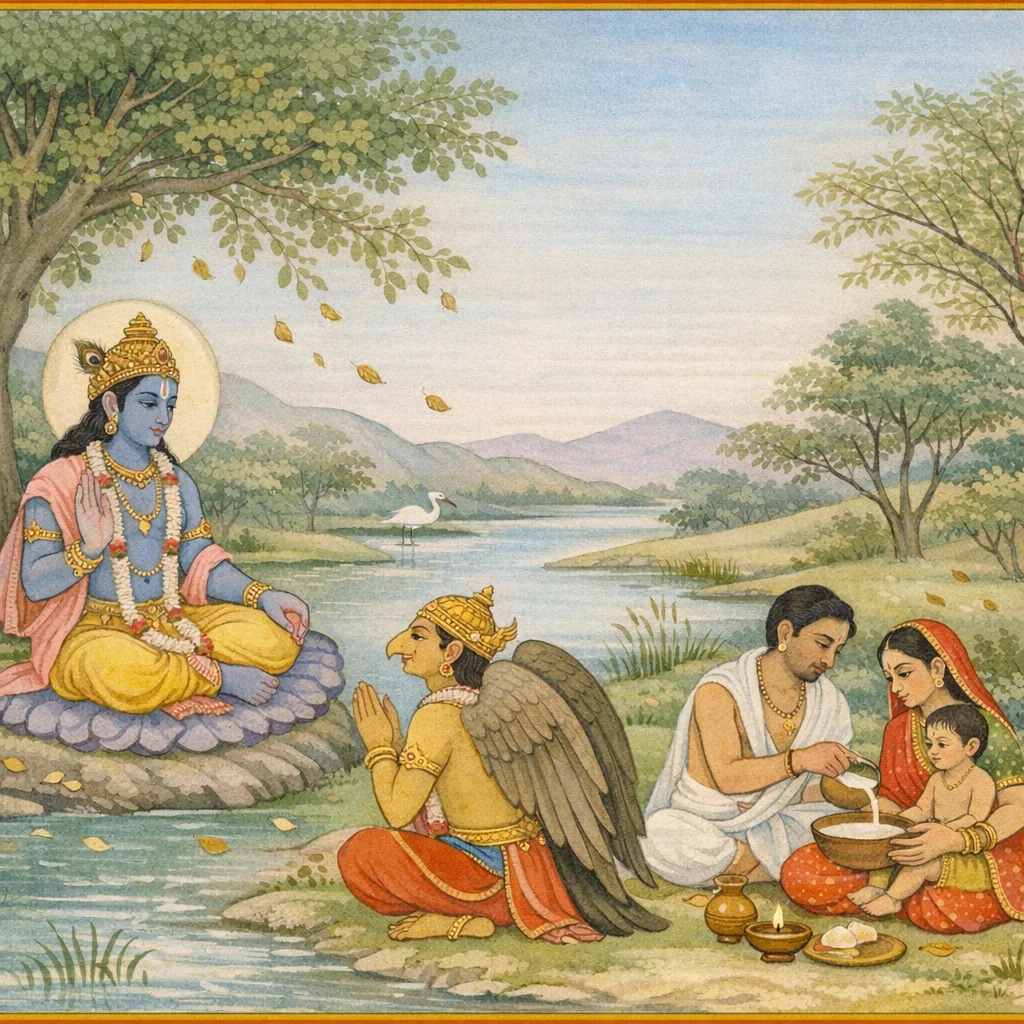
Continuing the Preta Kalpa’s post-death instruction, Garuḍa asks about the seeming conflict between the Vedic “appointed time” of death and the early deaths of kings and śrotriyas. Viṣṇu replies that a hundred-year lifespan is the normative order, but vikarma and abandonment of svadharma swiftly cause āyuḥ-kṣaya, the wasting of life. He names specific causes—neglect of Vedic study and lineage duties, indulgence in forbidden acts, impurity, lack of śraddhā, and harm to society—and explains how unrighteous rulers come under Yama’s chastisement. The teaching then stresses the body’s impermanence and the urgency of purifying disciplines: snāna, dāna, japa, homa, svādhyāya, and sadācāra. Garuḍa next asks for practical rites when children die, including miscarriage and death before cūḍākaraṇa. Viṣṇu gives rules for aśauca after miscarriage, prescribes milk offerings for children, cremation from cūḍā-karma to five years, and full jāti-based rites after five years, along with specific dāna such as a water-pot and pāyasa. The chapter closes by warning that failure to give charity brings poverty, sin, and repeated suffering, linking ritual duty to the cycle of rebirth that the next teachings seek to exhaust.
Shlokas
Verse 1
प्रेतकृतितदुक्तितच्चिह्नतद्विमुक्त्युपायनिरूपणं नाम त्रयोविंशो ऽध्यायः गरुड उवाच / नाकाले म्रियते कश्चिदिति वेदानुशासनम् / कस्मान्मृत्युमवाप्नोति राजा वा श्रोत्रियोपि वा
Garuda said: “The Veda lays down this instruction—‘no one dies before the appointed time.’ If so, why does death still befall a king, or even a learned Vedic scholar (śrotriya)?”
Verse 2
यदुक्तं ब्राह्मणा पूर्वमनृतं तद्धि दृश्यते / वेदैरुक्तं तु यद्वाक्यं शतं जीवति मानुषे
What the brahmins formerly uttered as untruth is indeed seen to pass away; but the statement spoken in accordance with the Vedas lives on among humans for a hundred years.
Verse 3
जीवन्ति मानुषे लोके सर्वे वर्णा द्विजातयः / अन्त्यजाम्लेच्छजाश्चैव खण्डे भारतसंज्ञके
In the human world, all classes of people live—the varṇas and the twice-born, as well as the antyajas and those born among mlecchas—within the region known as Bhārata.
Verse 4
न दृश्यते कलौ तच्च कस्माद्देव समादिश / (आधानान्मृत्युमाप्नोति बालो वा स्थविरो युबा
“That observance is not seen in the Kali age—why is it so? O Lord, instruct me. From undertaking the ādhāna (the rite of establishing the sacred fires), death may befall—whether one is a child, an old man, or a youth.”
Verse 5
सधनो निर्धनो वापि सुकुमारः सुरूपवान् / अविद्वांश्चैव विद्वांश्च ब्राह्मणस्त्वितरो जनः
Whether wealthy or poor, delicate or fair of form; whether unlearned or learned—be he a brāhmaṇa or any other person, all alike are subject to the same order after death.
Verse 6
तपोरतो योगशीलो महाज्ञानी च यो नरः / सर्वज्ञानरतः श्रीमान्धर्मात्मातुलविक्रमः
That man who is devoted to austerity, established in yoga, and truly great in wisdom—who delights in all sacred knowledge—is illustrious, righteous-souled, and of incomparable valor.
Verse 7
) सर्वमेतदशषेण जायते वसुधातले / कस्मान्मृत्युमवाप्नोति राजा वा श्रोत्रियो ऽपि वा
All this, without exception, is born upon the surface of the earth. Why, then, does one meet with death—be he a king or even a learned Vedic scholar (śrotriya)?
Verse 8
श्रीभगवानुवाच / साधुसाधु महाप्राज्ञ यस्त्वं भक्तो ऽसि मे प्रियः / श्रूयतां वचनं गुह्यं नानादेशविनाशनम्
The Blessed Lord said: “Well done, well done, O greatly wise one—since you are My devotee and dear to Me. Now listen to this secret teaching, which destroys the many kinds of misfortunes that befall one in various places and conditions.”
Verse 9
विधातृविहितो मृत्युः शीघ्रमादाय गच्छति / ततो वक्ष्यामि पक्षीन्द्र काश्यपेय महाद्युते
Death, ordained by the Creator (Vidhātṛ), swiftly seizes a being and departs. Therefore, O king of birds—O radiant son of Kaśyapa—I shall now explain what follows.
Verse 10
मानुषः शतजीवीति पुरा वेदेन भाषितम् / विकर्मणः प्रभावेण शीघ्रं चापि विनश्यति
The Veda declared long ago that a human is meant to live a hundred years; yet, under the force of vikarma—wrongful deeds against dharma—one quickly perishes.
Verse 11
वेदानभ्यसनेनैव कुलाचारं न सेवते / आलस्यात्कर्मणां त्यागो निषिद्धे ऽप्यादरः सदा
Without studying the Vedas, one does not follow the established duties and traditions of one’s lineage. Out of laziness one abandons the prescribed rites and responsibilities, yet remains ever eager for what is forbidden.
Verse 12
यत्र तत्र गृहे ऽश्राति परक्षेत्ररतस्तथा / एतैरन्यैर्महादोषैर्जायते चायुषः क्षयः
One who eats indiscriminately in any house, and one who is addicted to another’s spouse—by these and other grave faults, one’s lifespan is indeed diminished.
Verse 13
अश्रद्दधानमशुचिं नास्तिकं त्यक्तमङ्गलम् / परद्रोहानृतरं ब्राह्मणं यत (म) मन्दिरम्
A Brahmin who is faithless, impure, nāstika, who has abandoned auspicious observances, and who is given to harming others and to falsehood—his dwelling is to be regarded as a defiled place unfit for sacred acts.
Verse 14
अरक्षितारं राजानं नित्यं धर्मविवर्जितम् / क्रूरं व्यसनिनं मूर्खं वेदवादबहिष्कृतम् / प्रजापीडनकर्तारं राजानं यमशासनम्
A king who gives no protection and is ever devoid of dharma—cruel, addicted to vices, foolish, and cast out from Vedic counsel—who oppresses his subjects: such a king falls under Yama’s chastisement, the rule of punishment.
Verse 15
प्रापयन्ति वशं मृत्योस्ततो याति च यातनाम् / स्वकर्माणि परित्यज्य मुख्यवृत्तानि यानि च
They bring him under the dominion of Death; thereafter he proceeds to the punishments. Forsaking his own deeds and even the chief occupations by which he lived in the world, he is borne onward by the force of death and karma.
Verse 16
परकर्मरतो नित्यं यमलोकं स गच्छति / शूद्रः करोतिः यत्किञ्चिद्विजशुश्रूषणं विना
One who is ever intent on another’s (forbidden) work goes to Yama’s realm. Likewise, if a Śūdra undertakes any act without devoted service to the twice-born (dvija), he incurs the path that leads to Yama’s world.
Verse 17
उत्तमाधममध्ये वा यमलोके स पच्यते / स्नानं दानं जपो होमो स्वाध्यायो दवर्ताच्चनम्
Whether among the higher, the lower, or those in between, in Yama’s realm he is “cooked” by the fruits of karma. Purificatory bathing, charity, mantra-recitation (japa), fire-offering (homa), self-study of scripture (svādhyāya), and righteous conduct—these are the means that counteract and purify.
Verse 18
यस्मिन्दिने न सेव्यन्ते स वृथा दिवसो नृणाम् / अनित्यमध्रुवं देहमनाधारं रसोद्भवम्
That day on which one does not engage in spiritual service (sevā) is a wasted day for human beings; for the body is impermanent and unstable, without lasting support, and born of mere essence and fluids.
Verse 19
अन्नोदकमये देहे गुणानेतान्वदाम्यहम् / यत्प्रातः संस्कृतं सायं नूनमन्नं विनश्यति
In this body constituted of food and water, I declare these qualities: whatever food is prepared in the morning surely perishes by evening.
Verse 20
तदीयरससम्पुष्टकाये का बत नित्यता / गतं ज्ञात्वा तु पक्षीन्द्र वपुरर्धं स्वकर्मभिः
In a body nourished only by its own juices and essences, what permanence could there be? Knowing it must pass away, O lord of birds, the body is borne onward—half as if by its own deeds (karma).
Verse 21
नरः पापविनाशाय कुर्वीत परमौषधम् / देहः किमन्नदातुः स्विन्निषेक्तुर्मातुरेव वा
To destroy sin, a person should employ the supreme remedy. For whose, indeed, is this body—of the giver of food, of the begetter who planted the seed, or only of the mother who bore it?
Verse 22
उभयोर्वा प्रभोर्वापि बालनोग्नेः शुनो ऽपि वा / कस्तत्र परमो यज्ञः कृमिविड्भस्मसंज्ञके
Whether for both of them, or for a master, or even for a child, an outcaste, fire, or a dog—when the body is reduced to what is called “worms, excrement, and ashes,” what, in that situation, can truly be the highest sacrifice (yajña)?
Verse 23
कर्तव्यः परमो यत्नः पातकस्य विनाशने / अनेकभवसम्भूतं पातकं तु त्रिधा कृतम्
One should make the utmost effort to destroy sin. Sin, accumulated across many births, is indeed classified in three ways.
Verse 24
यदा प्राप्नोति मानुष्यं तदा सर्वं तपत्यपि / सर्वजन्मानि संस्मृत्य विषादी कृतचेतनः
When the departed being attains the human condition (human awareness in the after-death state), then everything truly burns him; remembering all his births, he becomes grief-stricken, his mind fully awakened to what he has done.
Verse 25
अवेक्ष्य गर्भवासांश्च कर्मजा गतयस्तथा / मानुषोदरवासी चेत्तदा भवति पातकी
Having reflected on the many abodes within the womb and the karmically fashioned courses of rebirth, if one still chooses to return as a dweller in a human womb, then one becomes a sinner.
Verse 26
अण्डजादिषु भूतेषु यत्रयत्र प्रसर्पति / आधयो व्याधयः क्लेशा जरारूपविपर्ययः
Among beings born in diverse ways—egg-born and the rest—wherever embodied existence creeps and spreads, there too spread mental afflictions, bodily diseases, sufferings, and the distortions of form brought by old age.
Verse 27
गर्भवासाद्विनिर्मुक्तस्त्वज्ञानतिमिरावृतः / न जानातिः खगश्रेष्ठ बालभावं समाश्रितः
Released from the confinement of the womb, yet veiled by the darkness of ignorance, he does not understand, O best of birds, Garuḍa; having taken refuge in infancy, he remains unaware.
Verse 28
यौवने तिमिरान्धश्च यः पश्यति स मुक्तिभाक् / आधानान्मृत्युमाप्नोति बालो वा स्थविरो युवा
Even if one is ‘blind in the darkness’ of youth, whoever truly comes to see Reality becomes fit for liberation. For death may arrive suddenly and seize anyone—child, elder, or youth.
Verse 29
सधनो निर्धनश्चैव सुकुमारः कुरूपवान् / अविद्वांश्चैव विद्वांश्च ब्राह्मणास्त्वितरो जनः
Whether wealthy or poor, delicate or ugly, learned or unlearned—whether a brāhmaṇa or any other person—all are subject to the same law that governs the jīva’s journey after death.
Verse 30
तपोरतो योगशीलो महाज्ञानी च यो नरः / महादानरतः श्रीमान्धर्मात्मातुलविक्रमः / विना मानुपदेहं तु सुखं दुः खं न विन्दति
Even a man devoted to austerity, disciplined in yoga, greatly learned, fond of great gifts, prosperous, righteous, and of incomparable valor—without a human body he experiences neither pleasure nor pain.
Verse 31
प्राकृतैः कर्मपाशैस्तु मृत्युमाप्नोति मानवः / आधानात्पञ्च वर्षाणि स्वल्पपापैर्विपच्यते
A human being, bound by the ordinary fetters of karma, comes to death; and from the time of conception, for five years, even minor sins ripen into their results.
Verse 32
पञ्चवर्षाधिको भूत्वा महापापैर्विपच्यते / योनिं पूरयते यस्मान्मृतो ऽप्यायाति याति च
Having lived beyond five years, a person is ‘cooked’ in suffering by great sins. Because he again fills the womb—entering conception once more—even after death he comes and goes, returning repeatedly in the cycle of birth and death.
Verse 33
मृतो दानप्रभावेण जीवन्मर्त्यश्चिरं भुवि / सूत उवाच / इति कृष्णवचः श्रुत्वा गरुडो वाक्यमब्रवीत्
By the power of charitable giving, even one who is dead may, as it were, live on, and a mortal may live long upon the earth. Sūta said: Having thus heard the words of Kṛṣṇa, Garuḍa then spoke.
Verse 34
गरुड उवाच / मृते बाले कथं कुर्यात्पिण्डदानादिकाः क्रियाः / गर्भेषु च विपन्नानामाचूडाकरणाच्छिशोः
Garuḍa said: “If a child dies, how should one perform the rites beginning with the offering of piṇḍas (piṇḍa-dāna)? And in the case of those who die in the womb, and of a child who dies before the cūḍākaraṇa (tonsure) ceremony, what should be done?”}]}}
Verse 35
कथं किं केन दातव्यं मृतान्ते को विधिः स्मृतः / गरुडोक्तमिति श्रुत्वा विष्णुर्वाक्यमथाब्रवीत्
“How, what, and by whom should gifts be given at the time of death? What procedure is prescribed?” Hearing these words spoken by Garuḍa, Lord Viṣṇu then began to reply.
Verse 36
श्रीविष्णुरुवाच / यदि गर्भो विपद्यते स्त्रवते वापि योषितः / यावन्मासं स्थितो गर्भस्तावद्दिनमशौचकम्
Śrī Viṣṇu said: If a pregnancy is lost, or if a woman miscarries with a discharge, then the period of aśauca (ritual impurity) lasts for as many days as the embryo had remained in the womb in months.
Verse 37
तस्य किञ्चिन्न कर्तव्यमात्मनः श्रेय इच्छता / ततो जाते विपन्ने तु आ चूडाकरणाच्छिशोः
For one who seeks his own highest good, nothing should be done in that regard; but if, after that, a child is born and then dies, the prescribed observances apply up to the child’s cūḍākaraṇa, the first tonsure-rite.
Verse 38
दुग्धं भोज्यं ताशक्ति बालानां च प्रदीयते / आ चूडात्पञ्चवर्षे तु देहदाहो विधीयते
For children, milk and suitable food should be offered according to one’s capacity. But from the time of the cūḍā-karma (tonsure-rite) up to the age of five years, the burning of the body (cremation) is enjoined.
Verse 39
दुग्धं तस्य प्रदेयं स्याद्बालानां भोजनं शुभम् / पञ्चवर्षाधिके प्रेते स्वजातिविहितानि च
For that departed child, milk should be offered; for children, such an offering of food is auspicious. But if the deceased is more than five years old, then the rites and offerings prescribed for one’s own jāti (social class) should also be performed.
Verse 40
कुर्यात्कर्माणि सर्वाणि चोदकुम्भादि पायसम् / दातव्यं तु खगश्रेष्ठ ऋणसम्बन्धकस्तु सः
One should perform all the prescribed rites, and also give in charity such items as a water-pot and sweet rice (pāyasa). O best of birds, Garuda, such giving becomes a bond for the repayment of debts (ṛṇa).
Verse 41
जातस्य हि ध्रुवो मृत्युर्ध्रुवं जन्म मृतस्य च / कर्तव्यं पक्षिशार्दूल पुनर्देहक्षयाय वै
For one who is born, death is certain; and for one who has died, rebirth is certain as well. Therefore, O tiger among birds, Garuda, one should do what must be done to end taking a body again, so that the cycle is exhausted.
Verse 42
तस्मै यद्रोचते देयमदत्त्वा निर्धने कुले / स्वल्पायुर्निर्धनो भूत्वा रतिभक्तिविवर्जितः
Therefore, one should give to that person what is pleasing and fitting. If one does not give, one is born in a poor family, becomes short-lived and destitute, and is deprived of love and devotion (bhakti).
Verse 43
पुनर्जन्माप्नुयान्मर्त्यस्तस्माद्देयमृते शिशोः / पुराणे गीयते गाथा सर्वथा प्रतिभाति मे
A mortal may obtain rebirth; therefore, the prescribed post-death offering should be given—except in the case of a child. In the Purāṇa a traditional verse is sung; it is wholly evident to me.
Verse 44
मिष्टान्नं भोजनं देयं दाने शक्तिस्तु दुर्लभा / भोज्ये भोजनशक्तिश्च रतिशक्तिर्वरस्त्रियः
One should give sweet food and a proper meal in charity; yet the capacity (and willingness) to give is rare. Likewise, the power to enjoy what is edible and the power for sexual enjoyment are also rare gifts, especially through excellent women.
Verse 45
विभवे दानशक्तिश्च नाल्पस्य तपसः फलम् / दानाद्भोगानवाप्नोति सौख्यं तीर्थस्य सेवनात् / सुभाषणान्मृतो यस्तु स विद्वान्धर्मवित्तमः
When one has the means, one should have the power to give; the fruit of austerity (tapas) is not small. From charity (dāna) one attains enjoyments, and from serving the sacred tīrthas—holy places of pilgrimage—one gains happiness. Yet the one who leaves this life with noble, well-spoken words is truly wise, the finest knower of dharma.
Verse 46
अदत्तदानाच्च भवेद्दरिद्रो दरिद्रभावाच्च करोतिपापम् / पापप्रभावान्नरकं प्रयाति पुनर्दरिद्रः पुनरेव पापी
By failing to give charity (dāna), one becomes poor; from poverty one commits sin. By the force of sin one goes to hell; and then again one returns poor, and again indeed a sinner.
Frequently Asked Questions
Viṣṇu links āyuḥ-kṣaya to concrete violations: abandoning Vedic study and prescribed rites out of laziness, pursuing forbidden pleasures, eating indiscriminately (without discernment of purity/appropriateness), adultery, faithlessness and impurity in a brāhmaṇa, and cruelty/adharma in a king. These acts generate karmic pressure that ‘quickly makes one perish’ despite the normative śata-āyuḥ.
The chapter outlines a tiered approach: (1) for very young children, milk and suitable food offerings are recommended according to capacity; (2) from cūḍā-karma up to five years, cremation is enjoined and milk offerings remain auspicious; (3) if older than five years, one should perform rites and offerings as prescribed for one’s own jāti (social class), along with appropriate charity.