Adhyaya 12
Jīva-yonis (84 Lakhs), Rarity of Human Birth, Sense-Restraint, Craving, and Śraddhā-based Dharma
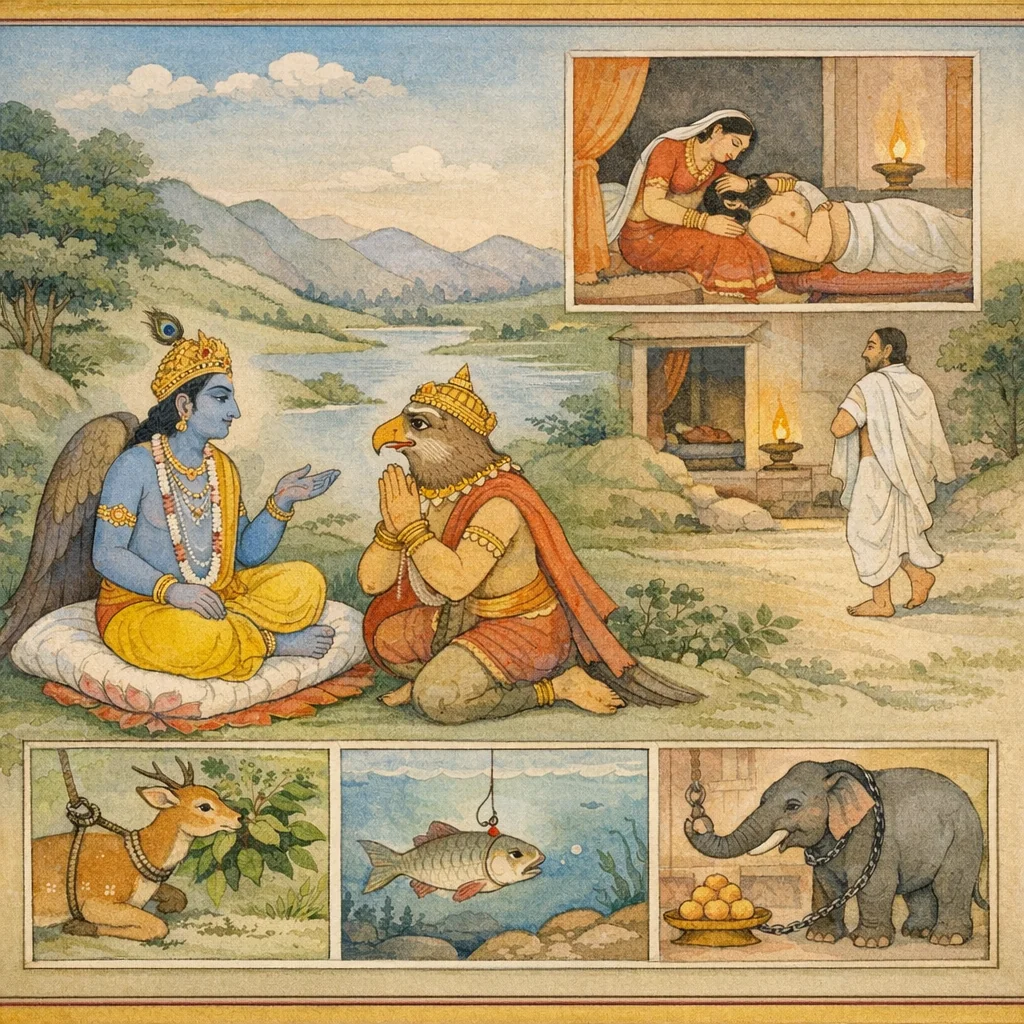
Continuing the prior chapter’s teaching on the “exit-door” at death and the signs of post-mortem ascent or descent, Śrī Kṛṣṇa tells Garuḍa that these instructions are for human welfare and to prevent preta-hood. He then outlines embodied existence through the 84 lakhs of living beings and the four modes of birth, stressing that human birth is exceedingly rare and uniquely fit to attain svarga and mokṣa. Turning to ethics, he teaches that mastery of the senses arises from merit and is open to all social conditions, while unchecked craving grows without end—even beyond divine attainments—and leads to naraka. By examples of creatures ruined by a single sense-object, he warns that indulgence in all five senses is destruction. He critiques attachment to parents, lovers, and descendants, insisting that at death one goes alone: only karma follows, while body, wealth, and kin are left behind. The chapter closes by prescribing dāna and dharma sustained by śraddhā: acts without faith are “asat,” fruitless here and hereafter, whereas sincere dharma supports artha and kāma and ultimately leads to mokṣa, preparing the ground for later teachings on the afterlife and rites.
Shlokas
Verse 1
ऊर्ध्वाधोगतिज्ञापकोत्क्रमणद्वारनिरूपणं नामैकादशो ऽध्य्याः श्रीकृष्ण उवाच / एवं ते कथितस्तार्क्ष्य जीवितस्य विनर्णयः / मानुषाणां हितार्थाय प्रेतत्वविनिवृत्तये
“The description of the exit-door at death, and the signs that indicate an upward or downward course (after death)”—thus is the (preceding) chapter. Śrī Kṛṣṇa said: “So, O Tārkṣya (Garuḍa), the account concerning life has been explained to you—told for the welfare of human beings, and for the removal of the condition of becoming a preta (restless departed spirit).”
Verse 2
चतुरशीतिलक्षाणि चतुर्भेदाश्च जन्तवः / अण्डजाः स्वेदजाश्चैव उद्भिज्जाश्च जारायुजाः
Living beings are said to be eighty-four lakhs in number, and they are of four kinds: those born from eggs, those born from sweat (moisture), those that sprout from the earth (plants), and those born from the womb (viviparous beings).
Verse 3
एकविंशतिलक्षाणि अण्डजाः परिकीर्तिताः / स्वेदजाश्च तथा प्रोक्ता उद्भिज्जाश्च क्रमेण तु
It is proclaimed that egg-born beings number twenty-one lakhs; likewise are spoken of sweat-born beings, and also those born from sprouting plants (udbhijja)—each in its proper order.
Verse 4
जरायुजास्तथा प्रोक्ता मनुष्याद्यास्तथा परे / सर्वेषामेव जन्तूनां मानुषत्वं हि दुर्लभम्
Those born from the womb (jarāyuja) are said to be humans and the like, and there are other kinds of beings as well; yet among all living creatures, attaining human birth is indeed rare.
Verse 5
पञ्चेन्द्रियनिधानत्वं महापुण्यैरवाप्यते / ब्राह्मणाः क्षत्त्रिया वैश्याः शूद्रास्तत्परजातयः
Mastery in restraining the five sense-faculties is attained through great merit. This attainment is available to all—Brahmins, Kshatriyas, Vaishyas, Shudras, and those born in related mixed lineages.
Verse 6
रजकश्चर्मकारश्च नटो बुरुड एव च / कैवर्तमेदभिल्लाश्च सप्तैते ह्यन्त्यजाः स्मृताः
The washerman, the leather-worker, the actor, and the Buruḍa; as well as the Kaivarta, the Meda, and the Bhilla—these seven are traditionally remembered as ‘antyajas’ (those counted among the lowest social groups).
Verse 7
म्लेच्छतुम्बविभेदेन जातिभेदास्त्वनेकशः / जन्तूनामेव सर्वेषां जातिभेदाः सहस्रशः
Through the differing divisions among mlecchas and the various tribes and groups, the distinctions of birth (jāti) become many. Indeed, for all living beings, the varieties of birth are in the thousands.
Verse 8
जन्तूनामेव सर्वेषां भेदाश्चैव सहस्रशः / आहारो मैथुनं निद्रा भयं क्रोधस्तथैव च
All living beings indeed are of countless varieties; yet in them all these impulses are common: food, sexual union, sleep, fear, and anger.
Verse 9
सर्वेषा मेव जन्तूनां विवेको दुर्लभः परः / एकपादादिरूपेण देहभेदास्त्वनेकशः
Among all living beings, true discriminative wisdom is exceedingly rare; for embodied forms are of many kinds—appearing as one-footed and other varieties—with innumerable distinctions of bodies.
Verse 10
कृष्णसारो मृगो यत्र धर्मदशः स उच्यते / ब्रह्माद्या देवताः सर्वास्तत्र तिष्ठन्ति सर्वशः
Where the blackbuck (kṛṣṇasāra) deer is found, that place is declared to be ‘dharma’ in full measure. There, all the deities—beginning with Brahmā—abide on every side.
Verse 11
भूतानां प्राणिनः श्रेष्ठाः प्राणिनां मतिजीविनः / मतिमत्सु नराः श्रेष्ठा नरेषु ब्राह्मणाः स्मृताः
Among all beings, the living creatures are considered superior; among living creatures, those who live by intellect are superior. Among the intelligent, humans are superior; and among humans, Brahmanas are remembered as the foremost.
Verse 12
मानुष्यं यः समासाद्य स्वर्गमेक्षैकसाधकम् / तयोर्न साधयेदेकं तेनात्मा वञ्चितो ध्रुवम्
Having obtained human birth—capable of accomplishing both heaven and liberation—if one fails to pursue even one of these two, then surely one’s own self stands deceived.
Verse 13
इच्छति शती सहस्रं सहस्री लक्षमीहते कर्तुम् / लक्षाधिपती राज्यं राजापि सकलां धरां लब्धुम्
One who has a hundred desires longs for a thousand; one who has a thousand strives to make it a lakh. A lord of lakhs seeks a kingdom, and even a king yearns to obtain the entire earth.
Verse 14
चक्रधरो ऽपि सुरत्वं सुरभावे सकलसुरपतिर्भवितुम् / सुरपतिरूर्ध्वगतित्वं तथापि ननिवर्तते तृष्णा
Even the wielder of the discus may attain the state of a god, and by a divine disposition become the lord of all gods; even as the lord of gods he may rise to higher and higher realms—yet craving does not, even then, come to an end.
Verse 15
तृष्णया चाभिभूतस्तु नरकं प्रतिपद्यते / तृष्णामुक्तास्तु ये केचित्स्वर्गवासं लभन्ति ते
One who is overpowered by craving (tṛṣṇā) indeed falls into hell; but those few who are freed from craving attain residence in heaven.
Verse 16
आत्माधीनः पुमांल्लोके सुखी भवति निश्चितम् / शब्दः स्पर्शश्च रूपं च रसो गन्धश्च तद्गुणाः
A man who is self-governed becomes happy in this world—this is certain. Sound, touch, form, taste, and smell are the qualities that belong to the field of sensory experience.
Verse 17
तथा च विषयाधीनो दुः खी भवति निश्चितम्
And thus, one who is dependent on sense-objects surely becomes sorrowful—this is certain.
Verse 18
कुरङ्गमताङ्गपतङ्गभृङ्गमीना हताः पञ्चभिरेव पञ्च / एकः प्रमादी स कथं न हन्यते यः सेवते पञ्चभिरेव पञ्च
The deer, the elephant, the moth, the bee, and the fish—these five are each destroyed by only one of the five sense-objects. How then would a heedless person not be ruined, who indulges in all five sense-objects at once?
Verse 19
पितृमातृमयो बाल्ये यौवने दयितामयः / पुत्रपौत्रमयश्चान्ते मूढो नात्ममयः क्वचित्
In childhood one is absorbed in father and mother; in youth one is absorbed in the beloved; and in the end one is absorbed in sons and grandsons. Deluded, one is never—at any time—absorbed in the Self.
Verse 20
लोहदारुमयैः पाशैः पुमान्बद्धो विमुच्यते / पुत्रदारमयैः पाशैर्नैव बद्धो विमुच्यते
A man bound with fetters made of iron or wood can be set free; but one bound by the nooses made of sons and wife is not released at all.
Verse 21
एकः करोति पापानि फलं भुङ्क्ते महाजनः / भोक्तारो विप्रयुज्यन्ते कर्ता दोषेण लिप्यते
One person commits the sins, yet the consequence is often borne by the wider multitude. The enjoyers of the results become separated, while the doer alone is stained by the fault.
Verse 22
को ऽपि मृत्युं न जयति बालो वृद्धो युवापि वा / सुखदुः खादिको वापि पुनरायाति याति च
No one conquers death—whether a child, an old man, or even a youth. Bound to the tasting of pleasure and pain, one comes again and again, and departs again as well.
Verse 23
सर्वेषां पश्यतामेव मृतः सर्वं परित्यजेत् / एकः प्रजायते जन्तुरेक एव प्रलीयते
Even as all look on, the dead leave everything behind. A being is born alone, and alone indeed it comes to dissolution.
Verse 24
एको ऽपि भुङ्क्ते सुकृतमेक एव च दुष्कृतम् / मृतं शरीरमुत्सृज्य काष्ठलोष्टसमङ्क्षितौ
Alone indeed one tastes the fruit of merit, and alone the fruit of sin. Casting off the dead body, it becomes as insignificant as a piece of wood or a clod of earth.
Verse 25
बान्धवा विमुखा यान्ति धर्मस्तमनुगच्छति / गृहेष्वर्था निवर्तन्ते श्मशानान्मित्रबान्धवाः
Relatives turn away and depart, but Dharma follows that person. Wealth remains behind at home, and friends and kinsmen return from the cremation ground.
Verse 26
शरीरं वह्निरादत्ते सुकृतं दुष्कृतं व्रजेत् / शरीरं वह्निना दग्धं पुण्यं पापं सह स्थितम्
Fire takes away only the physical body; one’s good deeds and evil deeds proceed onward. Though the body is burned by fire, merit and sin remain together with the departing being and are not destroyed.
Verse 27
शुभं वा यदि वा पापं भुङ्क्ते सर्वत्र मानवः / यदनस्तमिते सूर्ये न दत्तं धनमर्थिनाम्
A human being inevitably experiences the results of both good and evil everywhere; but before the sun has set, if wealth is not given to those who ask in need, that omission becomes a failing of Dharma.
Verse 28
न जाने तस्य तद्वित्तं प्रातः कस्य भविष्यति / रारटीति धनं तस्य को मे भर्ता भविष्यति
I do not know to whom his wealth will belong tomorrow morning. Yet he keeps crying, “My money! my money!”—and (his wife laments), “Who will be my protector (husband) now?”
Verse 29
न दत्तं द्विजमुख्येभ्यः परोपकृतये तथा / पूर्वजन्मकृतात्पुण्याद्यल्लब्धं बहु चाल्पकम्
Whatever wealth—great or small—one has obtained through merit earned in a previous birth, if it has not been given for the benefit of others to the foremost among the twice-born (worthy Brāhmaṇas), remains spiritually unfulfilled.
Verse 30
तदीदृशं परिज्ञाय धर्मार्थे दीयते धनम् / धनेन धार्यते धर्मः श्रद्धापूतेन चेतसा
Knowing the recipient to be of such worth, one should give wealth for the sake of dharma; for dharma is sustained by wealth when the mind is purified by faith (śraddhā).
Verse 31
श्रद्धाविरहितो धर्मो नेहामुत्र च तत्फलम् / धर्माच्च जायते ह्यर्थो धर्मात्कामो ऽपि जायते
Dharma that is devoid of faith yields no fruit—neither in this world nor in the next. From dharma indeed arises artha (prosperity), and from dharma even kāma (fulfilment of desires) is born.
Verse 32
धर्म एवापवर्गाय तस्माद्धर्मं समाचरेत् / श्रद्धया साध्यते धर्मो बहुभिर्नार्थराशिभिः
Dharma alone leads to apavarga (liberation); therefore one should diligently practice dharma. Dharma is accomplished through faith and sincerity—not by amassing great heaps of wealth.
Verse 33
अकिञ्चना हि मुनयः श्रद्धावन्तो दिवं गताः / अश्रद्धया हुतं दत्तं तपस्तप्तं कृतं च यत् / असदित्युच्यते पक्षिन्प्रेत्य चेह न तत्फलम्
Indeed, the sages—without possessions yet endowed with faith—attained heaven. But whatever is offered into the fire, given in charity, or performed as austerity, when done without faith, is called “unreal” (fruitless), O Bird; after death and even here, it yields no result.
Frequently Asked Questions
The chapter states that one overpowered by tṛṣṇā “falls into hell,” while those freed from craving attain heavenly residence. The logic is karmic and psychological: craving binds the mind to sense-objects, generating actions and attachments that mature as painful post-mortem experiences, whereas restraint and contentment support an upward course.
It teaches that dependence on sense-objects produces sorrow, while self-governance produces happiness. By citing the deer, elephant, moth, bee, and fish—each destroyed by one sense-object—it warns that a heedless person indulging all five senses simultaneously is even more vulnerable to ruin.
It explicitly declares that dharma devoid of faith yields no fruit in this world or the next, and that offerings, charity, and austerities done without śraddhā are “asat” (unreal/ineffective). The intended shastric point is that inner assent and sincerity are the operative causes that connect outward ritual/charity to karmic fruition.
While it does not deny the role of rites, it repeatedly emphasizes that the body is burned, relatives return, and wealth stays behind, whereas merit and sin proceed with the jīva. The takeaway is that rites and charity are meaningful insofar as they are dharmic, faith-rooted, and consonant with the person’s karmic continuity—preparing the reader for later, more technical preta-ritual discussions.