Adhyaya 11
Karma, Subtle-Body Formation, and the Route of Departure (Ūrdhva-mārga)
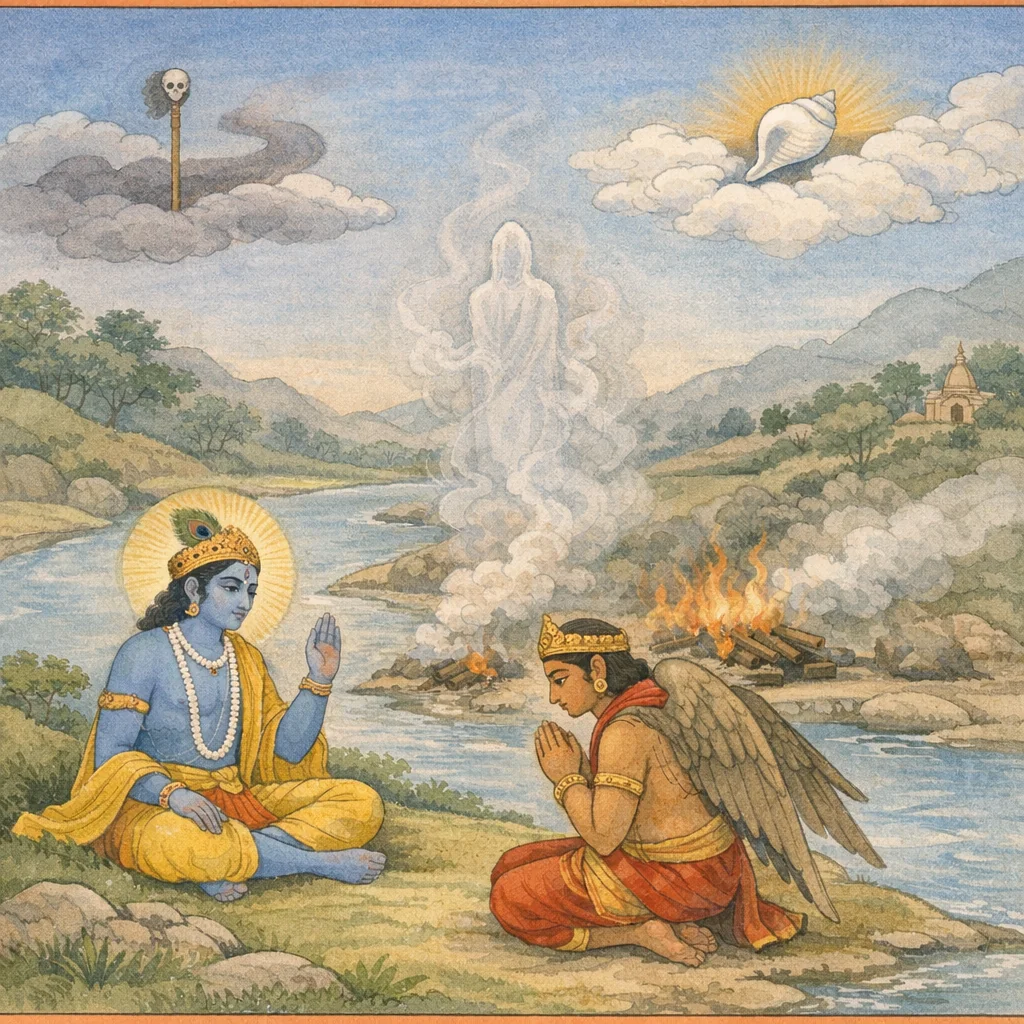
Continuing the wider Preta-kalpa inquiry into the dead, Garuḍa presses: what causes human birth and death, where senses and karma persist, why the departed becomes “untouchable” yet still undergoes results, and how beings reach Yama-loka or Viṣṇu-loka. Śrī Kṛṣṇa answers by linking specific sins to degraded rebirths (such as brahma-rākṣasa states and low-caste births), then teaches that repeated desires fashion the liṅga-śarīra, a subtle body untouched by gross elements yet retaining functional faculties and bodily apertures. The chapter identifies an “upper opening” as the virtuous exit-route and stresses the necessity of prescribed rites from the day of death through the annual ceremony. It concludes that faults of mind, speech, and body inevitably bear fruit: dharmic persons attain well-being after death, while those bound to vikarma remain caught in māyā’s snare, preparing for the next teachings on post-mortem experience and ritual consequences.
Shlokas
Verse 1
श्राद्धस्य तृप्तिदत्वादिनिरूपणं नाम दशमो ऽध्यायः गरुड उवाच / मानुषत्वं लभेत्कस्मान्मृत्युमाप्नोति तत्कथम् / म्रियते कः सुरश्रेष्ठ देहमाश्रित्य कुत्रचित्
Garuda said: “O best among the gods, from what cause does a being attain human birth? And how does it come to meet with death? Who is it that dies—having taken up a body here in some place?”
Verse 2
इन्द्रियाणि कुतो यान्ति ह्यस्पृश्यः स कथं भवेत् / क्व कर्माणि कृतानीह कथं भुङ्क्ते प्रसर्पति
“Where do the senses go? And how can that departed being become ‘untouchable’? Where do the deeds (karma) done here remain, and how does he experience their results and move about?”
Verse 3
प्रसादं कुरु मे मोहं छेत्तुमर्हस्यशेषतः / काश्यपो ऽहं सुरश्रेष्ठ विनतागर्भ संभवः / यमलोकं कथं यान्ति विष्णुलोकं च मानवाः
“Be gracious to me and cut away my delusion completely. I am Kāśyapa’s son, O best among the gods, born from the womb of Vinatā. How do human beings go to Yama’s realm (Yama-loka), and how do they attain Viṣṇu’s realm (Viṣṇu-loka)?”}]}
Verse 4
श्रीकृष्ण उवाच / परस्य योषितं हृत्वा ब्रह्मस्वमपहृत्य च
Śrī Kṛṣṇa said: “One who abducts another man’s wife, and who also steals the property belonging to a brāhmaṇa…”
Verse 5
अरण्ये निर्जने देशे जायते ब्रह्मराक्षसः / हीनजातौ प्रजायेत रत्नानामपहारकः
In a forest—an isolated, desolate place—one is born as a brahma-rākṣasa. But the thief who steals jewels is born into a low and degraded birth.
Verse 6
यंयं काममभिध्यायेत्स तल्लिङ्गो ऽभिजायते / नैनं छिन्दन्ति शस्त्राणि नैनं दहति पावकः
Whatever desire a being repeatedly contemplates, according to that desire the liṅga-śarīra (subtle body) takes form; weapons cannot cut it, and fire cannot burn it.
Verse 7
न चैनं क्लेदयन्त्यापो न शोषयति मारुतः / वाक् चक्षुर्नासिका कर्णौ गुदं मूत्रस्य सञ्चरः
Waters do not moisten it, nor does the wind dry it. Speech, sight, smell, and hearing remain; and there are also the anus and the passage for the flow of urine.
Verse 8
अण्डजादिकजन्तूनां छिद्राण्येतानि सर्वशः / आनाभेर्मूर्धपर्यन्तमूर्ध्वच्छिद्राणि चाष्ट वै
For egg-born beings and other creatures, these apertures are found in every way. From the navel up to the head, there are indeed eight upward-facing openings.
Verse 9
सन्तः सुकृतिनो मर्त्या ऊर्ध्वच्छिद्रेण यान्ति वै / मृताहे वार्षिकं यावद्यथोक्तविधिना खग
O Garuḍa, the virtuous and meritorious among mortals indeed depart through the upper opening. From the day of death until the annual rite, the prescribed ceremonies should be performed in the manner that has been stated.
Verse 10
कुर्यात्सर्वाणि कर्माणि निर्धनो ऽपि हि मानवः / देहे यत्र वसेज्जन्तुस्तत्र भुङ्क्ते शुभाशुभम्
Even if a man is poor, he should perform all prescribed duties; for the embodied being experiences the results—both auspicious and inauspicious—right in the very body in which he dwells.
Verse 11
मनोवाक्कायजान्दोषांस्तथां भुङ्क्ते खगेश्वर / मृतः स सुखमाप्नोति मायापाशैर्न बध्यते / पाशबद्धो नरो यस्तु विकर्मनिरतो भवेत्
O Khageśvara (Garuḍa), one certainly experiences the faults born of mind, speech, and body. Yet, after death, such a one attains well-being and is not bound by the nooses of illusion (Māyā). But the man caught in the snare, devoted to vikarma—wrongful acts—meets bondage and suffering.
Frequently Asked Questions
The text states that whatever a being repeatedly contemplates, the subtle body takes form in accordance with that desire. This implies that persistent mental orientations become causal forces shaping post-death experience and rebirth trajectories, functioning alongside ethical karma.
It denotes an auspicious exit-route at death associated here with the virtuous and meritorious. The chapter contrasts this favorable departure with bondage caused by vikarma, implying that ethical and spiritually aligned living supports an elevated post-mortem passage.
It presents a continuous ritual obligation during the liminal post-death period, aligning family duty (dharma) with the departed’s transition. The instruction suggests that these rites are prescribed supports within the Preta-kalpa framework for orderly post-mortem movement and welfare.