Adhyaya 54
Names of Priyavrata’s Sons; Division of the Seven Continents; Sapta-dvīpa and Meru Description; Nābhi–Ṛṣabha–Bharata Lineage
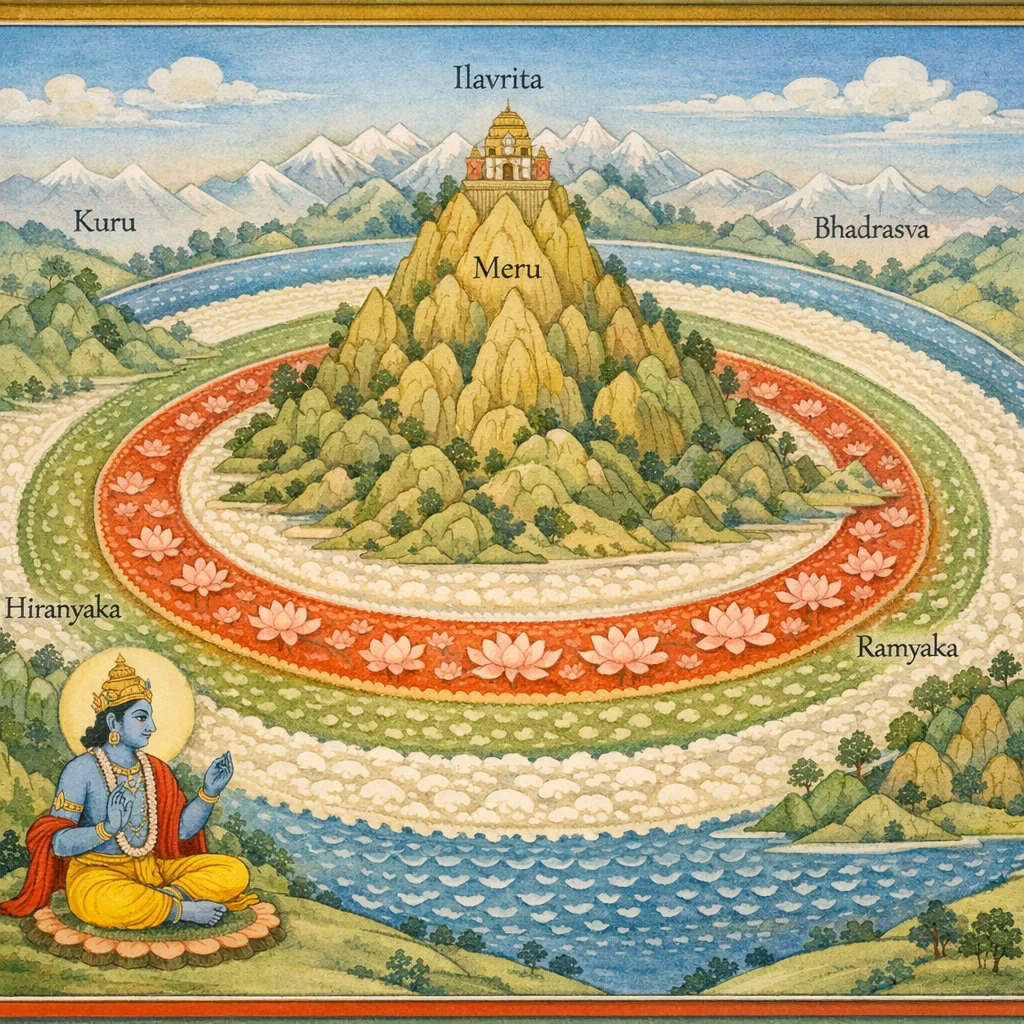
Continuing the Purāṇic account of the primordial kings and the ordering of the earth, Hari lists Priyavrata’s sons and notes a yogic current among Medhāgnibāhu’s descendants, setting renunciation beside royal duty. The narrative then turns to cosmography: the earth is measured, the seven dvīpas are named, and each is encircled by seven oceans of different substances, with each successive dvīpa and ocean doubling in size. Jambūdvīpa is centered on Mount Meru, whose breadth, height, subterranean reach, and summit width are specified, along with the surrounding regions and varṣa-mountains. Returning to dynastic history, the chapter mentions the nine sons linked to Jambūdvīpa’s lord and proceeds to Nābhi, the birth of Ṛṣabha, then Bharata and the succeeding rulers in genealogical order. Thus the adhyāya joins the cosmic map to sacred history, preparing for later discussions of regional divisions, lineages, and their dharmic meaning.
Shlokas
Verse 1
नाम त्रिपञ्चाशत्तमो ऽध्यायः हरिरुवाच / अग्नीध्रश्चाग्निबाहुश्च बपुष्मान्ध्युतिमांस्तथा / मेधामेधातिथिर्भव्यः शबलः पुत्र एव च
Chapter Fifty-Four (Names). Hari said: “They are Agnīdhra, and also Agnibāhu; likewise Bapuṣmān and Dhyutimān; Medhā, Medhātithi, Bhavya, and Śabala—these too are the sons.”
Verse 2
ज्योतिष्मान्दशमो जातः पुत्रा ह्येते प्रियव्रतात् / मेधाग्निबाहुपुत्रास्तु त्रयो योगपरायणाः
The tenth son, named Jyotiṣmān, was born. These indeed were the sons of Priyavrata; and the three sons of Medhāgnibāhu were devoted to the path of Yoga.
Verse 3
जातिस्मरा महाभागा नैराज्याय ममो दषुः / विभज्य सप्त द्वीपानि सप्तानां प्रददौ नृपः
The noble lady, endowed with memory of past births, urged me toward renunciation. Then the king, dividing the seven continents, bestowed them upon seven rulers.
Verse 4
योजनानां प्रमाणेन पञ्चाशत्कोटिराप्लुता / जलोपरि मही याता मौरिवास्ते सरिज्जले
Measured in yojanas, the earth—flooded to the extent of fifty koṭis—rose above the waters; and the beings called Mauris dwell within the river-water.
Verse 5
जम्बूप्लक्षाह्वयौ द्वीपौ शाल्मलश्चापरो हर / कुशः क्रौञ्चस्तथा शाकः पुष्करश्चैव सप्तमः
The dvīpas (sacred continents) are named Jambū and Plakṣa; then Śālmala and next Hara; followed by Kuśa, Krauñca, and Śāka; and Puṣkara is the seventh.
Verse 6
एते द्वीपाः समुद्रैस्तु सप्त सप्तभिरावृताः / लवणेक्षुसुरासर्पिर्दाधिदुग्धजलैः समम्
These dvīpas are encircled by seven oceans in sevenfold order: salt-water, sugarcane-juice, surā (wine), clarified butter (ghṛta), curd (dadhi), milk, and pure water.
Verse 7
द्वीपात्तु द्विगुणो द्वीपः समुद्रश्च वृषध्वज / जम्बूद्वीपे स्थितो मेरुर्लक्षयोजनविस्तृतः
O Vṛṣadhvaja, Bearer of the Bull-banner, each succeeding dvīpa is said to be twice the size of the one before it, and so too each encircling ocean. In Jambūdvīpa stands Mount Meru, a hundred thousand yojanas in breadth.
Verse 8
चतुरशीतिसाहस्रैर्योजनैरस्य चोच्छ्रयः / प्रविष्टः षोडशाधस्ताद्द्वत्रिंशन्मूर्ध्नि विस्तृतः
Its height is eighty-four thousand yojanas. It extends sixteen yojanas downward, and at the summit it spreads to thirty-two yojanas in breadth.
Verse 9
अधः षोडशसाहस्रः कर्णिकाकारसंस्यितः / हिमवान्हेमकूटश्च निषधश्चास्य दक्षिणे
Below it, extending for sixteen thousand yojanas, lies a region shaped like a lotus-whorl. To its south are the mountains Himavān, Hemakūṭa, and Niṣadha.
Verse 10
नीलः श्वेतश्च शृङ्गी च उत्तरे वर्षपर्वताः / प्लक्षादिषु नरा रुद्र ये वसन्ति सनातनाः
O Rudra, in the northern quarter stand the Varṣa-mountains named Nīla, Śveta, and Śṛṅgī; and in the lands beginning with Plakṣa dwell the ancient, primeval races of men.
Verse 11
शङ्कराथ न तेष्वस्ति युगावस्था कथञ्चन / जम्बूद्वीपेश्वरात्पुत्रा ह्यग्रीध्नादभवन्नव
For Śaṅkara’s sake, among them there is in no way any fixed succession of the yugas. From the lord of Jambūdvīpa were born nine sons, beginning with Agrīdhna.
Verse 12
नाभिः किंपुरुषश्चैव हरिवर्षमिला वृतः / रम्यो हिरण्मयाख्यश्च कुरुर्भद्राश्व एव च
Nābhi is encircled by Kimpuruṣa and Hari-varṣa; and likewise by Ramya, the region called Hiraṇmaya, Kuru, and also Bhadrāśva.
Verse 13
केतुमालो नृपस्तेभ्यस्तत्संज्ञान् खण्डकान्ददौ / नाभेस्तु मेरुदेव्यां तु पुत्रो ऽभूदृषभो हर
King Ketumāla bestowed upon them the territorial divisions bearing those very names. And to Nābhi, from Merudevī, a son was born—Ṛṣabha, O Hara.
Verse 14
तत्पुत्रो भरतो नाम शालग्रामे स्थितो व्रती / सुमतिर्भरतस्याभूत्तत्पुत्रस्तैजसो ऽभवत्
His son was named Bharata, a vow-observing ascetic who dwelt at Śālagrāma. Bharata’s son was Sumati, and Sumati’s son was Taijasa.
Verse 15
इन्द्रद्युम्नश्च तत्पुत्रः परमेष्ठी ततः स्मृतः / प्रतीहारश्चतत्पुत्रः प्रतिहर्ता तदात्मजः
Indradyumna—and his son is remembered as Parameṣṭhī. Pratīhāra is said to be his son, and Pratihartā is the son of Pratīhāra.
Verse 16
सुतस्तस्मादथै जातः प्रस्तारस्तत्सुतो विभुः / पृथुश्च तत्सुतो नक्तो नक्तस्यापि गयः स्मृतः
From him, Suta was then born; and Suta’s son was the mighty Prastāra. Pr̥thu was his son; Pr̥thu’s son was Nakta; and Nakta’s son is remembered as Gaya.
Verse 17
नरो गयस्य तनयस्तत्पुत्रोभुद्विराडगतः / ततो धीमान्महातेजा भौवनस्तस्य चात्मजः
Nara was the son of Gaya; his son was Virāḍāgata. Thereafter, the wise and greatly radiant Bhauvana was born as his son.
Verse 18
त्वष्टा त्वष्टुश्च विरजा रजस्तस्याप्यभूत्सुतः / शतजिद्रजसस्तस्य विष्वग्ज्योतिः सुतः स्मृतः
From Tvaṣṭā was born Virajā; and from Virajā was born Rajas. From Rajas, Śatajit was born; and Śatajit’s son is remembered as Viṣvagjyoti.
Frequently Asked Questions
The chapter lists Priyavrata’s sons including Agnīdhra, Agnibāhu, Bapuṣmān, Dhyutimān, Medhā, Medhātithi, Bhavya, Śabala, and the tenth named Jyotiṣmān, presenting them as a foundational genealogical set within early Purāṇic kingship.
Within Purāṇic framing, a yogic disposition indicates inward discipline oriented toward liberation (mokṣa), often paired with reduced attachment to sovereignty. The text uses this to show that spiritual realization can arise within royal lines, balancing pravṛtti (worldly order) and nivṛtti (renunciation).
The chapter states a proportional rule: each successive dvīpa is twice the size of the preceding one, and each surrounding ocean likewise doubles. This creates a systematic, expanding concentric model for bhū-maṇḍala.
The adhyāya portrays Bharata as vow-observing and ascetic, living at Śālagrāma—a tīrtha strongly associated with Viṣṇu worship. This links the royal name “Bhārata” to a devotional-ascetic ideal, not merely political sovereignty.