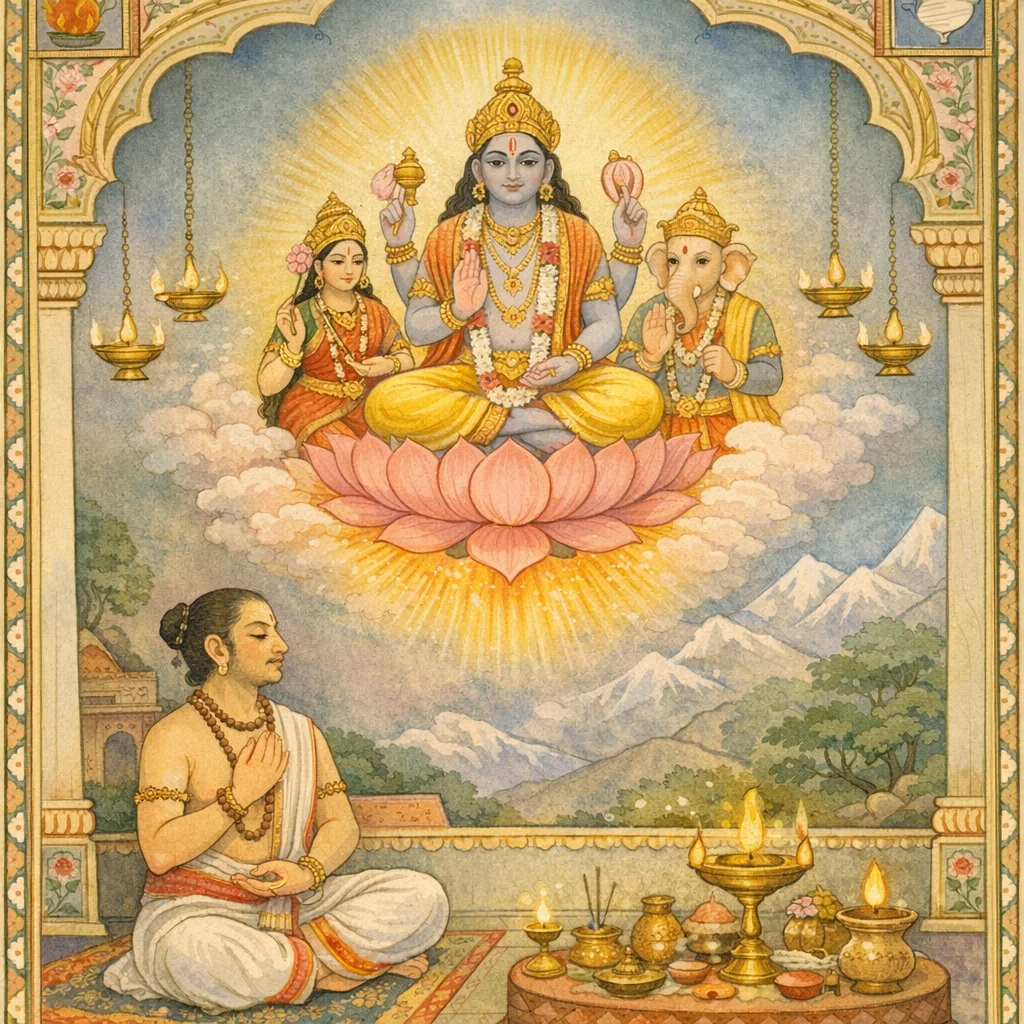
Adhyaya 30
The Procedure of Worship (Śrīdharapūjā-vidhi)
Continuing Khanda 1’s ācāra-focused instruction, Sūta sets out a complete liturgical order for worship of Śrīdhara (Viṣṇu) with His parivāra. The practitioner begins with nyāsa-mantras placed on the body (heart, head, śikhā, kavaca, eyes, astra), performs Vaiṣṇava mudrās, and meditates on self-identification as Śrīdhara bearing śaṅkha–cakra–gadā. Worship proceeds within a consecrated maṇḍala marked by auspicious signs, starting with āsana-pūjā and extended salutations that situate the rite amid cosmic supports and ethical categories (dharma, jñāna, vairāgya, aiśvarya and their opposites). Hari is invoked, then Śrī (Lakṣmī), divine ornaments and weapons, dikpālas and guṇas, and Viṣvaksena are honored. Standard upacāras culminate in mantra-japa 108 times, inner dhyāna on the crystal-radiant Lord in the heart, and a stotra of repeated salutations to Śrīnivāsa/Śrīpati. The chapter ends with a phalaśruti promising destruction of sins and attainment of Viṣṇu’s supreme abode, preparing for further practice-oriented teachings.
Shlokas
Verse 1
पूजनविधिर्नामैकोनत्रिंशो ऽध्यायः सूत उवाच / विस्तरेण प्रवक्ष्यामि श्रीधरस्यार्चनं शुभम् / परिवारश्च सर्वेषां समोज्ञेयो हि पण्डितैः
“The chapter called ‘The Procedure of Worship’.” Sūta said: “I shall set forth in detail the auspicious rite of adoration (arcana) of Śrīdhara (Viṣṇu), and also His entire attendant retinue (parivāra); this the learned should rightly understand.”
Verse 2
ॐ श्रां हृदयाय नमः / ॐ श्रींशिरसे स्वाहा / ॐ श्रू शिखायै वषटू / ॐ श्रैं कवचाय हुं / ॐ श्रौं नेत्रत्रयाय वौषट् / ॐ श्रः अस्त्राय फट् इति
“Om śrāṃ—salutations to the Heart; Om śrīṃ—svāhā to the Head; Om śrū—vaṣaṭ to the śikhā (crown-lock); Om śraiṃ—huṃ to the kavaca (protective armor); Om śrauṃ—vauṣaṭ to the Three Eyes; Om śraḥ—phaṭ to the astra (weapon).” Thus are the nyāsa-mantras.
Verse 3
दर्शयेदात्मनो मुद्रां शङ्खचक्रगदादिकाम् / ध्यात्वात्मानं श्रीधराख्यं शङ्खचक्रगदाधरम्
Display one’s own mudrās—such as those of the conch, discus, mace, and the like—and then meditate on oneself as Śrīdhara, the bearer of the conch (śaṅkha), discus (cakra), and mace (gadā).
Verse 4
ततस्तं पूजयेद्देवं मण्डले स्वस्तिकादिके / आसनं पूजयेदादौ देवदेवस्य शार्ङ्गिणः / एबिर्मन्त्रैर्महादेव तान्मत्राञ्छृणु शङ्कर
Then one should worship that Lord within a consecrated maṇḍala marked with auspicious signs such as the svastika. First, one should worship the āsana, the seat of Śārṅgiṇa—Viṣṇu, God of gods, bearer of the Śārṅga bow. O Mahādeva, O Śaṅkara, listen to those mantras used for this worship.
Verse 5
ॐ श्रीधरासनदेवताः आगच्छता / ॐ समस्तपरिवारायच्युतासनाय नमः
Om. O deities presiding over Śrīdhara’s seat, please come. Om. Salutations to Acyuta’s seat, together with the entire divine retinue.
Verse 6
ॐ धात्रे नमः / ॐ विधात्रे नमः / ॐ गङ्गायै नमः / ॐ यमुनायै नमः / ॐ आधारशक्तयै नमः / ॐ कूर्ंमाय नमः / ॐ अनन्ताय नमः / ॐ पृथिव्यै नमः / ॐ धर्ंमाय नमः / ॐ ज्ञानाय नमः / ॐ वैराग्याय नमः / ॐ ऐश्वर्याय नमः / ॐ अधर्ंमाय नमः / ॐ अज्ञानाय नमः / ॐ अवैराग्याय नमः / ॐ अनैश्वर्याय नमः / ॐ कन्दाय नमः / ॐ नालाय नमः / ॐ पद्माय नमः / ॐ विमलायै नमः / ॐ उत्कर्षिण्यै नमः / ॐ ज्ञानायै नमः / ॐ क्रियायै नमः / ॐ योगायै नमः / ॐ प्रह्व्यै नमः / ॐ सत्यायै नमः / ॐ ईशानायै नमः / ॐ अनुग्रहायै नमः
Om—salutations to Dhātṛ; Om—salutations to Vidhātṛ; Om—salutations to Gaṅgā; Om—salutations to Yamunā; Om—salutations to the Supporting Power (Ādhāra-śakti); Om—salutations to Kūrma; Om—salutations to Ananta; Om—salutations to Earth (Pṛthivī); Om—salutations to Dharma; Om—salutations to Knowledge (Jñāna); Om—salutations to Dispassion (Vairāgya); Om—salutations to Divine Lordship (Aiśvarya); Om—salutations to Adharma; Om—salutations to Ignorance (Ajñāna); Om—salutations to Non-dispassion (Avairāgya); Om—salutations to Powerlessness (Anaiśvarya); Om—salutations to the root (Kanda); Om—salutations to the stalk (Nāla); Om—salutations to the lotus (Padma); Om—salutations to Vimalā; Om—salutations to Utkarṣiṇī; Om—salutations to Jñānā; Om—salutations to Kriyā; Om—salutations to Yoga; Om—salutations to Prahvī; Om—salutations to Satya; Om—salutations to Īśāna; Om—salutations to Grace (Anugraha).
Verse 7
अर्चयित्वा समं रुद्र हरिमावाह्य संयजेत् / मन्त्रैरेभिर्महाप्राज्ञः सर्वपापप्रणाशनैः
Having duly worshipped Rudra, and having invoked Hari, the very wise should perform the rite of worship with these mantras that destroy all sins.
Verse 8
ॐ ह्रीं श्रीधराय त्रैलोक्यमोहनाय विष्णवे नमः आगच्छ
Om. Hrīṃ. Salutations to Viṣṇu—Śrīdhara, the Enchanter of the three worlds. Come forth; be present here.
Verse 9
ॐ श्रियै नमः / ॐ श्रां हृदयाय नमः / ॐ श्रीं शिरसे नमः / ॐ श्रूं शिखायै नमः / ॐ श्रैं कवचाय नमः / ॐ श्रौं नेत्रत्रयाय नमः / ॐ श्रः अस्त्राय नमः / ॐ शङ्खाय नमः / ॐ पद्माय नमः / ॐ चक्राय नमः / ॐ गदायै नमः / ॐ श्री वत्साय नमः / ॐ कौस्तुभ्य नमः / ॐ वनमालायै नमः / ॐ पीताम्बराय नमः / ॐ व्रह्मणे नमः / ॐ नारदाय नमः / ॐ गुरुभ्यो नमः / ॐ इन्द्राय नमः / ॐ अग्नये नमः / ॐ यमाय नमः / ॐ निरृतये नमः / ॐ वरुणाय नमः / ॐ वायवे नमः / ॐ सोमाय नमः / ॐ ईशानाय नमः / ॐ अनन्ताय नमः / ॐ ब्रह्मणे नमः / ॐ सत्त्वाय नमः / ॐ रजसे नमः / ॐ तमसे नमः / ॐ विष्वक्सेनाय नमः
Om—salutations to Śrī (Lakṣmī). Om—salutations to the Lord’s heart; to the head; to the crown-tuft (śikhā); to the protective armor; to the three eyes; and to the divine missile (astra). Om—salutations to the conch, the lotus, the discus, and the mace; to Śrīvatsa; to Kaustubha; to the forest-garland; and to the yellow garment (pītāmbara). Om—salutations to Brahmā; to Nārada; to the Gurus; to Indra; to Agni; to Yama; to Nirṛti; to Varuṇa; to Vāyu; to Soma; to Īśāna; to Ananta; to Brahmā; and to the guṇas—sattva, rajas, and tamas. Om—salutations to Viṣvaksena.
Verse 10
अभिषेकं तथा वस्त्त्रं ततो यज्ञोपवीतकम् / गन्धं पुष्पं तथा धूपं दीपमन्नं प्रदक्षिणम्
One should perform the abhiṣeka (ceremonial bathing), offer clothing, and then the sacred thread (yajñopavīta); also offer fragrance, flowers, incense, a lamp, food, and finally pradakṣiṇa—reverent circumambulation.
Verse 11
दद्यादेभिर्महामन्त्रैः समप्यार्थ जपेन्मनुम् / शतमष्टोत्तरं चापि जप्त्वा ह्यथ समर्पयेत्
Having made the offering with these great mantras and duly concluded the rite, one should recite the mantra; and after chanting it one hundred and eight times, one should formally offer it again, bringing the worship to completion.
Verse 12
ततो मुहूर्तमेकन्तुध्यायेद्देवं हृदि स्थितम् / शुद्धस्फटिकसंकाशं सूर्यकोटिसमप्रभम्
Then, in solitude, one should meditate for a muhūrta upon the Lord abiding in the heart—radiant like pure crystal, with a splendor equal to ten million suns.
Verse 13
प्रसन्नवदनं सौम्यं स्फुरन्मकरकुण्डलम् / किरीटिनमुदाराङ्गं वनमालासमन्वितम्
He appeared with a serene face and gentle aspect, wearing shining makara-shaped earrings; crowned, with noble and splendid limbs, and adorned with the forest-garland (vanamālā).
Verse 14
परब्रह्मस्वरूपं च श्रीधरं चिन्तयेत्सुधीः / अनेन चैव स्तोत्रेण स्तुवीत परमेश्वरम्
The wise should contemplate Śrīdhara as the very form of the Supreme Brahman; and with this same hymn should praise the Supreme Lord (Parameśvara).
Verse 15
श्रीनिवासाय देवाय नमः श्रीपतये नमः / श्रीधराय सशार्ङ्गाय श्रीप्रदाय नमोनमः
Salutations to the divine Lord Śrīnivāsa; salutations to Śrīpati, the consort of Lakṣmī. Salutations to Śrīdhara, bearer of Śrī (Lakṣmī), to Him who bears the Śārṅga bow, and to the bestower of auspicious prosperity—again and again, salutations.
Verse 16
श्रीवल्लभाय शान्ताय श्रीमते च नमोनमः / श्रीपर्वतनिवासाय नमः श्रेयस्कराय च
Salutations again and again to Śrī Vallabha, the tranquil and auspicious Lord; salutations to the One who dwells on the sacred mountain, the bestower of supreme good (śreyas).
Verse 17
श्रेयसां पतये चैव ह्याश्रमाय नमोनमः / नमः श्रेयः स्वरूपाय श्रीकराय नमोनमः
Repeated salutations to the Lord of all that is auspicious, and indeed to the sacred refuge (āśrama). Salutations again to Him whose very nature is supreme good (śreyas), and to the bestower of śrī—prosperity and auspiciousness.
Verse 18
शरण्याय वरेण्याय नमो भूयो नमोनमः / स्तोत्रं कृत्वा नमस्कृत्य देवदेवं विसर्जयेत्
Salutations again and again to the One who is the refuge and the most worthy of adoration. Having composed (or recited) a hymn and bowed in reverence, one should respectfully take leave of Devadeva, the Lord of gods.
Verse 19
यः करोति महाभक्त्या स याति परमं पदम्
Whoever performs this with great devotion attains the supreme abode.
Verse 20
इं यः पठते ऽध्यायं विष्णुपूजाप्रकाशकम् / स विधूयेह पापानि याति विष्णोः परं पदम्
Whoever recites this chapter that illuminates the worship of Viṣṇu, shakes off sins here itself and attains Viṣṇu’s supreme abode.
Frequently Asked Questions
This is a ritual internalization: by mudrā and bhāvanā (identity-meditation), the practitioner aligns the body-mind with the deity’s form, making the subsequent external worship (bāhya-pūjā) coherent with inner presence (antar-yāga). It reflects the Purāṇic-tantric tendency to fuse devotion with disciplined visualization.
The chapter prescribes japa of the invoked mantra 108 times before a concluding offering. In classical Hindu ritual culture, 108 functions as a complete count (pūrṇatā) for japa, marking disciplined repetition that stabilizes attention and seals the rite with a formal completion (pūrṇāhuti-like closure).