Adhyaya 20
Śiva-taught Mantra-Weapons, Mudrās, and Rakṣā-Rites (Removal of Kīlaka; Protection from Nāga, Viṣa, Graha, and Storms)
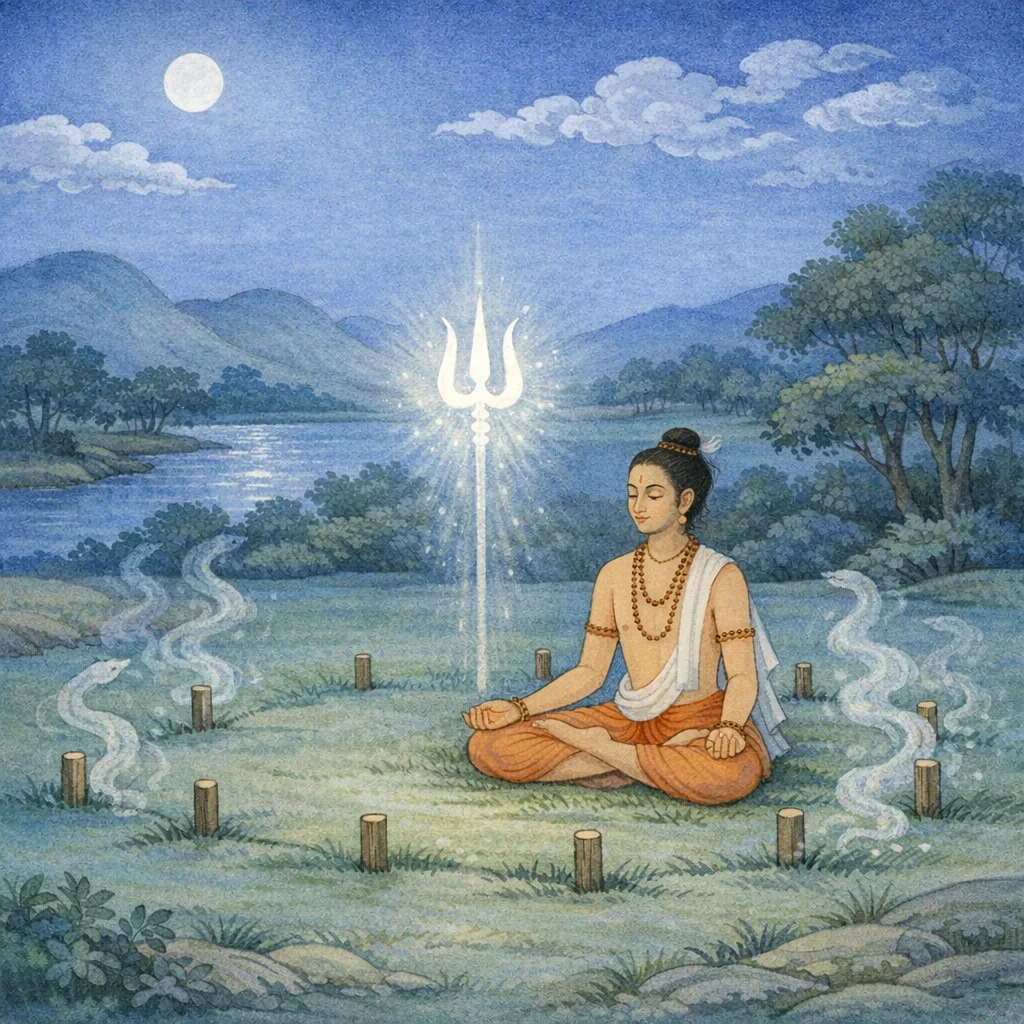
Continuing Sūta’s Purāṇic mode of instruction, this chapter turns to a guarded “supreme secret” of mantra-śastra: the noose (pāśa), bow, discus (cakra), mudrā, trident (triśūla), and battle-axe, taught as practical means for a ruler’s victory and protection. It explains proper extraction and writing of mantras, cites the Īśāna-patraka and an eightfold syllabic grouping, and installs Śiva upon the trident through bīja sequences. Protective uses follow: trident-visualization to destroy nāgas; sky-directed dhyāna to neutralize malignant clouds, grahas, and rākṣasas; and the compact safeguard mantra “Oṁ jūṁ sūṁ hūṁ phaṭ.” Field-protection rites employ eight khadira pegs and a nocturnal burial after 21 recitations to remove the kīlaka obstruction. Further mantras invoke Sadāśiva, Gaṇeśa, and Bhairava, with specialized mudrās (vajra and pāśa) to counter poison, seizing spirits, and hostile forces. The chapter closes with a technical note on prāṇāyāma empowerment: inhalation fills mantras with vital force, retention consecrates them, and praṇava sustains their efficacy, bridging to later ritual instructions.
Shlokas
Verse 1
निरूपणं नामैकोनविंशो ऽध्यायः सूत उवाच / वक्ष्ये तत्परमं गुह्यं शिवोक्तं मन्त्रबृन्दकम् / पाशं धनुश्च चक्रं च मुद्ररं शूलपट्टिशम्
Sūta said: “I shall expound this supreme secret—the cluster of mantras taught by Śiva: the noose, the bow, the discus, the mudrā, the trident, and the battle-axe.”
Verse 2
एतैरेवायुधैर्युद्धे मन्त्रैः शत्रूञ्जयेन्नृपः / मन्त्रोद्धारः पद्मपात्रे आदि पूर्वादिके लिखेत्
With these very weapons, together with the accompanying mantras, a king should conquer his enemies in battle. The extracted (collected) mantra should be written on a lotus-leaf vessel, beginning with the first syllable and proceeding in proper order.
Verse 3
अष्टवर्गं चाष्टमं च ख्यातमीशानपत्रके / ॐ कारो ब्रह्म बीजं स्याद्ध्रीङ्कारो विष्णुरेव च
In the well-known Īśāna-patraka, the group of eight syllables and the eighth as well are taught: ‘Oṁ’ is said to be the seed (bīja) of Brahmā, and ‘Hrīṁ’ indeed is Viṣṇu.
Verse 4
ह्रीङ्का रश्च शिवः शूले त्रिशाखे तु क्रमान्न्यसेत् / ॐ ह्रीं ह्रीं
Then, in due sequence, one should place the syllable ‘Hrīṁ’ and invoke Śiva upon the trident with three prongs, uttering: ‘Oṁ hrīṁ hrīṁ.’
Verse 5
शूलं गृहीत्वा हस्तेनाभ्राम्य चाकाशसंमुखम् / तद्दर्शनान्द्रहा नागा दृष्ट्वा वा नाशमाप्नु युः
Grasping a trident in his hand and whirling it facing the sky, by merely seeing it the serpents are swiftly struck down—or, on seeing it, they meet destruction.
Verse 6
धूमारक्ते करं मध्ये ध्यात्वा खे चिन्तयेन्नरः / दुष्टा नागा ग्रहा मेघा विनश्यन्ति च राक्षसाः
Meditating on a smoke-red ray in the center of the palm and contemplating it in the sky, a person brings about the destruction of wicked serpents, malignant graha afflictions, storm-clouds, and even rākṣasas.
Verse 7
त्रिलोकान्रक्षयेन्मन्त्रो मर्त्यलोकस्य का कथा / ॐ जूं सूं हूं फट्
This mantra can protect the three worlds—what need be said, then, of protecting the mortal realm? Oṁ jūṁ sūṁ hūṁ phaṭ.
Verse 8
खादिरान्कीलकानष्टौ क्षेत्रे संमन्त्र्य विन्यसेत् / न तत्र वज्रपातस्य स्फूर्जथ्वादेरुपद्रवः
After consecrating them with mantras, one should place eight khadira-wood pegs in the field; there, no calamity from lightning-strikes, thunder, and the like will occur.
Verse 9
गरुडोक्तैर्महामन्त्रैः कीलकानष्ट मन्त्रयेत् / एकविंशतिवाराणि क्षेत्रे तु निखनेन्निशि
With the great mantras spoken by Garuḍa, one should consecrate the eight pegs to remove the ‘kīlaka’ obstruction. Repeating it twenty-one times, one should bury them in a field at night.
Verse 10
विद्युन्मूषकवज्रादिसमुपद्रव एव च / हरक्षमलवरयू बिन्दुयुक्तः सदाशिवः
And there are afflictions such as lightning, rats, vajra-like thunderbolts, and the like. (For protection) one should contemplate or recite Sadāśiva, joined with the bindu, together with Hara, Kṣamala, and Varayū.
Verse 11
ॐ ह्रां सदाशिवाय नमः / तर्जन्या विन्यसेत्पिण्डं (ण्डे) दाडिमीकुसुमप्रभम्
“Om hrāṃ, obeisance to Sadāśiva.” With the index finger one should place (install) the piṇḍa, radiant like the blossom of a pomegranate.
Verse 12
तस्यैव दर्शनाद्दुष्टा मेघविद्युद्दिपादयः / राक्षसा भूतडाकिन्यः प्रद्रवन्ति दिशो दश
At the very sight of him, the wicked—such as terrifying cloud-and-lightning apparitions—along with rākṣasas, bhūtas, and ḍākinīs, flee in all ten directions.
Verse 13
ॐ ह्रीं गणेशाय नमः / (ॐ ह्रीं) स्तम्भनादिचक्राय नमः / ॐ ऐं ब्रहयैन्त्रै लोक्यडामराय नमः
“Om, Hrīṃ—salutations to Gaṇeśa. (Om, Hrīṃ)—salutations to the cakra of rites beginning with ‘stambhana’ (arresting/immobilizing). Om, Aiṃ—salutations to the Brahma-yantra, to Lokya-Ḍāmara.”
Verse 14
भैरवं पिण्डमाख्यातं विषपापग्रहापहम् / क्षेत्रस्य रक्षणं भूतराक्षसादेः प्रमर्दनम्
The piṇḍa known as “Bhairava” is said to remove poison, sins, and malignant planetary/seizing influences; it protects the sacred site and crushes bhūtas, rākṣasas, and the like.
Verse 15
ॐ नमः / इन्द्रवज्रं करे ध्यात्वा दुष्टमेघादिवारणम् / विष शत्रुगणा भूता नश्यन्ते वज्रमुद्रया
Om, salutations. Meditating on Indra’s thunderbolt in one’s hand—warding off wicked clouds and the like—poison, hostile bands of enemies, and malevolent spirits are destroyed by the Vajra hand-gesture (mudrā).
Verse 16
ॐ क्षुं(क्ष) नमः / स्मरेत्पाशं वामहस्ते विषभूतादि नश्यति / ॐ ह्रां (ह्रो) नमः / हरेदुच्चारणान्मन्त्रो विषमेघग्रहादिकान्
“Oṃ kṣuṃ (kṣa), namaḥ.” If one visualizes a noose in the left hand, poison, harmful spirits, and the like are destroyed. “Oṃ hrāṃ (hro), namaḥ.” By the mere utterance of this mantra, perilous influences—malignant clouds, graha-afflictions, and related dangers—are removed.
Verse 17
ध्यात्वा कृतान्तं च दहेच्छेदकास्त्रेण वै जगत् / ॐ क्ष्णं (क्ष्म) नमः / ध्यात्वा तु भैरवं कुर्यान्द्रहभूतविषापहम्
Having meditated on Kṛtānta (Yama, the Ender), one should burn away the world’s destructive forces with the cutting weapon-mantra. (Chant:) “Oṃ kṣṇaṃ (or kṣma) namaḥ.” Then, meditating on Bhairava, one should perform the rite that removes afflictions caused by grahas, bhūtas, and poison.
Verse 18
ॐ लसद्दिजिह्वाक्ष स्वाहा / क्षेत्रादौ ग्रहभूतादिविषपक्षिनिवारणम्
“Oṃ—lasaddijihvākṣa—svāhā.” This mantra wards off, in fields and other places, the afflictions of seizing grahas, bhūtas, and the harm caused by poisons and venomous birds.
Verse 19
ॐ क्ष्व (क्ष्णं) नमः / रक्तेन पटहे लिख्य शब्दात्रेसुर्ग्रहादयः / ॐ मर मर मारयमारय स्वाहा / ॐ हुं फट् स्वाहा
“Oṃ kṣva (or kṣṇam), namaḥ.” Having written these syllables on a drum with blood, its sound subdues hostile forces such as grahas and the like. “Oṃ mara mara; māraya māraya—svāhā.” “Oṃ huṃ—phaṭ—svāhā.”
Verse 20
शूलं चाष्टशतैर्मन्त्र्य भ्रामणाच्छत्रुवृन्दहृत् / ऊर्धशक्तिनिपातेन अधः शक्तिं निकुञ्चेयेत्
Having empowered the trident by reciting the mantra eight hundred times, it becomes a remover of masses of enemies through its whirling motion. By striking with the upper force, one should press down and contract the lower force.
Verse 21
पूरके पूरिता मन्त्राः कुम्भकेन सुमन्त्रिताः / प्रणवेनाप्यायितास्ते मनवस्तदुदीरिताः / एवमाप्यायिता मन्त्रा भृत्यवत्फलदायकाः
In inhalation the mantras are filled with vital force; by retention they become well consecrated; and nourished by the syllable Oṁ (praṇava), those mantras—so it is taught—thus invigorated, bestow results like obedient servants.
Frequently Asked Questions
They function as a consecrated protective boundary. After mantra-saṃskāra, eight khadira pegs are installed so that calamities like lightning, thunder-related harm, and allied disturbances do not arise within the protected area.
The chapter states a three-step energizing logic: inhalation “fills” the mantra with vital force, retention stabilizes and consecrates it, and praṇava (Oṁ) nourishes it—after which the mantra yields results reliably, “like obedient servants.”
Bhairava is presented as a piṇḍa (installed luminous form) that removes poison, sins, and graha/seizing influences, protects the sacred site, and crushes or drives away bhūtas, rākṣasas, and related hostile entities.