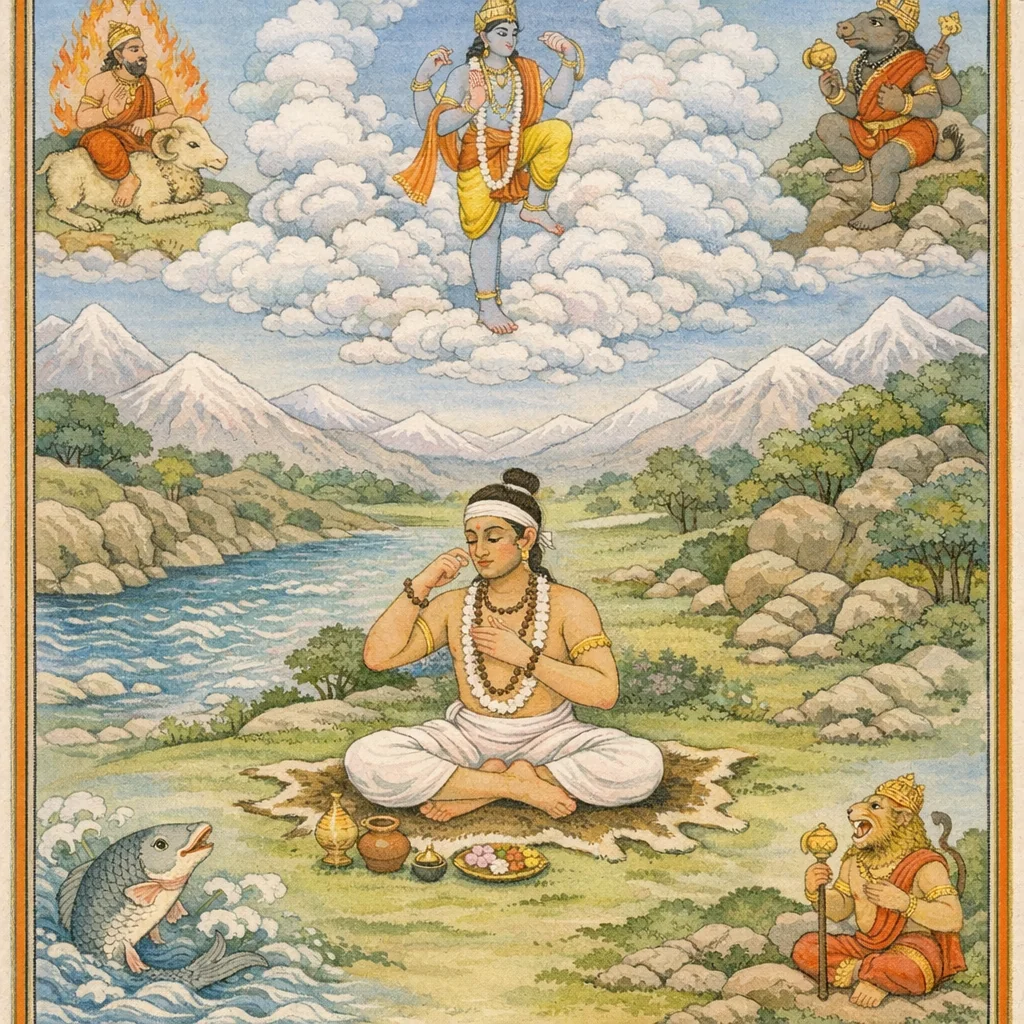
Adhyaya 196
Viṣṇu-dharma Rakṣā: Nyāsa and Nārāyaṇa-Kavaca (Protective Invocation of Viṣṇu and His Avatāras)
Hari introduces a revered corpus of sacred knowledge called “Viṣṇu-dharma,” declaring its power to raise a devotee to Indra-like sovereignty. He then lays out an exact nyāsa: placing Oṁ-born syllables on the limbs from feet to head, performing hand-nyāsa with the twelve-syllabled “namo nārāyaṇāya,” installing praṇava in the heart, the full mantra on the crown, and Oṁ at the brow. The rite culminates in a kavaca recitation that assigns Viṣṇu’s forms to guard specific realms—waters (Matsya), sky (Trivikrama), earth (Vāmana/Varāha), forests and mountains (Narasiṃha and Rāma)—and to ward inner dangers such as anger, ignorance, heresy, disease, and sin (Nāga, Vyāsa, Buddha, Kalki). Protection is further mapped to the hours from morning to midnight and strengthened by Viṣṇu’s weapons and attendants (discus, Kaumodakī, conch, lotus, Garuḍa, Śārṅga, Śeṣa). The chapter ends with a phalaśruti: the bearer/reciter gains self-mastery, freedom from sin and illness, and ascent to heavenly worlds, forming a devotional shield that leads into the following dharma and upāsanā teachings.
Shlokas
Verse 1
ऽध्यायः हरिरुवाच / अवाप जप्त्वा चेन्द्रत्वं विष्णुधर्माख्यविद्यया / सर्वाञ्छत्रून्विनिर्जित्य ताञ्च वक्ष्ये महेश्वर
Hari said: “By reciting the sacred knowledge called ‘Viṣṇu-dharma’, he attained even the status of Indra; having conquered all enemies, O Maheśvara, I shall also describe those matters to you.”
Verse 2
पादयोर्जानुनोरूर्वोरुदरे हृद्यथोरसि / मुखे शिरस्यानुपूर्वमोङ्का रादीनि विन्यसेत्
Upon the feet, the knees, the thighs, the belly, the heart and the chest—and then upon the mouth and the head—one should, in due order, place (mentally or ritually) the sacred syllables beginning with Oṁ.
Verse 3
नमो नारायणायेति विपर्यासमथापि च / करन्यासं ततः कुर्याद्द्वादक्षरविद्यया
Reciting the mantra “namo nārāyaṇāya,” and also performing it in reverse order, one should then perform the hand-nyāsa, using the twelve-syllabled sacred formula.
Verse 4
प्रणवादियकारान्तमङ्गुल्यं गुष्ठपर्वसु / न्यसेद्धृदय ओङ्कारं मनुं मूर्ध्नि समस्तकम्
Placing the mantra that begins with Praṇava and ends with the syllable ‘ya’ upon the finger-joints and the joints of the thumb, one should then install the Oṅkāra in the heart, and place the complete mantra upon the crown of the head.
Verse 5
ओङ्कारन्तु भ्रुवोर्मध्ये शिकानेत्रादिमूर्धतः / ॐ विष्णवे इति इमं मन्त्रन्यासमुदीरयेत्
One should place the syllable Oṁ at the space between the eyebrows, and then from the crown of the head—beginning with the tuft (śikhā) and the eyes—recite and perform this mantra-nyāsa, saying: “Oṁ, (salutations) to Viṣṇu.”
Verse 6
आत्मानं परमं ध्यायेच्छेषं यच्छक्तिभिर्युतम् / मम रक्षां हरिः कुर्यान्मत्स्यमूर्तिर्जले ऽवतु
One should meditate on the Supreme Self, on Śeṣa endowed with divine powers. May Hari grant me protection; may the Lord in the form of Matsya safeguard me in the waters.
Verse 7
त्रिविक्रमस्तथाकाशे स्थले रक्षतु वामनः / अटव्यां नरसिंहस्तु रामो रक्षतु पर्वते
May Trivikrama protect me in the sky; may Vāmana protect me upon the earth. In the forest may Narasiṃha guard me, and on the mountains may Rāma protect me.
Verse 8
भूमौ रक्षतु वाराहौ व्योम्नि नारायणो ऽवतु / कर्मबन्धाच्च कपिलो दत्तो रोगाच्च रक्षतु
May Varāha protect me upon the earth; may Nārāyaṇa safeguard me in the sky. May Kapila and Datta (Dattātreya) free me from the bondage of karma, and may they protect me from disease.
Verse 9
हयग्रीवो देवताभ्यः कुमारो मकरध्वजात् / नारदो ऽन्यार्चनाद्देवः कूर्मो वै नैरृते सदा
Among the gods He is praised as Hayagrīva; in relation to Makaradhvaja He is known as Kumāra. Through the worship of others He is revered as the divine Nārada; and in the south‑west direction He is ever manifest as Kūrma.
Verse 10
धन्वन्तीरश्चापथ्याच्च नागः क्रोधवशात्किल / यज्ञो रोगात्समस्ताच्च व्यासो ऽज्ञानाच्च रक्षतु
May Dhanvantari protect me from unwholesome food and improper regimen; may the Nāga protect me from anger that overpowers the mind. May Yajña protect me from diseases of every kind; and may Vyāsa protect me from ignorance.
Verse 11
बुद्धः पाषण्डसंघातात्कल्की रक्षतु कल्मषात् / पायान्मध्यन्दिने विष्णुः प्रातर्नारायणो ऽवतु
May Buddha protect me from the massed forces of heresy; may Kalki protect me from sin. May Viṣṇu guard me at midday, and may Nārāyaṇa protect me in the morning.
Verse 12
मधुहा चापराह्ने च सायं रक्षतु माधवः / हृषीकेशः प्रदोषे ऽव्यात्प्रत्यूषे ऽव्याज्जनार्दनः
May Madhuhā protect me in the afternoon; may Mādhava protect me in the evening. May Hṛṣīkeśa guard me at twilight; and may Janārdana protect me at daybreak.
Verse 13
श्रीधरो ऽव्यादर्धरात्रे पद्मनाभो निशीथके / चक्रकौमोदकीबाणा घ्नन्तु शत्रूंश्च राक्षसान्
May Śrīdhara protect me at midnight; may Padmanābha protect me in the deepest hour of night. May the discus, the mace Kaumodakī, and the arrows strike down enemies and also the rākṣasas (demonic forces).
Verse 14
शङ्खः पद्मं च शत्रुभ्यः शार्ङ्गं वै गरुडस्तथा / बुद्धीन्द्रियमनः प्राणान्पान्तु पार्श्वविभूषणः
May the conch and the lotus protect me from enemies; and may Garuḍa, as well as Śārṅga (the divine bow), protect my intellect, senses, mind, and vital breaths—He who is adorned with ornaments at His sides.
Verse 15
शेषः सर्पस्वरूपश्च सदा सर्वत्र पातु माम् / विदिक्षु दिक्षु च सदा नारसिंहश्च रक्षतु
May Śeṣa, whose form is that of the serpent, always protect me everywhere; and may Nārasiṁha ever guard me in all directions and intermediate directions.
Verse 16
एतद्धारयमाणश्च यं यं पश्यति चक्षुषा / स वशी स्याद्विपाप्मा च रोगमुक्तो दिवं व्रजेत्
Whoever bears (keeps or wears) this, and with his eyes looks upon whomever he will—he becomes masterful and self-controlled; he is freed from sin, released from disease, and goes to the heavenly realms.
Frequently Asked Questions
Purāṇic kavacas often distribute protection through multiple nāmas and rūpas to cover different realms and vulnerabilities; each avatāra symbolizes a specific mode of divine intervention (e.g., Matsya in waters, Narasiṃha against fear/hostility), creating a comprehensive protective grid.
The weapons function as personified protective powers: the cakra and gadā are invoked to neutralize hostile forces (including rākṣasas), while the śaṅkha and padma signify auspiciousness, purification, and safeguarding—completing the protective symbolism beyond mere verbal praise.
In kavaca literature, “bearing” can indicate memorizing/reciting, keeping the text as a protective amulet, or ritually internalizing it through nyāsa. The intended sense is sustained association with the mantra-hymn so its protective efficacy is continually activated.