Adhyaya 190
Therapeutic Formulations for Glandular Swelling, Skin Diseases, Heat-Afflictions, Bleeding Disorders, Respiratory Complaints, and Vomiting
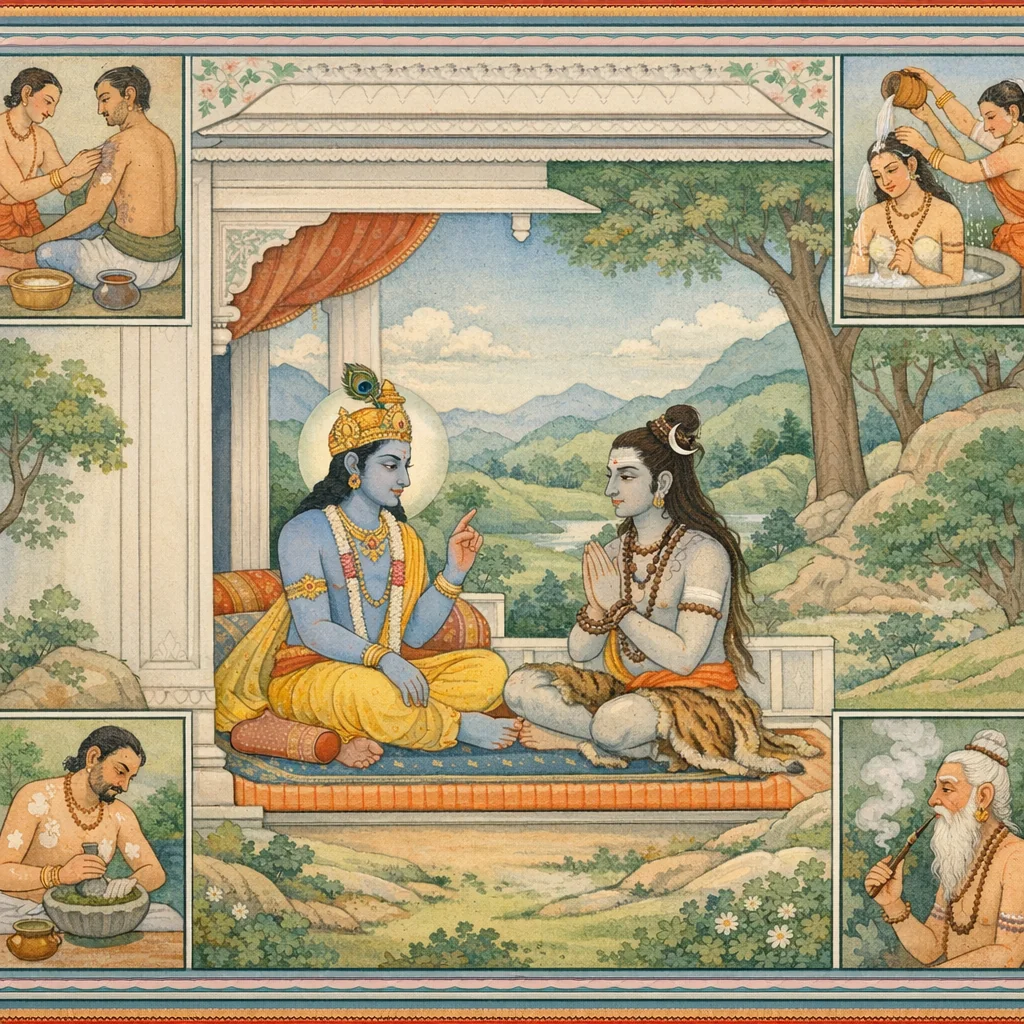
Continuing the Brahma Khanda’s practical, instruction-driven style, this adhyāya compiles specific remedies attributed to Hari’s authoritative speech. It opens with single-drug and compound prescriptions for scrofula and pains of the neck and arms, then extends to topical applications for genital and breast disorders and for sustaining vitality and beauty. The focus then turns to major skin diseases—kuṣṭha, dadru (ringworm), scabies, and sidhma—presenting many pastes, kṣāra (alkali) preparations, and buttermilk- and cow-urine-based formulas, including month-long regimens and strict procedural cautions. Next come guidance on hygiene and seasonal ease: body rubs to remove malodour and prevent summer-heat afflictions, along with milk bathing and friction powders for complexion. The closing section treats internal medicine with drinks for raktapitta, jaundice, anemia, pīnasa, hoarseness, cough (including medicated smoke), thirst/fever, and threefold vomiting, ending with guḍūcī with honey and bilva-root water as a stabilizing, digestion-oriented conclusion that leads into further therapeutic cataloging.
Shlokas
Verse 1
ऽध्यायः हरिरुवाच / अपराजिताया मूलञ्च गोमूत्रेण समन्वितम् / पीतञ्चाशु हरत्येव गण्डमालां न संशयः
Hari (Lord Viṣṇu) said: “The root of the aparājitā plant, combined with cow’s urine and then drunk, quickly removes scrofula (swollen glands/neck-tumor disease); of this there is no doubt.”
Verse 2
अथेन्द्रवारुणीमूलं विधिना पीतमीश्वर / जिङ्गिण्यैरण्डकं रुद्र शूकशिम्ब्या समन्वितम् / शीतोदकञ्च तत्र्यस्तं बाहुग्रीवाव्यथां हरेत्
Next, O Lord, when the root of indravāruṇī is taken according to proper procedure—together with jiṅgiṇī and castor (airaṇḍa), and combined with śūkaśimbī—then, when administered with cool water, it removes pain affecting the arms and the neck.
Verse 3
माहिषं नवनीतञ्च अश्वगन्धा च पिप्पली / वचा कुष्ठद्वयं लेपो लिङ्गस्रोतस्तनार्तिहृत्
Buffalo ghee and fresh butter, together with aśvagandhā and pippalī, and a paste of vacā with the two kinds of kuṣṭha—this sacred unguent, when applied, relieves pain and disorders of the genital channels and the breasts.
Verse 4
कुष्ठनागबलाचूर्णं नवनीतसमन्वितम् / तल्लेपो युवतीनाञ्च कुर्याद्वृत्तोजकौ शुभौ
A paste of the powders of kuṣṭha, nāga, and balā, blended with fresh butter—when young women apply it as a cosmetic unguent, it brings forth auspicious, full, and pleasing ojas, vitality and radiance.
Verse 5
इन्द्रवारुणिकामूलं यस्य नाम्ना सुदूरतः / निः क्षिप्यते समुत्पाट्य तस्य प्लीहा विनश्यति
If the root of indravāruṇikā is dug up and, uttering a person’s name, is cast away from a great distance, that person’s spleen (plīhā) is said to be destroyed.
Verse 6
पुनर्नवायाः शुक्लाया मूलं तण्डुलवारिणा / पीतं विद्रधिनुत्स्याच्च नात्र कार्या विचारणा
The root of white punarnavā, taken with rice-water, destroys abscesses and boils (vidradhi); of this there is no need for further deliberation.
Verse 7
कदलीदलक्षारन्तु पानीयेन प्रसाधितम् / तस्यादनाद्विनश्यन्ति उदरव्याधयो ऽखिलाः
The kṣāra—an alkaline extract prepared from banana leaves and properly mixed with drinking water—when consumed, destroys all diseases of the abdomen.
Verse 8
कदल्या मूलमादाय गुडाज्येन समन्वितम् / अग्निना साधितं जग्धमुदरस्थक्रिमीन्हरेत्
Taking the root of the banana plant, mixing it with jaggery and ghee, cooking it over fire and eating it—this drives out the intestinal worms lodged within the belly.
Verse 9
नित्यं निम्बदलानाञ्च चूर्णमामलकस्य च / प्रत्यूषे भक्षयेच्चैव तस्य कुष्ठं विनश्यति
If one regularly eats, at dawn, neem leaves together with amla powder, that person’s kuṣṭha—leprosy and other skin diseases—is destroyed.
Verse 10
हरीतकीविडङ्गञ्च हरिद्रा सितसर्षपाः / सोमराजस्य मूलानि करञ्जस्य च रौन्धवम् / गोमूत्रपिष्टान्येतानि कुष्ठरोगहराणि वै
Harītakī and viḍaṅga, turmeric and white mustard; the roots of somarāja, karañja, and raundhava—when ground with cow’s urine, they are indeed destroyers of kuṣṭha and other skin diseases.
Verse 11
एकश्च त्रिफलाभागस्तथा भागद्वयं शिवा / सोमराजस्य बीजानां जग्धं पथ्येन दद्रुनुत्
Let one part be Triphalā and two parts be Śivā (Harītakī). Together with the seeds of somarāja, when eaten with Pathyā, it destroys dadrū (ringworm).
Verse 12
अम्लतक्रं सगोमूत्रं क्वथितं लवणान्वितम् / कांस्यघृष्टं खरं लेपात्कुष्ठदद्रुविनाशनम्
Sour buttermilk together with cow’s urine, boiled and mixed with salt, then rubbed in a bronze vessel to strengthen it—applied as a paste, it destroys kuṣṭha and dadrū (ringworm) and related skin diseases.
Verse 13
हरिद्रा हरितालश्च दूर्वागोमूत्रसैन्धवम् / अयं लेपो हन्ति दद्रुं पामानं च गरं तथा
Turmeric, yellow orpiment, dūrvā grass, cow’s urine, and rock-salt—this sacred medicinal paste destroys ringworm, scabies, and also counters poison.
Verse 14
सोम राजस्य बीजानि नवनीतयुतानि च / मधुनास्वादितानि स्युः शुक्लकुष्ठहराणि वै / तक्रान्नपानतो रुद्र नात्र कार्या विचारणा
The seeds of Soma-rāja, taken with fresh butter and savored with honey, are indeed said to cure śukla-kuṣṭha (white leprosy). O Rudra, when taken with buttermilk as food and drink, there is no need for further deliberation about their efficacy.
Verse 15
श्वेतापरा जितामूलं वर्तितं चास्य वारिणा / तल्लेपो रुद्र मासेन शुक्लकुष्ठविनाशनः
White aparā and the herb called jitāmūla, ground and mixed with water—applied as a paste for one month (a Rudra-month observance), it destroys śukla-kuṣṭha, the white skin-disease.
Verse 16
माहिषं नवनीतञ्च सिन्दूरं समरीचकम् / पामा विलेपनान्नश्येद्दुर् नामा वृषभध्वज
O Bull-bannered Lord (Vṛṣabhadhvaja), pāmā such as scabies is cured by anointing with a paste of buffalo-milk product, fresh butter, red sindūra (vermilion), and black pepper; even the dreaded skin disease is destroyed by such an unction.
Verse 17
विशुष्कगाम्भारीमूलं पक्वं क्षीरेण संयुतम् / भक्षितं शुक्लपित्तस्य विनाशकरमीश्वर
O Lord, the dried root of gambhārī, cooked and mixed with milk—when eaten—destroys the disorder called śukla-pitta, a disturbance of bile and inner heat.
Verse 18
मूलकस्य तु बीजानि ह्यपा मार्गरसेन वै / पिष्टानि तेन लेपेन सिध्मकं रुद्र नश्यति
The seeds of the radish, pounded with the juice of apāmārga and applied as a paste, destroy sidhmaka, the scaly skin disorder, O Rudra.
Verse 19
कदलीक्षारसंयुक्तहरिद्रा सिध्मकापहा / रम्भापामार्गयोः क्षार एरण्डेन विमिश्रितः / तदभ्यङ्गान्महादेव ! सद्यः सिध्म विनश्यति
Turmeric mixed with the alkaline extract of banana destroys sidhma, the whitish scaly skin disease. Likewise, the alkali made from rambhā (plantain) and apāmārga, blended with castor oil and applied as an oil-rub (abhyanga), O Mahādeva, makes sidhma vanish at once.
Verse 20
कूष्माण्डनालक्षारश्च सगोमूत्रश्च तत्त्वतः / जलपिष्टा हरिद्रा च सिद्धा मन्दानलेनहि
Alkali prepared from the stalk of kuṣmāṇḍa (ash-gourd), together with cow’s urine in proper measure, and turmeric ground with water, should be cooked over a gentle fire until fully prepared.
Verse 21
माहिषेण पुरीषेण वेष्टिता वृषभध्वज / अस्या उद्वर्तनं कुर्यादङ्गसौष्ठवमीश्वर
O Lord who bears the bull-emblem (Vṛṣabhadhvaja), she is to be smeared over with buffalo-dung; and, O Īśvara, one should perform for her the rubbing and anointing (udvartana), so that the body becomes well-formed and healthy.
Verse 22
तिलसर्षपसंयुक्तं हरिद्राद्वयकुष्ठकम् / तेनोद्वर्तितदेहः स्याद्दुर्गन्धः सुरभिः पुमान्
Combine sesame and mustard with two kinds of turmeric and kuṣṭha (costus), and use it to rub the body. By anointing and massaging with it, a man once foul-smelling becomes pleasantly fragrant.
Verse 23
मनोहरश्चानुदिनं दूर्वाणां काकजङ्घाया / अर्जुनस्य तु पुष्पाणि जम्बूपत्रयुतानि च / सलोध्राणि च तल्लेपो देहदुर्गन्धतां हरेत्
A daily body-paste made from fragrant dūrvā grass and the herb called kāka-jaṅghā, together with arjuna-flowers, jambū leaves, and lodhra, removes foul body-odour.
Verse 24
युक्तं लोध्रभवैर्नोरैश्चूर्णन्तु कनकस्य च / तेनोद्वर्तितदेहस्य न स्याद्ग्रीष्मप्रबाधिका
Prepare a powder blended with lodhra and other fragrant substances, along with fine gold; by anointing and rubbing the body with it, the affliction caused by summer heat will not arise.
Verse 25
दुग्धेनोषसि सेकश्च घर्मदोषश्च नश्यति / काकजङ्घोद्वर्तनन्तु ह्यङ्गरागकरं भवेत्
If one bathes or rinses with milk at dawn, the bodily affliction caused by excessive heat is destroyed. And rubbing the body with kāka-jaṅghā produces a healthy glow and complexion.
Verse 26
मधुयष्टी शर्करा च वासकस्य रसो मधु / एतत्पीतं रक्तपित्तकामलापाण्डुरोगनुत्
Licorice, sugar, the juice of vāsaka, and honey—when this mixture is drunk, it alleviates disorders such as raktapitta (bleeding ailments), kāmalā (jaundice), and pāṇḍu-roga (anemia/pallor).
Verse 27
रक्तपित्तं हरेत्पीतो वासकस्य रसो मधु / प्रातः काले तोयपानात्पीनसं दारुणं हरेत्
When the juice of vāsaka, mixed with honey, is drunk, it alleviates raktapitta (bleeding disorders). And by drinking water in the early morning, one removes severe pīnasa (a chronic nasal/respiratory affliction).
Verse 28
बिभीतकस्य वै चूर्णं पिप्पल्याः सैन्धवस्य च / पीतं सकाञ्जिकं हन्ति स्वरभेदं महेश्वर
O Maheśvara, the powder of bibhītaka, pippalī, and saindhava-salt—taken with kāñjika (sour gruel)—removes hoarseness and disorders of the voice.
Verse 29
चूर्णमामलकं सेव्यं पीतं गव्यपयो ऽन्वितम् / मनः शिला बलामूलं कोलपण च गुग्गुलुः
Powdered āmalaka should be taken, drunk along with cow’s milk. Likewise, manaḥśilā (realgar), the root of balā, a kola-measure (dose), and guggulu are to be used as prescribed.
Verse 30
जातिपत्रं कोलपत्रं तथा चैव मनः शिला / एभिश्चैव कृता वर्तिर्बदर्यग्नौ महेश्वर / धूमपानं कासहरं नात्र कार्या विचारणा
Jasmine leaves, jujube leaves, and manaḥśilā—made into a wick and smoked over the fire of jujube-wood, O Maheśvara—this inhalation of medicated smoke removes cough; there is no need for doubt.
Verse 31
त्रिफलापिप्पलीचूर्णं भक्षितं मधुनायुतम् / भोजनादौ हि समधु पिपासाज्व(त्व)रितं हरेत्
Triphala and long-pepper powder, taken mixed with honey, should be consumed at the beginning of a meal; taken with honey, it alleviates thirst and fever (and acute distress).
Verse 32
बिल्वमूलञ्च समधुगुडूचीक्वथितं जलम् / पीतं हरेच्च त्रिवधं छर्दिं नैवात्रसंशयः / पीता दूर्वा छर्दिनुत्स्यात्पिष्टातण्डुलवारिणा
Water boiled with guḍūcī and mixed with honey, together with the root of the bilva tree—when drunk—removes vomiting of three kinds; of this there is no doubt. Likewise, dūrvā grass taken with water prepared from ground rice also checks vomiting.
Frequently Asked Questions
Skin diseases (kuṣṭha and allied disorders such as ringworm, scabies, and sidhma) receive the densest coverage, followed by abdominal ailments/worms, heat and body-odour management, and then raktapitta/jaundice/anemia and respiratory complaints like pīnasa, hoarseness, cough, fever, thirst, and vomiting.
Kṣāra is presented as a potent preparation method—especially from banana/plantain leaves and other plant parts—used internally for abdominal diseases and externally (often with turmeric or oils) for sidhma-type skin disorders, indicating an emphasis on scraping/clearing actions consistent with classical Ayurvedic rationale.
Yes. Substances like manaḥśilā (realgar) and haritāla/yellow orpiment are arsenic-containing minerals in traditional rasashastra contexts and should not be used without expert processing standards and qualified supervision; the text reports efficacy, but modern safety/toxicity considerations are essential.