Adhyaya 149
Kāsa-bheda: The Fivefold Classification of Cough and Its Clinical Signs
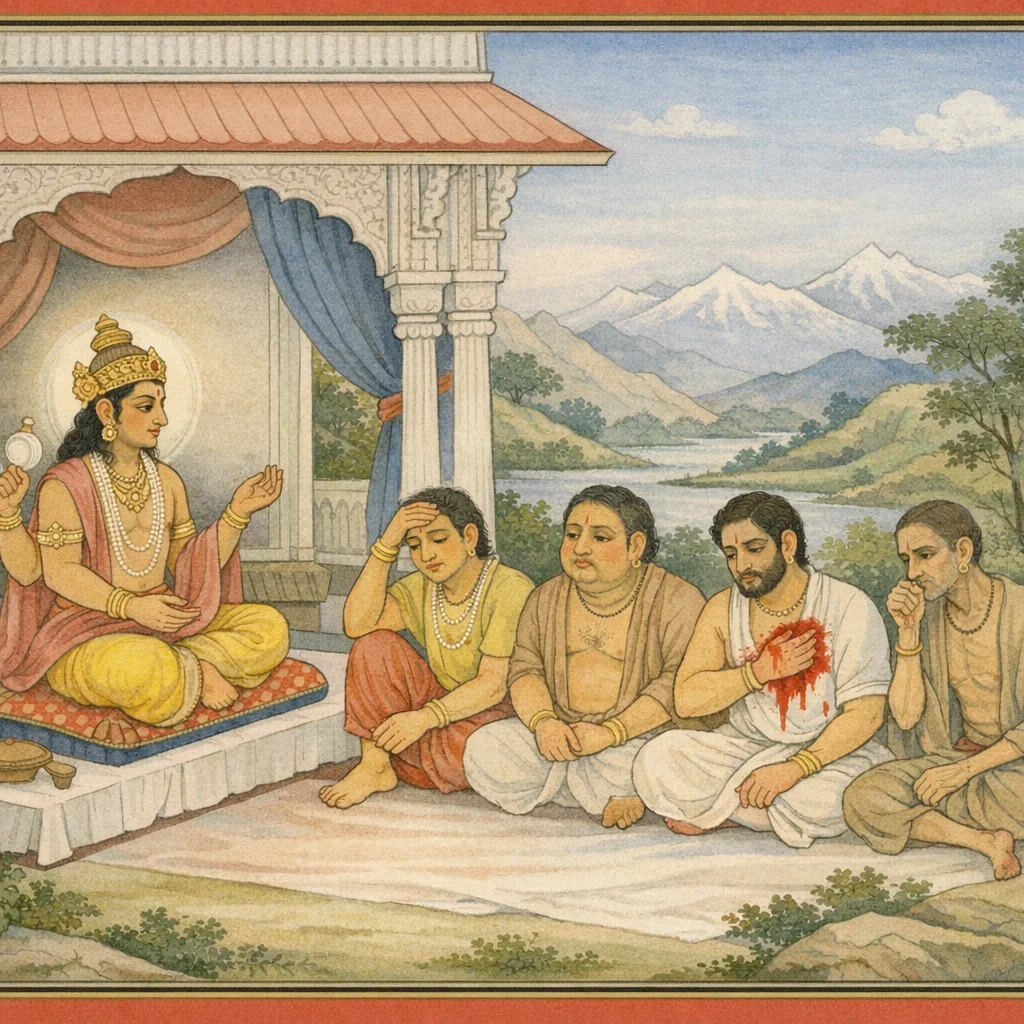
Continuing Dhanvantari’s therapeutic teaching, this chapter treats cough as a swiftly worsening disorder that must be recognized at once. It sets out a fivefold classification—vāta-, pitta-, kapha-born, injury-born (kṣataja), and consumption/rajayakṣmā-born (kṣayaja)—and explains how disturbed vāyu rises to the throat, producing the cough sound and bodily strain. The doṣic types are marked by distinct signs: vāta with dryness, rasping sound, piercing pains, and scant, difficult expectoration; pitta with yellowing, bitterness, fever, thirst, vomiting of bile or blood, and smoky vision; kapha with heaviness, slimy coating, nausea, congestion, and thick greasy phlegm. It then describes kṣataja cough from overexertion and injury, with blood-mixed sputum and severe chest pain, and finally kṣayaja/rajayakṣmā with foul, pus-like mixed sputum, wasting, abnormal cravings, and decline. The chapter closes by distinguishing curable cases from those only manageable (especially injury- and consumption-related forms) and warns that neglect leads to breathlessness, vomiting, loss of voice, and further systemic disease, preparing for ordered, condition-specific treatments in the following instruction.
Shlokas
Verse 1
नामाष्टचत्वारिंशदुत्तरशततमो ऽध्यायः धन्वन्तरिरुवाच / आशुकारी यतः कासः स एवातः प्रवक्ष्यते / पञ्च कासाः स्मृता वातपित्तश्लेष्मक्षतक्षयैः
Chapter one-hundred and forty-nine begins. Dhanvantari said: Since cough arises swiftly and can quickly become severe, it is now being explained. Cough is remembered as being of five kinds—arising from vāta, pitta, śleṣman (kapha), injury (kṣata), and consumption (kṣaya).
Verse 2
क्षयायोपेक्षिताः सर्वे बलिनश्चोत्तरोत्तरम् / तेषां भविष्यतां रूपं कण्ठे कण्डूररोचकः
All of these, though strong at first, when neglected lead gradually toward decline. The form they are destined to assume is marked by itching and an unpleasant affliction in the throat.
Verse 3
शुष्ककर्णास्यकण्ठत्वं तत्राधोविहितो ऽनिलः / ऊर्ध्वं प्रवृत्तः प्राप्यो रस्तस्मिन्कण्ठे च संसृजन्
There the ears, mouth, and throat become parched; the vital wind (anila) is driven downward. Then, striving to rise upward, it reaches the throat and, moving there, produces a rasping sound.
Verse 4
शिरास्रोतांसि संपूर्य ततो ऽङ्गान्युत्क्षिपन्ति च / क्षिपन्निवाक्षिणी क्लिष्टस्वरः पार्श्वे च पीडयन्
When the channels of the head are filled, the limbs are then jerked upward; as though tossed about, the eyes roll, the voice grows strained, and a pressing pain grips the sides of the body.
Verse 5
प्रवर्तते सवक्रेण भिन्नकांस्योपमध्वनिः / हृत्पार्श्वेरुशिरः शूलमोहक्षोभस्वरक्षयान्
Then, with a crooked and distorted motion, a sound like cracked bronze arises, bringing piercing pains in the heart, the sides, the thighs, and the head—together with delusion, agitation, loss of voice, and wasting away.
Verse 6
करोति शुष्ककासञ्च महावेगरुजास्वनम् / सोंगहर्षो कफं शुष्कं कृछ्रान्मुक्त्वाल्पतां व्रजेत्
It produces a dry cough and a voice—or breath—strained by intense pain and force; the hairs of the body stand on end. The phlegm dries up, and though expelled with great difficulty, it is discharged only in a scanty amount.
Verse 7
पित्तात्पीताक्षिकत्वं च तिक्तास्यत्वं ज्वरो भ्रमः / पित्तासृग्वमनं तृष्णा वैस्वर्यं धूमको मदः
From the aggravation of pitta arise yellowing of the eyes, bitterness in the mouth, fever, and dizziness; vomiting of bile and blood, intense thirst, hoarseness, a smoky veil before the eyes, and delirium like intoxication.
Verse 8
प्रततं कासवेगे च ज्योतिषामिव दर्शनम् / कफादुरो ऽल्परुङ्मूर्धि हृदयं स्तिमिते गुरु
There is constant coughing, and during the bouts one sees flashes like stars. When the disorder arises from kapha, there is only slight pain in the head; the heart feels heavy and constricted, and the body becomes sluggish and weighty.
Verse 9
कण्ठे प्रलेपमदजं पीनसच्छर्द्यरोचकाः / रोमहर्षो धनस्निग्धंश्लेष्मणाञ्च प्रवर्तनम्
In the throat there forms a slimy coating with nausea; nasal blockage, vomiting, and loss of appetite arise; the hairs stand on end, and the phlegm grows thick and greasy, stirred into motion—swelling and being discharged.
Verse 10
युद्धाद्यैः साहसैस्तैस्तैः सेवितैरयथाबलम् / उपस्यन्तः क्षतो वायुः पित्तेनानुगतो बली
By taking up battles and other rash exploits beyond one’s strength, the vital wind, vāyu, is wounded; and when it is powerfully accompanied by pitta—bile and heat—it afflicts the person all the more.
Verse 11
कुपितः कुरुते कासं कफं तेन सशोणितम् / पीतं श्यावञ्च शुष्कञ्च ग्रथितं कुपितं बहु
When it becomes aggravated, it brings on coughing; and thus the phlegm is mixed with blood—yellowish or dark, dry and thick, as if coagulated—greatly disturbed and increased in amount.
Verse 12
ष्ठीवेत्कण्ठेन रुजता विभिन्नेनैव चोरसा / सूचीभिरिव तीक्ष्णाभिस्तुद्यमानेन शूलिना
He spits, his throat in pain, as though a thief had split his chest; and he is tormented by piercing agony, as if pricked by sharp needles and impaled upon a stake.
Verse 13
दुः खस्पर्शेन शूलेन भेदपीडाहितापिना / पर्वभेदज्वरश्वासतृष्णावैस्वर्यकम्पवान्
Afflicted by painful contact and stabbing torment—by splitting aches and burning fever—he suffers joint-rending pains, fever, laboured breathing, thirst, loss of voice, and trembling.
Verse 14
पारावत इवोत्कूजन्पार्श्वशूली ततो ऽस्य च / कफाद्यैर्वमनं पक्तिबलवर्णञ्च हीयते
Then he coos like a pigeon and is afflicted with pain in the side. He vomits phlegm and the like, and his digestive power, strength, and complexion decline.
Verse 15
क्षीणस्य सासृङ्मूत्रत्वं श्वासपृष्टकटिग्रहः / षायुप्रधानाः कुपिता धावतो राजयक्ष्मणः
For one who has become emaciated, there is urination mixed with blood, laboured breathing, and stiffness or pain in the back and waist; the bodily winds (vāyus), chiefly disturbed, run violently—this is the condition known as rājayakṣmā (consumption).
Verse 16
कर्वन्ति यक्ष्मायतने कासं ष्ठीवत्कफं ततः / पूतिपूयोपमं वीतं मिश्रं हरितलोहितम्
In the condition of consumption (yakṣmā), they develop coughing and then spit out phlegm; the expectoration is foul, like pus, and appears mixed—greenish and reddish.
Verse 17
सुप्यते तुद्यत इव हृदयं पचतीव च / अकस्मादुष्णशीतेच्छा बह्वाशित्वं बलक्षयः
One falls into sleep as if struck; the heart feels as though it is being pierced, and as though it is burning. There arises, without cause, a craving for heat or cold, excessive appetite, and a wasting of strength.
Verse 18
स्निग्धप्रसन्नवक्रत्वं श्रीमद्दर्शननेत्रता / ततो ऽस्य क्षयरूपाणि सर्वाण्याविर्भवन्ति च
A gentle and serene countenance, and eyes radiant with an auspicious, splendid vision—thereafter, all the signs that mark his decline and exhaustion manifest as well.
Verse 19
इत्येष क्षयजः कास क्षीणानां देहनाशनः / याप्यौ वा बलिनां तद्वत्क्षतजो ऽपि नवौ तु तौ
Thus, the cough born of consumption (kṣaya) destroys the body of the emaciated; but in the strong it can be managed. Likewise, the cough born of injury—these two are to be understood as treatable only through careful, disciplined management.
Verse 20
सिध्येतामपि सामर्थ्यात्साध्यादौ च पृथक्क्रमः / मिश्रा याप्याश्च ये सर्वे जरसः स्थविरस्य च
Even if remedies could be accomplished by one’s own capacity, the regimen should still be applied separately, in proper sequence, for what is “curable” and for what is otherwise. All ailments that are mixed in nature, those that are only manageable (yāpya), and those arising from senescence and old age are to be treated accordingly.
Verse 21
कासश्वासक्षयच्छर्दिस्वरसादादयो गदाः / भवन्त्युपेक्षया यस्मात्तस्मात्तास्त्वरया जयेत्
Cough, breathlessness, consumption (kṣaya), vomiting, loss of voice, and other ailments arise from neglect; therefore one should overcome them promptly.
Frequently Asked Questions
Vāta cough is marked by dryness, rasping sound, intense pain, and scanty difficult expectoration, while kapha cough emphasizes heaviness, slimy throat coating, nausea/congestion, and thick greasy phlegm.
The text highlights overexertion leading to injured vāyu with pitta involvement, producing severe chest/throat pain and expectoration mixed with blood (yellowish/dark, thick/coagulated).
Because they are linked with wasting/consumption or structural injury and thus tend to be chronic and debilitating; the chapter advises careful, staged management and prognosis-based treatment rather than assuming easy cure.