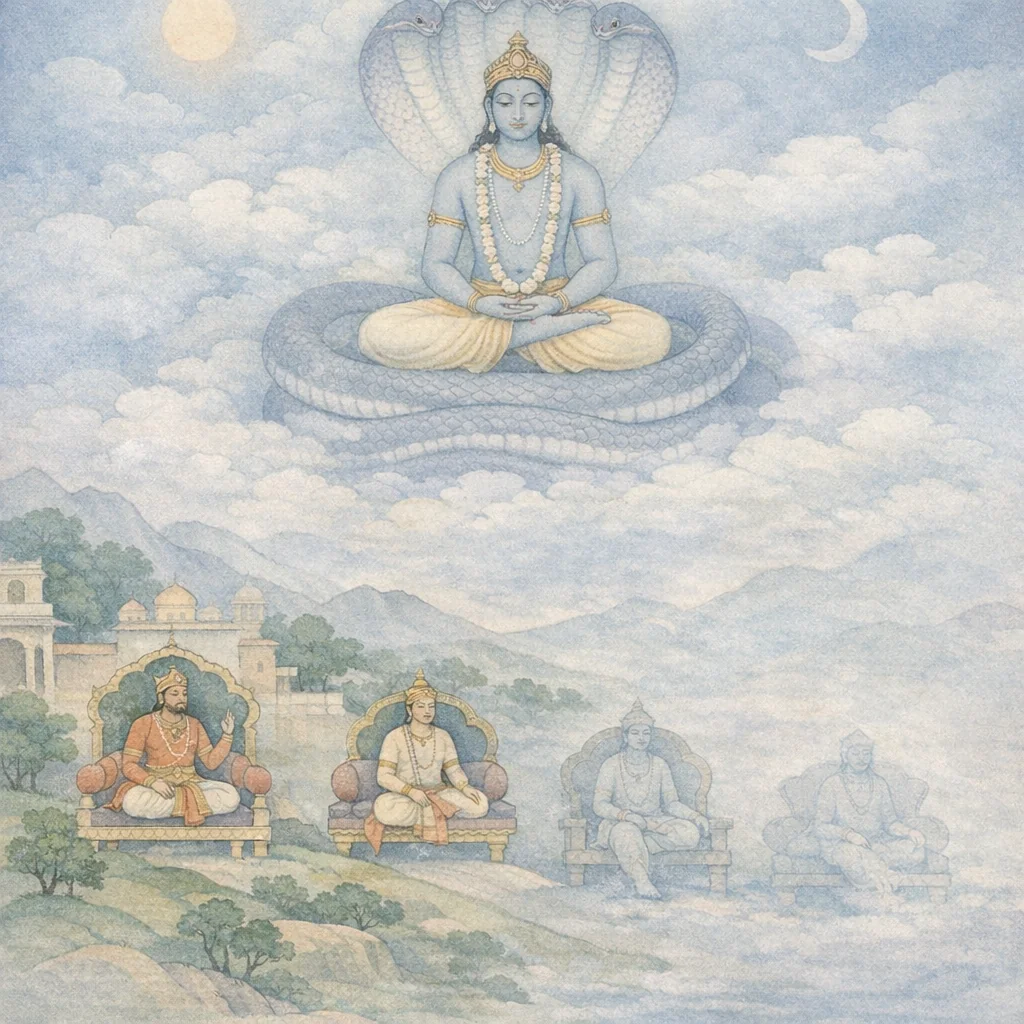
Adhyaya 141
Dynastic Enumeration and the Threefold Pralaya (वंशानुकीर्तनं—प्रलयत्रयवर्णनम्)
Continuing the Purāṇic preservation of sacred history, Hari lists the successive kings—first a run of rulers by name, then those of the Ikṣvāku line (including Bṛhadbala and his descendants), and thereafter the Māgadha/Bārhadratha succession beginning with the mention of Sumitra. Having shown the breadth and impermanence of temporal power, the teaching turns to a moral and metaphysical conclusion: later kings will be unrighteous, yet only the imperishable Lord Nārāyaṇa bestows true prosperity. The chapter then explains three pralaya—naimittika, prākṛtika, and ātyantika—describing the reabsorption of gross elements and subtle principles, culminating in the jīva entering the avyakta and the Supreme Self. The closing injunction is clear: since kings and worlds perish, abandon sin, stand firm in dharma, and seek Hari, preparing for further teachings that value the ultimate end over historical renown.
Shlokas
Verse 1
नाम चत्वारिंशदुत्तरशततमो ऽध्यायः हरिरुवाच / शतानीको ह्यश्वमेधदत्तश्चाप्यधिसोमकः / कृष्णो ऽनिरुद्धश्चाप्युष्णस्ततश्चित्ररथो नृपः
Chapter one hundred and forty-one begins. Hari said: “There were kings named Śatānīka, Aśvamedhadatta, and Adhisomaka; also Kṛṣṇa, Aniruddha, and Uṣṇa; and then the king Citraratha.”
Verse 2
शुचिद्रथो वृष्णिमांश्च सुपेणश्च सुनीथकः / नृचक्षुश्च मुखाबाणः मेधावी च नृपञ्जयः
Śucidratha, Vṛṣṇimān, Supeṇa, Sunīthaka; Nṛcakṣu, Mukhābāṇa, Medhāvī, and Nṛpañjaya—these names too are recited.
Verse 3
पारिप्लवश्च मुनयो मेधावी च नृपञ्जयः / बृहद्रथो हरिस्तिग्मो शतानीकः सुदानकः
Pariplava and Munaya; Medhāvī and Nṛpañjaya; also Bṛhadratha, Haristigma, Śatānīka, and Sudānaka—these are the names spoken of.
Verse 4
उदानो ऽह्निनरश्चैव दण्डपाणिर्निमित्तकः / क्षेमकश्च ततः शूद्रः पिता पूर्वस्ततः सुतः
Udāna, Ahninara, and Daṇḍapāṇi called Nimittaka; then Kṣemaka; then Śūdra—first the father, and thereafter the son.
Verse 5
बृहद्बलास्तु कथयन्ते नृपोश्चैक्ष्वाकुवंशजाः / बृहद्बलादुरुक्षयो वत्सव्यूहस्ततः परः
They declare that among the kings born in the Ikṣvāku line was Bṛhadbala; from Bṛhadbala arose Urukṣaya, and after him came Vatsavyūha.
Verse 6
वत्सव्यूहात्ततः सूर्यः सहदेवस्तदात्मजः / बृहदश्वो भानुरथः प्रतीच्यश्च प्रतीतकः / मनुदेवः सुनक्षत्रः किन्नरश्चान्तरिक्षकः
From Vatsavyūha came Sūrya, and his son was Sahadeva. Then followed Bṛhad-aśva, Bhānuratha, Pratīcya and Pratītaka; also Manudeva, Sunakṣatra, Kinnara, and Antarikṣaka.
Verse 7
सुपर्णः कृतजिच्चैव बृहद्भ्राजश्च धार्मिकः / कृतञ्जयो धनञ्जयः संजयः शाक्य एव च
Suparṇa, Kṛtajit, and Bṛhadbhrāja; and Dhārmika, the righteous one. Kṛtañjaya, Dhanañjaya, Saṃjaya, and also Śākya.
Verse 8
शुद्धोदनो बाहुलश्च सेनजित्क्षुद्रकस्तथा / सुमित्रः कुडवश्चातः सुमित्रान्मागधाञ्छणु
Śuddhodana, Bāhula, Senajit, and likewise Kṣudraka; also Sumitra and Kuḍava. Now hear, from Sumitra, of the Māgadhas.
Verse 9
जरासन्धः सहदेवः सोमापिश्च श्रुतश्रवाः / अयुतायुर्निरमित्रः सुक्षत्रो बहुकर्मकः
Jarāsandha, Sahadeva, Somāpi, and Śrutaśravā; Ayutāyu, Niramitra, Sukṣatra, and Bahukarmaka—these are the names recited in due succession.
Verse 10
श्रुतञ्जयः सेनजिच्च भूरिश्चैव शुचिस्तथा / क्षेम्यश्च सुव्रतो धर्मः श्मश्रुलो दृढसेनकः
Śrutañjaya, Senajit, Bhūri, and Śuci; likewise Kṣemya, Suvrata, Dharma, Śmaśrula, and Dṛḍhasenaka—these are the names being enumerated.
Verse 11
सुमतिः सुबलो नीतो सत्यजिद्विश्वजित्तथा / इषुञ्जयश्च इत्येते नृपा बार्हद्रथाः स्मृताः
Sumati, Subala, Nīta, Satyajit, Viśvajit, and also Iṣuñjaya—these kings are remembered as the Bārhadratha rulers.
Verse 12
अधर्मिष्ठाश्च शूद्राश्च भविष्यन्ति नृपास्ततः / स्वर्गादिकृद्धि भगवान्साक्षान्नारायणो ऽव्ययः
Then kings will arise who are intensely unrighteous and of śūdra disposition. Yet the Lord—imperishable Nārāyaṇa Himself—remains the direct bestower of prosperity beginning with heaven.
Verse 13
नैमित्तिकः प्राकृतिकस्तथैवात्यन्तिको लयः / याति भूः प्रलयं चाप्सु ह्यापस्तेजसि पावकः
Dissolution is of three kinds: occasional (naimittika), primordial (prākṛtika), and absolute (ātyantika). At dissolution, earth merges into water; water into fire; and fire into radiance (tejas).
Verse 14
वायौ वायुश्च वियति त्वाकाशौ यात्यहङ्कृतौ / अहं बुद्धौ मतिर्जोवे जीवो ऽव्यक्ते तदात्मनि
The principle of wind merges into wind; and space (ether) into space; both return into egoity (ahaṅkāra). The ‘I’-sense dissolves into intellect (buddhi); the mind’s intention (mati) into the vital impulse (jīva). The individual soul (jīva) enters the Unmanifest (avyakta)—that Supreme Self (tad-ātman).
Verse 15
आत्मा परेश्वरो विष्णुरेको नारायणो नरः / अविनाश्यपरं सर्वं जगत्स्वर्गादि नाशि हि
The Self is the Supreme Lord—Vishnu alone, Narayana, the eternal Person. He is imperishable and the highest reality; whereas the whole world, including heaven and all else, is truly perishable.
Verse 16
नृपादयो गता नाशमतः पापं विवर्जयेत् / धर्मं कुर्यात्स्थिरं येन पापं हित्वा हरिं व्रजेत्
Kings and all others have gone to destruction; therefore one should abandon sin. One should practice steadfast dharma, by which—having given up sin—one may go to Hari (Vishnu).
Frequently Asked Questions
The chapter uses dynastic impermanence to teach detachment: since even kings are destroyed, one should give up pāpa (sin), establish oneself in dharma, and aim for Hari who alone is imperishable.
It indicates the withdrawal of individualized consciousness from manifest conditions into the unmanifest causal state; the text then identifies the ultimate ground as the Supreme Self—Vishnu/Narayana—beyond perishable worlds.