Adhyaya 124
Śivarātri Vrata: Timing, Accidental Merit, and the Complete Night-Vigil Procedure
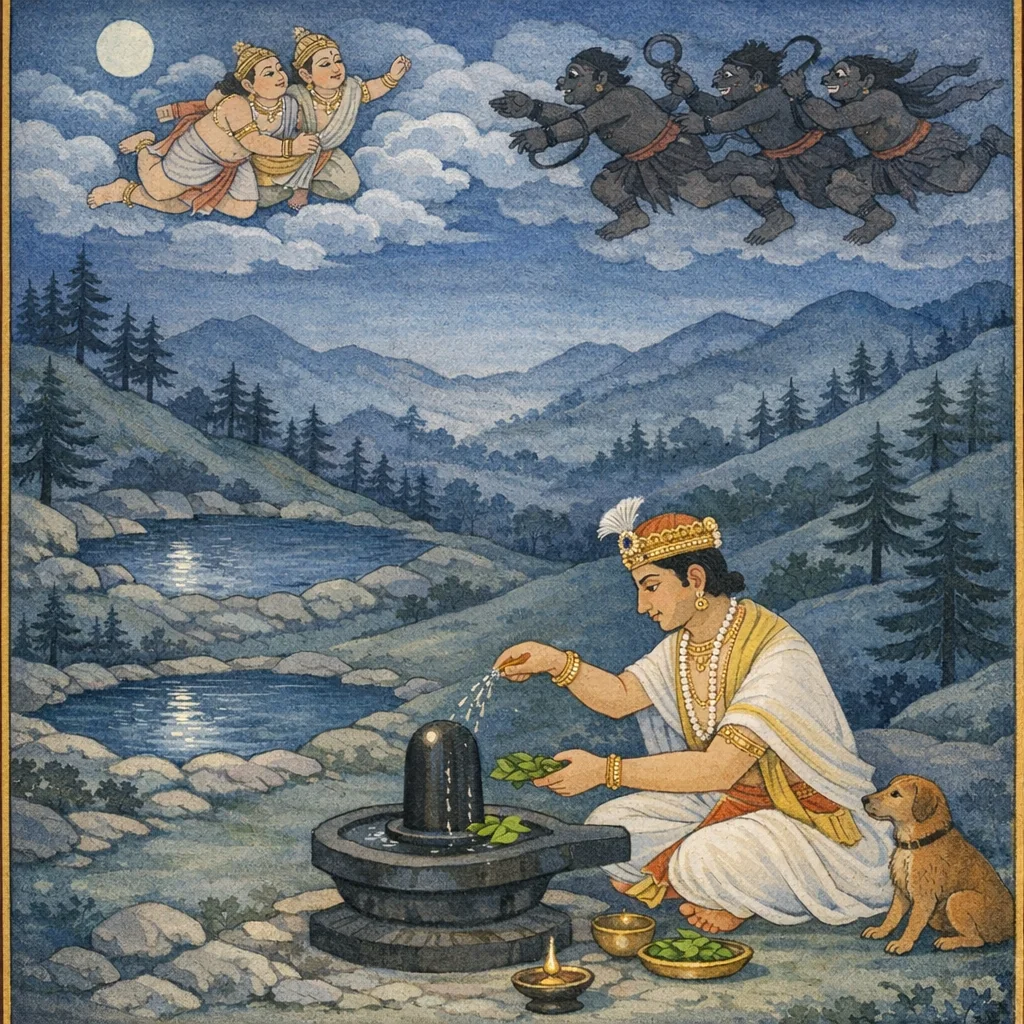
Continuing the ācāra-based teaching on vows and observances, Brahmā presents a Śivarātri vrata-kathā arising from Gaurī’s question to Śiva, fixing the vow’s calendrical timing and promising both worldly enjoyment and liberation. The chapter then gives an exemplum: the sinful Niṣāda king Sundarasenaka hunts in Arbuda and spends a hungry night by ponds, unknowingly performing liṅga-centered acts that resemble formal worship—offering leaves, sprinkling water/abhiṣeka, touching, and keeping an all-night vigil. When he later dies, Yama’s attendants seize him, but Śiva’s attendants defeat them and release the king; even his dog is purified and becomes a close attendant of Śiva. The narrative closes by turning from story to sādhanā, distinguishing limited “unknowing” merit from imperishable “knowing” merit, and prescribing the vrata’s discipline: fasting, pañcagavya/amṛta bathing, taking refuge in the guru, mantra, homa offerings, worship through multiple night watches, dawn atonement, feeding and gifting (dāna), and extended observance—bridging inspiring kathā into repeatable ritual practice for the following chapters on niyamas and fruits of the vow.
Shlokas
Verse 1
नाम त्रयोविंशत्युत्तरशततमो ऽध्यायः ब्रह्मोवाच / शिवरात्रिव्रतं वक्ष्ये कथां वै सर्वकामदाम् / यथा च गौरी भूतेशं पृच्छति स्म परं व्रतम्
Brahmā said: I shall describe the observance of the Śivarātri fast—indeed a narrative that grants all desired aims—how Gaurī once asked Bhūteśa (Śiva) about that supreme vow.
Verse 2
ईश्वरौवाच / माघफाल्गुनयोर्मध्ये कृष्णा या तु चतुर्दशी / तस्यां जागरणाद्रुद्रः पूजितो भुक्तिमुक्तिदः
The Lord said: The Krishna Chaturdaśī that falls between the months of Māgha and Phālguna—by keeping vigil on that night, Rudra is worshipped, and he bestows both worldly enjoyment and liberation.
Verse 3
कामयुक्तो हरः पूज्यो द्वादश्यामि केशवः / उपोषितैः पूजितः सन्नरकात्तरयत्तथा
When one is driven by desire, Hara (Śiva) is to be worshipped; on the twelfth tithi (Dvādaśī), Keśava (Viṣṇu) is to be worshipped. Worshipped by those who observe fasting, he likewise delivers the devotee from hell.
Verse 4
निषादश्चर्बुदे राजा पापी सुन्दरसेनकः / स कुक्रुरैः समायुक्तो मृगान्हन्तुं वनं गतः
In Arbuda there was a Niṣāda king, the sinful Sundarasenaka. Accompanied by fierce hunting dogs, he went into the forest to kill deer.
Verse 5
मृगादि कमसंप्राप्य क्षुत्पिपासार्दितो गिरौ / रात्रौ तडागतीरेषु निकुञ्जे जाग्रदास्थितः
Reaching on the mountain a small hollow, a shelter used by deer and other beasts, tormented by hunger and thirst, he kept vigil through the night in a thicket by the banks of ponds.
Verse 6
तत्रास्ति लिङ्गं स्वं रक्षञ्छरीरं चाक्षिपत्ततः / पर्णानि चापतन्मूर्ध्नि लिङ्गस्यैव न जानतः
There, while striving to safeguard his own liṅga (the individual mark, the subtle body), he cast off the physical frame. Then leaves fell upon the head of that very liṅga—though he did not recognize it.
Verse 7
तेन धूलिनिरोधाय क्षिप्तं नीरं च लिङ्गके / शरः प्रमादेनैकस्तु प्रच्युतः करपल्लवात्
To lay the dust, he sprinkled water upon the liṅga; yet through a moment’s carelessness, a single arrow slipped and fell from the gentle grasp of his hand.
Verse 8
जानुभ्यामवनीं गत्वा लिङ्गं स्प्टष्ट्वा गृहीतवान् / एवं स्नानं स्पर्शनं च पूजनं जागरो ऽभवत्
Going down upon his knees to the earth, he touched the liṅga and took hold of it. Thus arose the acts of bathing, touching, worship, and keeping vigil.
Verse 9
प्रातर्गृहागतो भार्यादत्तान्नं भुक्तवान्स च / काले मृतो यमभटैः पाशैर्बद्ध्वा तु नीयते
In the morning he returned home and ate the food given by his wife; and when his appointed time arrived, he died—then Yama’s attendants bound him with nooses and carried him away.
Verse 10
तदा मम गणैर्युद्धे जित्वा मुक्तीकृतः स च / कुक्कुरेण सहैवाभूद्गणो मत्पार्श्वगो ऽमलः
Then, having been defeated in battle by my attendants, he too was released; and together with the dog he became a spotless attendant, abiding at my side.
Verse 11
एवमज्ञानतः पुण्यञ्ज्ञानात्पुण्यमथाक्षयम् / त्रयोदश्यां शिवं पूज्य कुर्यात्त नियमं व्रती
Thus, merit gained unknowingly is limited; but merit gained with understanding becomes imperishable. Therefore, on the thirteenth lunar day, the observant votary should worship Śiva and duly perform the prescribed discipline (niyama).
Verse 12
प्रातर्देव ! चतुर्दश्यां जागरिष्याम्यहं निशि / पूजां दानं तपो होमं करिष्याम्यात्मशक्तितः
O Lord! On the fourteenth lunar day I shall keep vigil through the night; and, according to my own capacity, I shall perform worship, charity, austerity, and sacrificial offerings (homa).
Verse 13
चतुर्दश्यां निराहारो भूत्वा शम्भो परे ऽहनि / भोक्ष्ये ऽहं भुक्तिमुक्त्यर्थं शरणं मे भवेश्वर
“On the fourteenth lunar day, having remained without food, O Śambhu, on the following day I shall eat for the sake of both enjoyment and liberation. O Bhaveśvara, be my refuge.”
Verse 14
पञ्चगव्यामृतैः स्नाप्य तत्काले गुरुं श्रितः / ॐ नमो नमः शिवाय गन्धाद्यः पूजयेद्धरम्
After bathing (the sacred image) with the five products of the cow (pañcagavya) and with nectar (amṛta), and at that time taking refuge in one’s guru, one should worship the Lord with fragrances and other offerings, reciting: “Oṁ, salutations, salutations to Śiva (Oṁ, namo namaḥ Śivāya).”
Verse 15
तिलतण्डुलव्रीहींश्च जुहुयात्सघृतं चरुम् / हुत्वा पूर्णाहुतिं दत्त्वा शृणुयाद्गीतसत्कथाम्
One should offer into the sacred fire sesame, rice-grains, and unhusked rice, together with ghee and the cooked oblation (caru). Having made the offerings and then given the final complete oblation (pūrṇāhuti), one should listen to sung hymns and noble sacred narratives.
Verse 16
अर्धरात्रे त्रियामे च चतुर्थे च पुनयर्जत् / मूलमन्त्रं तथा जप्त्वा प्रभाते तु क्षमापयेत्
At midnight, again in the third watch, and again in the fourth watch, one should perform worship once more. Having likewise repeated the root-mantra (mūla-mantra), at dawn one should seek forgiveness for any omissions or faults in the rite.
Verse 17
अविघ्नेन व्रतं देव ! त्वत्प्रसदान्मयार्चितम् / क्षमस्व जगतां नाथ ! त्रैलोक्याधिपते हर !
O Lord, may this vow be completed without obstacles—performed by me through Your grace. Forgive me, O Master of the worlds, O ruler of the three realms, O Hara.
Verse 18
यन्मयाद्य कृतं पुण्यं यद्रुद्रस्य निवेदितम् / त्वत्प्रसादान्मया देव ! व्रतमद्य समापितम्
Whatever merit I have gained today, and whatever has been offered to Rudra—by Your grace, O Deva, my vow has been completed today.
Verse 19
प्रसन्नो भव मे श्रीमन् गृहं प्रति च गम्यताम् / त्वदालोकनमात्रेण पवित्रो ऽस्मि न संशयः
Be gracious to me, O venerable one, and please proceed onward to Your abode. By merely beholding You, I have become purified—of this there is no doubt.
Verse 20
भोजयेद्ध्याननिष्ठांश्च वस्त्रच्छत्रादिकं ददेत् / देवादिदेव भूतेश लोकानुग्रहकारक
One should feed those steadfast in meditation, and also give garments, umbrellas, and the like—O Lord of the gods, O Lord of beings, who acts for the welfare of the worlds.
Verse 21
यन्मया श्रद्धया दत्तं प्रीयतां तेन मे प्रभुः / इति क्षमाप्य च व्रती कुर्याद्वादशवार्षिकम्
“May my Lord be pleased with what I have given in faith.” Saying thus, and seeking forgiveness, the observer of the vow should perform the twelve-year observance.
Verse 22
कीर्तिश्रीपुत्रराज्यादि प्राप्य शैवं पुरं व्रजेत् / द्वादशेष्वपि मासेषु प्रकुर्यादिह जागरम्
Having attained fame, prosperity, sons, kingdom and the like, one should go to Śiva’s city; and throughout all the twelve months, one should observe the vigil (jāgaraṇa) here in this world.
Verse 23
व्रती द्वादश संभोज्य दीपदः स्वर्गमाप्नुयात्
A vow-observing person, having fed twelve persons and having gifted a lamp, attains heaven.
Frequently Asked Questions
Because the vrata is defined by jāgaraṇa plus repeated pūjā across the night’s divisions (yāmas/praharas), which ritually sustains attention (smaraṇa) and intensifies the vow’s continuity; dawn worship is paired with kṣamā-yācñā to seal the rite despite omissions.
The text maps ordinary actions onto ritual categories: leaf-fall becomes a symbolic offering, sprinkling water becomes abhiṣeka, touching becomes upacāra/contact in worship, and enforced wakefulness becomes jāgaraṇa—producing puṇya even without explicit intent.
It states that ajñāta (unknowing) merit is ‘limited’ (alpa/niyata-phala), whereas merit gained with understanding and deliberate observance becomes ‘imperishable’ (akṣaya), hence the instruction to perform the prescribed niyamas consciously.
Feeding those steadfast in meditation is emphasized, along with dāna such as garments and umbrellas; additionally, feeding twelve persons and gifting a lamp are mentioned as acts leading to heavenly attainment.