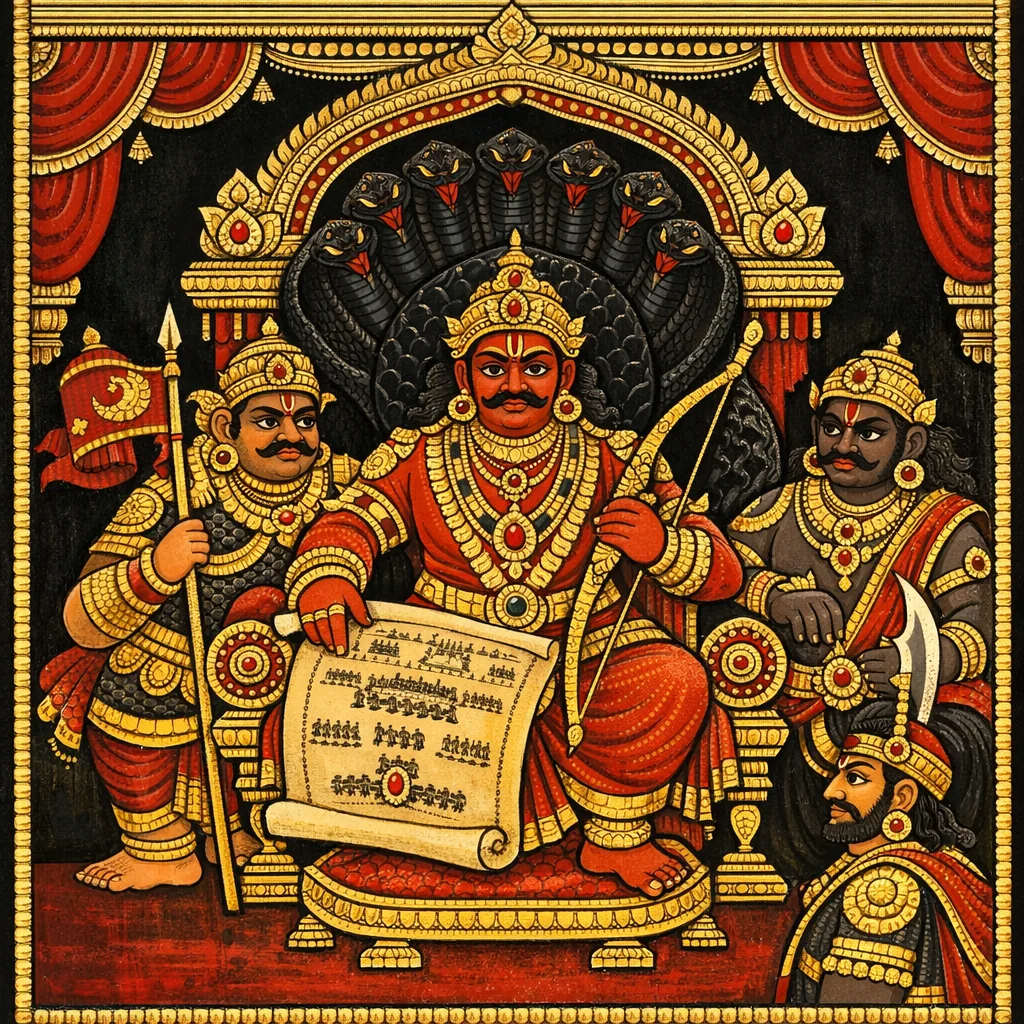
Adhyaya 25
भण्डासुरस्य मन्त्रणा (Bhaṇḍāsura’s War-Counsel against Lalitā)
This Adhyāya turns from the battlefield’s recent outcomes to the antagonist’s inner strategy. Hearing that mighty commanders have been destroyed, Bhaṇḍa Mahāsura flares up in rage, likened to a black serpent-king breathing out fury. In secret counsel he summons Mahodara and the allied ministers led by Kuṭilākṣa, seeking victory and devising countermeasures. Bhaṇḍa calls the reversal a cruel twist of fate (vidhi/bhavitavyatā), lamenting that devas once fled at the mere name of his servants, yet now “a woman, a māyinī” (Lalitā) routs his forces. The chapter’s core is tactical: based on spy reports of Lalitā’s position and marching order (elephants, horses, chariots), he commands a “pārṣṇigrāha” (rear-attack/flanking pursuit). He assigns Viṣaṅga a decisive role and dispatches seasoned commanders to execute the maneuver, preparing the next phase of conflict as calculated resistance to Śakti’s advance.
Shlokas
Verse 1
इति श्रीब्रह्माण्डमहापुराणे उत्तरभागे हयग्रीवागस्त्यसंवादे ललितोपाख्याने बलाहकादिसप्तसेनापतिवधो नाम चतुर्विंशो ऽध्यायः ततः श्रुत्वा वधं तेषां तपोबलवतामपि / न्यश्वसत्कृष्णसर्पेन्द्र इव भण्डो महासुरः
Thus, in the Śrī Brahmāṇḍa Mahāpurāṇa, in the latter section, in the dialogue of Hayagrīva and Agastya, within the Lalitā narrative, is the twenty-fourth chapter, called “The Slaying of the Seven Commanders beginning with Balāhaka.” Hearing of their death—even of those mighty in ascetic power—Bhaṇḍa, the great Asura, breathed hard like the lord of black serpents.
Verse 2
एकान्ते मन्त्रयामास स आहूय महोदरौ / भण्डः प्रचण्डशैण्डीर्यः काङ्क्षमाणो रणे जयम्
Bhaṇḍa, fierce and headstrong, longing for victory in war, summoned the two Mahodaras in private and took counsel with them in secret.
Verse 3
युवराजो ऽपि सक्रोधो विषङ्गेण यवीयसा / भण्डासुरं नमस्कृत्य मन्त्रस्थानमुपागमत्
Even the crown prince, aflame with wrath and accompanied by the younger Viṣaṅga, bowed to Bhaṇḍāsura and went to the seat of mantras.
Verse 4
अत्याप्तैर्मन्त्रिभिर्युक्तः कुटिलाक्षपुरःसरैः / ललिताविजये मन्त्रं चकार क्वथिताश्यः
Joined by his most trusted ministers, with Kuṭilākṣa at their head, his mouth as if boiling with rage, he fashioned a mantra for victory over Lalitā.
Verse 5
भण्ड उवाच अहो बत कुलभ्रंशः समायातः सुरद्विषाम् / उपेक्षामधुना कर्तुं प्रवृत्तो बलवान्विधिः
Bhaṇḍa said: “Alas! The downfall of the line of those who hate the Devas has arrived; mighty Fate has now set itself in motion to cast us into neglect.”
Verse 6
मद्भृत्यनाममात्रेण विद्रवन्ति दिवौकसः / तादृशानामिहास्माकमागतो ऽयं विपर्ययः
At the mere name of a servant of mine, the dwellers of heaven would flee; yet for us, who were once such, this reversal has now come.
Verse 7
करोति बलिनं क्लीबं धनिनं धनवर्जितम् / दीर्घायुषमनायुष्कं दुर्धाता भवितव्यता
Cruel destiny makes the strong impotent, the wealthy bereft of wealth, and the long-lived short-lived—such is the harsh inevitability of what must be.
Verse 8
क्व सत्त्वमस्मद्बाहुनां क्वेयं दुर्ल्ललिता वधूः / अकाण्ड एव विधिना कृतो ऽयं निष्ठुरो विधिः
Where is the valor of our arms, and whence comes this tender bride? Unbidden, Fate has wrought this harsh decree.
Verse 9
सर्पिणीमाययोदग्रास्तंया दुर्घटशौर्यया / अधिसंग्रामभूचक्रे सेनान्यो विनिपातिताः
With serpent-sliding sorcery and hard-to-withstand prowess, she deceived and struck; upon the wheel of battle the commanders were cast down.
Verse 10
एवमुद्दामदर्पाढ्या वनिता कापि मायिनी / यदि संप्रहरत्यस्मान्धिग्बलं नो भुजार्जितम्
That sorceress-woman is swollen with unbridled pride; if she strikes at us—shame on the strength our arms have won!
Verse 11
इमं प्रसंगं वक्तुं च जिह्वा जिह्वेति मामकी / वनिता किमु मत्सैन्यं मर्द यिष्यति दुर्मदा
I would speak of this, yet my tongue cries as if, “Tongue, O tongue!”—shall that insolent woman grind down my army?
Verse 12
तदत्र मूलच्छेदाय तस्या यत्नो विधीयताम् / मया चारमुखाज्ज्ञाता तस्या वृत्तिर्महाबला
Therefore, let effort be made to sever her at the root. From the mouths of spies I have learned her ways—she is of mighty power.
Verse 13
सर्वेषामपि सैन्यानां पश्चादेवावतिष्ठते / अग्रतश्चलितं सैन्यं हयहस्तिरथादिकम्
Of all the armies, most remain stationed in the rear; but the host that moves in the front is made up of horses, elephants, chariots, and the like.
Verse 14
अस्मिन्नेव ह्यवसरे पार्ष्णिग्राहो विधीयताम् / पार्ष्णिग्रहमिमं कर्तुं विषङ्गश्चतुरो भवेत्
At this very moment, let the rear-assault—the ‘seizing of the heel’—be set in motion. To carry out this encirclement from behind, Viṣaṅga must be deft and discerning.
Verse 15
तेन प्रौढमदोन्मता बहुसंग्रामदुर्मदाः / दश पञ्च च सेनान्यः सह यान्तु युयुत्सया
Therefore, let those troops—drunk with seasoned pride and made fierce by many battles—let fifteen commanders go forth together, eager for combat.
Verse 16
पृष्ठतः परिवारास्तु न तथा संति ते पुनः / अल्पैस्तु रक्षिता वै स्यात्तेनैवासौ सुनिग्रहा
But in the rear, their supporting guards are no longer as they once were. Protected by only a few, that force can be restrained and subdued with ease.
Verse 17
अतस्त्वं बहुसन्नाहमाविधाय मदोत्कटः / विषङ्ग गुप्तरूपेण पार्ष्णिग्राहं समाचर
Therefore, arm yourself with abundant gear and harness, fierce with proud ardor; and you, Viṣaṅga, in a concealed guise, carry out the ‘seizing of the heel’—the rear assault.
Verse 18
अल्पीयसी त्वया सार्द्धं सेना गच्छतु विक्रमात् / सज्जाश्च लन्तु सेनान्यो दिक्पालविजयोद्धताः
Let a small host march with you, upheld by your valor; and let the other commanders, ready and arrayed, set forth—exultant from victory over the Dikpālas, the guardians of the quarters.
Verse 19
अक्षौहिण्यश्च सेनानां दश पञ्च चलन्तु ते / त्वं गुप्तवेषस्तां दुष्टां सन्निपत्य दृढं जहि
Let fifteen akṣauhiṇīs of the armies move forth at your command; and you, in secret disguise, confront that wicked one and, closing in upon her, strike her down with unwavering resolve.
Verse 20
सैव निःशेषशक्तीनां मूलभूता महीयसी / तस्याः समूलनाशेन शक्तिवृन्दं विनश्यति
She alone is the mighty root-source of all śaktis, without remainder; when she is destroyed to the very root, the entire host of powers perishes.
Verse 21
कन्दच्छेदे सरोजिन्या दलजालमिवांभसि / सर्वेषामेव पश्चाद्यो रथश्चलति भासुरः
As when the root of a lotus-pond is cut and the mass of leaves scatters upon the waters, so too, after all the rest, the radiant chariot moves along behind.
Verse 22
दशयोजनसंपन्ननिजदेहसमुच्छ्रयः / महामुक्तातपत्रेण सर्वोद्ध्व परिशोभितः
His own form rose to the measure of ten yojanas; and above, all was splendidly adorned, made radiant by a great pearl-studded parasol lifted high overhead.
Verse 23
वहन्मुहर्वीज्यमानं चामराणां चतुष्टयम् / उत्तङ्गकेतुसंघातलिखितांबुदमण्डलः
The circle of clouds seemed inscribed by clusters of lofty banners; and the chariot was fanned again and again by a set of four cāmaras, as in sacred homage.
Verse 24
तस्मिन्रथे समायाति सा दृष्टा हरिणेक्षणा / निबृतं संनिपत्य त्वं चिह्नेनानेन लक्षिताम्
Upon that chariot she arrived—the doe-eyed one—and was seen; you, drawing near in quiet restraint, should recognize her by this sign.
Verse 25
तां विजित्य दुराचारां केशेष्वा कृष्य मर्दय / पुरतश्चलिते सैन्ये सत्त्वशालिनि सा वधूः
Conquer that ill-conducted woman; seize her by the hair, drag her, and subdue her. Even as the vanguard moved ahead, she—the bride—was rich in courage.
Verse 26
स्त्रीमात्ररक्षा भवतो वशमेष्यति सत्त्वरम् / भवत्सहायभूतायां सेनेन्द्राणामिहाभिधा
The safeguarding of women will swiftly come under your command; here are proclaimed the names of the armies of the Senendras, who stand as your allies.
Verse 27
शृणु यैर्भवतो युद्धे साह्यकार्यमतन्द्रितैः / आद्यो मदनको नाम दीर्घजिह्वो द्वितीयकः
Hear of those who, untiring, will perform the work of aid in your battle: the first is named Madanaka; the second is Dīrghajihva, “Long-Tongued.”
Verse 28
हुबको हुलुमुलुश्च कक्लसः कक्लिवाहनः / थुक्लसः पुण्ड्रकेतुश्च चण्डबाहुश्च कुक्कुरः
Hubaka, Hulumulu, Kaklasa, Kaklivāhana; Thuklasa, Puṇḍraketu, Caṇḍabāhu, and Kukkura—these are the sacred names of the commanders.
Verse 29
जंबुकाक्षो जंभनश्च तीक्ष्णशृङ्गस्त्रिकण्टकः / चन्द्रगुप्तश्च पञ्चैते दश चोक्ताश्चमूवराः
Jaṃbukākṣa, Jaṃbhana, Tīkṣṇaśṛṅga, Trikaṇṭaka, and Candragupta—these five, together with the ten already spoken of, are chamuvaras, leaders of the hosts.
Verse 30
एकैकाक्षौहिणीयुक्ताः प्रत्येकं भवता सह / आगमिष्यन्ति सेनान्यो दमनाद्या महाबलाः
Each is furnished with a full akṣauhiṇī; and each will come with you—the mighty generals, Damana and the rest.
Verse 31
परस्य कटकं नैव यथा जानाति ते गतिम् / तथा गुप्तसमाचारः पार्ष्णिग्राहं समाचर
Let not the enemy’s camp come to know your course; therefore move by secret intelligence and employ the rearward grasp (pārṣṇigrāha).
Verse 32
अस्मिन्कार्ये सुमहतां प्रौढिमानं समुद्वहन् / निषङ्ग त्वं हि तभसे जयसिद्धिमनुत्तमाम्
In this undertaking, bear the full-grown greatness of the mighty; O Niṣaṅga, you shall shine forth and attain the unsurpassed perfection of victory.
Verse 33
इति मन्त्रितमन्त्रो ऽयं दुर्मन्त्री भण्डदानवः / विषङ्गं प्रेषयामास रक्षितं सैन्यपालकैः
Thus, after counsel and mantra-craft were concluded, the ill-counselled dānava Bhaṇḍa dispatched Viṣaṅga, guarded by the wardens of the host.
Verse 34
अथ श्रीललितादेव्याः पार्ष्णिग्राहकृतोद्यमे / युवराजानुजे दैत्ये सूर्यो ऽस्तगिरिमाययौ
Then, as the glorious Śrī Lalitā Devī set in motion the act of seizing the heel against the daitya, the younger brother of the crown prince, the Sun—by māyā’s power—went down to Mount Astagiri.
Verse 35
प्रथमे युद्धदिवसे व्यतीते लोकभीषणे / अन्धकारः समभवत्तस्य बाह्यचिकीर्षया
When the first day of that world-terrifying battle had passed, darkness arose, for he sought to work his design from without.
Verse 36
महिषस्कन्धधूम्राभं वनक्रोडवपुर्द्दुति / नीलकण्ठनिभच्छायं निबिडं पप्रथे तमः
Dense darkness spread abroad—smoke-dusky like a buffalo’s shoulder, fierce as the forest boar’s form, and shadow-hued like the blue throat of Nīlakaṇṭha.
Verse 37
कुञ्जेषु पिण्डितमिव प्रधावदिव संधिषु / उज्जिहानमिव क्षोणीविवरेभ्यः सहस्रशः
It seemed to mass itself in the thickets, to race through every crevice, and to thrust forth by the thousand from the fissures of the earth.
Verse 38
निर्गच्छदिव शैलानां भूरि कन्दरमन्दिरात् / क्वचिद्दीपप्रभाजाले कृतकातरचेष्टितम्
As though great mountains were emerging from a cavern-palace rich with many grottoes; and somewhere, within a net of lamplight, there appeared fearful movements, as if contrived.
Verse 39
दत्तावलंबनमिव स्त्रीणां कर्णोत्पलत्विषि / एकीभूतमिव प्रौढदिङ्नागमिव कज्जले / आबद्धमैत्रकमिव स्फुरच्छाद्वलमण्डले
As though a support were granted to women in the sheen of the lotus at the ear; as though the mighty elephant of the quarters had merged into one within the black of kohl; as though friendship were bound fast upon a circle of shimmering green turf.
Verse 40
कृतप्रियाश्लेषमिव स्फुरन्तीष्वसियष्टिषु / गुप्तप्रविष्टमिव च श्यामासु वनपङ्क्तिषु
As though the embrace of the beloved had been enacted upon the flashing sword-hilts; and as though one had slipped in secret into the dark, Shyāmā-hued ranks of the forest.
Verse 41
क्रमेण बहुलीभूतं प्रससार महत्तमः / त्रियामावामनयना नीलकञ्चुकरोचिषा
Gradually the mighty darkness thickened and spread far and wide; the three-watch night, with downcast gaze, gleamed with the luster of a blue mantle.
Verse 42
तिमिरेणावृतं विश्वं न किञ्चित्प्रत्यपद्यत / असुराणां प्रदुष्टानां रात्रिरेव बलावहा
The whole world was veiled in darkness, and nothing could be made out; for the depraved Asuras, night itself is the bearer of strength.
Verse 43
तेषां मायाविलासो ऽयं तस्यामेव हि वर्धते / अथ प्रचलितं सैन्यं विषङ्गेण महौजसा
This is their sport of māyā, and in her alone it truly increases. Then the army began to move, led by Viṣaṅga of mighty splendor.
Verse 44
धौतखड्गलताच्छायावर्धिष्णु तिमिरच्छटम् / दमनाद्याश्च सेनान्यः श्मामकङ्कटधारिणः
The gleam-and-shadow of their burnished swords made the clusters of darkness swell. And the commanders—Damana and the rest—wore black cuirasses.
Verse 45
श्यामोष्णीषधराः श्यामवर्णसर्वपरिच्छदाः / एकत्वमिव संप्राप्तास्तिमिरेणातिभूयसा
They wore black headwraps, and all their gear was black in hue. Overwhelmed by the heavy darkness, they seemed to merge into a single oneness.
Verse 46
विषङ्गमनुसंचेलुः कृताग्रजनमस्कृतिम् / कूटेन युद्धकृत्येन विजिगीषुर्महेश्वरीम्
They moved in the wake of Viṣaṅga, who had first bowed to the elders. With deceitful stratagems of war, they sought to conquer Mahēśvarī.
Verse 47
मेघडंबरकं नाम दधे वक्षसि कङ्कटम् / यथा तस्य निशायुद्धानुरूपो वेषसंग्रहः
Upon his chest he wore a cuirass named “Meghaḍaṃbaraka.” Thus his whole array of dress was fitting for the night-battle that was his way.
Verse 48
तथा कृतवती सेना श्यामलं कञ्चुकादिकम् / न च दुन्दुभिनिस्वानो न च मर्द्दलगर्जितम्
Thus the host arrayed itself in dark-hued garments, with kañcuka armor and the like; there was no sound of dundubhi drums, nor any roar of marddala.
Verse 49
पणवानकभेरीणां न च घोषविजृंभणम् / गुप्ताचाराः प्रचलितास्तिमिरेण समावृताः
Nor was there any swelling clamor of paṇava, ānaka, or bherī; the secret scouts moved forth, veiled all around by darkness.
Verse 50
परैरदृश्यगतयो विष्कोशीकृतरिष्टयः / पश्चिमाभिमुखं यान्ति ललितायाः पताकिनीम्
They moved along courses unseen by others, their swords drawn from the scabbard; facing westward, they went toward Lalitā’s banner-bearing host.
Verse 51
आवृतोत्तरमार्गेण पूर्वभागमशिश्रियन् / निश्वासमपि सस्वानमकुर्वन्तः पदेपदे
Skirting by the northern route, they drew near the eastern quarter; at every step they made not even their breathing sound.
Verse 52
सावधानाः प्रचलिताः पार्ष्णिग्राहाय दानवाः / भूयः पुरस्य दिग्भागं गत्वा मन्दपराक्रमाः
The Dānavas moved with vigilance to seize from behind, like graspers of the heel; then again they went to a quarter of the city, their onrush now subdued.
Verse 53
ललितासैन्यमेव स्वान्सूचयन्तः प्रपृच्छतः / आगत्य निभृतं पृष्ठे कवचच्छन्नविग्रहाः
Lalitā’s warriors signaled to their own and questioned them; then, their forms covered in armor, they came quietly from the rear.
Verse 54
चक्रराजरथं तुङ्गं मेरुमन्दरसंनिभम् / अपश्यन्नतिदीप्ताभिः शक्तिभिः परिवारितम्
They beheld Cakrarāja’s lofty chariot, like Meru and Mandara, encircled by Śaktis of surpassing radiance.
Verse 55
तत्र मुक्तातपत्रस्य वर्त्तमानामधःस्थले / सहस्रादित्यसंकाशां पश्चिमाभिमुखीं स्थिताम्
There, beneath the pearl-white parasol spread above, she stood facing west, radiant as a thousand suns.
Verse 56
कामेश्वर्यादिनित्याभिः स्वसमानसमृद्धिभिः / नर्मालापविनोदेन सेव्यमानां रथोत्तमे
Upon that finest chariot she was attended by the Nityās—Kāmeśvarī and the rest—her equals in splendor, serving her with playful, gentle conversation.
Verse 57
तां तथाभूतवृत्तान्ताम तादृशरणोद्यमाम् / पुरोगतं महत्सैन्यं वीक्षमाण सकौतुकम्
Seeing matters thus and such readiness for battle, the great host marching in front gazed upon her with wonder and keen curiosity.
Verse 58
मन्वानश्च हि तामेव विषङ्गः सुदुराशयः / पृष्ठवंशे रथेन्द्रस्य घट्टयामास सैनिकैः
Viṣaṅga, of wicked intent and baleful desire, thinking it was she indeed, had his soldiers strike against the rear frame of Rathendra’s chariot, the lord of cars.
Verse 59
तत्राणि मादिशक्तीनां परिवारवरूथिनी / महाकलकलं चक्रुरणिमाद्याः परःशतम्
There the attendant host of the primal Śaktis raised a mighty uproar; Aṇimā and the rest—hundreds upon hundreds—made the battlefield resound.
Verse 60
पट्टिशैर्द्रुघणैश्चैव भिन्दिपालैर्भुशुण्डिभिः / कठोरवज्रनिर्धातनिष्ठुरैः शक्तिमण्डलैः
With paṭṭiśas and drughaṇas, with bhindipālas and bhuśuṇḍis, with circles of Śakti-weapons—hard as the vajra and pitiless in their blows—they smote.
Verse 61
मर्दयन्तो महासत्त्वाः समरं बहुमेनिरे / आकस्मिकरणोत्साहविपर्याविष्टविग्रहम्
The great heroes (mahāsattvas), crushing their foes, deemed the battle vast indeed; their bodies were seized by sudden ardor and a surge of impetuous zeal.
Verse 62
अकाण्डक्षुभितं चासीद्रथस्थं शक्तिमण्डलम् / विपाटैः पाटयामासुरदृश्यैरन्धकारिणः
The Śakti-host upon the chariot was thrown into sudden turmoil; and the Andhakāriṇas, beings of darkness, rent it apart with unseen cleaving strokes.
Verse 63
ततश्चक्ररथेन्द्रस्य नवमे पर्वणि स्थिताः / अदृश्यमानशस्त्राणामदृश्यनिजवर्मणाम्
Then, in the ninth parvan of Cakrarathendra, they took their stand—bearing unseen weapons and wearing their own unseen armor.
Verse 64
तिमिरच्छन्नरूपाणां दानवानां शिलीमुखैः / इतस्ततो बहु क्लिष्टं छन्नवर्मितमर्मवत्
The Dānavas, their forms shrouded in darkness, were struck by Śilīmukha arrows from every side; they were sorely afflicted, as though their vital points—though hidden by armor—had been pierced.
Verse 65
शक्तीनां मण्डलं तेने क्रन्दनं ललितां प्रति / पूर्वानुक्रम तस्तत्र संप्राप्तं सुमहद्भयम्
He arrayed a mandala of Śaktis and raised a wailing cry against Lalitā; and, in the course already set in motion, a very great fear came upon that place.
Verse 66
कर्णाकर्णिकयाकर्ण्य ललिता कोपमादधे / एतस्मिन्नन्तरे भण्डश्चण्डदुर्मत्रिपण्डितः
Hearing the tidings that reached her ear, Lalitā took up wrath. In that very interval appeared Bhaṇḍa—fierce, ill-minded, and learned in cruel stratagems.
Verse 67
दशाक्षौहिणिकायुक्तं कुटिलाक्षं महौजसम् / ललितासैन्यनाशाय युद्धाय प्रजिघाय सः
He dispatched to battle an army of ten akṣauhiṇīs—crooked-eyed and of mighty splendor—so as to destroy the host of Lalitā.
Verse 68
यथा पश्चात्कलकलं श्रुत्वाग्रेवर्तिनी चमूः / नागच्छति तथा चक्रे कुटिलाक्षो महारणम्
As a vanguard host, hearing the clamor behind, does not turn back, so Kuṭilākṣa contrived a mighty and dreadful battle.
Verse 69
एवं चोभयतो युद्धं पश्चादग्रे तथाभवत् / अत्यन्ततुमुलं चासीच्छक्तीनां सैनिके महत्
Thus the battle raged on both sides, behind and before; and within the great host the clash of śakti-spears was exceedingly tumultuous.
Verse 70
नक्तसत्त्वाश्च दैत्येन्द्रास्तिमिरेण समावृताः / इतस्ततः शिथिलतां कण्टके निन्युरुद्धताः
The Daitya lords, strong as creatures of the night, were shrouded in darkness; rushing here and there, through stubbornness they fell into disarray, as though caught in thorns.
Verse 71
निषङ्गेण दुराशेन धमनाद्यैश्चमूवरैः / चमूभिश्च प्रणहिता न्यपतञ्छत्रुकोटयः
With bow and quiver, with the foremost captains such as Durāśa and Dhamanā, and with the hosts dispatched, countless ranks of the foe were struck down.
Verse 72
ताभिर्दैत्यास्त्रमालाभिश्चक्रराजरथो वृतः / बकावलीनिबिडतः शैलराज इवाबभौ
Encompassed by the Daityas’ garlands of weapons, Cakrarāja’s chariot was ringed about; it shone like the king of mountains, tightly encircled by a dense flock of bakāvalī birds.
Verse 73
आक्रान्तपर्वणाधस्ताद्विषङ्गेण दुरात्मना / मुक्त एकः शरोदेव्यास्तालवृन्तमचूर्णयत्
Beneath the joint trodden down by Viṣaṅga, that wicked-souled one, a single arrow, once released, crushed to powder the palm-leaf stalk of the goddess Śarodevī.
Verse 74
अथ तेनाव्याहितेन संभ्रान्ते शक्तिमण्डले / कामेश्वरीमुखा नित्या महान्तं क्रोधमाययुः
Then, since that deed could not be checked and the Śakti-maṇḍala was thrown into turmoil, the Nityās, led by Kāmēśvarī, were seized by mighty wrath.
Verse 75
ईषद्भृकुटिसंसक्तं श्रीदेव्या वदनांबुजम् / अवलोक्य भृशोद्विग्ना नित्या दधुरतिश्रमम्
Beholding Śrīdevī’s lotus-face, with its brows slightly drawn together, the Nityās grew greatly distressed and bore an overwhelming weariness.
Verse 76
नित्या कालस्वरूपिण्यः प्रत्येकं तिथिविग्रहाः / क्रोधमुद्वीक्ष्य सम्नाज्ञ्या युद्धाय दधुरुद्यमम्
The Nityās, embodiments of Time itself, each one the very form of a lunar tithi, on seeing the Great Queen’s wrath, took up her command and readied themselves for war.
Verse 77
प्रणिपत्य च तां देवीं महाराज्ञीं महोदयाम् / ऊचुर्वाचमकाण्डोत्थां युद्धकौतुकगद्गदाम्
Prostrating before that Goddess, the Great Queen of lofty splendor, they spoke words that burst forth unbidden, their voices trembling with eagerness for battle.
Verse 78
तिथिनित्या उचुः / देवदेवी महाराज्ञी तवाग्रे ब्रेक्षितां चमूम् / दण्डिनीमन्त्रनाथादिमहाशक्त्याभपालिताम्
The Tithinityās spoke: “O Devadevī, great Mahārājñī! Before you there appears an army, guarded and upheld by the mighty Śaktis—Daṇḍinī, Mantranāthā, and the rest.”
Verse 79
धर्षितु कातरा दुष्टा मायाच्छद्मपरायणाः / पार्ष्णिग्राहेण युद्धेन बाधन्ते रथपुङ्गवम्
Those wicked ones, though faint-hearted, cling to māyā and deceit; by the warfare called pārṣṇigrāha—seizing from behind—they harass the noble war-chariot.
Verse 80
तस्मात्तिमिरसंछन्नमूर्तीनां विबुधद्रुहाम् / शमयामो वयं दर्पं क्षणमात्रं विलोकय
Therefore, upon those foes of the gods whose forms are shrouded in darkness, we shall quell their arrogance; look on for but a single moment.
Verse 81
या वह्निवासिनी नित्या या ज्वालामालिनी परा / ताभ्यां प्रदीपिते युद्धे द्रष्टुं शक्ताः सुरद्विषः
Nityā who dwells within the fire, and the Supreme who wears a garland of flames—only in the battle kindled by those two can the foes of the gods find strength to behold.
Verse 82
प्रशमय्य महादर्पं पार्ष्णिग्राहप्रवर्तिनाम् / सहसैवागमिष्यामः सेवितुं श्रीपदांबुजम् / आज्ञां देहि महाराज्ञि मर्दनार्थं दुरात्मनाम्
Having quelled the great arrogance of those who set the pārṣṇigrāha battle in motion, we shall come at once to serve the glorious lotus of your feet. O Mahārājñī, grant the command to crush the wicked-hearted.
Verse 83
इत्युक्ते सति नित्याभिस्तथास्त्विति जगाद सा / अथ कामेश्वरी नित्या प्रणम्य ललितेश्वरीम् / तया संप्रेषिता ताभिः कुण्डलीकृत कार्मुका
When this was spoken, she replied to the Nityās, “So be it.” Then the Nityā Kāmeśvarī bowed in reverence to Laliteśvarī; sent forth by Her command, she set out bearing a bow coiled like a ring.
Verse 84
सा हन्तुं तान्दुराचारान्कूटयुद्धकृतक्षणान् / बालारुणमिव क्रोधारुणं वक्त्रं वितन्वती
She went forth to slay those of wicked conduct, who contrived moments of deceitful war; and she spread a face crimson with wrath, like the tender red of the rising sun.
Verse 85
रे रे तिष्ठत पापिष्ठा मायानिष्ठाश्छिनद्मि वः / अन्धकारमनुप्राप्य कूटयुद्धपरायणाः
“Ho, ho! Stand fast, you most sinful, you who cling to Māyā—I shall cut you down! You who have entered darkness and are devoted to deceitful war!”
Verse 86
इति तान्भर्त्सयन्ती सा तूणीरोत्खातसायकात् / पर्वावरोहणं चक्रे क्रोधेन प्रस्खलद्गतिः
Thus rebuking them, she drew forth an arrow from the quiver; and, her gait unsteady with anger, she made the motion of drawing and lowering along the joints of the bow.
Verse 87
सज्जकार्मुकहस्ताश्च भगमालापुरःसराः / अन्याश्च चरिता नित्याः कृत पर्वावरोहणाः
With Bhagamālā leading the way, the other Nityās too stood ready, bows in hand; and all those Nityās had already performed the motion of drawing and lowering along the joints of the bow.
Verse 88
ज्वालामालिनि नित्या च या नित्या वह्निवासिनी / सज्जे युद्धे स्वतेजोभिः समदीपयतां रणे
Jvālāmālinī, the eternal Nityā who ever dwells within the sacred fire—when the battle was made ready, she lit the field of war with her own tejas.
Verse 89
अथ ते दुष्टदनुजाः प्रदीप्ते युद्धमण्डले / प्रकाशवपुषस्तत्र मरान्तं क्रोधमाययुः
Then those wicked Danujas, in the battle-circle blazing bright, beheld those radiant forms there and were seized by a wrath that reached the very brink of death.
Verse 90
कामेश्वर्यादिका नित्यास्ताः पञ्चदश सायुधाः / ससिंहनादास्तान्दैत्यानमृद्नन्नेव हेलया
The fifteen Nityās, beginning with Kāmeśvarī, all bore weapons; with lion-roars they crushed those Daityas, as though in effortless play.
Verse 91
महाकलकलस्तत्र समभूद्युद्धसीमनि / मन्दरक्षोभितांभोदिवेल्लत्कल्लोलमण्डलः
At the battle’s edge there arose a mighty uproar, like the ocean’s circling waves surging when churned by Mount Mandara.
Verse 92
ताश्च नित्यावलत्क्वाणकङ्कणैर्युधि पाणिभिः / आकृष्य प्रामकोदण्डास्तेनिरे युद्धमुद्धतम्
And those Nityās, in battle, their hands ringing with clashing bangles, drew their mighty bows and set in motion a fierce and exalted war.
Verse 93
यामत्रितयपर्यन्तमेवं युद्धमवर्त्तत / नित्यानां निशितैर्बाणैरक्षौहिण्यश्च संहृताः
Thus the battle raged on until three yāmas had passed; by the Nityās’ keen-pointed arrows, many akṣauhiṇī hosts were brought to ruin.
Verse 94
जघान दमनं दुष्टं कामेशी प्रथमं शरैः / दीर्घजिह्वं चमूनाथं भगमाला व्यदारत्
Kāmeśī first struck down the wicked Damana with her arrows; and Bhagamālā tore apart Dīrghajihvā, lord of the host.
Verse 95
नित्यक्लिन्ना च भेरुण्डा हुम्बेकं हुलुमल्लकम् / कक्लसं वह्निवासा च निजघान शरैः शतैः
Nityaklinnā and Bheruṇḍā slew Humbeka and Hulumallaka; and Vahnivāsā, with hundreds of arrows, struck down Kaklasa.
Verse 96
महावज्रेश्वरी बाणैरभिनत्केकिवाहनम् / पुक्लसं शिवदूती च प्राहिणोद्यमसादनम्
Mahāvajreśvarī pierced Kekivāhana with her arrows; and Śivadūtī sent forth against Puklasa a blow that shattered his onrush.
Verse 97
पुण्ड्रकेतुं भुजोद्दण्डं त्वरिता समदारयत् / कुलसुन्दरिका नित्या चण्डबाहुं च कुक्कुरम्
Tvaritā swiftly rent asunder Puṇḍraketu and Bhujoddaṇḍa; and the Nityā Kulasundarikā likewise destroyed Caṇḍabāhu and Kukura.
Verse 98
अथ निलपताका च विजया च जयोद्धते / जंबुकाक्षं जृंभणं च व्यतन्वातां रणे बलिम् / सर्वमङ्गलिका नित्या तीक्ष्णशृङ्गमखण्डयत् / ज्वालामालिनिका नित्या जघानोग्रं त्रिकर्णकम्
Then Nilapatākā and Vijayā, with Jayoddhate, spread the battle-offering upon the field against Jambukākṣa and Jṛmbhaṇa. The ever-abiding Sarvamaṅgalikā shattered Tīkṣṇaśṛṅga of the razor horns, and the ever-abiding Jvālāmālinikā struck down the fierce Trikarṇaka.
Verse 99
चन्द्रगुप्तं च दुःशीलं चित्रं चित्रा व्यदारत् / सेनानाथेषु सर्वेषु निहतेषु दुरात्मसु
Citrā tore apart Candragupta and the vile Duḥśīla, and Citra as well, when all the commanders of the hosts—those of wicked soul—had been slain.
Verse 100
विषङ्गः परमः कुद्धश्चचाल पुरतो बली / अथ यामावशेषायां यामिन्यां घटिकाद्वयम्
Viṣaṅga, the mighty one, burning with utmost wrath, surged to the fore. Then, when the night had only its last watch remaining, but two ghaṭikā were left.
Verse 101
नित्याभिः सह संग्रामं विधाय स दुराशयः / अशक्यत्वं समुद्दिश्य चक्राम प्रपलायितुम्
He, of evil intent, waged war with the Nityā; but, deeming victory impossible, he turned his steps toward flight.
Verse 102
कामेश्वरीकराकृष्टचापोत्थौर्निशितैः शरैः / भिन्नवर्मा दृढतरं विषङ्गो विह्वलाशयः / हतावशिष्टैर्योधैश्च सार्धमेव पलायितः
Pierced by the keen arrows loosed from the bow drawn by Kāmeśvarī’s own hand, Viṣaṅga’s armor was grievously shattered and his heart fell into turmoil. And with the warriors left alive after the slaughter, he fled away.
Verse 103
ताभिर्न निहतो दुष्टो यस्माद्वध्यः स दानवः / दण्डनाथाशरेणैव कालदण्डसमत्विषा
By those weapons the wicked Dānava was not slain, for he was fated to be killed only by the arrow of Dandhanātha, radiant like the rod of punishment of Kāla.
Verse 104
तस्मिन्पलायिते दुष्टे विषङ्गे भण्डसोदरे / सा विभाता च रजनी प्रसन्नाश्चाभवन्दिशः
When that wicked one fled—Viṣaṅga, born from Bhaṇḍa’s belly—the night began to brighten, and all the quarters became calm and clear.
Verse 105
पलायितं रणेवीरमनुसर्त्तुमनौचिती / इति ताः समरान्नित्यास्तस्मिन्काले व्यरंसिषुः
“It is not fitting to pursue a hero who has fled the battlefield”—so they judged; and the Nityās, ever steadfast in war, ceased from combat at that time.
Verse 106
दैत्यशस्त्रव्रणस्यन्दिशोणितप्लुतविग्रहाः / नित्याः श्रीललितां देवीं प्रणिपेतुर्जयोद्धताः
The Nityās, their bodies drenched in blood flowing from wounds dealt by Daitya weapons, exultant in victory, bowed down before the Goddess Śrī Lalitā.
Verse 107
इत्थं रात्रौ महद्युद्धं तत्र जातं भयङ्करम् / नित्यानां रूपजालं च शस्त्रक्षतमलोकयत्
Thus, in the night there arose there a great and dreadful battle; and one beheld the manifold forms of the Nityās, wounded by the blows of weapons.
Verse 108
श्रुत्वोदन्तं महाराज्ञी कृपापाङ्गेन सैक्षत / तदालोकनमात्रेण व्रणो निर्व्रणतामगात्
Hearing the tidings, the Great Queen looked on with a glance of compassion; by that mere look alone, the wound became as though unwounded and was healed.
Verse 109
नित्यानां विक्रमैश्चापि ललिता प्रीतिमासदत्
And through the valorous feats of the Nityās as well, Lalitā attained joy and delight.
Frequently Asked Questions
It serves as a strategic interlude: the text shifts from battlefield results to Bhaṇḍa’s internal reaction, intelligence assessment, and the issuing of tactical orders that set up the next confrontation.
The chapter highlights “pārṣṇigrāha” (a rear-attack/flanking pursuit). It implies targeting the marching formation from behind, using intelligence on how Lalitā’s forces are positioned and how the vanguard (horses/elephants/chariots) has advanced.
It frames the antagonist’s loss of control as cosmic inevitability: Bhaṇḍa interprets reversal as fate’s cruelty, while the narrative subtext presents Śakti’s ascendancy as the deeper order that overrides merely martial power.