Adhyaya 24
ध्रुवचर्याकीर्तनं / Dhruva-caryā-kīrtana (Account of Dhruva’s Course and Related Cosmological Ordering)
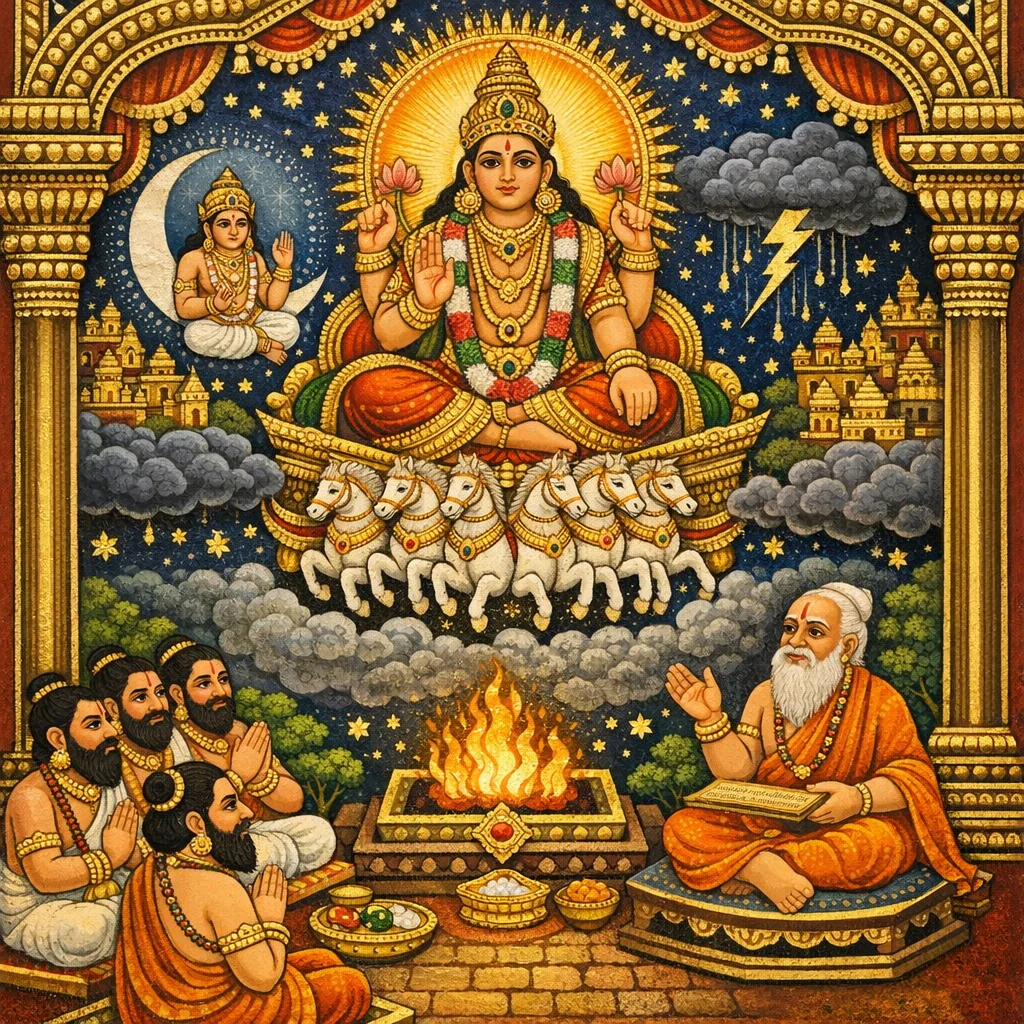
The chapter begins with Sūta (Lomaharṣaṇa) answering the sages, who, after hearing the earlier teaching, still harbor doubts and request a fuller explanation. Their inquiry turns to “devagṛhāṇi” (divine abodes/astral houses) and to the classification and determination of “jyotīṃṣi” (luminaries). In reply (in the teaching stream attributed to Vāyu), the origin of the Sun and Moon is introduced, followed by a technical exposition of fire as threefold—divine/solar, atmospheric/lightning, and terrestrial/physical—together with subtypes such as jāṭhara (digestive fire) and vaidyuta (electric or lightning fire). The chapter links primordial undifferentiated darkness to the manifestation of functional principles (light, heat, and celestial regulators), presenting a cosmology that both describes phenomena and orders them by sacred names and categories.
Shlokas
Verse 1
इति श्रीब्रह्माण्डे महादृवायुप्रोक्ते पूर्वभागे द्वितीये ऽनुषङ्गपादे ध्रुवचर्याकीर्त्तनं नाम त्रयोविंशतितमो ऽध्यायः सूत उवाच एतच्छ्रुत्वा तु सुनयः पुनस्ते संशयान्विताः / पप्रच्छुरुत्तरं भूयस्तदा ते रोमहर्षणम्
Thus, in the Śrī Brahmāṇḍa Purāṇa—former section, second anuṣaṅga-pāda—stands the twenty-third chapter, called “The Praise of Dhruva’s Course.” Sūta said: hearing this, the Sunayas, still filled with doubt, questioned Romaharṣaṇa again for a fuller reply.
Verse 2
यदेतदुक्तं भवतागृहाणीत्येव विस्तृतम् / कथं देवगृहाणि स्युः कथं ज्योतींषिवर्णय
You have spoken at length, saying, “Accept the gṛhas (abodes)”; how then are the divine abodes, and how should the heavenly lights be described?
Verse 3
एतत्सर्वं समाचक्ष्व ज्योतिषां चैव निर्णयम् / वायुरुवाच श्रुत्वा तु वचनं तेषां तदा सूतः समाहितः
Explain all this, and also the settled conclusion regarding the luminous bodies. Vāyu said: hearing their words, Sūta then became composed and intent.
Verse 4
उवाच परमं वाक्यं तेषां संशयनिर्णयम् / अस्मिन्नर्थे माहाप्राज्ञैर्यदुक्तं ज्ञानबुद्धिभिः
Then he spoke the supreme utterance that resolved their doubt—just as the great sages, endowed with knowledge and insight, have declared on this matter.
Verse 5
एतद्वो ऽहं प्रवक्ष्यामि सूर्याचन्द्रमसोर्भवम् / यथा देवगृहाणीह सूर्यचन्द्रग्रहाः स्मृताः
Now I shall tell you the origin of the Sun and the Moon, and how here the Sun and Moon, as grahas, are remembered as divine abodes (devagṛhas).
Verse 6
ततः परं च त्रिविधस्याग्नेर्वक्ष्ये समुद्भवम् / दिव्यस्य भौतिकस्याग्नेरब्योनेः पार्थि वस्य तु
Thereafter I shall speak of the arising of the threefold Agni: the divine fire, the elemental (material) fire, and also the womb-unborn (abyoni) and the earthly (pārthiva) fire.
Verse 7
व्युष्टायां तु रजन्यां वै ब्रह्मणो ऽव्यक्तजन्मनः / अव्याकृतमिदं त्वासीन्नैशेन तमसावृतम्
When the night had passed, in the time of Brahmā whose birth is unmanifest, all this was still undifferentiated, veiled by the darkness of night.
Verse 8
सर्वभूतावशिष्टे ऽस्मिंल्लोके नष्टविशेषणे / स्वयंभूर्भगवांस्तत्र लोकतन्त्रार्थसाधकः
When in this world, with all beings dissolved, distinctions had vanished, the Blessed Self-born (Svayambhū) appeared there to establish the order of the cosmos.
Verse 9
खद्योतवत्स व्यचरदाविर्भावचिकीर्षया / सो ऽग्निं दृष्ट्वाथ लोकादौ पृथिवीजलसंश्रितम्
Wishing to manifest, he moved about like a firefly; then he beheld Fire at the world’s beginning, abiding in earth and in water.
Verse 10
संवृत्य तं प्रकाशार्थं त्रिधा व्यमजदीश्वरः / पवनो यस्तु लोके ऽस्मिन्पार्थिवः सो ऽग्निरुच्यते
For the sake of illumination, the Lord contained it and apportioned it threefold; and the wind that in this world is of earthly (gross) nature is called “Agni”.
Verse 11
यश्चासौ तपते सूर्ये शुचिरग्निस्तु स स्मृतः / वैद्युतो ऽब्जस्तु विज्ञेयस्तेषां वक्ष्ये ऽथ लक्षमम्
That which burns in the sun is remembered as Śuci-Agni; and that which is of lightning-nature and abides in the waters is also to be known—now I shall speak of their characteristics.
Verse 12
वैद्युतो जाठरः सौरो ह्यपां गर्भास्त्रयो ऽग्रयः / तस्मादपः पिबन्सूर्यो गोभिर्दीप्यत्यसौ दिवि
Lightning, the inner gastric fire, and the solar radiance—these are the three foremost lights born from the womb of the waters. Therefore the Sun, drinking the waters, shines in heaven with his rays.
Verse 13
वैद्युतेन समाविष्टो वार्ष्यो नाद्भिः प्रशाम्यति / मानवा नां च कुक्षिस्थो नाद्भिः शास्यति पावकः
Fire pervaded by lightning-power, appearing as rain, is not quenched by water; and the sacred Pāvaka abiding in the bellies of men is likewise not subdued by water.
Verse 14
तस्मात्सौरो वैद्युतश्च जाठरश्चप्यनिन्धनः / किञ्चिदप्सु मतं तेजः किञ्चिद्दृष्टमबिं धनम्
Therefore the solar, the lightning-born, and the gastric fire are all without fuel. Some of this tejas is held to abide within the waters, and some is seen manifest without any fuel.
Verse 15
काष्ठेन्धनस्तु निर्मथ्यः सो ऽद्भिः शाम्यति पावकः / अर्चिष्मान्पवमानो ऽग्निर्निष्प्रभो जाठरः स्मृतः
Fire kindled by churning wood as fuel is quenched by water. The flame-tongued pavamāna Agni is radiant, but the gastric fire is remembered as without outward brilliance.
Verse 16
यश्चायं मण्डले शुक्लो निरूष्मा संप्रकाशकः / प्रभा सौरी तु पादेन ह्यस्तं याति देवाकरे
And that white light within the orb, heatless yet illuminating, is the solar prabhā. It sets into Devākara, the Sun, by but a single pāda.
Verse 17
अग्निमाविशते रात्रौ तस्माद्दूरात्प्रकाशते / उद्यन्तं च पुनः सूर्यमौष्णमयमाग्नेयमाविशत्
At night, Night enters into Fire; therefore it shines even from afar. And when the Sun rises again, the fiery heat enters into Surya.
Verse 18
पादेन पार्थिवस्याग्नेस्तस्मादग्निस्तपत्यसौ / प्राकाश्यं च तथौष्ण्यं च सौराग्नेये तु तेजसी
By a portion of the earthly fire, this fire burns with heat. In the solar-igneous radiance, both brilliance and warmth abide.
Verse 19
परस्परानुप्रवेशादाप्यायेते परस्परम् / उत्तरे चैव भूम्यर्द्धे तथा ह्यग्निश्च दक्षिणे
Through mutual interpenetration, they nourish one another. In the northern half of the earth (one abides), and likewise Agni is in the south.
Verse 20
उत्तिष्ठति पुनः सूर्ये रात्रिराविशते ह्यपः / तस्मात्तप्ता भवन्त्यापो दिवारत्रिप्रवेशनात्
When the Sun rises again, Night enters into the waters. Therefore the waters become heated by the entering of day and night.
Verse 21
अस्तं याति पुन सूर्ये अहर्वै प्रविशत्यपः / तस्मान्नक्तं पुनः शुक्ला आपो ऽदृश्यन्त भास्वराः
When the Sun sets again, Day enters into the waters. Therefore at night the waters are seen once more—white and radiant.
Verse 22
एतेन क्रमयोगेन भूम्यर्द्धे दक्षिणोत्तरे / उदयास्तमने नित्यमहोरात्रं विशत्यपः
By this ordered sequence, the waters ever enter the southern and northern halves of the earth, following sunrise and sunset, pervading day and night.
Verse 23
यश्चासौ तपते सूर्यः पिबन्नंभो गभस्तिभिः / पार्थिवाग्निविमिश्रो ऽसौ दिव्यः शुचिरिति स्मृतः
The Sun that blazes drinks the waters with his rays; though mingled with earthly fire, he is remembered as divine and pure.
Verse 24
सहस्रपादसौ वह्निर्घृतकुंभनिभः शुचिः / आदत्ते स तु नाडीनां सहस्रेण समन्ततः
That pure fire, as though thousand-footed and shining like a jar of ghee, draws in the waters from all sides through a thousand channels.
Verse 25
नादेयीश्चैव सामुद्रीः कौप्याश्चैव समन्ततः / स्थावरा जङ्गमाश्चैव याश्च कुल्यादिका अपः
River-waters, ocean-waters, and well-waters on every side; waters abiding in the unmoving and the moving, and those of channels and rivulets—all these.
Verse 26
तस्य रश्मिसहस्रं तु शीतवर्षोष्णनिःस्तवम् / तासां चतुःशता नाड्यो वर्षन्ते चित्र मूर्त्तयः
His thousand rays bring forth coolness, rain, and heat; and among them, four hundred channels pour down rain in manifold forms.
Verse 27
चन्दनाश्चैव साध्यश्च कूतनाकूतनास्तथा / अमृता नामतः सर्वा रश्मयो वृष्टिसर्जनाः
The rays called Candanā, Sādhya, and Kūtanā-Akūtanā—known collectively as “Amṛtā”—bring forth the creation of rain.
Verse 28
हिमोद्गताश्च ताभ्यो ऽन्या रश्मयस्त्रिशताः पुनः / दृश्या मेघाश्च याम्यश्च ह्रदिन्यो हिमसर्जनाः
From them arise again three hundred other rays, born of frost; called Dṛśyā, Meghā, Yāmya, and Hradinī, they generate snow.
Verse 29
चन्द्रास्ता नामतः प्रोक्ता मिताभास्तु गभस्तयः / शुक्लाश्च कुहकाश्चैव गावो विश्वभृतस्तथा
These are declared by name as “Candrā”; their beams (gabhasti) shine with measured radiance. There are also Śuklā, Kuhakā, Gāvo, and Viśvabhṛt.
Verse 30
शुक्लास्ता नामतः सर्वस्त्रिशता धर्मसर्जनाः / समं विभज्य नाडीस्तु मनुष्टपितृदेवताः
All those three hundred rays named “Śuklā” are creators of Dharma; dividing the nāḍīs evenly, they flow to humans, the Pitṛs, and the devas.
Verse 31
मनुष्यानौषधेनेह स्वधया तु पितॄनपि / अमृतेन सुरान्सर्वांस्त्रींस्त्रिभिस्तर्पयत्यसौ
Here he satisfies humans with sacred herbs, the Pitṛs with svadhā, and all the devas with amṛta—thus nourishing the three with three offerings.
Verse 32
वसंते चैव ग्रीष्मे च शतैः स तपति त्रिभिः / वर्षास्वथो शरदि वै चतुर्भिश्च प्रवर्षति
In spring and in summer he scorches with three hundred rays; in the rainy season and in autumn he pours forth rain with four hundred rays.
Verse 33
हेमन्ते शिशिरे चैव हिम मुत्सृजते त्रिभिः / इन्द्रो धाता भगः पूषा मित्रो ऽथ वरुणोर्ऽयमा
In hemanta and in sisira he releases snow with three hundred rays; (as forms of the Aditya) are Indra, Dhata, Bhaga, Pusha, Mitra, Varuna, and Aryama.
Verse 34
अंशुर्विवस्वास्त्वष्टा च सविता विष्णुरेव च / माघमासे तु वरुणः पूषा चैव तु फलाल्गुने
Anshu, Vivasvan, Tvashtri, Savita, and Vishnu—these are (forms of the Aditya); in the month of Magha it is Varuna, and in Phalguna it is remembered as Pusha.
Verse 35
चैत्रे मासि तु देतोंशुर्धाता वैशाखतापनः / ज्येष्ठमासे भवेदिन्द्रश्चाषाढे सविता रविः
In the month of Chaitra it is Detomshu; in Vaishakha, Dhata the warming one; in Jyeshtha it becomes Indra; and in Ashadha, Savita as Ravi.
Verse 36
विवस्वाञ्छ्रावणे मासि प्रोष्ठे मासे भागः स्मृतः / पर्जन्यो ऽश्वयुजे मासि त्वष्टा च कार्तिके रविः
In the month of Shravana it is Vivasvan; in Proshthapada it is remembered as Bhaga; in Ashvayuja it is Parjanya; and in Kartika it is Tvashtri and Ravi.
Verse 37
मार्गशीर्षे भवेन्मित्रः पौषेविष्णुः सनातनः / पञ्चरश्मिसहस्राणि वरुणस्यार्ककर्मणि
In the month of Mārgaśīrṣa the Sun becomes Mitra; in Pauṣa, the eternal Viṣṇu. In Varuṇa’s solar office, five thousand rays are set to their work.
Verse 38
षड्भिः सहस्रैः पूषा तु देवो ऽशुसप्तभिस्तथा / धाताष्टभिः सहस्रैस्तु नवभिस्तु शतक्रतुः
With six thousand rays moves the god Pūṣā; with seven thousand, Aśu. With eight thousand, Dhātā; and with nine thousand rays, Śatakratu (Indra) performs his office.
Verse 39
सविता दशभिर्याति यात्येकादशभिर्भगः / सप्तभिस्तपते सित्रस्त्वष्टा चैवाष्टभिस्तपेत्
Savitā moves with ten (thousand) rays; Bhaga moves with eleven. Sitra burns with seven rays; and Tvaṣṭā too burns with eight (thousand) rays.
Verse 40
अर्यमा दशाभिर्याति पर्जन्यो नवभिस्तपेत् / षड्भी रश्मिसहस्रैस्तु विषणुस्तपति मेदिनीम्
Aryamā moves with ten (thousand) rays; Parjanya burns with nine. And Viṣaṇu, with six thousand rays, heats Medinī—the Earth.
Verse 41
वसंते कपिलः सूर्यो ग्रीष्मेर्ऽकः कनकप्रभः / श्वेतवर्णस्तु वर्षासु पाण्डुः शरदि भास्करः
In spring the Sun is kapila—ruddy in hue; in summer Arka shines with golden splendor. In the rains he is white in color; in autumn Bhāskara appears pale and gentle.
Verse 42
हेमन्ते ताम्रवर्णस्तु शैशिरे लोहितो रविः / इति वर्णाः समा ख्याताः सूर्यस्यर्तुसमुद्भवाः
In hemanta the Sun is copper-hued; in śaiśira Ravi is ruddy red. Thus are the Sun’s colors, born of the seasons, declared to be well known.
Verse 43
औषधीषु बलं धत्ते स्वधया च पिदृष्वपि / सूर्यो ऽमरेष्वप्यमृतं त्रयं त्रिषु न यच्छति
The Sun places strength within the healing herbs, and by svadhā he also satisfies the Pitṛs. Even among the gods he is the cause of amṛta; yet this threefold gift he does not bestow interchangeably upon the three.
Verse 44
एवं रश्मिसहस्रं तु सौरं लोकार्थसाधकम् / भिद्यते ऋतुमासाद्य जलशीतोष्णनिस्रवम्
Thus the Sun’s thousand rays, working for the welfare of the worlds, on reaching the seasons become divided, sending forth in the waters the outflow of coolness and heat.
Verse 45
इत्येतन्मण्डलं शुक्लं भास्वरं सूर्य संज्ञितम् / नक्षत्रग्रहसोमानां प्रतिष्ठा योनिरेव च
Thus this white and radiant orb is called the Sun (Sūrya). It is the support and also the womb-source of the constellations, the planets, and Soma (the Moon).
Verse 46
चन्द्रऋक्षग्रहाः सर्वे विज्ञेयाः सूर्यसंभवाः / नक्षत्राधिपतिः सोमो ग्रह राजो दिवाकरः
The Moon, the constellations, and all the planets are to be known as born of the Sun. Soma is lord of the constellations, and Divākara—the Sun—is king of the planets.
Verse 47
शेषाः पञ्च ग्रहा ज्ञेया ईश्वराः कामचारिणः / पठ्यते चाग्निरादित्य उदकं चन्द्रमाः स्मृतः
The remaining five Grahas are to be known as divine lords, moving as they will. In the recitation, Agni is called Āditya, and water is remembered as Candra (the Moon).
Verse 48
शेषाणा प्रकृतीः स्मयग्वर्ण्यमाना निबोधत / सुरसेनापतिः स्कन्दः पठ्यते ऽङ्गारको ग्रहः
Hear, as they are rightly described, the natures of the remaining Grahas. Skanda, commander of the hosts of the gods, is recited as the Graha Aṅgāraka (Mars).
Verse 49
नारायणं बुधं प्राहुर्वेदज्ञानविदो बुधाः / रुद्रो वैवस्वतः साक्षाद्यमो लोकप्रभुः स्वयम्
The wise, skilled in Vedic knowledge, declare the Graha Budha to be Nārāyaṇa. And Rudra himself is Vaivasvata—Yama manifest, the lord of the worlds.
Verse 50
महाग्रहो द्विजश्रेष्ठो मन्दगामी शनैश्वरः / देवासुरगुरू द्वौ तु भानुमन्तौ महा ग्रहौ
Śanaiśvara is the great Graha, foremost among the twice-born, moving with slow pace. And the two teachers of Devas and Asuras—Śukra and Bṛhaspati—are radiant great Grahas.
Verse 51
प्रजापतिसुतावेतावुभौ शुक्रबृहस्पती / आदित्यमूलमखिलं त्रैलोक्यं नात्र संशयः
These two—Śukra and Bṛhaspati—are sons of Prajāpati. The whole of the three worlds has Āditya as its root; of this there is no doubt.
Verse 52
भवत्यस्माज्जगत्कृत्स्नं सदेवासुरमानुषम् / रुद्रोपेन्द्रेन्द्रचन्द्राणां विप्रेन्द्रास्त्रिदिवौकसाम्
From Him arises the entire universe, with gods, asuras, and humankind; from Him come Rudra, Upendra, Indra, and Chandra, and the foremost brahmins who dwell in the heavenly realms.
Verse 53
द्युतिर्द्युतिमतां कृत्स्नं यत्तेजः सार्वलौकिकम् / सर्वात्मा सर्वलोकेशो महादेवः प्रजापतिः
He is the complete radiance of all that shines, the tejas that pervades every world; He is the Self of all, Lord of all realms—Mahadeva, Prajapati.
Verse 54
सूर्य एव त्रिलोकस्य सूलं परमदैवतम् / ततः संजायते सर्वं तत्र चैव प्रलीयते
Surya alone is the supreme divinity of the three worlds, like the sacred trident; from Him all things are born, and in Him alone they dissolve.
Verse 55
भावाभावौ हि लोकानामादित्यान्निःमृतौ पुरा / जगज्ज्ञेयो ग्रहो विप्रा दीप्तिमान्सुप्रभो रविः
O vipras, the being and non-being of the worlds once issued forth from Aditya; the luminary to be known by the universe is Ravi, radiant and supremely bright.
Verse 56
अत्र गच्छन्ति निधनं जायन्ते च पुनः पुनः / क्षणा मुहूर्त्ता दिवसा निशाः पक्षाश्च कृत्स्नशः
Here, moments, muhūrtas, days, nights, and all fortnights are born again and again, and again and again pass into dissolution.
Verse 57
मासाः संवत्सराश्चैव ऋतवो ऽथ युगानि च / तदादित्यादृते ह्येषा कालंसख्या न विद्यते
Months, years, seasons, and yugas—all these exist; without that Aditya, there is no reckoning of Time.
Verse 58
कालादृते न निगमो न दीक्षा नाह्निकक्रमः / ऋतूनामविभागाच्च पुष्पमूलफलं कुतः
Without Time there is no Nigama, no initiation, no daily order of rites; and without the division of seasons, whence would flower, root, and fruit arise?
Verse 59
कुतः सस्यविनिष्पत्तिस्तृणौषधिगणो ऽपि वा / अभावो व्यवहाराणां जन्तूनां दिवि चैह च
Whence would crops come to fruition, or even the host of grasses and healing herbs? The dealings of beings would vanish—both in heaven and here on earth.
Verse 60
जगत्प्रतापनमृते भास्करं वारितस्करम् / स एष कालश्चाग्निश्च द्वादशात्मा प्रजापतिः
Without Bhāskara who warms the world, who could restrain the thief called darkness? He indeed is Time and he is Fire—the twelve-formed Prajāpati.
Verse 61
तपत्येष द्विजश्रेष्ठास्त्रैलोक्यं सचराचरम् / स एष तेचसां राशिस्तमो घ्रन्सार्वलौकिकम्
O best of the twice-born! He heats the three worlds with all that moves and stands still; he is a mass of radiance, destroying the darkness of every realm.
Verse 62
उत्तमं मार्गमास्थाय वायोर्भाभिरिदं जगत् / पार्श्वमूर्ध्वमधश्चैव तापयत्येष सर्वशः
Taking the highest course, by the radiances of Vāyu this world is heated on every side—at the flanks, above, and below, everywhere.
Verse 63
यथा प्रभाकरो दीपोगृहमध्ये ऽवलंबितः / पार्श्वमूर्ध्वमधश्चैव तमो नाशयते समम्
As a radiant lamp hung in the middle of a house destroys darkness evenly—at the sides, above, and below—so it is.
Verse 64
तद्वत्सहस्रकिरणो ग्रहराजो जगत्पतिः / सूर्यो गोभिर्जगत्सर्वमादीपयति सर्वतः
So too the Sun—thousand-rayed, king of the planets and lord of the world—illumines the entire universe with his beams on every side.
Verse 65
रवे रश्मिसहस्रं यत्प्राङ्मया समुदात्दृतम् / तेषां श्रेष्ठाः पुनः सप्त रश्मयो ग्रहयो नयः
Of the Sun’s thousand rays spoken of earlier, seven are again the most excellent—those that guide the courses of the planets.
Verse 66
सुषुम्णो हरिकेशश्च विश्वकर्मा तथैव च / विश्वश्रवाः पुनश्चान्यः संपद्वसुरतः परः
Those seven rays are: Suṣumṇā, Harikeśa, Viśvakarmā, Viśvaśravā; and two more—Saṃpad and Vasurata—most exalted of all.
Verse 67
अर्वावसुः पुनश्चान्यः स्वराडन्यः प्रकीर्त्तितः / सुषुम्णः सूर्यरश्मिस्तु क्षीण शशिनमेधयेत्
Again, another ray is praised as Arvāvasu, and another is renowned as Svarāṭ. Suṣumṇā is a ray of the Sun, by which the waning Moon is nourished.
Verse 68
तिर्यगूर्ध्वप्रचारो ऽसौ सुषुम्णः परिकीर्त्तितः / हरि केशः पुरस्ताद्य ऋक्षयोनिः स कीत्यते
Suṣumṇā is proclaimed as moving both across and upward. That which stands in the east is called Harikeśa, and is also known as Ṛkṣayoni.
Verse 69
दक्षिणे विश्वकर्मा तु रश्मिन्वर्द्धयते वुधम् / विश्वश्रवास्तु यः पश्चच्छुक्रयोनिः स्मृतो बुधैः
In the south, the ray called Viśvakarmā increases Budha. And that which is in the west is Viśvaśravā, remembered by the wise as Śukrayoni.
Verse 70
संपद्वसुस्तु यो रश्मिः स योनिर्लोहितस्य तु / षष्ठस्त्वर्व्वावसू रश्मिर्योनिस्तु स बृहस्पतेः
The ray called Saṃpadvasu is the yoni, the source of Lohita (Maṅgala, Mars). And the sixth ray, Arvāvasu, is said to be the yoni of Bṛhaspati (Jupiter).
Verse 71
शनैश्चरंपुन श्चापि रश्मिराप्यायते स्वराट् / एवं सूर्यप्रभावेण ग्रहनक्षत्रतारकाः
And by the ray Svarāṭ, Śanaiścara (Saturn) too is nourished. Thus, by the Sun’s radiance, the planets, lunar mansions, and stars shine forth.
Verse 72
वर्त्न्ते दिवि ताः सर्वा विश्वं चैदं पुनर्जगत् / नक्षीयन्ते यतस्तानि तस्मान्नक्षत्रसंज्ञिताः
All of them move in the heavens, and this whole universe turns again and again; because they do not wane, they are therefore called “Nakshatras” (the imperishable stars).
Verse 73
क्षेत्राण्येतानि वै पूर्वमापतन्ति गभस्तिभिः / तेषां क्षेत्राण्यथादत्ते सूर्यो नक्षत्रकारकाः
These regions first appear with their rays; then the Sun—who is the maker and regulator of the Nakshatras—takes up their regions in due order.
Verse 74
तीर्णानां सुकृतेनेह सुकृतान्ते ग्रहाश्रयात् / तारणात्तारका ह्येताः शुक्लत्वाच्चैव तारकाः
Those who have crossed beyond by merit here, at the end of their merit find support in the Grahas; because they help one to cross, they are called Tārakās, and also because of their white radiance.
Verse 75
दिव्यानां पार्थिवानां च नैशानां चैव सर्वशः / आदानान्नित्यमादित्यस्तेजसा तपसामपि
From the heavenly, the earthly, and the nocturnal in every way, Aditya ever draws in all things by his radiance—even the fiery power of ascetic tapas.
Verse 76
स्वनं स्यन्दनार्थे चु धातुरेषु विभाव्यते / स्वनात्तेजसो ऽपां च तेनासौ सविता मतः
Among the verbal roots, ‘svan’ is also understood in the sense of ‘syandana’, “to cause to flow”; because he sets radiance and the waters in motion, he is therefore regarded as Savitā.
Verse 77
बह्वर्थश्चदिरित्येष ह्लादने धातुरुच्यते / शुक्लत्वे चामृतत्वे च शीतत्वे च विभाव्यते
The root “cadi” is said to bear many meanings and to signify hlādana, sacred delight; it is also understood as manifest in whiteness, in the nature of amṛta, and in coolness.
Verse 78
सूर्याचन्द्रमसो र्दिव्ये मण्डले भास्वरे खगे / जलतेचौमये शुक्ले वृत्तकुंभनिभे शुभे
The divine, radiant discs of Sun and Moon move in the sky—white, formed of water and splendor, like a rounded jar, and auspicious.
Verse 79
घनतोयात्मकं तत्र मण्डलं शशिनः स्मृतम् / घनतेजोमयं शुक्लं मण्डलं भास्करस्य तु
There, the disc of Śaśin (the Moon) is remembered as having the nature of dense water; but the white disc of Bhāskara (the Sun) is of dense radiance.
Verse 80
विशन्ति सर्वदेवास्तु स्थानान्येतानि सर्वशः / मन्वन्तरेषु सर्वेषु ऋक्षसूर्यग्रहाश्रयाः
All the Devas enter these abodes in every way; in every Manvantara they dwell supported by the constellations, the Sun, and the Grahas.
Verse 81
तानि देवगृहाण्येव तदाख्यास्ते भवन्ति च / सौरं सूर्यो विशेत्स्थानं सौम्यं सोमस्तथैव च
These are truly the houses of the Devas, and they are known by those very names: the Sun enters the Saura abode, and Soma (the Moon) likewise enters the Saumya abode.
Verse 82
शौक्रं शुक्रो विशेत्स्थानं षोड शार्चिः प्रभास्वरम् / जैवं बृहस्पतिश्चैव लौहितं चैव लोहितः
Śukra enters the station called Śaukra, radiant with sixteen beams of light. Bṛhaspati enters the station called Jaiva, and Lohita (Mars) enters the station called Lauhita.
Verse 83
शनैश्चरो र्विशेत्स्थानं देवः शानैस्चरं तथा / बौधं बुधो ऽथ स्वर्भानुः स्वर्भानुस्थानमास्थितः
Śanaiścara (Saturn) enters the station called Śanaiścara; and the deva likewise enters Śānaiscara. Then Budha (Mercury) enters the station Baudha, and Svarbhānu abides in his own station.
Verse 84
नक्षत्राणि च सर्वाणि नक्षत्राणि विशन्त्युत / गृहाण्येतानि सर्वाणि ज्योतींषि सुकृतात्म नाम्
All the nakṣatras enter their respective stellar stations. All these planetary abodes become luminous dwellings for souls endowed with meritorious deeds.
Verse 85
कल्पादौ संप्रवृत्तानि निर्मितानि स्वयंभुवा / स्थानान्येतानि तिष्ठन्ति यावदात्रूतसंप्लवम्
At the beginning of the kalpa, this order commenced and was fashioned by Svayambhū (Brahmā). These stations endure until the great inundation of dissolution, the saṃplava, arrives.
Verse 86
मन्वन्तरेषु सर्वेषु देवस्थानानि तानि वै / अभिमानिनो ऽवतिष्ठन्ते देवस्थानानि वै पुनः
In all the manvantaras, those divine stations indeed remain. In those very stations, their presiding deities (abhimānins) abide again and again.
Verse 87
अतीतैस्तु सहातीता भाव्या भाव्यैः सुरैः सह / वर्त्तन्ते वर्त्तमानैश्च स्थानिभिस्तैः सुरैः सह / अस्मिन्मन्वन्तरे चैव ग्रहा वैतानिकाः स्मृताः
The gods who have passed with the past, who shall arise with the future, and who abide with the present—these are the steadfast Suras. In this Manvantara, the Grahas are remembered as “vaitānika” (ritual powers).
Verse 88
विवस्वानदितेः पुत्रः सूर्यो वैवस्वते ऽन्तरे / त्विषिनामा धर्मसुतः सोमो देवो वसुः स्मृतः
Vivasvān, son of Aditi, is Surya in the Vaivasvata Manvantara. And Soma, the god named Tviṣi, son of Dharma, is remembered as a Vasu.
Verse 89
शुक्रो देवस्तु विज्ञेयो भार्गवो ऽसुरयाजकः / बृहत्तेजाः स्मृतो देवो देवाचार्यो ऽगि रस्सुतः
Śukra is to be known as a deity—the Bhārgava who serves as priest to the Asuras. And the god called Bṛhattejā, son of Aṅgiras, is remembered as the ācārya, the preceptor of the Devas.
Verse 90
बुधो मनोहरश्चैव त्विषिपुत्रस्तु स स्मृतः / शनैश्चरो विरूपस्तु संज्ञापुत्रो विवस्वतः
Budha is fair and delightful, remembered as the son of Tviṣi. And Śanaiścara (Saturn), called Virūpa, is the son of Saṃjñā by Vivasvān.
Verse 91
अग्नेर्विकेश्यां जज्ञे तु युवासौ लोहिताधिपः / नक्षत्राण्यृक्षनामानो दाक्षायण्यस्तु ताः स्मृताः
From Agni, in Vikeśyā, was born Yuvā, lord of Lohita. And the Nakṣatras bearing the name Ṛkṣa are remembered as the Dākṣāyaṇīs—the daughters of Dakṣa.
Verse 92
स्वर्भानुः सिंहिकापुत्रो भूतसंतापनो ऽसुरः / सोमर्क्षग्रहसूर्येषु कीर्त्तिता ह्यभिमानिनः
Svarbhānu, son of Siṃhikā, is the asura who torments beings; he is spoken of as proud and defiant toward Soma, the constellations, the planets, and the Sun.
Verse 93
स्थानान्येतानि चोक्तानि स्थानिनश्चाथ देवताः / शुक्लमग्निमयं स्थानं सहस्रांशोर्विवस्वतः
These abodes have been declared, and the deities who dwell within them; the station of Vivasvat, the thousand-rayed Sun, is white and made of fire.
Verse 94
सहस्रांशोस्त्विषेः स्थानमम्मयं शुक्लमेव च / आप्यं श्यामं मनोज्ञस्य पञ्चरश्मेर्गृहं स्मृतम्
The station of the thousand-rayed one’s radiance is likewise white and of watery essence; the home of the lovely five-rayed one (the Moon) is remembered as watery and dark-hued.
Verse 95
शुक्रस्याप्यम्मयं शुक्लं पद्मं षौडःशरश्मिषु / नवरश्मेस्तु भौमस्य लौहितं स्थानमम्मयम्
Śukra’s abode too is white, of watery essence, lotus-like, with sixteen rays; but the station of nine-rayed Bhauma (Mars) is watery and crimson-red.
Verse 96
हरिदाप्यं बृहत्स्थानं द्वादशांशैर्बृहस्पतेः / अषृ रश्मिगृहं प्रोक्तं कृष्णं मन्दस्य चाम्मयम्
The vast abode of twelve-rayed Bṛhaspati is greenish and of watery essence; and the home of Manda (Śani, Saturn) is said to have eight rays, watery in nature, and black in hue.
Verse 97
स्वर्भानोस्तामसं स्थानं भूतसंतापनालयम् / विज्ञेयास्तारकाः सर्वा अम्मयास्त्त्वे करश्मयः
Svarbhanu’s tamasic realm is an abode that scorches living beings; know all the stars to be such, their rays spoken of as water-natured.
Verse 98
आश्रयाः पुण्यकीर्तीनां सुशुक्लाश्चापि वर्णतः / घनतोयात्मिका ज्ञेयाः कल्पादावेव निर्मिताः
They are the refuge of those famed for merit, and in hue they are brilliantly white; know them as dense, water-formed beings, fashioned at the very dawn of the kalpa.
Verse 99
आदित्यरश्मिसंयोगात्संप्रकाशात्मिकाः स्मृताः / नवयोजनसाहस्रो विष्कंभः सवितुः स्मृतः
By union with the Sun’s rays they are remembered as having the very nature of radiance; the diameter of Savitar is said to be nine thousand yojanas.
Verse 100
त्रिगुणास्तस्य विस्तारो मण्डलस्य प्रमाणतः / द्विगुणः सूर्यविस्ताराद्विस्तारः शशिनः स्मृतः
The expanse of that orb is said, by measure, to be threefold; and the expanse of Shashi, the Moon, is remembered as twice the Sun’s.
Verse 101
तुल्यस्तयोस्तु स्वर्भानुर्भूत्वाधस्तात्प्रसर्पति / उद्धृत्य पृथिवीछायां निर्मितो मण्डलाकृतिः
Equal to those two, Svarbhanu moves creeping beneath; lifting up the Earth’s shadow, a circular mandala-form is brought into being.
Verse 102
स्वर्भानोस्तु बृहत्स्थानं तृतीयं यत्तमोमयम् / आदित्यात्तच्च निष्क्रम्य सोमं गच्छति पर्वसु
Svarbhānu’s vast abode is the third, made of darkness; departing from Āditya, at the times of the parvas he goes to Soma, the Moon.
Verse 103
आदित्यमेति सोमाच्च पुनः सौरेषु पर्वसु / स्वर्भासा नुदते यस्मात्तस्मात्स्वर्भानुरुच्यते
From Soma he reaches Āditya, and again returns at the Sun’s parvas; because he is driven back by Svarbhā, the radiance, he is therefore called Svarbhānu.
Verse 104
चन्द्रस्य षोडशो भागो भार्गवस्तु विधीयते / विष्कंभान्मण्डलाच्चैव योजनाग्रात्प्रमाणतः
Bhārgava (Venus) is set by the measure of one sixteenth of the Moon; according to the diameter of its orb and the standard of yojanas.
Verse 105
भार्गवात्पादहीनस्तु विज्ञेयो वै बृहस्पतिः / बृहस्पतेः पाद हीनौ भौमसौरावुभौ स्मृतौ
Bṛhaspati is known to be one pāda less than Bhārgava; and one pāda less than Bṛhaspati are remembered both Bhauma (Mars) and Saura (Saturn).
Verse 106
विस्तारान्मण्डलाच्चैव पादहीनस्तयोर्बुधः / तारानक्षत्ररूपाणि वपुष्मन्ति च यानि वै
Budha (Mercury) is one pāda less than those two in both breadth and orb; and the forms of stars and nakṣatras too are truly embodied and radiant.
Verse 107
बुधेन समरूपाणि विस्तारान्मण्डलाच्च वै / प्रायशश्चन्द्रयोगीनि विद्यादृक्षाणि तत्त्ववित्
Let the knower of truth understand: those lunar mansions that resemble Budha in form, by their extent and by their circular sphere, are for the most part joined with the Moon’s yoga.
Verse 108
तारानक्षत्ररूपाणि हीनानि तु परस्परात् / शतानि पञ्च चत्वारि त्रीणि द्वे चैव योजने
The stars, in the forms of the nakshatras, are each less than the other; their separations are spoken of as five hundred, four hundred, three hundred, and two hundred yojanas.
Verse 109
पूर्वापरनिकृष्टानि तारकामण्डलानि च / योजनाद्यर्द्धमात्राणि तेभ्यो ह्रस्वं न विद्यते
The starry circles to the east and to the west lie close to one another; their interval is only half a yojana, and nothing is shorter than that.
Verse 110
उपरिष्टात्त्रयस्तेषां ग्रहा ये दूरसर्पिणः / सौरोङ्गिराश्च वक्रश्च ज्ञेया मन्दविचारिणः
Above them are three planets that range far in their course—Saura, Āṅgirasa, and Vakra; know them as slow-moving in their revolutions.
Verse 111
तेभ्यो ऽध स्तात्तु चत्वारः पुनरेव महाग्रहाः / सूर्यसोमौ बुधश्चैव भार्गवश्चैव शीघ्रगाः
Below them again are four great planets—Sūrya, Soma (the Moon), Budha, and Bhārgava (Venus); these are swift in their course.
Verse 112
तावत्यस्तारकाकोट्यो यावदृक्षाणि सर्वशः / विधिना नियमाच्चैषामृक्षचर्या व्यवस्थिता
As many are the crores of stars as there are ṛkṣas (nakṣatras) everywhere; by sacred ordinance and rule, their stellar courses are duly established.
Verse 113
गतिस्तासु च सूर्यस्य नीचौच्चे त्वयनक्रमात् / उत्तरायणमार्गस्थो यदा पर्वसु चन्द्रमाः
Within those nakṣatras the Sun’s course becomes low and high according to the sequence of the ayanas; and at the parva times the Moon abides upon the path of Uttarāyaṇa.
Verse 114
उच्चत्वाद्दृश्यते शीघ्रं नीतिव्यक्तैर्गभस्तिभिः / तदा दक्षिणमार्गस्यो नीयां विथीमुपाश्रितः
Because of its loftiness it is quickly seen by its clearly borne rays; then it resorts to the lower track of the southern path, the Dakṣiṇa-mārga.
Verse 115
भूमि लेखावृतः सूर्यः पूर्णामावास्ययोः सदा / न दृश्यते यथाकालं शीघ्रमस्तमुपैति च
At full moon and at new moon the Sun is ever veiled by the earth’s line; it is not seen at the proper time and swiftly hastens to its setting.
Verse 116
तस्मादुत्तरमार्गस्थो ह्यमावस्यां निशाकरः / दृश्यते दक्षिणे मार्गे नियमाद्दृश्यते न च
Therefore, on the amāvāsyā the Niśākara (Moon) is seen when it stands upon the northern path; but by ordained rule, upon the southern path it is not seen.
Verse 117
ज्योतिषां गतियोगेन सूर्याचन्द्रमसावृतः / समानकालास्तमयौ विषुवत्सु समोदयौ
By the conjunction of the motions of the luminaries, the Sun and the Moon are as though veiled; at the equinoxes their setting and rising occur at equal times.
Verse 118
उत्तरासु च वीथीषु व्यन्तरास्तमनोदयौ / पूर्णामवास्ययोर्ज्ञोयौ ज्योतिश्चक्रानुवर्तिनौ
On the northern tracks there is a difference between their setting and rising; at full moon and new moon this distinction should be known, for they move in accord with the wheel of the heavens.
Verse 119
दक्षिणायनमार्गस्थो यदा चरति रश्मिवान् / तदा सर्वग्रहाणां च सूर्यो ऽधस्तात्प्रसर्पति
When the radiant Sun moves along the path of the Dakṣiṇāyana, then the Sun seems to glide beneath all the planets.
Verse 120
विस्तीर्ण मण्डलं कृत्वा तस्योर्द्ध्व चरते शशी / नक्षत्रमण्डलं कृत्स्नं सोमादूर्द्ध्व प्रसर्पति
Having formed a broad circle, the Moon moves above it; and the entire sphere of the Nakṣatras extends still higher than Soma (the Moon).
Verse 121
नक्षत्रेभ्यो बुधश्चोर्द्ध्र बुधादूर्द्ध्वं तु भार्गवः / वक्रस्तु भार्गवादूर्द्ध्व वक्रादूर्द्ध्वं बृहस्पतिः
Above the Nakṣatras is Budha (Mercury), above Budha is Bhārgava (Śukra, Venus); above Bhārgava is Vakra (Maṅgala, Mars), and above Vakra is Bṛhaspati (Jupiter).
Verse 122
तस्माच्छनैश्चरश्चोर्द्ध्वं तस्मात्सप्तर्षिमण्डलम् / ऋषीणां चापि सप्तानां ध्रुव ऊर्द्ध्वं व्यवस्थितः
Above that is Śanaiścara (Saturn); above him lies the circle of the Seven Ṛṣis; and above those seven sages, the star Dhruva stands fixed on high.
Verse 123
द्विगुणेषु सहस्रेषु योजनानां शतेषु च / ताराग्रहान्तराणि स्युरुपरिष्टाद्यथाक्रमम्
By measures of hundreds of yojanas and thousands doubled, above, in due order, lie the intervals between the stars and the planets.
Verse 124
ग्रहाश्च चन्द्रसूर्यौं च दिवि दिव्येन तेज सा / नित्यमृक्षेषु युज्यन्ते गच्छन्तो नियताः क्रमात्
The planets, and the Moon and Sun as well, shine with divine splendor in the heavens, ever joined to the constellations, moving onward in a fixed order.
Verse 125
ग्रहनक्षत्रसूर्यास्तु नीचोच्चमृजवस्तथा / समागमे च भेदे च पश्यन्ति युगपत्प्रजाः
The planets, the stars, and the Sun have low and high stations, and also straight courses; their meeting and their parting are beheld by beings all at once.
Verse 126
परस्परस्थिता ह्येते युज्यन्ते च परस्परम् / असंकरेण विज्ञेयस्तेषां योगस्तु वै बुधैः
They stand in relation to one another and join with one another; the wise should know that their conjunction is understood without any confusion or intermingling.
Verse 127
इत्येवं सन्निवेशो वै वृथिव्या ज्यौतिषस्य च / द्विपानामुदधीनां च पर्वतानां त्थैव च
Thus has been set forth the arrangement of the Earth and the sacred order of Jyotiṣa, and likewise of the continents, the oceans, and the mountains.
Verse 128
वर्षाणां च नदीनां च ये च तेषु वसंति वै / एतेष्वेव ग्रहाः सर्वे नक्षत्रेषु समुत्थिताः
As for the regions (varṣa), the rivers, and those who dwell within them—within these very nakṣatras all the grahas (planets) have arisen.
Verse 129
विवस्वानदितेः पुत्रः सूर्यो वै चाक्षुषेंऽतरे / विशाखासु समुत्पन्नो ग्रहाणां प्रथमो ग्रहः
Vivasvān, son of Aditi—Sūrya indeed—during the Cākṣuṣa Manvantara arose in Viśākhā; he is the first among the grahas.
Verse 130
त्विषिमान् धर्मपुत्रस्तु सोमो देवो वसोस्सुतः / शीतरश्मिः समुत्पन्नः कृत्तिकासु निशाकरः
Soma, radiant, the son of Dharma and the divine son of Vasu—cool-rayed Niśākara—arose in the Kṛttikā nakṣatra.
Verse 131
षोडशार्चिर्भृगोः पुत्रः शुक्रः सूर्यादनन्तरम् / ताराग्रहाणां प्रवरस्तिष्यऋक्षे समुत्थितः
Śukra, son of Bhṛgu, sixteen-rayed, arose after the Sun; foremost among the starry grahas, he manifested in the Tiṣya nakṣatra.
Verse 132
ग्रहश्चाङ्गिरसः पुत्रो द्वादशार्चिर्बृहस्पतिः / फाल्गुनीषु समुत्पन्नः पूर्वासु च जगद्गुरुः
Bṛhaspati, the twelve-rayed planet, son of Aṅgirasa, was born in the Pūrvā Phālgunī stars and is revered as the Guru of the world.
Verse 133
नवार्चिर्लोहिताङ्गश्च प्रजापतिसुतो ग्रहः / आषाढास्विह पूर्वासु समुत्पन्न इति श्रुतिः
The nine-rayed, red-bodied planet, son of Prajāpati—Mangala—was born in the Pūrvā Āṣāḍhā stars; so declares the Śruti.
Verse 134
रेवतीष्वेव सप्तार्चिस्तथा सौरिः शनैश्चरः / सौम्यो बुधो धनिष्ठासु पञ्चार्चिरुदितो ग्रहः
In Revati was born Sauri Shanaishchara (Saturn), the seven-rayed; and in Dhanishtha arose gentle Budha as the five-rayed planet.
Verse 135
तमोमयो मृत्युसुतः प्रजाक्षयकरः शिखी / आर्श्लेषासु समुत्पन्नः सर्वहारी महाग्रहः
Shikhī, formed of darkness, son of Mṛtyu, bringer of the waning of beings, was born in Ārśleṣā—the all-seizing Mahāgraha.
Verse 136
तथा स्वनामधेयेषु दाक्षायण्यः समुछ्रिताः / तमोवीर्यमयो राहुः प्रकृत्या कृष्णमण्डलः
So too they are exalted in the Dakṣāyaṇī stars that bear their own names; and Rāhu, filled with the might of darkness, is by nature a black orb.
Verse 137
भरणीषु समुत्पन्नो ग्रहश्चन्द्रार्कमर्द्दनः / एते तारा ग्रहाश्चापि बोद्धव्या भार्गवादयः
In the Bharaṇī nakṣatra arose the graha called Candrārkamardana, the subduer of Moon and Sun. These too are stars and grahas—Bhārgava and the rest—worthy to be known.
Verse 138
जन्मनक्षत्रपीडासु यान्ति वैगुण्यतां यतः / स्पृश्यन्ते तेन दोषेण ततस्तद्ग्रहभक्तितः
In the afflictions of one’s birth-nakṣatra, beings fall into defect and imbalance. Touched by that fault, therefore one should practice devotion to the corresponding graha.
Verse 139
सर्वग्रहाणामेतेषामादिरादित्य उच्यते / ताराग्रहाणां शुक्रस्तु केतूनामपि धूमवान्
Of all these grahas, the first is said to be Āditya, the Sun. Among the star-grahas is Śukra (Venus), and among the ketus is Dhūmavān, the smoky comet.
Verse 140
ध्रुवः कीलो ग्रहाणां तु विभक्तानां चतुर्द्दिशम् / नक्षत्राणां श्रविष्ठा स्यादयनानां तथोत्तरम्
For the grahas set out toward the four directions, Dhruva is like the peg of the cosmic axis. Among the nakṣatras is Śraviṣṭhā, and among the ayanas, Uttarāyaṇa (the northward course).
Verse 141
वर्षाणां चापि पञ्चानामाद्यः संवत्सरः स्मृतः / ऋतूनां शिशिरश्चापि मासानां माघ एव च
Among the five kinds of year, the first is remembered as Saṃvatsara. Among the seasons is Śiśira (the cold season), and among the months, Māgha.
Verse 142
पक्षाणां शुक्लपक्षश्च तिथीनां प्रतिपत्तथा / अहोरात्रविभागानामहश्चापि प्रकीर्तितम्
Among the fortnights is the bright fortnight (Śuklapakṣa); among the lunar days is Pratipadā; and in the division of day and night, ‘ahaḥ’—the day—is also proclaimed.
Verse 143
मुहूर्त्तानां तथैवादिर्मुहूर्त्तो रुद्रदैवतः / क्षणश्चापि निमेषादिः कालः कालविदां वराः
Among the muhūrtas, the first muhūrta has Rudra as its presiding deity; and the kṣaṇa too begins with the nimeṣa and the rest—O best of time-knowers, this is Kāla.
Verse 144
श्रवणान्तं धनिष्ठादि युगं स्यात्पञ्चवार्षिकम् / भानोर्गतिविशेषेण चक्रवत्परिवर्त्तते
The yuga beginning with Dhaniṣṭhā and ending at Śravaṇa is said to be five years; by the particular course of the Sun, it turns about like a wheel.
Verse 145
दिवाकरः स्मृतस्तस्मात्कालस्तद्विद्भिरीश्वरः / चतुर्विधानां भूतानां प्रवर्त्तकनिवर्त्तकः
Therefore Divākara, the Sun, is remembered as Kāla, and the wise know him as Īśvara; he sets in motion and brings to rest the fourfold beings.
Verse 146
तस्यापि भगवान्रुद्रः साक्षाद्देवः प्रवर्त्तकः / इत्येष ज्योतिषामेव संनिवेशोर्ऽथनिश्चयात्
Even for that, the direct impeller is Bhagavān Rudra himself, the manifest Deva; thus, by determination of the meaning, this is the very arrangement of jyotiṣa.
Verse 147
लोकसंव्यवहारार्थ मीश्वरेण विनिर्मितः / उत्तराश्रवणेनासौ संक्षिप्तश्च ध्रुवे तथा
For the sake of the world’s orderly conduct, it was fashioned by the Lord Īśvara; and by Uttarāśravaṇa it was also condensed and set in Dhruva.
Verse 148
सर्वतस्तेषु विस्तीर्णो वृत्ताकार इव स्थितः / बुद्धिबूर्वं भागवता कल्पदौ संप्रवर्त्तितः
It spreads everywhere among them, abiding as though in a circular form; and at the beginning of the kalpa, the Bhagavān set it in motion with wisdom.
Verse 149
साश्रयः सो ऽभिमानी च सर्वस्य ज्योतिषात्मकः / वैश्वरूपप्रधानस्य परिणामो ऽयमद्भुतः
It has a support and bears the sense of “I”; it is the luminous essence of all. This is the wondrous transformation of the Vaiśvarūpa Pradhāna.
Verse 150
नैतच्छक्यं प्रसंख्यातुं याथातथ्येन केनचित् / गतागतं मनुष्येण ज्योतिषां सांसचक्षुषा
No one can truly reckon this as it is; a human being, with worldly sight, cannot measure the comings and goings of the luminaries.
Verse 151
आगमादनुमा नाच्च प्रत्यक्षदुपपत्तितः / परिक्ष्य निपुणं बुद्ध्या श्रद्धातव्यं विपश्चिता
Through Āgama, inference, and the soundness of direct perception—having examined it skillfully with the intellect—the discerning should place śraddhā (faith).
Verse 152
चक्षुः शास्त्रं जलं लेख्यं गणितं बुद्धिवित्तमाः / पञ्चैते हेतवो विप्रा ज्योतिर्गणविवेचने
Sight, śāstra, water, writing, calculation, and discerning intellect—these five, O brāhmaṇas, are the means for examining the computations of Jyotiṣa.
Frequently Asked Questions
They are requesting a structured account of celestial ‘abodes/houses’ and the correct classification of luminaries—i.e., how astral order is organized and named within the Purāṇic cosmological scheme.
The chapter outlines a triadic model: (1) solar/divine fire associated with the Sun’s heat, (2) atmospheric/lightning fire (vaidyuta), and (3) terrestrial/physical fire connected with earth and fuel, alongside related internal fire (jāṭhara).
It presents creation as functional differentiation: light and heat are not incidental but foundational regulators that make the cosmos intelligible and habitable, enabling later discussions of time-cycles, astral motion, and worldly order.