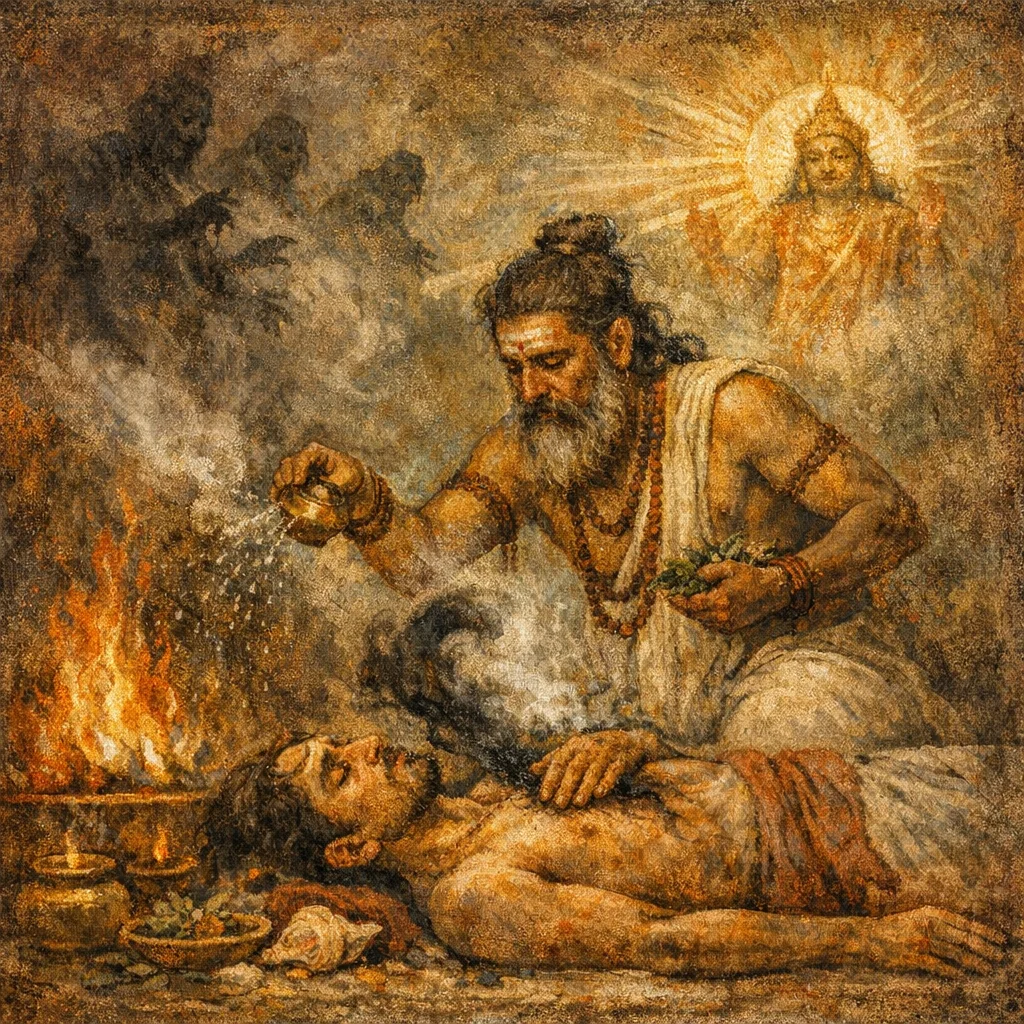
Sukta 30
Rishi: Atharvanic tradition (longevity charms frequently ascribed to Atharvan seers in ancillary lists)
Devata: Āyus/Asu (vital breath) with implicit opposition to Mṛtyu; Pitṛs as the avoided destination
Chandas: Mixed/Anuṣṭubh-like cadence (prose-like opening with metrical continuation)
Mantras
Mantra 1
दीघायुष्यम्। आवतस्त आवतः परावतस्त आवतः । इहैव भव मा नु गा मा पूर्वाननु गाः पितॄनसुं बध्नामि ते दृढम्
For long life. From near for thee, from near; from far for thee, from near. Here verily be; go not away, go not after the former ones, the Fathers: thy breath, thy life, I bind fast for thee.
Mantra 2
यत् त्वाभिचेरुः पुरुषः स्वो यदरणो जनः । उन्मोचनप्रमोचने उभे वाचा वदामि ते
Whatsoever man hath wrought sorcery against thee—be he thine own, or be he alien folk— for unbinding and for full release I speak to thee the twofold spell with speech.
Mantra 3
यद् दुद्रोहिथ शेपिषे स्त्रियै पुंसे अचित्त्या । उन्मोचनप्रमोचने उभे वाचा वदामि ते
If thou hast wrought offence in matters of the member—against woman or against man—through heedlessness: for unbinding and for full release I speak to thee the twofold spell with speech.
Mantra 4
यदेनसो मातृकृताच्छेषे पितृकृताच्च यत्। उन्मोचनप्रमोचने उभे वाचा वदामि ते
What guilt is left, wrought by thy mother, and what by thy father—both for unloosing and for full release, with speech I utter for thee.
Mantra 5
यत् ते माता यत् ते पिता जामिर्भ्राता च सर्जतः । प्रत्यक् सेवस्व भेषजं जरदष्टिं कृणोमि त्वा
What thy mother, what thy father, what kinsman and brother have sent forth—turn it back; cleave thou to the medicine: I make thee one whose staff is old age.
Mantra 6
इहैधि पुरुष सर्वेण मनसा सह। दूतौ यमस्य मानु गा अधि जीवपुरा इहि
Be here, O man, with all thy mind together. Follow not the two messengers of Yama: come hither, above the living’s strongholds.
Mantra 7
अनुहूतः पुनरेहि विद्वानुदयनं पथः । आरोहणमाक्रमणं जीवतोजीवतोऽयनम्
Called after, come back again, thou knowing one, by the path of rising: the mounting, the firm stepping—this passage from the living unto the living.
Mantra 8
0 मा बिभेर्न मरिष्यसि जरदष्टिं कृणोमि त्वा । निरवोचमहं यक्ष्ममङ्गेभ्यो अङ्गज्वरं तव
Fear not; thou shalt not die: I make thee one whose staff is old age. Forth have I spoken the wasting-disease from thy limbs, thy fever that is in the members.
Mantra 9
अङ्गभेदो अङ्गज्वरो यश्च ते हृदयामयः । यक्ष्मः श्येन इव प्रापप्तद् वाचा साढः परस्तराम्
The limb-rending pain, the fever of the limbs, and whatsoever heart-sickness is thine—yakṣma, like a hawk, hath swooped upon thee: by our speech, subdued, be it driven farther away.
Mantra 10
ऋषी बोधप्रतीबोधावस्वप्नो यश्च जागृविः । तौ ते प्राणस्य गोप्तारौ दिवा नक्तं च जागृताम्
Two Seers—Awaking and Re-awaking—Sleeplessness and Wakeful Watch: let these, thy life-breath’s guardians, keep ward for thee by day and also by night.
Mantra 11
अयमग्निरुपसद्य इह सूर्य उदेतु ते । उदेहि मृत्योर्गम्भीरात् कृष्णाच्चित् तमसस्परि
Here is Agni, to be approached and sat beside; let the Sun arise for thee. Rise thou forth from Death’s deep gulf—yea, from the blackness—out of the darkness round about.
Mantra 12
नमो यमाय नमो अस्तु मृत्यवे नमः पितृभ्य उत ये नयन्ति । उत्पारणस्य यो वेद तमग्निं पुरो दधेऽस्मा अरिष्टतातये
Homage to Yama; homage be to Death; homage to the Fathers, and to those who lead away. Whoso knoweth the saving passage, he setteth Agni in front for this man, for his unharmed security.
Mantra 13
ऐतु प्राण ऐतु मन ऐतु चक्षुरथो बलम्। शरीरमस्य सं विदां तत् पद्भ्यां प्रति तिष्ठतु
Let breath come back; let mind come back; let sight come back, and also strength. This man’s body—whole do I recognize it—let that stand firm upon its feet.
Mantra 14
प्राणेनाग्ने चक्षुषा सं सृजेमं समीरय तन्वा३सं बलेन । वेत्थामृतस्य मा नु गान्मा नु भूमिगृहो भुवत्
With breath, O Agni, and with sight, set thou this man in ordered union; quicken him with body and with strength. Thou knowest the way of immortality: let him not now depart; let not the earth-house be his home.
Mantra 15
मा ते प्राण उप दसन्मो अपानोऽपि धायि ते । सूर्यस्त्वाधिपतिर्मृत्योरुदायच्छतु रश्मिभिः
Let not thy breath sink down, nor let thy down-breath be laid upon thee. The Sun, thy sovereign lord, shall draw thee up from Death with his rays.
Mantra 16
इयमन्तर्वदति जिह्वा बद्धा पनिष्पदा। त्वया यक्ष्मं निरवोचं शतं रोपीश्च तक्मनः
This (charm) speaks from within; the tongue is bound, moving with stealthy step. By thee have I spoken forth and expelled consumption, and a hundred creeping maladies, and fever.
Mantra 17
अयं लोकः प्रियतमो देवानामपराजितः । यस्मै त्वमिह मृत्यवे दिष्टः पुरुष जज्ञिषे। स च त्वानु ह्वयामसि मा पुरा जरसो मृथाः
This world is dearest to the Gods, unconquered. For whom thou wast here appointed unto Death, O man, thou wast born: and him we call thee back from; die not before old age.
Frequently Asked Questions
It is a ritual and verbal act of stabilizing the person’s life-breath so it does not ‘slip away’ toward death. Practically, it is often paired with tying a cord as a symbolic anchor for vitality.
In Atharvavedic healing language, going to the Pitṛs implies dying and joining the ancestral realm. The hymn blocks that destination by commanding the patient to remain here among the living.
Primarily it is for life-threatening weakness or collapse, but it also addresses ‘sent harm’ and ominous influences. It functions as both healing and protective stabilization when death feels near.