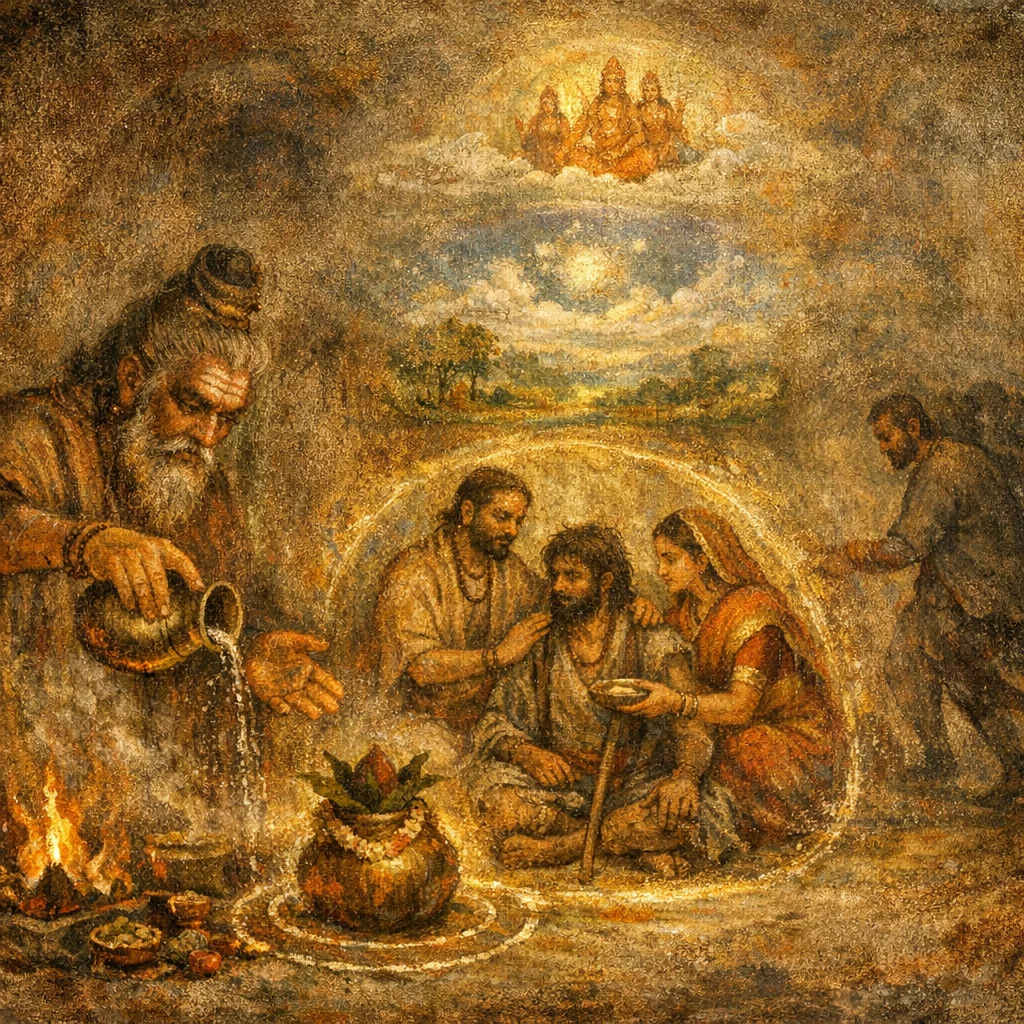
Sukta 13
Rishi: Atharvanic tradition (Vratya-cycle; specific ṛṣi not explicit in the given excerpt)
Devata: Loka/puṇya (merit-realms) as the effective object; implicitly the Vratya as merit-conduit
Chandas: Prose-like Atharvanic anuṣṭubh-leaning cadence (not a strict RV-style metrical verse)
Mantras
Mantra 1
तद् यस्यैवं विद्वान् व्रात्य एकां रात्रिमतिथिर्गृहे वसति
This (is the consequence) for him—at whose house, thus, the knowing Vrātya abides as guest for a single night.
Mantra 2
ये पृथिव्यां पुन्या लोकास्तानेव तेनाव रुन्द्धे
What meritorious worlds there are upon the earth—those very worlds he thereby wins and makes his own.
Mantra 3
तद् यस्यैवं विद्वान् व्रात्यो द्वितीयां रात्रिमतिथिर्गृहे वसति
And this (further accrues) to him—at whose house, thus, the knowing Vrātya abides as guest for a second night.
Mantra 4
ये३न्तरिक्षे पुण्या लोकास्तानेव तेनाव रुन्द्धे
What meritorious worlds there are in the mid-air—those, even those, by that (knowledge and observance) he verily secures unto himself.
Mantra 5
तद् यस्यैवं विद्वान् व्रात्यस्तृतीयां रात्रिमतिथिर्गृहे वसति
That (same reward) is his, for whom, in this wise, a knowing Vratya, a guest, abides in the house the third night.
Mantra 6
ये दिवि पुण्या लोकास्तानेव तेनाव रुन्द्धे
What meritorious worlds there are in heaven—those, even those, by that he verily wins and holds fast.
Mantra 7
तद् यस्यैवं विद्वान् व्रात्यश्चतुर्थीं रात्रिमतिथिर्गृहे वसति
That (same celestial gain) is his, for whom, in this wise, a knowing Vratya, a guest, abides in the house the fourth night.
Mantra 8
ये पुण्यानां पुण्या लोकास्तानेव तेनाव रुन्द्धे
What worlds are the meritorious among the meritorious—those, even those, by that he verily secures.
Mantra 9
तद् यस्यैवं विद्वान् व्रात्योऽपरिमिता रात्रीरतिथिर्गृहे वसति
That man, in whose house the Vrātya—knowing thus—abides as a guest for nights unmeasured, (wins) that (foretold reward).
Mantra 10
य एवापरिमिताः पुण्या लोकास्तानेव तेनाव रुन्द्धे
Even those worlds of merit that are unmeasured—those very worlds he, by that (observance), makes fast and wins unto himself.
Mantra 11
अथ यस्याव्रात्यो व्रात्यब्रुवो नामबिभ्रत्यतिथिर्गृहानागच्छेत्
Then, if unto a man’s houses there should come as guest one no Vrātya, yet bearing the name and saying ‘I am Vrātya,’—
Mantra 12
कर्षेदेनं न चैनं कर्षेत्
One should hale him—yet one should not hale him.
Mantra 13
अस्यै देवताया उदकं याचामीमां देवतां वासय इमामिमां देवतां परि वेवेष्मीत्येनं परि वेविष्यात्
‘For this deity I ask water; this deity do thou cause to dwell; this—this very deity—I encompass round about’: thus should he encompass him round about.
Mantra 14
तस्यामेवास्य तद् देवतायां हुतं भवति य एवं वेद
In that very Deity, for him, that offering is truly offered and comes to effect—whoso thus knoweth.
Frequently Asked Questions
It aims to convert correct observance—especially proper reception of a powerful guest (Vrātya)—into puṇya that ‘secures’ access to meritorious worlds (puṇyā lokāḥ) across cosmic regions.
It presents merit-realms as distributed through layers of the cosmos; by repeating the securing formula, the performer ritually ‘claims’ those destinations/statuses as attainable outcomes.
Water is requested for the devatā as a purification/control medium, and the encircling (pari-veveṣmi) is a protective boundary act—honoring the presence while containing it for safety and auspiciousness.