Sarga 4
समुद्रतट-प्रयाणम् तथा वेलावन-निवेशः (March to the Seacoast and Encampment at the Shore)
युद्धकाण्ड
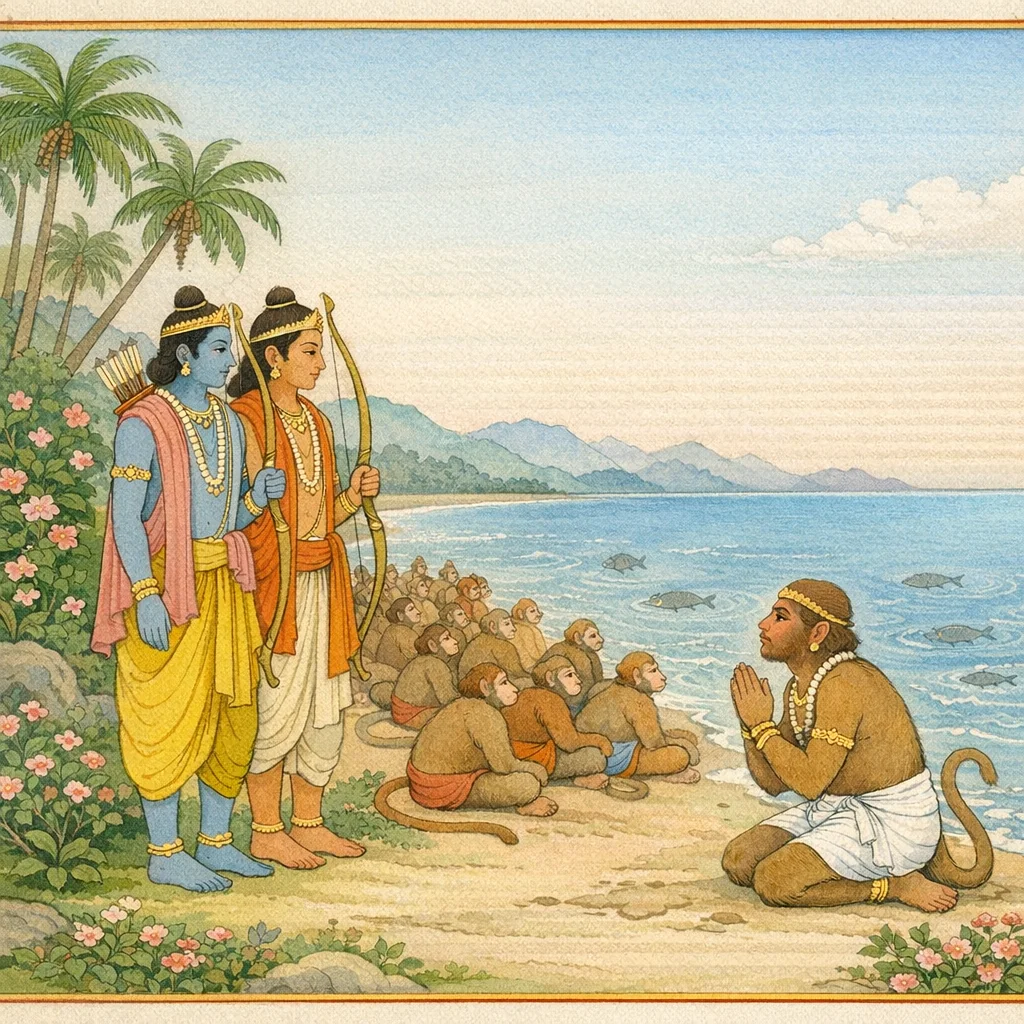
Sarga 4 opens with Rāma responding to Hanumān’s report about Laṅkā, declaring an immediate resolve to destroy the rākṣasa stronghold and recover Sītā. He frames the departure as auspicious—citing stellar configurations and favorable omens—and issues operational orders that reveal disciplined coalition warfare: Nīla is appointed to lead the vanguard, secure a route rich in water, fruits, and roots, and prevent rākṣasa sabotage of provisions; vānaras are instructed to reconnoiter difficult terrain, including lowlands, forest-forts, and concealed positions. The chapter then expands into a detailed march-narrative: the vānaras move in immense, organized formations with named commanders guarding flanks and rear, while Lakṣmaṇa interprets celestial signs as portents of success. The army traverses the Sahya and Malaya ranges, reaches Mahendra, and finally arrives at the varuṇālaya (the ocean). Confronted with the vast, dangerous sea—poetically described as indistinguishable from the sky, inhabited by makaras, serpents, and timingila fish—Rāma commands a coastal encampment and calls for counsel on how to cross, marking the strategic pause before the engineering and diplomatic solutions to the ocean barrier.
Shlokas
Verse 1
श्रुत्वा हनुमतो वाक्यं यथावदनुपूर्वशः ।ततोऽब्रवीन्महातेजा रामस्सत्यपराक्रमः ।।।।
After hearing Hanumān’s words, set forth properly and in due order, the mighty and radiant Rāma—whose valor stands by truth—then spoke.
Verse 2
यां निवेदयसे लङ्कां पुरीं भीमस्य रक्षसः ।क्षिप्रमेनां मथिष्यामि सत्यमेतद्ब्रवीमि ते ।।।।
That Laṅkā which you describe—the city of the fearsome rākṣasa—I shall swiftly crush it. This I tell you in truth.
Verse 3
अस्मिन् मुहूर्ते सुग्रीव प्रयाणमभिरोचये ।युक्तो मुहूर्तो विजयः प्राप्तो मध्यं दिवाकर ।।।।
Sugrīva, I choose to set out at this very moment. The hour is well-joined for victory, for the Sun has reached the midpoint of the sky.
Verse 4
सीतां हृत्वा तु मे जातु क्वासौ यास्यति यास्यत: ।सीता श्रुत्वाभियानं मे अशामेष्यति जीविते ।जीवितान्तेऽ मृतं स्पृष्टवा पीत्वा विषमिवातुरः ।।।।
Having abducted Sītā, where could that man ever go to escape me? When Sītā hears of my advance, she will regain hope in life—like a man stricken after drinking poison who, at life’s very end, touches nectar and so revives.
Verse 5
उत्तरा फल्गुनी ह्यद्य श्वस्तु हस्तेन योक्ष्यते ।अभिप्रायाम सुग्रीव सर्वानीकसमावृताः ।।।।
Today the Uttarā Phalgunī asterism is ascendant; and tomorrow it will join with Hasta. Sugrīva, gather all divisions of the army—my resolve is to set forth under this auspicious timing.
Verse 6
निमित्तानि च पश्यामि यानि प्रादुर्भवन्ति च ।निहत्य रावणं सीतामानयिष्यामि जानकीम् ।।।।
I see the omens as they arise; having slain Rāvaṇa, I shall bring back Sītā, Janaka’s daughter.
Verse 7
उपरिष्टाद्धि नयनं स्फुरमाणमिदं मम ।विजयं समनुप्राप्तं शंसतीव मनोरथम् ।।।।
The twitching of my upper eyelid seems to foretell that victory is at hand, as though proclaiming that my cherished aim will be fulfilled.
Verse 8
ततो वानरराजेन लक्ष्मणेन सुपूजितः ।उवाच रामो धर्मात्मा पुनरप्यर्धकोविदः ।।।।
Thereafter, the righteous-souled Rama, who is an expert in polity and was highly honored by the King of Monkeys and Lakshmana, spoke once again.
Verse 9
अग्रे यातु बलस्यास्य नीलो मार्गमवेक्षितुम् ।वृतश्शतसहस्रेण वानराणां तरस्विनाम् ।।।।
“Let Nīla go at the head of this force to survey the route,” (said Rāma), “escorted by a hundred thousand swift and valiant vānaras.”
Verse 10
फलमूलवता नील शीतकाननवारिणा ।पथा मधुमता चाशु सेनां सेनापते नय ।।।।
O Nīla, commander—lead the army swiftly along a route rich in fruits and roots, with cool forest-water and sweet honey.
Verse 11
दूषयेयुर्दुरात्मनः पथि मूलफलोदकम् ।राक्षसाः परिरक्षेथास्तेभ्यस्त्वं नित्यमुद्यतः ।।।।
“The evil-minded Rākṣasas may contaminate the roots, fruits, and water along the route; stay ever vigilant and protect (the supplies) from them.”
Verse 12
निम्नेषु वनदुर्गेषु वनेषु च वनौकसः ।अभिप्लुत्याभिपश्येयुः परेषां निहितं बलम् ।।।।
"O forest-dwellers, search even in low-lying places, in hard-to-reach forest strongholds, and in the woods; leaping up, you should also look beyond what is ordinarily visible for the enemy’s concealed forces."
Verse 13
यच्च फल्गु बलं किञ्चित्त दत्रैवोपपद्यताम् ।एतद्धि कृत्यं घोरं नो विक्रमेण प्रयुज्यताम् ।।।।
“If there are any who are weak in strength, let them be assigned right here for such supporting work; for the task before us is formidable—let valor be fully brought to bear.”
Verse 14
सागरौघनिभं भीममग्रानीकं महाबलाः ।कपिसिंहाः प्रकर्षस्तु शतशोऽथ सहस्रशः ।।।।
In hundreds and in thousands, the mighty lion-like monkeys advanced at the head of the host—fierce, surging like the ocean’s swelling tides.
Verse 15
गजश्च गिरिसङ्काशो गवयश्च महाबलः ।गवाक्षश्चाग्रतो यातु गवां दृप्तइवर्षभ: ।।।।
Let Gaja—mountain-like in form—together with the mighty Gavaya, and Gavākṣa go in the forefront, like proud bulls leading the herd.
Verse 16
यातु वानरवाहिन्या वानरः प्लवतां वरः ।पालयन्दक्षिणं पार्श्वमृषभो वानरर्षभः ।।।।
Let Ṛṣabha—the best among leaping monkeys, a bull among vanaras—guard the right flank of the monkey host.
Verse 17
गन्धहस्तीव दुर्धर्षस्तरस्वी गन्धमादनः ।यातु वानरवाहिन्या स्सव्यं पार्श्वमधिष्ठितः ।।।।
Let Gandhamādana—powerful and unassailable like a rut-elephant—take position over the left flank of the vanara army.
Verse 18
यास्यामि बलमध्येऽहं बलौघमभिहर्षयन् ।अधिरुह्य हनूमन्त मैरावत मिवेश्वरः ।।।।
I shall go into the midst of the host, heartening the army, mounting Hanumān—just as the Lord of the gods rides Airāvata.
Verse 19
अङ्गदेनैष संयातु लक्ष्मणश्चान्त कोपमः ।सार्वभौमेन भूतेशो द्रविणाधिपतिर्यथा ।।।।
Let Lakṣmaṇa—terrible as Antaka—advance mounted on Aṅgada, as the Lord of wealth rides Sārvabhauma, the elephant of Kubera.
Verse 20
जाम्बवांश्च सुषेणश्च वेगदर्शी च वानरः ।ऋक्षराजो महासत्त्वः कुक्षिं रक्षन्तु ते त्रयः ।।।।
Let those three—Jāmbavān, Suṣeṇa, and the vānara Vegadarśī—together with the mighty bear-king, guard the flank/rear.
Verse 21
राघवस्य वचश्श्रुत्वा सुग्रीवो वाहिनीपतिः ।व्यादिदेश महावीर्यो वानरान्वानरर्षभ ः ।।।।
Hearing Rāghava’s words, Sugrīva—the commander of the host, the bull among vānaras—issued orders to the vānaras, that great hero.
Verse 22
ते वानरगणास्सर्वे समुत्पत्य युयुत्सवः ।गुहाभ्यश्शिखरेभ्यश्च अशु पुप्लुविरे तदा ।।।।
Then all those troops of vānaras, eager to fight, sprang forth swiftly—from caves and from mountain-peaks—leaping into motion.
Verse 23
ततो वानरराजेन लक्ष्मणेन च पूजितः ।जगाम रामोधर्मात्मा ससैन्यो दक्षिणां दिशम् ।। ।।
Thereafter Rāma, righteous in spirit, honored by the king of vānaras and by Lakṣmaṇa, set out with his army toward the southern direction.
Verse 24
शतैः शतसहस्रैश्च कोटिभिश्चायुतैरपि ।वारणाभैश्च हरिभिर्ययौ परिवृतस्तदा ।।।।
Then he proceeded surrounded by vānaras in countless numbers—by hundreds, by hundreds of thousands, by crores, and by myriads—like a mass of elephant-like warriors around him.
Verse 25
तं यान्तमनुयान्ती सा महती हरिवाहिनी ।दृप्ता: प्रमुदितास्सर्वे सुग्रीवेणाभिपालिताः ।।।।
As he advanced, that great vānarā host followed behind—confident and joyful, all kept in order under Sugrīva’s command.
Verse 26
आप्लवन्तः प्लवन्तश्च गर्जन्तश्च प्लवङ्गमाः ।क्षेवळन्तो निनदन्तस्ते जग्मुर्वै दक्षिणां दिशम् ।।।।
Leaping and bounding, roaring and calling out, those plavaṅgamas went indeed toward the southern direction—sportive in movement yet ready for battle.
Verse 27
भक्ष्यन्त स्सुगन्धीनि मधूनि च फलानि च ।उद्वहन्तो महावृक्षान् मञ्जरीपुञ्जधारिणः ।।।।
The vanaras moved along eating fragrant honey and fruits, and carrying great tree-branches laden with clusters of blossoms.
Verse 28
अन्योन्यं सहसा दृप्ता निर्वहान्ति क्षिपन्ति च ।पतन्तश्पोत्पत्नत्यन्ये पातयन्त्यपरे परान् ।।।।
In high spirits and sudden exuberance, they carried one another and tossed one another about; some leapt as others fell, and some pushed others down in boisterous play.
Verse 29
रावणो नो निहन्तव्यस्सर्वे च रजनीचराः ।इति गर्जन्ति हरयो राघवस्य समीपतः ।।।।
“Rāvaṇa must be slain by us—along with all the night-roamers!” Thus the vanaras roared near Rāghava (Rāma).
Verse 30
पुरस्तादृषभो वीरो नील: कुमुद एव च ।पन्थानं शोधयन्तिस्म वानरैर्बहुभि स्सह ।।।।
Up ahead, the heroic Ṛṣabha, Nīla, and Kumuda—together with many vanaras—kept scouting and clearing the route.
Verse 31
मध्ये तु राजा सुग्रीवो रामो लक्ष्मण एव च ।बलभिर्बहुभि र्भीमैर्वृताश्शत्रुनिबर्हणाः ।।।।
In the center marched King Sugrīva, and Rāma with Lakṣmaṇa, surrounded by many fierce and mighty warriors—destroyers of the enemy.
Verse 32
हरिश्शतवलिर्वीरः कोटीभिर्दशभिर्वृतः ।सर्वामेको ह्यावष्टभ्य ररक्ष हरिवाहिनीम् ।।।।
The heroic vanara Śatavali, ringed by ten crores (of troops), held the line and—though one—protected the entire vanara host.
Verse 33
कोटीशतपरीवारः केसरी पनसो गजः ।अर्कश्चातिबल: पार्श्वमेकं तस्याभिरक्षति ।।।।
With a following of a hundred crores, Keśarī, Panasa, Gaja, and also Arka with Atibala guarded one flank of that host.
Verse 34
सुषेणो जाम्बवांश्चैव ऋक्षैर्बहुभिरावृतौ ।सुग्रीवं पुरतः कृत्वा जघनं सम्ररक्षतुः ।।।।
Suṣeṇa and Jāmbavān—surrounded by many bears—kept Sugrīva before them and guarded the rear of the host.
Verse 35
तेषां सेनापतिर्वीरो नीलो वानरपुङ्गवः ।सम्पतन्पततां श्रेष्ठस्तद्बलं पर्यपालयात् ।।।।
Their heroic commander, Nīla—the foremost among those who leap and descend—moved about the force, overseeing and regulating the army.
Verse 36
दरीमुखः प्रजङ्घश्च रम्भोऽथ रभसः कपिः ।सर्वतश्च ययुर्वीरास्त्वरयन्तः प्लवङ्गमान् ।।।।
The valiant monkeys—Dārīmukha, Prajaṅgha, Rambha, and the kapi Rabhasa—moved about on every side, urging on the leaping vānaras.
Verse 37
एवं ते हरिशार्दूला गच्छन्तो बलदर्पिताः ।अपश्यंस्ते गिरिश्रेष्ठं सह्यं द्रुमालतायुतम् ।।।।सरांसि च सुपुल्लानि तटाकानि वनानि च ।।।।
Thus those tiger-like vānaras, exulting in their strength as they marched, beheld the Sahya—foremost among mountains—clothed with trees and creepers, and (they saw) lakes with fully blossomed lotuses, ponds, and forests.
Verse 38
एवं ते हरिशार्दूला गच्छन्तो बलदर्पिताः ।अपश्यंस्ते गिरिश्रेष्ठं सह्यं द्रुमालतायुतम् ।।6.4.37।।सरांसि च सुपुल्लानि तटाकानि वनानि च ।।6.4.38।।
Thus those tiger-like vānaras, proud of their strength as they went, looked upon the Sahya, the foremost of mountains, filled with trees and creepers, as well as lakes with fully blossomed lotuses, ponds, and forests.
Verse 39
रामस्य शासनं ज्ञात्वा भीमकोपस्य भीतवत् ।वर्जयन्नगराभ्याशां स्तथा जनपदानपि ।।।।सागरौघनिभं भीमं तद्वानरबलं महत् ।उत्ससर्प महाघोषं भीमघोषमिवार्णव: ।।।।
Knowing Rāma’s command—and as though in fear of his terrible wrath—the great and dreadful vānaras, vast like the ocean’s surge, advanced onward, avoiding the outskirts of cities and even the villages, roaring with a mighty, fearsome sound like the ocean.
Verse 40
रामस्य शासनं ज्ञात्वा भीमकोपस्य भीतवत् ।वर्जयन्नगराभ्याशां स्तथा जनपदानपि ।।6.4.39।।सागरौघनिभं भीमं तद्वानरबलं महत् ।उत्ससर्प महाघोषं भीमघोषमिवार्णव: ।।6.4.40।।
The great vānaras, immense like an ocean-surge, advanced with a thunderous roar—yet, knowing Rāma’s command, they avoided towns and villages as though fearing his dreadful displeasure.
Verse 41
तस्यदाशरथे: पार्श्वे शूरास्ते कपिकुङजराः ।तोर्णमापुप्लुवु स्सर्वे सदश्वा इव चोदिताः ।।।।
Beside that son of Daśaratha, those heroic monkey-lords swiftly sprang forward—all of them urged on like well-driven steeds.
Verse 42
कपिभ्यामुह्यमानौ तौ शुशुभाते नरर्षभौ ।महाद्भ्यामिव सम्स्पृष्टौ ग्रहाभ्यां चन्द्रभास्करौ ।।।।
Borne along by the two monkeys, those two best of men shone brilliantly—like the sun and the moon when touched by two great planets.
Verse 43
ततो वानरराजेन लक्ष्मणेन सुपूजितः ।जगाम रामो धर्मात्मा ससैन्यो दक्षिणां दिशम् ।।।।
Then Rāma, righteous in nature, honored reverently by the king of vānaras and by Lakṣmaṇa, set out with his army toward the southern direction.
Verse 44
तमङ्गदगतो रामं लक्ष्मणश्शुभया गिरा ।उवाच परिपूर्णार्थ: स्मृतिमान् प्रतिभानवान् ।।।।
Lakṣmaṇa—borne by Aṅgada, endowed with sound memory and keen insight, and intent on fully accomplishing the purpose—spoke to Rāma in auspicious words.
Verse 45
हृतामवाप्य वैदेहीं क्षिप्रं हत्वा च रावणम् ।समृद्धार्थस्समृद्धार्थमयोध्यां प्रतियास्यसि ।।।।
Once Vaidehī is recovered and Rāvaṇa is swiftly slain, you will return to Ayodhyā as one whose purpose has been fulfilled, having accomplished your rightful aim.
Verse 46
महान्ति च निमित्तानि दिवि भूमौ च राघव ।शुभानि तव पश्यामि सर्वाण्येनार्थसिद्धये ।अनुवाति शिवो वायु स्सेवां मृदुहित स्सुखः ।।।।
Rāghava, I see great and auspicious omens for you—both in the sky and on the earth—pointing to the success of your purpose. A благоприятный wind also blows, gentle and pleasant, aiding the army’s advance.
Verse 47
पूर्णवल्गुस्वराश्चेमे प्रवदन्ति मृगद्विजाः ।प्रसन्नाश्च दिश स्सर्वा विमलश्च दिवाकरः ।।।।
These beasts and birds call out in full, sweet tones; all directions appear serene, and the Sun shines clear and bright.
Verse 48
उशना च प्रसन्नार्चिरनु त्वां भार्गवो गतः ।।।।ब्रह्मराशिर्विशुद्धश्च शुद्दाश्च परमर्षयः ।अर्चिष्मन्तः प्रकाशन्ते ध्रुवं सर्वे प्रदक्षिणम् ।।।।
Śukra (Uśanā), the Bhārgava, follows behind you shining with a calm brilliance; and the supremely pure seers, radiant like flames, circle Dhruva in reverent rightward course—signs pointing firmly to success.
Verse 49
उशना च प्रसन्नार्चिरनु त्वां भार्गवो गतः ।।6.4.48।।ब्रह्मराशिर्विशुद्धश्च शुद्दाश्च परमर्षयः ।अर्चिष्मन्तः प्रकाशन्ते ध्रुवं सर्वे प्रदक्षिणम् ।।6.4.49।।
This verse repeats the same astral omen: Śukra shines serenely behind you, and the radiant great seers circle Dhruva to the right—an emphatic assurance of auspicious success.
Verse 50
त्रिशङ्कुर्विमलो भाति राजर्षिस्सपुरोहितः ।पितामहाः पुरोऽस्माकमिक्ष्वाकूणां महात्मनाम् ।।।।
Triśaṅku, the royal sage—forefather of our great-souled Ikṣvāku line—shines forth clearly, together with his priest, as a favorable ancestral sign before us.
Verse 51
विमले च प्रकाशेते विशाखे निरुपप्लुवे ।नक्षत्र वरमस्माकमिक्ष्वाकूणां महात्मनाम् ।।।।
Viśākhā shines bright and clear, unobstructed—celebrated as the foremost star for our great-souled Ikṣvāku house.
Verse 52
नैरृतं नैरृतानां च नक्षत्रमभिपीड्यते ।मूलो मूलवता स्पृष्टो धूप्यते धूमकेतुना ।।।।
The Nairṛta star—linked with the Nairṛtas—is sorely afflicted: Mūla, touched by Mūlavatā, is further oppressed by the comet (Dhūmaketu).
Verse 53
सर्वं चैतद्विनाशाय राक्षसानामुप स्थितम् ।काले कालगृहीतानां नक्षत्र ग्रहपीडितम् ।।।।
All these portents have arisen for the destruction of the Rākṣasas; those seized by their destined end will, at the appointed time, be crushed by the afflictions of stars and planets.
Verse 54
प्रसन्ना स्सुरसाश्चापो वनानि फलवन्ति च ।प्रवान्त्यभ्य नाधिकं गन्धान्यथर्तुकुसुमा द्रुमाः ।।।।
The waters are clear and sweet; the forests are laden with fruit. Fragrant breezes do not blow harshly, and the trees stand blossoming as though beyond their proper season—signs of auspiciousness on the march.
Verse 55
व्यूढानि कपिसैन्यानि प्रकाशन्तेऽधिकं प्रभो ।।।।देवानामिव सैन्यानि सङ्ग्रामे तारकामये। एवमार्य ।समीक्ष्यैतान्प्रीतो भवितुमर्हसि ।।।।
O King, the monkey battalions, arrayed in proper formation, shine exceedingly—like the hosts of the gods in the star-lit battle against Tāraka. Seeing these dispositions, O noble one, you ought to be satisfied.
Verse 56
व्यूढानि कपिसैन्यानि प्रकाशन्तेऽधिकं प्रभो ।।6.4.55।।देवानामिव सैन्यानि सङ्ग्रामे तारकामये। एवमार्य ।समीक्ष्यैतान्प्रीतो भवितुमर्हसि ।।6.4.56।।
O King, the monkey battalions, arrayed in proper formation, shine exceedingly—like the hosts of the gods in the famed battle against Tāraka. Seeing these dispositions, O noble one, you should be pleased.
Verse 57
इति भ्रातरमाश्वास्य हृष्ट स्सौमित्रिरब्रवीत् ।अथावृत्य महीं कृत्स्नां जगाम महती चमू: ।।।।ऋक्षवानरशर्दूलैर्न खदंष्ट्रायुधैर्वुता ।
Thus Saumitrī, delighted, reassured his brother and spoke. Then the great host moved on, spreading across the whole earth—surrounded by tiger-like bears and monkeys whose weapons were claw and fang.
Verse 58
काराग्रैश्चरणाग्रैश्च वानरै रुत्थितं रजः ।भीममन्तर्दधे लोकं निवार्य सवितुः प्रभाम् ।।।।पर्वतवनाकाशां दक्षिणां हरिवाहिनी ।छादयन्ती ययौ भीमा द्यामिवाम्बुदसन्ततिः ।।।।
The dust, raised by the monkeys’ hands and feet, became dreadful and veiled the world, shutting out the sun’s radiance. The fierce southern host of the Vānara army moved on, covering mountains, forests, and the sky—like a mass of clouds spread across the heavens.
Verse 59
काराग्रैश्चरणाग्रैश्च वानरै रुत्थितं रजः ।भीममन्तर्दधे लोकं निवार्य सवितुः प्रभाम् ।।6.4.58।। पर्वतवनाकाशां दक्षिणां हरिवाहिनी ।छादयन्ती ययौ भीमा द्यामिवाम्बुदसन्ततिः ।।6.4.59।।
The dust raised by the monkeys’ hands and feet turned fearsome, covering the world and blocking the sun’s light. The formidable southern Vānara host advanced, blanketing mountain, forest, and sky like a continuous spread of clouds.
Verse 60
उत्तरन्त्यां च सेनायां स्सततं बहुयोजनम् ।नदीस्रोतांसि सर्वाणि सस्यन्दुर्विपरीतवत् ।।।।
As the army kept crossing continuously for many yojanas, all the river-currents flowed in a contrary, turbulent way, as though in flood.
Verse 61
सरांसि विमलाम्भांसि द्रुमाकीर्णांश्च पर्वता ।समान् भूमिप्रदेशांश्च वनानि फलवन्ति च ।मध्येन च समन्ताच्च तिर्यक्चाथश्च समाऽविशत् ।।।।
They moved through lakes of clear water, across mountains thick with trees, over level stretches of land, and through fruit-laden forests—passing through the middle, around the edges, sideways and beneath, as they pressed onward in every way.
Verse 62
समावृत्य महीं कृत्स्नां जगाम महती चमूः ।तेहृष्टवदना स्सर्वे जग्मुर्मारुतरंहसः ।।।।
The great host advanced, spreading across the entire land; all of them went on with joyful faces, swift as the wind.
Verse 63
हरयो राघवस्यार्थे समारोपितविक्रमाः ।।।।हर्षंवीर्य बलोद्रेकान्दर्शयन्तः परस्परम् ।यौवनोत्सेकजान्दर्पाद्विविधांश्चक्रुरध्वनि ।।।।
For Rāghava’s cause, the Vānara warriors marched on, displaying to one another their exhilaration, heroism, and surging strength; and on the road, from the pride born of youthful ardour, they performed many kinds of spirited gestures.
Verse 64
हरयो राघवस्यार्थे समारोपितविक्रमाः ।।6.4.63।।हर्षंवीर्य बलोद्रेकान्दर्शयन्तः परस्परम् ।यौवनोत्सेकजान्दर्पाद्विविधांश्चक्रुरध्वनि ।।6.4.64।।
For Rāghava’s cause, the Vānara warriors proceeded, showing one another their joy, heroism, and swelling might; and along the way, spurred by the pride that arises from youthful ardour, they made many kinds of lively demonstrations.
Verse 65
तत्र केचिद्द्रुतं जग्मुरुत्पेतुश्च तथापरे ।केचित्किलकिलां चक्रुर्वानरा वनगोचराः ।।।।
There, the forest-ranging Vānaras—some hurried swiftly ahead, others leapt as they went, and some made the shrill ‘kila-kilā’ cries customary to their kind.
Verse 66
प्रास्पोटयंश्च पुच्छानि सन्निजग्मु: पदान्यपि ।भुजावनिक्षिप्य शैलांश्च द्रुमानन्ये बभञ्जिरे ।।।।
Some slapped their tails against the ground; some stamped their feet; others, hurling their arms with force, crushed rocks and broke trees.
Verse 67
आरोहन्तश्च शृङ्गाणि गिरीणां गिरिगोचराः ।महानादान्प्रमुञ्चन्ति क्ष्वेळ्वामन्ये प्रचक्रिरे ।।।।
The mountain-ranging Vānaras climbed the peaks of the hills and let out great cries; others roared and wheeled about in circles.
Verse 68
ऊरुवेगैश्च ममृदुर्लताजालान्यनेकशः ।जृम्भमाणाश्च विक्रान्ता विचिक्रीडुश्शिलाद्रुमै ः ।।।।
With the force and speed of their thighs they tore apart many tangles of creepers; and even while yawning, the bold ones sported by whirling stones and trees about.
Verse 69
शतश्शतसहस्रैश्च कोटिभिश्च सहस्रशः ।वानराणां सुघोराणां श्रीमत्परिवृता मही ।।।।
The earth lay splendidly covered all around by the exceedingly formidable Vānaras—by hundreds, by hundreds of thousands, and by crores in countless multitudes.
Verse 70
सा स्म याति दिवारात्रं महती हरिवाहिनी ।प्रहृष्टमुदितास्सेना सुग्रीवेणाभिपालिताः ।।।।वानरास्त्वरितं यान्ति सर्वे युद्धाभिनन्दिनः ।प्रमोक्षयिषव स्सीतां मुहूर्तं क्वापि नावसन् ।।।।
That mighty Vānara host, safeguarded by Sugrīva, marched on day and night, joyful and elated. All the Vānaras hastened forward, welcoming the prospect of battle; intent on freeing Sītā, they did not halt anywhere even for a moment.
Verse 71
सा स्म याति दिवारात्रं महती हरिवाहिनी ।प्रहृष्टमुदितास्सेना सुग्रीवेणाभिपालिताः ।।6.4.70।।वानरास्त्वरितं यान्ति सर्वे युद्धाभिनन्दिनः ।प्रमोक्षयिषव स्सीतां मुहूर्तं क्वापि नावसन् ।।6.4.71।।
That mighty Vānara host, under Sugrīva’s protection, pressed on day and night in high spirits. Delighting in the coming battle and intent on freeing Sītā, they did not pause anywhere even briefly.
Verse 72
ततः पादपसम्भाधं नानामृगसमायुताम ।सह्यपर्वतमासेदुर्मलयञ्च महीधरम् ।।।।
Thereafter, they [the Vanara army] reached the Sahya mountain and the Malaya mountain, which were dense with trees and inhabited by various kinds of wild animals.
Verse 73
काननानि विचित्राणि नदी: प्रस्रवणानि च ।पश्यन्ननि ययौ रामस्सह्यस्य मलयस्य च ।।।।
Rāma continued on, even as he gazed upon the wondrous forests and the river-streams and springs belonging to the Sahya and Malaya ranges.
Verse 74
वकुळान्स्तिलकांश्चूतानसोकान् सिन्धुवारकान् ।करवीरांश्च तिनिशान् भजन्ति स्म प्लवङ्गगमाः ।।।।
The vanaras, moving about with leaps, paid reverent attention to the vakula, tilaka, mango, aśoka, sindhuvāra, karavīra, and tiniśa trees.
Verse 75
अङ्कोलांश्च करञ्चांश्च प्लक्षन्यग्रोधतिन्दुकान् ।जम्बुकामलकान्नापान्भजन्ति स्म प्लवङ्गमाः ।।।।
The Vanaras resorted to and enjoyed the Ankola, Karanja, Plaksha, Nyagrodha, Tinduka, Jambu, Amalaka, and Nipa trees.
Verse 76
प्रस्तरेषु च रम्येषु विविधाः काननद्रुमाः ।वायुवेगप्रचलिताः पुष्पैरवकिरन्ति तान् ।।।।
Various forest trees standing on beautiful rocky slopes, shaken by the force of the wind, showered them [the Vanaras] with flowers.
Verse 77
मारुतस्सुखसंस्पर्शो वाति चन्दनशीतलः ।षटपदैरनुकूजद्भिर्वनेषु मधुगन्धिषु ।।।।
A breeze, pleasant to the touch and cool as sandalwood, blows through the honey-scented forests, accompanied by the humming of bees.
Verse 78
अधिकं शैलराजस्तु धातुभिस्सुविभूषितः ।धातुभ्यःप्रसृतो रेणुर्वायुवेग विघट्टितः ।सुमहद्वानरानीकं छादयामास सर्वतः ।।।।
That king of mountains, richly adorned with mineral ores, shone exceedingly bright. Dust of those minerals—stirred up and hurled about with the force of the wind by the trampling—rose and covered the vast army of vānaras on every side.
Verse 79
गिरिप्रस्थेषु रम्येषु सर्वत सम्प्र पुष्पिताः ।केतकस्सिन्दुवाराश्च वासन्त्यश्च मनोरमाः ।।।।माधव्यो गन्धपूर्णाश्च कुन्दगुल्माश्च पुष्पिताः ।चिरिबिल्वा मधूकाश्च वञ्जुला प्रियकास्तथा ।।।।सुफूर्जकास्तिलकाश्चैव नागवृक्षाश्च पुष्पिताः ।चूताः पाटलयकाश्चैव कोविदाराश्च पुष्पिताः ।।।।मुचुलिन्दार्जुनाश्चैव शिंशुपाः कुटजास्तथा ।धवा श्शाल्मलयश्चैव रक्ता: कुरवकास्तथा ।।।।हिन्तालास्तिनिशाश्चैव चूर्णका नीपकास्तथा ।नीलाशोकाश्च वरणा अङ्कोलाः पद्मकास्तथा ।।।।प्लवमानै: प्लवंगैस्तु सर्वे पर्याकुलीकृतां ।।।।
On the lovely slopes of the mountains, trees and creepers were everywhere in full bloom—ketaka, sinduvāra, and charming spring-flowering plants; mādhavī, fragrant clusters of kunda and gulma; ciribilva and madhūka; vañjula and priyaka; suphūrjaka and tilaka; nāga-trees in blossom; cūta (mango), pāṭalī, and kovidāra; muculinda and arjuna; śiṃśupā and kuṭaja; dhava and śālmali; red kuravaka; hintāla and tiniśa; cūrṇaka and nīpaka; dark-blue aśoka, varaṇa, aṅkola, and padmaka. All that woodland was thrown into lively commotion by the leaping vanaras, shaking and ranging through it.
Verse 80
गिरिप्रस्थेषु रम्येषु सर्वत सम्प्र पुष्पिताः । केतकस्सिन्दुवाराश्च वासन्त्यश्च मनोरमाः ।।6.4.79।। माधव्यो गन्धपूर्णाश्च कुन्दगुल्माश्च पुष्पिताः ।चिरिबिल्वा मधूकाश्च वञ्जुला प्रियकास्तथा ।।6.4.80।।सुफूर्जकास्तिलकाश्चैव नागवृक्षाश्च पुष्पिताः ।चूताः पाटलयकाश्चैव कोविदाराश्च पुष्पिताः ।।6.4.81।। मुचुलिन्दार्जुनाश्चैव शिंशुपाः कुटजास्तथा । धवा श्शाल्मलयश्चैव रक्ता: कुरवकास्तथा ।।6.4.82।। हिन्तालास्तिनिशाश्चैव चूर्णका नीपकास्तथा ।नीलाशोकाश्च वरणा अङ्कोलाः पद्मकास्तथा ।।6.4.83।। प्लवमानै: प्लवंगैस्तु सर्वे पर्याकुलीकृतां ।।6.4.84।।
There too were mādhavī-creepers, heavy with perfume, and kunda and gulma plants all in bloom; likewise chiribilva trees and madhūka trees, and also vañjula and priyaka trees—everywhere flowering.
Verse 81
गिरिप्रस्थेषु रम्येषु सर्वत सम्प्र पुष्पिताः । केतकस्सिन्दुवाराश्च वासन्त्यश्च मनोरमाः ।।6.4.79।। माधव्यो गन्धपूर्णाश्च कुन्दगुल्माश्च पुष्पिताः ।चिरिबिल्वा मधूकाश्च वञ्जुला प्रियकास्तथा ।।6.4.80।।सुफूर्जकास्तिलकाश्चैव नागवृक्षाश्च पुष्पिताः ।चूताः पाटलयकाश्चैव कोविदाराश्च पुष्पिताः ।।6.4.81।। मुचुलिन्दार्जुनाश्चैव शिंशुपाः कुटजास्तथा । धवा श्शाल्मलयश्चैव रक्ता: कुरवकास्तथा ।।6.4.82।। हिन्तालास्तिनिशाश्चैव चूर्णका नीपकास्तथा ।नीलाशोकाश्च वरणा अङ्कोलाः पद्मकास्तथा ।।6.4.83।। प्लवमानै: प्लवंगैस्तु सर्वे पर्याकुलीकृतां ।।6.4.84।।
On those lovely mountain-slopes, the suphūrjaka and tilaka trees, as well as nāga-trees, stood in full bloom; and so too the mangoes, pāṭalā trees, and kovidāras were all flowering.
Verse 82
गिरिप्रस्थेषु रम्येषु सर्वत सम्प्र पुष्पिताः । केतकस्सिन्दुवाराश्च वासन्त्यश्च मनोरमाः ।।6.4.79।। माधव्यो गन्धपूर्णाश्च कुन्दगुल्माश्च पुष्पिताः ।चिरिबिल्वा मधूकाश्च वञ्जुला प्रियकास्तथा ।।6.4.80।।सुफूर्जकास्तिलकाश्चैव नागवृक्षाश्च पुष्पिताः ।चूताः पाटलयकाश्चैव कोविदाराश्च पुष्पिताः ।।6.4.81।। मुचुलिन्दार्जुनाश्चैव शिंशुपाः कुटजास्तथा । धवा श्शाल्मलयश्चैव रक्ता: कुरवकास्तथा ।।6.4.82।। हिन्तालास्तिनिशाश्चैव चूर्णका नीपकास्तथा ।नीलाशोकाश्च वरणा अङ्कोलाः पद्मकास्तथा ।।6.4.83।। प्लवमानै: प्लवंगैस्तु सर्वे पर्याकुलीकृतां ।।6.4.84।।
There were also muculinda and arjuna trees, and likewise śiṃśupā and kuṭaja; dhava and śālmali too—along with red-flowering kuravakas.
Verse 83
गिरिप्रस्थेषु रम्येषु सर्वत सम्प्र पुष्पिताः । केतकस्सिन्दुवाराश्च वासन्त्यश्च मनोरमाः ।।6.4.79।। माधव्यो गन्धपूर्णाश्च कुन्दगुल्माश्च पुष्पिताः ।चिरिबिल्वा मधूकाश्च वञ्जुला प्रियकास्तथा ।।6.4.80।।सुफूर्जकास्तिलकाश्चैव नागवृक्षाश्च पुष्पिताः ।चूताः पाटलयकाश्चैव कोविदाराश्च पुष्पिताः ।।6.4.81।। मुचुलिन्दार्जुनाश्चैव शिंशुपाः कुटजास्तथा । धवा श्शाल्मलयश्चैव रक्ता: कुरवकास्तथा ।।6.4.82।। हिन्तालास्तिनिशाश्चैव चूर्णका नीपकास्तथा ।नीलाशोकाश्च वरणा अङ्कोलाः पद्मकास्तथा ।।6.4.83।। प्लवमानै: प्लवंगैस्तु सर्वे पर्याकुलीकृतां ।।6.4.84।।
There were hintāla and tiniśa trees, as well as cūrṇaka and nīpa; and likewise nīlāśoka, varaṇa, aṅkola, and padmaka trees.
Verse 84
गिरिप्रस्थेषु रम्येषु सर्वत सम्प्र पुष्पिताः । केतकस्सिन्दुवाराश्च वासन्त्यश्च मनोरमाः ।।6.4.79।। माधव्यो गन्धपूर्णाश्च कुन्दगुल्माश्च पुष्पिताः ।चिरिबिल्वा मधूकाश्च वञ्जुला प्रियकास्तथा ।।6.4.80।।सुफूर्जकास्तिलकाश्चैव नागवृक्षाश्च पुष्पिताः ।चूताः पाटलयकाश्चैव कोविदाराश्च पुष्पिताः ।।6.4.81।। मुचुलिन्दार्जुनाश्चैव शिंशुपाः कुटजास्तथा । धवा श्शाल्मलयश्चैव रक्ता: कुरवकास्तथा ।।6.4.82।। हिन्तालास्तिनिशाश्चैव चूर्णका नीपकास्तथा ।नीलाशोकाश्च वरणा अङ्कोलाः पद्मकास्तथा ।।6.4.83।। प्लवमानै: प्लवंगैस्तु सर्वे पर्याकुलीकृतां ।।6.4.84।।
All of those places were made lively and bustling by the leaping vānaras.
Verse 85
वाप्यस्तस्मिन् गिरौ शिता: पल्वलानि तथैव च ।चक्रवाकानुचरिताः कारण्डवनिषेविताः ।।।।प्लवैः क्रौञ्चेश्च सङ्कीर्णा वराहमृग सेविताः ।ऋक्षैस्तरक्षुभिस्सिम्हैश्शार्दूलैश्च भयावहैः ।।।।व्यालैश्च बहुभिर्भीमै स्सेव्यमाना स्समन्ततः ।पद्मैस्सौगन्दिकैः पुल्लैः कुमुदैश्चोत्पलैस्तथा ।।।।वारिजैर्विविधैः पुष्पै रम्यास्तत्र जलाशयाः ।
On that mountain were cool reservoirs and ponds as well—haunted by cakravāka birds and frequented by kāraṇḍava waterfowl.
Verse 86
वाप्यस्तस्मिन् गिरौ शिता: पल्वलानि तथैव च ।चक्रवाकानुचरिताः कारण्डवनिषेविताः ।।6.4.85।।प्लवैः क्रौञ्चेश्च सङ्कीर्णा वराहमृग सेविताः ।ऋक्षैस्तरक्षुभिस्सिम्हैश्शार्दूलैश्च भयावहैः ।।6.4.86।।व्यालैश्च बहुभिर्भीमै स्सेव्यमाना स्समन्ततः ।पद्मैस्सौगन्दिकैः पुल्लैः कुमुदैश्चोत्पलैस्तथा ।।6.4.87।।वारिजैर्विविधैः पुष्पै रम्यास्तत्र जलाशयाः ।
They were filled with water-birds and krauñca birds, and visited by boars and deer; and they were also the haunt of bears, hyenas, lions, and fearsome tigers.
Verse 87
वाप्यस्तस्मिन् गिरौ शिता: पल्वलानि तथैव च ।चक्रवाकानुचरिताः कारण्डवनिषेविताः ।।6.4.85।।प्लवैः क्रौञ्चेश्च सङ्कीर्णा वराहमृग सेविताः ।ऋक्षैस्तरक्षुभिस्सिम्हैश्शार्दूलैश्च भयावहैः ।।6.4.86।।व्यालैश्च बहुभिर्भीमै स्सेव्यमाना स्समन्ततः ।पद्मैस्सौगन्दिकैः पुल्लैः कुमुदैश्चोत्पलैस्तथा ।।6.4.87।।वारिजैर्विविधैः पुष्पै रम्यास्तत्र जलाशयाः ।
All around, they were resorted to by many terrifying beasts; and they were adorned with blossoming, fragrant lotuses, with kumudas and blue utpalas as well.
Verse 88
तस्य सानुषु कूजन्ति नानाद्विजगणास्तथा ।।।।स्नात्वा पीत्वोदकान्यत्र जले क्रीडन्ति वानराः ।अन्योन्यं प्लावयन्ति स्म शैलमारुह्य वानराः ।।।।
On its slopes, flocks of many kinds of birds likewise sang out.
Verse 89
तस्य सानुषु कूजन्ति नानाद्विजगणास्तथा ।।6.4.88।। स्नात्वा पीत्वोदकान्यत्र जले क्रीडन्ति वानराः ।अन्योन्यं प्लावयन्ति स्म शैलमारुह्य वानराः ।।6.4.89।।
There the vānaras, having bathed and drunk water, sported in the pools; climbing onto rocks, they splashed and drenched one another in play.
Verse 90
फलान्य मृतगन्धीनि मूलानि कुसुमानि च ।बभञ्जुर्वास्तत्र पादपानं मदोत्कटाः ।।।।
There the vānaras, swollen with exhilaration, clambered over the trees and devoured fruits fragrant like nectar, along with roots and flowers.
Verse 91
द्रोणमात्रप्रमाणानि लम्बमानानि वानराः ।ययुः पिबन्त हृष्टास्ते मधूनि मधुपिङ्गलाः ।।।।
Those tawny-eyed vānaras went on their way, delighted as they drank honey from great hanging combs, each as large as a droṇa-measure.
Verse 92
पादपानवभञ्जन्तो विकर्षन्त स्तथा लताः ।विधमन्तो गिरिवरान्प्रययुः प्लवगर्षभाः ।।।।
The foremost of the leapers pressed on—splintering trees, tearing down creepers, and battering even the best of mountains as they went.
Verse 93
वृक्षेभ्योऽन्ये तु कपयो नदन्तो मधुदर्पिताः ।अन्ये वृक्षान्प्रपद्यन्ते प्रपिबन्त्यपि चापरे ।।।।
Some monkeys, made reckless by honey’s intoxication, roamed about shouting away from the trees; others rushed up into the trees, and still others leapt about, drinking again and again.
Verse 94
बभूव वसुधा तैस्तु सम्पूर्णा हरियूथपै: ।यथा कलमकेदारैः पक्वैरिव वसुन्दरा ।।।।
The earth became wholly filled with those leaders of the monkey-hosts, as though the land were a paddy-field thick with ripened kalama grain.
Verse 95
महेन्द्रमथ सम्प्राप्य रामो राजीवलोचनः ।अध्यारोहन्महाबाहुश्शिखरं द्रुमभूषितम् ।।।।
Then lotus-eyed Rāma, mighty-armed, reached Mahendra and climbed its peak, adorned with trees.
Verse 96
ततश्शिखरमारुह्य रामो दशरथात्मजः ।कूर्ममीनसमाकीर्णमपश्यत्सलिलाकुलम् ।।।।
Then Rāma, Daśaratha’s son, having climbed the summit, beheld the ocean—its waters teeming with tortoises and fish.
Verse 97
ते सह्यं समतिक्रम्य मलयं च महागिरिम् ।आसेदुरानुपूर्व्येण समुद्रं भमनिस्स्वनम् ।।।।
Crossing the Sahya and then the great Malaya mountain in due succession, they came at last to the ocean, whose roar was terrifying.
Verse 98
अवरुह्य जगामाशु वेलावनमनुत्तमम् ।रामो रमयतां श्रेष्ट स्ससुग्रीव स्सलक्ष्मणः ।।।।
Descending, Rāma—best among those who bring joy—quickly went to the excellent coastal grove, accompanied by Sugrīva and Lakṣmaṇa.
Verse 99
अथ धौतोपलतलां तोयौघै स्सहसोत्थितैः ।वेलामासाद्य विपुलान्रामो वचनमब्रवीत् ।।।।
Then, reaching the broad shore—its stony surface polished by surging waves—Rāma spoke these words.
Verse 100
एते वयमनुप्राप्ता स्सुग्रीव वरुणालयम् ।इहेदानीं विचिन्ता साया नः पूर्वसमुत्थिता ।।।।
O Sugrīva, we have now reached Varuṇa’s abode—the sea. Now, here itself, we must deliberate on the very plan that arose in our minds earlier.
Verse 101
अतः परमतीरोऽयं सागर स्सरितां पतिः ।न चायमनुपायेन शक्यस्तरितुमर्णवः ।।।।
Beyond this lies the farther shore—the ocean, lord of rivers. And this sea cannot be crossed without a means.
Verse 102
तदिहैव निवेशोऽस्तु मन्त्रः प्रस्तूयतामिह ।यथेदं वानरबलं परं पारमवाप्नुयात् ।।।।
Let the encampment be made right here; let counsel be undertaken here itself—so that this army of Vānaras may reach the farther shore.
Verse 103
इतीव स महाबाहुस्सीताहरणकर्शितः ।रामस्सागरमासाद्य वासमाज्ञापयत्तदा ।।।।
Having spoken thus, mighty-armed Rāma—tormented by Sītā’s abduction—on reaching the ocean, then ordered the army to take up quarters.
Verse 104
सर्वा स्सेना निवेश्यन्तां वेलायां हरिपुङ्गव ।सम्प्राप्तो मन्त्रकालो नस्सागरस्येह लङ्घने ।।।।
“O best of monkeys, let the entire army be encamped on the seashore. The time for our counsel has arrived—how we are to cross the ocean here.”
Verse 105
स्वां स्वां सेनां समुत्सृज्य मा च कश्चित्कुतो व्रजेत् ।गच्छन्तु वानराश्शूराज्ञेयं छन्नं भयं च नः ।।।।
“Let no one go anywhere, abandoning his own unit. Let the heroic Vānaras keep watch; understand that danger may be hidden from us.”
Verse 106
रामस्य वचनं श्रुत्वा सुग्रीव स्सहलक्ष्मणः ।सेनां निवेशयततीरे सागरस्य द्रुमायुते ।।।।
Hearing Rāma’s words, Sugrīva—together with Lakṣmaṇa—encamped the army on the ocean’s shore, a coast thick with trees.
Verse 107
विरराज समीपस्थं सागरस्य तु तद्बलम् ।मधुपाण्डुजल श्रशीमान् द्वितीय इव सागरः ।।।।
That host, stationed near the sea, shone forth—like a splendid second ocean, its waters tawny-hued.
Verse 108
वेलावनमुपागम्य ततस्ते हरिपुङ्गवाः ।निविष्टाश्च परं पारं काङ्क्षमाणा महोदधेः ।।।।
Then those foremost Vānaras, arriving at the coastal woodland, settled in place—longing to reach the far shore of the great ocean.
Verse 109
तेषां निविशमानानां सैन्यसन्नाहनिस्स्वनः ।अन्तर्धाय महानादमर्णवस्य प्रशुश्रुवे ।।।।
As they were settling in, the clamor of the army’s preparations overwhelmed and drowned out the mighty roar of the ocean.
Verse 110
सा वानराणां ध्वजिनी सुग्रीवेणाभिपालिता ।त्रिधा निविष्टा महती रामस्यार्थपराऽभवत् ।।।।
That great Vānara host, protected by Sugrīva, having encamped in three divisions, stood intent upon accomplishing Rāma’s purpose.
Verse 111
सा महार्णवमासाद्य हृष्टा वानरवाहिनी ।वायुवेगसमाधूतं पश्यमाना महार्णवम् ।।।।
Having reached the great ocean, the vanara host rejoiced as they beheld that vast sea, churned and lashed by the force of the wind.
Verse 112
दूरपारमसम्बाधं रक्षोगणनिषेवितम् ।पश्यन्तो वरुणावासं निषेदुर्हरियूथपाः ।।।।
Beholding Varuṇa’s ocean—its far shore distant, its expanse unbroken, and its waters frequented by hosts of rākṣasas—the leaders of the vanara troops sat down to deliberate.
Verse 113
चण्डनक्रग्राहं घोरं क्षपादौ दिवसक्ष्ये ।हसन्तमिव फेनौघैर्नृत्यन्तमिव चोर्मिभिः ।।।।
At day’s end, as night began, the ocean—terrible with fierce crocodiles and grasping creatures—seemed to laugh with its masses of foam and to dance with its surging waves.
Verse 114
चन्द्रोदये समुद्भूतं प्रतिचन्द्रसमाकुलम् ।चण्डानिलमहाग्राहैः कीर्णं तिमितिमिङ्गिलैः ।।।।
At moonrise the ocean swelled, crowded with many moon-reflections, and was strewn with great sea-graspers driven by fierce winds, along with timitimiṅgila monsters.
Verse 115
दीप्तभोगैरिवाकीर्णं भुजङ्गैर्वरुणालयम् ।अवगाढं महासत्त्वैर्नानाशैलसमाकुलम् ।सुदुर्गं दुर्गमार्गं तमगाध मसुरालयम् ।।।।
That abode of Varuṇa looked strewn with serpents as though with blazing coils; it plunged deep with mighty beings beneath, crowded with many submarine mountains—an extremely hard passage, unfathomable, like a dreadful underworld.
Verse 116
मकरैर्नागभोगैश्च विगाढा वातलोलिताः ।उत्पेतुश्च निपेतुश्च प्रवृद्धा जलराशयः ।।।।
Masses of water, driven deep and tossed by the wind, surged up and fell again—thick with makaras and with serpent-coils.
Verse 117
अग्निचूर्णमिवाविद्धं भास्वराम्बुमहोरगम् ।सुरारिविषयं घोरं पाताळविषमं सदा ।।।।
The sea seemed as if pierced with sparks of fire, its shining waters filled with mighty serpents—terrible, like the realm of the gods’ foes, ever resembling the dread unevenness of Pātāla.
Verse 118
सागरं चाम्बरप्रख्यमम्बरं सागरोपमम् ।सागरं चाम्बरं चेति निर्विशेष मदृश्यत ।।।।
The ocean looked like the sky, and the sky like the ocean; sea and heaven appeared indistinguishable, with no difference to be seen.
Verse 119
सम्पृक्तं नभसाप्यम्भस्सम्पृक्तं च नभोऽम्भसा ।तादृग्रूपेच दृश्यते तारारत्नसमाकुले ।।।।
Water seemed mingled with the sky, and the sky with the water; in that shared appearance, one saw them both—crowded with stars above and gem-like gleams below.
Verse 120
समुत्पतितमेघस्य वीचिमालाकुलस्य च ।विशेषो न द्वयोरासीत्सागरस्याम्बरस्य च ।।।।
With clouds rising aloft and waves thronging in garlands, there seemed no difference between the ocean and the sky.
Verse 121
अन्योन्यैराहता स्सक्ता स्सस्वनुर्भीमनिस्स्वनाः ।ऊर्मयस्सिन्धुराजस्य महाभेर्य इवाहवे ।।।।
The waves of the ocean-king, striking and clinging against one another, roared with dreadful sound—like great war-drums (or horns) in battle, as though issuing a challenge.
Verse 122
रत्नौघ जलसन्नादं विषक्तमिव वायुना ।उत्पतन्तमिव क्रुद्धं यादोगणसमाकुलम् ।।।।ददृशुस्ते महोत्साह वाताहतजलाशयम् ।अनिलोद्धूतमाकाशे प्रवल्गन्त ममिवोर्मिभिः ।।।।
Those high-spirited warriors beheld the sea—resounding with water over its masses of gems, driven and compacted as if by the wind—surging upward as though enraged, teeming with schools of aquatic creatures; wave after wave leapt up as if flung into the sky by the gale.
Verse 123
रत्नौघ जलसन्नादं विषक्तमिव वायुना ।उत्पतन्तमिव क्रुद्धं यादोगणसमाकुलम् ।।6.4.122।।ददृशुस्ते महोत्साह वाताहतजलाशयम् ।अनिलोद्धूतमाकाशे प्रवल्गन्त ममिवोर्मिभिः ।।6.4.123।।
This record repeats the preceding description: the enthusiastic warriors saw the wind-lashed sea, roaring over gem-filled depths, crowded with aquatic life, and hurling its waves up toward the sky as if in anger.
Verse 124
ततो विस्मयमापन्ना हरयो ददृशुर्हरयस्तदा ।भ्रान्तोर्मिजालसन्नादं प्रलोलमिव सागरम् ।।।।
Then the monkeys, struck with astonishment, saw the ocean—noisy with its tangled, rolling nets of waves—restless and violently agitated, as though in distress.
Frequently Asked Questions
The pivotal action is Rāma’s shift from vow to execution: he authorizes immediate mobilization while simultaneously enforcing discipline—route security, protection of provisions from sabotage, and prohibition against uncontrolled movement—showing that righteous force must be governed by order and collective safety.
The chapter models dharmic governance as a union of resolve and deliberation: even with just cause and favorable omens, leadership pauses at the ocean to convene mantra (counsel), acknowledging that ends do not negate the need for prudent means.
Key landmarks include the Sahya and Malaya mountain ranges, Mahendra mountain, the coastal forest (Vēlāvana), and the ocean as Varuṇālaya; culturally, the text highlights nakṣatra/omen-reading, military vyūha organization, and the seacoast encampment as a liminal strategic threshold before Laṅkā.