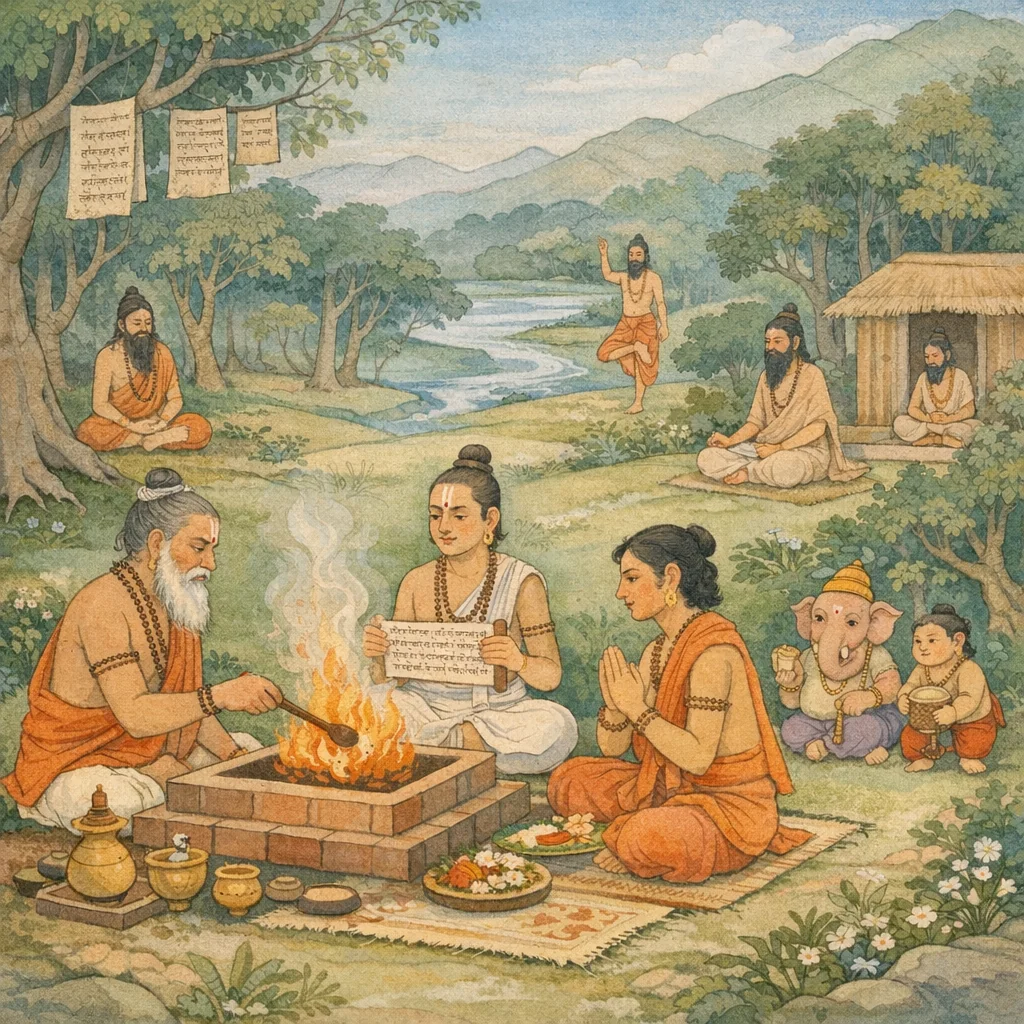
Adhyaya 221
भद्रवटगमनम् — स्कन्देन महिषदानवनिग्रहः (Bhadravaṭa Procession and Skanda’s Neutralization of Mahiṣa)
Upa-parva: Mārkaṇḍeya-upākhyāna (Śiva–Skanda/Deva-Asura episode at Bhadravaṭa)
Mārkaṇḍeya narrates Śiva’s radiant departure toward Bhadravaṭa with Umā, mounted on a sun-like chariot drawn by lions, amid a vast and symbolically ordered celestial entourage (Kubera in Puṣpaka, Indra on Airāvata, Varuṇa with aquatic beings, Yama with Mṛtyu and personified afflictions, and many cosmic collectives). Śiva addresses Skanda (Mahāsena/Kṛttikāsuta), confirming his command role and directing him to guard a particular Marut formation; Skanda assents and is promised welfare through devotion and readiness to appear when needed. After Skanda is dismissed, a sudden portent overwhelms the devas, followed by the emergence of a formidable hostile force that routes the divine host. Indra stabilizes morale and reorganizes resistance, but the daitya Mahiṣa escalates the threat by seizing Rudra’s chariot. Śiva then recalls Skanda as the decisive countermeasure. Skanda arrives in martial radiance, releases his śakti, beheads Mahiṣa, and disperses the remaining hostile forces; the devas praise Skanda’s first famed deed, forecasting enduring renown. The chapter closes with a phalaśruti: attentive recitation of Skanda’s birth/deeds yields prosperity and proximity to Skanda’s sphere.
Chapter Arc: मार्कण्डेय ऋषि यज्ञ-विद्या के एक सूक्ष्म रहस्य का द्वार खोलते हैं—श्रुति-वाक्य के अनुसार अग्नि और सोम को ‘उपांशु’ (मन्द/गुप्त) मन्त्रोच्चारण के साथ आज्यभाग अर्पित करने का विधान, और उसके पीछे छिपा कारण। → आंगिरस-वंशी तपस्वी पुत्र-प्राप्ति हेतु दीर्घकाल तक तीव्र तप करते हैं—ऐसा पुत्र चाहिये जो ब्रह्मा के समान यशस्वी और धर्मिष्ठ हो। पर यज्ञ-मार्ग में विघ्न खड़े होते हैं: विनायक-गण हवि का अपहरण करते, अग्नियों के भाग में बाधा डालते और यज्ञ को अस्थिर कर देते हैं। → सृष्टि-रहस्य का विस्फोटक वर्णन—देव-तत्त्वों/अग्नि-स्वरूपों की उत्पत्ति और साम-स्वरों (बृहत्, रथन्तर) का प्राकट्य; साथ ही यह निर्णायक संकेत कि चिताग्नि (संस्कारित, प्रज्वलित अग्नि) और मन्त्र-शक्ति ही विघ्नकारियों को रोकने का वास्तविक अस्त्र है। → यज्ञ-निपुण विद्वान बाह्य वेदी पर विनायकों के लिये ‘तदादान’ (उचित अर्पण/प्रबन्ध) करते हैं ताकि वे मुख्य अग्नि के समीप न आयें; मन्त्रों से शान्त की गयी अग्नि यज्ञ-भाग की रक्षा करती है। अंततः हवि-विभाग का नियम स्थिर होता है और तपस्वी/यजमान परम प्रसन्नता पाते हैं। → आंगिरसोपाख्यान की धारा आगे बढ़ती है—यज्ञ-रक्षा के इस विधान के बाद पुत्र-प्राप्ति/फल-प्राप्ति का अगला चरण किस रूप में प्रकट होगा?
Shlokas
Verse 1
#::73:.8 #::3:.:7 () हि २ 7 ३. “अग्नीषोमावुपांशु यष्टव्यावजामित्वाय” इस श्रुतिमें अग्नि और सोमको उपांशु मन्त्रोच्चारणपूर्वक आज्यभाग अर्पण करनेका विधान है। यहाँ सोमके साथ जिस अग्निको आज्यभागका अधिकारी बताया गया है, वह “वीर” नामक अनि ही है। २. ये वाक्के अभिमानी देवता हैं। “तस्य वाचा सृष्टौ पृथिवी चाग्निश्व' इस श्रुतिसे भी यही सिद्ध होता है। विशर्त्याधिकद्विशततमो< ध्याय: पाञज्चजन्य अग्निकी उत्पत्ति तथा उसकी संततिका वर्णन मार्कण्डेय उवाच काश्यपो हाथ वासिष्ठ: प्राणश्न॒ प्राणपुत्रक: । अग्निराड्धिरसश्वैव च्यवनस्त्रिषु वर्चक:,मार्कण्डेयजी कहते हैं--युधिष्ठिर! कश्यपपुत्र काश्यप, वसिष्ठ-पुत्र वासिष्ठ, प्राणपुत्र प्राणक, अंगिराके पुत्र च्यवन तथा त्रिवर्चा-ये पाँच अग्नि हैं
Markandeya said: “O Yudhiṣṭhira, these are the five sacred fires: Kāśyapa (son of Kaśyapa), Hāṭha-Vāsiṣṭha (son of Vasiṣṭha), Prāṇa (and Prāṇaputraka), Agni of the Āṅgirasa line, and Cyavana, the three-radiant one. Thus is described the origin and lineage of the Pañcajana fires.”
Verse 2
अचरन्त तपस्तीव्रं पुत्रार्थ बहुवार्षिकम् । पुत्रं लभेम धर्मिष्ठं यशसा ब्रह्मणा समम्
Mārkaṇḍeya said: “For the sake of obtaining a son, we practiced severe austerities for many years, praying that we might be granted a son of the highest righteousness—one whose fame would be equal to that of Brahmā.”
Verse 3
इन्होंने पुत्रकी प्राप्तिके लिये बहुत वर्षोतक तीव्र तपस्या की। इनकी तपस्याका उद्देश्य यह था कि हम ब्रह्माजीके समान यशस्वी और धर्मिष्ठ पुत्र प्राप्त करें ।। महाव्याह्तिभिर्ध्यात: पञ्चभिस्तैस्तदा त्वथ । जज्ञे तेजो महार्चिष्मान् पज्चवर्ण: प्रभावन:,पूर्वोक्त पाँच अग्निस्वरूप ऋषियोंने महाव्याह्ृृतिसंज्ञक पाँच मन्त्रोंद्वारा- परमात्माका ध्यान किया, तब उनके समक्ष अत्यन्त तेजोमय, पाँच वर्णोंसे विभूषित एक पुरुष प्रकट हुआ, जो ज्वालाओंसे प्रज्वलित अग्निके समान प्रकाशित होता था। वह सम्पूर्ण जगत्की सृष्टि करनेमें समर्थ था
Mārkaṇḍeya said: After those five sages—who were themselves of the nature of sacred fire—had meditated upon the Supreme through the five great Vyāhṛtis, there appeared before them a being of overwhelming radiance, blazing with mighty flames. Adorned with five hues and endowed with extraordinary power, he manifested as one capable of bringing forth creation itself—an answer to their long austerities undertaken for the sake of obtaining a righteous and illustrious progeny.
Verse 4
समिद्धो5ग्नि: शिरस्तस्य बाहू सूर्यनिभौ तथा । त्वड्नेत्रे च सुवर्णाभे कृष्णे जड्घे च भारत,भारत! उसका मस्तक प्रज्वलित अग्निके समान जगमगा रहा था, दोनों भुजाएँ प्रभाकरकी प्रभाके समान थीं, दोनों आँखें तथा त्वचा--सुवर्णके समान देदीप्यमान हो रही थीं और उस पुरुषकी पिण्डलियाँ काले रंगकी दिखायी देती थीं
Mārkaṇḍeya said: “His head blazed like a kindled fire; his two arms shone like the sun. His skin and eyes gleamed with the luster of gold, O Bhārata; yet his shanks appeared dark.” The description underscores a being of overwhelming radiance whose mixed signs—golden brilliance alongside dark limbs—mark him as extraordinary and awe-inspiring, inviting careful discernment rather than hasty judgment based on outward appearance alone.
Verse 5
पज्चवर्ण: स तपसा कृतस्तै: पञ्चभिर्जनै: । पाज्चजन्य: श्रुतों देवः पजचवंशकरस्तु सः,उपर्युक्त पाँच मुनिजनोंने अपनी तपस्याके प्रभावसे उस पाँच वर्णवाले पुरुषको प्रकट किया था, इसलिये उस देवोपम पुरुषका नाम पाञज्चजन्य हो गया। वह उन पाँचों ऋषियोंके वंशका प्रवर्तक हुआ
Mārkaṇḍeya said: By the power of austerity, those five sages brought forth a man of fivefold hue. Because he was thus heard of as ‘Pāñcajanya’—a godlike being associated with the five—he became the founder and continuator of the lineages of those five ṛṣis. The passage underscores how disciplined tapas, when rightly directed, is portrayed as creative and lineage-establishing, binding spiritual effort to social continuity and responsibility.
Verse 6
दशवर्षसहस््राणि तपस्तप्त्वा महातपा: । जनयत् पावकं घोरं पितृणां स प्रजा: सृजन्,फिर महातपस्वी पाञ्चजन्यने अपने पितरोंका वंश चलानेके लिये दस हजार वर्षोंतक घोर तपस्या करके भयंकर दक्षिणाग्निको उत्पन्न किया
Mārkaṇḍeya said: “After performing severe austerities for ten thousand years, that great ascetic kindled a dreadful sacred fire; and, intent on continuing the line of his forefathers, he set about bringing forth progeny.”
Verse 7
बृहद् रथन्तरं मूर्थ्नों वक्त्राद् वा तरसाहरौ । शिवं नाभ्यां बलादिन्द्रं वाय्वग्नी प्राणतोडसृजत्,उन्होंने मस्तकसे बृहत् तथा मुखसे रथन्तर सामको प्रकट किया। ये दोनों वेगपूर्वक आयु आदिको हर लेते हैं, इसलिये “तरसाहर” कहलाते हैं। फिर उन्होंने नाभिसे रुद्रको, बलसे इन्द्रको तथा प्राणसे वायु और अग्निको उत्पन्न किया
Mārkaṇḍeya said: From his head he brought forth the Sāman called Bṛhat, and from his mouth the Sāman called Rathantara—both swift in their power, and therefore known as “tarasā-hara,” ‘those who seize away by speed’ (i.e., who rapidly carry off vitality and lifespan). Then, from his navel he produced Śiva (Rudra); from his strength he produced Indra; and from his vital breath he generated Vāyu and Agni. The passage presents creation as an ordered emergence of cosmic functions—speech, breath, strength, and inner vitality—each becoming a deity responsible for sustaining (and also limiting) embodied life.
Verse 8
बाहुभ्यामनुदात्तौ च विश्वे भूतानि चैव ह । एतान् सृष्टवा ततः पठच पितृणामसृजत् सुतान्,दोनों भुजाओंसे प्राकृत और वैकृत भेदवाले दोनों अनुदात्तोंको मन और ज्ञानेन्द्रियोंके समस्त (छहों) देवताओंको तथा पाँच महाभूतोंको उत्पन्न किया। इन सबकी सृष्टि करनेके पश्चात् उन्होंने पाँचों पितरोंके लिये पाँच पुत्र और उत्पन्न किये
Mārkaṇḍeya said: “From the two arms he brought forth the two classes (natural and modified) of the ‘anudātta’ beings, along with the totality of the deities presiding over mind and the senses, and also the five great elements. Having created all these, he then produced sons for the Pitṛs as well.” The passage frames creation as an ordered unfolding—cosmic functions and ancestral continuity are established so that the world may be sustained through right succession and ritual obligation.
Verse 9
बृहद्रथस्य प्रणिधि: काश्यपस्य महत्तर: । भानुरज्धिरसो धीर: पुत्रो वर्चस्य सौभर:,(जिनके नाम इस प्रकार हैं--) वासिष्ठ बृहद्रथके अंशसे प्रणिधि, काश्यपके अंशसे महत्तर, अंगिरस च्यवनके अंशसे भानु तथा वर्चके अंशसे सौभर नामक पुत्रकी उत्पत्ति हुई
Mārkaṇḍeya said: From a portion of Bṛhadratha was born Praṇidhi; from a portion of Kaśyapa, Mahattara; from a portion of Aṅgiras, the steadfast Bhānu; and from a portion of Varcas, a son named Saubhara. Thus the lineage is traced by linking each descendant to the spiritual ‘share’ of an earlier seer, underscoring continuity of merit and inherited sacred potency.
Verse 10
प्राणस्य चानुदात्तस्तु व्याख्याता: पञचविंशति: । देवान् यज्ञमुषश्नान्यानू सूृजत् पञ्चदशोत्तरान्,प्राणके अंशसे अनुदात्तकी उत्पत्ति हुई। इस प्रकार पचीस पुत्रोंके नाम बताये गये। तत्पश्चात् “तप” नामधारी पांचजन्यने यज्ञमें विघध्म डालनेवाले अन्य पंद्रह उत्तर देवों (विनायकों)-की सृष्टि की। उनका विवरण इस प्रकार है--सुभीम, अतिभीम, भीम, भीमबल और अबल--इन पाँच विनायकोंकी उत्पत्ति उन्होंने पहले की, जो देवताओंके यज्ञका विनाश करनेवाले हैं
Mārkaṇḍeya said: From Prāṇa there also arose Anudātta, and the names of his twenty-five progeny were explained. Thereafter, one known as Tapas generated fifteen additional divine beings—Vināyakas—who are described as obstructers and destroyers of the gods’ sacrificial rites. First among them were produced five: Subhīma, Atibhīma, Bhīma, Bhīmabala, and Abala—agents of disruption whose presence tests the steadiness, purity, and vigilance required for sacred action.
Verse 11
सुभीममतिभीम॑ं च भीम॑ भीमबलाबलम् | एतान् यज्ञमुष: पज्च देवानां हासृजत् तप:,प्राणके अंशसे अनुदात्तकी उत्पत्ति हुई। इस प्रकार पचीस पुत्रोंके नाम बताये गये। तत्पश्चात् “तप” नामधारी पांचजन्यने यज्ञमें विघध्म डालनेवाले अन्य पंद्रह उत्तर देवों (विनायकों)-की सृष्टि की। उनका विवरण इस प्रकार है--सुभीम, अतिभीम, भीम, भीमबल और अबल--इन पाँच विनायकोंकी उत्पत्ति उन्होंने पहले की, जो देवताओंके यज्ञका विनाश करनेवाले हैं
Mārkaṇḍeya said: “Tapaḥ (the ascetic power personified) brought forth these five ‘yajña-stealers’—Subhīma, Atibhīma, Bhīma, Bhīmabala, and Abala—beings who disrupt and ruin the sacrificial rites of the gods.” In this passage, the narrative underscores how even divine order (yajña as a pillar of cosmic and social dharma) can be threatened by obstructive forces, and how vigilance and right ritual discipline are required to protect sacred action from sabotage.
Verse 12
सुमित्रं मित्रवन्तं च मित्रज्ञं मित्रवर्धनम् । मित्रधर्माणमित्येतान् देवानभ्यसृजत् तप:,इनके बाद पाञ्चजन्यने सुमित्र, मित्रवान, मित्रज्ञ, मित्रवर्धन और मित्रधर्मा--इन पाँच देवरूपी विनायकोंको उत्पन्न किया
Markandeya said: “Austerity (tapas), as if endowed with creative power, brought forth these divine beings—Sumitra, Mitravān, Mitrajña, Mitravardhana, and Mitradharmā—embodiments of guardianship through friendship: those who are good friends, possess friends, understand friendship, increase friendship, and uphold the law of friendship.”
Verse 13
सुरप्रवीरं वीरं॑ च सुरेशं च सुवर्चसम् । सुराणामपि हन्तारं पञ्चैतानसृजत् तपः,तदनन्तर पाञ्चजन्यने सुरप्रवीर, वीर, सुरेश, सुवर्चा तथा सुरहन्ता--इन पाँचोंको प्रकट किया
Mārkaṇḍeya said: “Then ascetic power brought forth these five—Surapravīra, Vīra, Sureśa, Suvarcas, and even Surahantā, a slayer of the gods. Thus, through the force of tapas, formidable beings were manifested, showing how concentrated austerity can generate powers that may uphold or endanger cosmic order depending on their use.”
Verse 14
त्रिविध॑ संस्थिता होते पडच पञठ्च पृथक् पृथक् । मुष्णन्त्यत्र स्थिता होते स्वर्गतो यज्ञयाजिन:,इस प्रकार ये पंद्रह देवोपम प्रभावशाली विनायक पृथक्-पृथक् पाँच-पाँच व्यक्तियोंके तीन दलोंमें विभक्त हैं। इस पृथ्वीपर ही रहकर स्वर्गलोकसे भी यज्ञकर्ता पुरुषोंकी यज्ञ- सामग्रीका अपहरण कर लेते हैं
Markandeya said: “These beings are arranged in three separate bands, each consisting of five, distinct from one another. Though they remain here on earth, they steal away the sacrificial requisites of men who perform sacrifices—as if from heaven itself—thus obstructing righteous ritual action.”
Verse 15
तेषामिष्टं हरन्त्येते निघ्नन्ति च महद्धवि: । स्पर्थया हव्यवाहानां निध्नन्त्येते हरन्ति च,ये विनायकगण अग्नियोंके लिये अभीष्ट महान् हविष्यका अपहरण तो करते ही हैं, उसे नष्ट भी कर डालते हैं। अग्निगणोंके साथ लाग-डाँट रखनेके कारण ही ये हविष्यका अपहरण और विध्वंस करते हैं
Mārkaṇḍeya said: “These beings seize what is offered as the desired oblation and even destroy the great sacrificial offering. Out of rivalry with the carriers of the oblation—the fires—they both snatch away and ruin the havis.” The verse warns that ritual offerings, when disrupted by hostile forces and by contention surrounding the sacred fire, can be rendered fruitless, underscoring the need for disciplined, dharmic conduct in sacrifice.
Verse 16
बहिर्वेद्यां तदादानं कुशलै: सम्प्रवर्तितम् । तदेते नोपसर्पन्ति यत्र चाग्नि: स्थितो भवेत्,इसीलिये यज्ञनिपुण विद्वानोंने यज्ञशालाकी बाह्य वेदीपर इन विनायकोंके लिये देयभाग रख देनेका नियम चालू किया है; क्योंकि जहाँ अग्निकी स्थापना हुई हो, उस स्थानके निकट ये विनायक नहीं जाते हैं
Mārkaṇḍeya said: “Therefore, skilled ritualists have established the practice of placing that offering outside the sacrificial altar. For these Vināyakas do not approach the place where the sacred fire has been properly installed.”
Verse 17
चितोअग्निरुद्धतन् यज्ञ पक्षाभ्यां तान् प्रबाधते । मन्त्रै: प्रशमिता होते नेष्टं मुष्णन्ति यज्ञियम्,मन्त्रद्वारा संस्कार करनेके पश्चात् प्रजजलित अग्निदेव जिस समय आहुति ग्रहण करते हुए यज्ञका सम्पादन करते हैं, उस समय वे अपने दोनों पंखों (पार्श्ववर्ती शिखाओं) द्वारा उन विनायकोंको कष्ट पहुँचाते हैं (इसीलिये वे उनके पास नहीं फटकते)। मन्त्रोंद्वारा शान्त कर देनेपर वे विनायक यज्ञसम्बन्धी हविष्यका अपहरण नहीं कर पाते हैं
Mārkaṇḍeya said: “When the sacrificial fire, once kindled and blazing, proceeds with the rite, it harasses those obstructing spirits with its two ‘wings’—the flanking tongues of flame. But when it is pacified through mantras, those Vināyakas are unable to steal the oblations meant for the sacrifice.”
Verse 18
बृहदुक्थस्तपस्यैव पुत्रो भूमिमुपाश्रित: । अन्निहाोत्रे हूयमाने पृथिव्यां सद्धिरिज्यते,इस पृथ्वीपर जब अग्निहोत्र होने लगता है, उस समय तप (पाञ्चजन्य)-के ही पुत्र बृहदुक्थ इस भूतलपर स्थित हो श्रेष्ठ पुरुषोंद्वारा पूजित होते हैं
Mārkaṇḍeya said: ‘Bṛhaduktha, the son of Tapas, remains established upon the earth. And when the Agnihotra is being offered on the earth, he is duly worshipped there by the virtuous and accomplished.’ The verse underscores the ethical primacy of Vedic duty: when sacrificial fire is maintained and offerings are made, worthy beings are honored, and the world-order is upheld through reverence for dharma.
Verse 19
रथन्तरश्न॒ तपस: पुत्रो$ग्नि: परिपठ्यते | मित्रविन्दाय वै तस्य हविरध्वर्यवों विदु:,तपके पुत्र जो रथन्तर नामक अग्नि कहे जाते हैं, उनको दी हुई हवि मित्रविन्द देवताका भाग है, ऐसा यजुर्वेदी विद्वान् मानते हैं। महायशस्वी तप (पाज्चजन्य) अपने इन सभी पुत्रोंके सहित अत्यन्त प्रसन्न हो आनन्दमग्न रहते हैं
Mārkaṇḍeya said: “Among the sons of Tapas, the fire named Rathantara is recited in the ritual tradition. The Yajurvedic officiants (adhvaryus) know that the oblation offered into that fire is assigned as the share of the deity Mitravindā. Thus Tapas, illustrious and satisfied, abides in joy together with all these sons.”
Verse 20
मुमुदे परमप्रीतः सह पुत्र्महायशा:,तपके पुत्र जो रथन्तर नामक अग्नि कहे जाते हैं, उनको दी हुई हवि मित्रविन्द देवताका भाग है, ऐसा यजुर्वेदी विद्वान् मानते हैं। महायशस्वी तप (पाज्चजन्य) अपने इन सभी पुत्रोंके सहित अत्यन्त प्रसन्न हो आनन्दमग्न रहते हैं
Mārkaṇḍeya said: The illustrious Tapas, delighted beyond measure, rejoiced together with his sons. The oblation offered to those fires—known as the sons of Tapas and bearing the name Rathantara—is regarded by Yajurvedic experts as the portion belonging to the deity Mitravinda. Thus Tapas (also called Pāñcajanya), surrounded by all his sons, remained exceedingly pleased and immersed in joy.
Verse 219
इस प्रकार श्रीमहाभारत वनपर्वके अन्तर्गत मार्कण्डेययमास्यापर्वमें आंगिरसोपाख्यानविषयक दो सौ उतन्नीसवाँ अध्याय पूरा हुआ
Thus ends the two hundred and nineteenth chapter of the Mahābhārata’s Vana Parva, within the Markandeya-Samāsya section, dealing with the Āṅgirasa episode. This is a colophon-style closing that marks the completion of the chapter rather than continuing the narrative itself.
Verse 220
इति श्रीमहाभारते वनपर्वणि मार्कण्डेयसमास्यापर्वणि आद्धिरसोपाख्याने विंशत्यधिकद्धिशततमो<ध्याय:
Thus ends the two-hundred-and-twentieth chapter in the Vana Parva of the Śrī Mahābhārata, within the Markandeya-Samāsya section, in the narrative episode known as the Āddhirāsa-upākhyāna.
Frequently Asked Questions
The devas face a governance dilemma under sudden destabilization: whether morale and coordination can be restored without abandoning duty. The narrative resolves it through legitimate command (Indra’s rally) and specialized intervention (Skanda’s mandated role).
Duty is situational and continuous: one must remain available for rightful tasks, and disciplined devotion combined with readiness to act is presented as a pathway to śreyas (welfare and excellence).
Yes. The chapter states that one who recites the account of Skanda’s birth/deeds with concentration attains prosperity in this world and reaches Skanda’s sphere (Skanda-sālokyatā), framing the narrative as both history and devotional text.