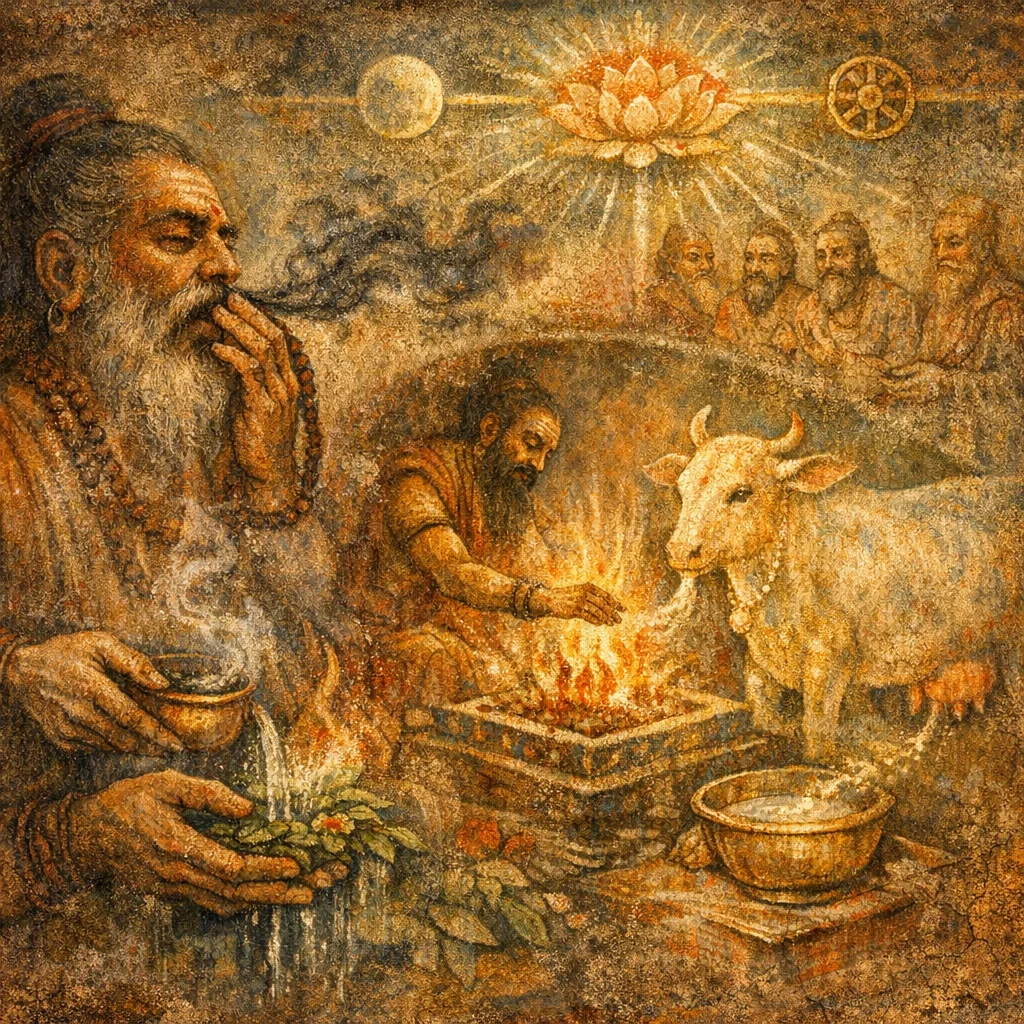
Sukta 10
Rishi: Traditionally attributed within AV 9 as speculative seers (often Angiras/Atharvanic attribution in anukramaṇī traditions; exact r̥ṣi assignment depends on the AV anukramaṇī).
Devata: Gopā (cosmic guardian; interpreted as Sūrya/Brahman).
Chandas: Triṣṭubh-like cadence (as transmitted; metrical classification varies by pada-count and edition).
Mantras
Mantra 1
आत्मा। यद् गायत्रे अधि गायत्रमाहितं त्रैष्टुभं वा त्रैष्टुभान्निरतक्षत । यद् वा जगज्जगत्याहितं पदं य इत् तद् विदुस्ते अमृतत्वमानशुः
The Self: what, upon the Gāyatrī, they have set as Gāyatra; or what Trāiṣṭubha they have hewn forth from Trāiṣṭubha; or what step, set in the Jagatī, (is) Jagat—those who indeed know that, they have attained immortality.
Mantra 2
गायत्रेण प्रति मिमीते अर्कमर्केण साम त्रैष्टुभेन वाकम्। वाकेन वाकं द्विपदा चतुष्पदाक्षरेण मिमते सप्त वाणीः
With Gāyatrī he measures out the hymn; with hymn, the Sāman; with Trāiṣṭubha, speech. With speech (he measures) speech: by the syllable they measure the seven voices, two-footed and four-footed.
Mantra 3
जगता सिन्धुं दिव्यऽस्कभायद् रथंतरे सूर्यं पर्यपश्यत्। गायत्रस्य समिधस्तिस्र आहुस्ततो मह्ना प्र रिरिचे महित्वा
With Jagatī he propped the flood in heaven; in Rathantara he beheld the Sun all round. Three kindlings, they say, belong to the Gāyatra: thence, by greatness, it overflowed in majesty.
Mantra 4
उप ह्वये सुदुघां धेनुमेतां सुहस्तो गोधुगुत दोहदेनाम्। श्रेष्ठं सवं सविता साविषन्नोऽभीऽद्धो घर्मस्तदु षु प्र वोचत्
Hither I call this well-yielding milch-cow: let the deft-handed cow-milker draw her out. Savitṛ hath impelled for us the best impulsion; kindled up, the Gharma—this indeed hath he auspiciously proclaimed.
Mantra 5
हिङ्कृण्वती वसुपत्नी वसूनां वत्समिच्छन्ती मनसाभ्यागात्। दुहामश्विभ्यां पयो अघ्न्येयं सा वर्धतां महते सौभगाय
Lowing ‘hiṅ,’ the mistress of riches, seeking her calf with mind, hath come hither. Let this inviolable cow milk out milk for the Aśvins; let her increase unto great good fortune.
Mantra 6
गौरमीमेदभि वत्सं मिषन्तं मूर्धानं हिङ्ङकृणोन्मातवा उ । सृक्वाणं घर्ममभि वावशाना मिमाति मायुं पयते पयोभिः
The Cow lowed over the calf that stirred; with the hiṅ-cry she made (as it were) a motherly head. Licking him, yearning toward the warmth, she metes out the cry, and with her milks she gives him to drink.
Mantra 7
अयं स शिङ्क्ते येन गौरभिवृता मिमाति मायुं ध्वसनावधि श्रिता। सा चित्तिभिर्नि हि चकार मर्त्यान् विद्युद् भवन्ती प्रति वव्रिमौहत
This is that wherewith she sprinkles: the Cow, encompassing, dispenses her cry, settled upon the stall. She, with her devices, verily brought mortals under (her power); becoming lightning, she smote back the enclosing cover.
Mantra 8
अनच्छये तुरगातु जीवमेजद् ध्रुवं मध्य आ पस्त्याऽनाम्। जीवो मृतस्य चरति स्वधाभिरमर्त्यो मर्त्येना सयोनिः
In the undecaying (realm) the swift-going living (power) moves, firm, in the midst of the homesteads. The living one walks amid the dead by its own ordinances—immortal, yet of one origin with the mortal.
Mantra 9
विधुं दद्राणं सलिलस्य पृष्ठे युवानं सन्तं पलितो जगार । देवस्य पश्य काव्यं महित्वाद्य ममार स ह्यः समान
The Vidhú, running on the back of the waters—young though being— the gray-haired one hath roused. Behold the god’s poetic craft by his greatness: today he hath died, who yesterday was the same.
Mantra 10
य ईं चकार न सो अस्य वेद य ईं ददर्श हिरुगिन्नु तस्मात्। स मातुर्योना परिवीतो अन्तर्बहुप्रजा निरृतिरा विवेश
He who made it knoweth not of it; he who beheld it—lo, from him it slipped away. Enwrapped within the mother’s womb, that many-progenied (power)—Nirṛti hath entered into it.
Mantra 11
अपश्यं गोपामनिपद्यमानमा च परा च पथिभिश्चरन्तम्। ससध्रीचीः स विषूचीर्वसान आ वरीवर्ति भुवनेष्वन्तः
I beheld the Herdsman, never sinking down, who goeth on the paths both hitherward and far away. Wearing his straight-going and his cross-going courses, within the worlds he rolleth ever to and fro.
Mantra 12
द्यौर्नः पिता जनिता नाभिरत्र बन्धुर्नो माता पृथिवी महीयम्। उत्तानयोश्चम्वो३र्योनिरन्तरत्रा पिता दुहितुर्गर्भमाधात्
Heaven is our Father, begetter, and here our navel; our kinsman: Earth, the mighty, is our Mother. Between the two outstretched bowls is the womb; there the Father hath deposited the embryo of the Daughter.
Mantra 13
पृच्छामि त्वा परमन्तं पृथिव्याः पृच्छामि वृष्णो अश्वस्य रेतः । पृच्छामि विश्वस्य भुवनस्य नाभिं पृच्छामि वाचः परमं व्योऽम
I ask thee of the uttermost end of Earth; I ask of the seed of the virile Horse. I ask of the navel of all this world of being; I ask of Speech’s highest firmament.
Mantra 14
इयं वेदिः परो अन्तः पृथिव्या अयं सोमो वृष्णो अश्वस्य रेतः । अयं यज्ञो विश्वस्य भुवनस्य नाभिर्ब्रह्मायं वाचः परमं व्योऽम
This altar is the uttermost end of Earth; this Soma is the seed of the virile Horse. This sacrifice is the navel of all the world of being; this is the Brahman, Speech’s highest firmament.
Mantra 15
न वि जानामि यदिवेदमस्मि निण्यः संनद्धो मनसा चरामि । यदा मागन् प्रथमजा ऋतस्यादिद् वाचो अश्नुवे भागमस्याः
I know not clearly whether I be even this: hidden, close-bound, I wander with the mind. When to me came the first-born of ṛta, then verily I attained a portion of this Speech.
Mantra 16
अपाङ् प्राङेति स्वधया गृभीतोऽमर्त्यो मर्त्येना सयोनिः । ता शश्वन्ता विषूचीना वियन्ता न्य१न्यं चिक्युर्न नि चिक्युरन्यम्
Backward and forward he moveth, seized by Svadhā: the Immortal, by the mortal, of one common womb. Those twain, enduring ever, diverging and parting, have known the one the other; yet the other they have not known.
Mantra 17
सप्तार्धगर्भा भुवनस्य रेतो विष्णोस्तिष्ठन्ति प्रदिशा विधर्मणि । ते धीतिभिर्मनसा ते विपश्चितः परिभुवः परि भवन्ति विश्वतः
Seven, half-embryoned, the seed of all existence, in Viṣṇu’s ordinance stand fast in the quarters. They, by insight and by mind, they the discerning, become encompassers, prevailing on every side.
Mantra 18
ऋचो अक्षरे परमे व्योऽमन् यस्मिन् देवा अधि विश्वे निषेदुः । यस्तन्न वेद किमृचा करिष्यति य इत् तद् विदुस्ते अमी समासते
The Ṛc-verses in the Imperishable, in the highest firmament, wherein all the Gods have taken seat. He who knoweth not That—what shall he accomplish with a verse? But they who verily know That, these are they who sit in concord.
Mantra 19
ऋचः पदं मात्रया कल्पयन्तोऽर्धर्चेन चाक्लृपुर्विश्वमेजत्। त्रिपाद् ब्रह्म पुरुरूपं वि तष्ठे तेन जीवन्ति प्रदिशश्चतस्रः
The Ṛc-verses, shaping the word-step by measured rule, with half a stanza have ordered all that moveth. Three-footed Brahman, multiform, hath spread abroad: thereby the four quarters live.
Mantra 20
सूयवसाद् भगवती हि भूया अधा वयं भगवन्तः स्याम । अद्धि तृणमघ्न्ये विश्वदानीं पिब शुद्धमुदकमाचरन्ती
From goodly pasture, O Blessed One, do thou indeed increase; then may we be blessed with thee. Eat thou the grass, O Cow whom none may slay, all-giving; drink pure water as thou roamest.
Mantra 21
गौरिन्मिमाय सलिलानि तक्षत्येकपदी द्विपदी सा चतुष्पदी । अष्टापदी नवपदी बभूवुषी सहस्राक्षरा भुवनस्य पङ्क्तिस्तस्याः समुद्रा अधि वि क्षरन्ति
The Bright One hath measured out the waters; she, the Artificer, doth fashion them: one-footed, two-footed, she—four-footed; eight-footed, nine-footed hath she become, a thousand-syllabled Paṅkti of the world. Upon her the oceans, spreading, pour themselves abroad.
Mantra 22
कृष्णं नियानं हरयः सुपर्णा अपो वसाना दिवमुत्पतन्ति । तं आववृत्रन्त्सदनादृतस्यादिद् घृतेन पृथिवीं व्यूऽदुः
The tawny, fair-winged powers, robed in waters, spring aloft to heaven. That black restraint they overcame from the seat of Order; then verily with ghee they opened and anointed the Earth.
Mantra 23
अपादेति प्रथमा पद्वतीनां कस्तद् वां मित्रावरुणा चिकेत । गर्भो भारं भरत्या चिदस्या ऋतं पिपर्त्यनृतं नि पाति
Forth comes the first among the footed forms: who, Mitra-Varuṇa, of you twain hath known that? The embryo bears the burden even of her; it maketh ṛta full, and it keepeth down unṛta.
Mantra 24
विराड् वाग् विराट् पृथिवी विराडन्तरिक्षं विराट् प्रजापतिः । विराण्मृत्युः साध्यानामधिराजो बभूव तस्य भूतं भव्यं वशे स मे भूतं भव्यं वशे कृणोतु
Virāj is Speech; Virāj is Earth; Virāj is Mid-air; Virāj is Prajāpati. From Virāj Death became the over-king of the Sādhyas: the Past and the Future are in his dominion—may he set for me the Past and the Future in dominion.
Mantra 25
शकमयं धूममारादपश्यं विषूवता पर एनावरेण । उक्षाणं पृश्निमपचन्त वीरास्तानि धर्माणि प्रथमान्यासन्
A smoke of dung-fuel from far away I beheld, at the turning-time, with the farther and the nearer side. A speckled bull the heroes cooked: those were the first-established ordinances.
Mantra 26
त्रयः केशिन ऋतुथा वि चक्षते संवत्सरे वपत एक एषाम्। विश्वमन्यो अभिचष्टे शचीभिर्ध्राजिरेकस्य ददृशे न रूपम्
Three are the long-haired Powers who, season by season, are seen apart; within the year one of them sheareth (his hair). Another, with efficacious might, looketh forth upon the All; the flashing splendour of one is seen—yet not his form.
Mantra 27
चत्वारि वाक् परिमिता पदानि तानि विदुर्ब्राह्मणा ये मनीषिणः । गुहा त्रीणि निहिता नेङ्गयन्ति तुरीयं वाचो मनुष्याऽवदन्ति
Four are the measured stations of Speech: these the Brahmans know, the wise in thought. Three, laid away in secrecy, stir not; the fourth of Speech is that which men do utter.
Mantra 28
इन्द्रं मित्रं वरुणमग्निमाहुरथो दिव्यः स सुपर्णो गरुत्मान्। एकं सद् विप्रा बहुधा वदन्त्यग्निं यमं मातरिश्वानमाहुः
They call him Indra, Mitra, Varuṇa, Agni; and he is the heavenly fair-winged Garuṭmān. The Real is One: sages speak of it in many a fashion; they call it Agni, Yama, Mātariśvan.
Frequently Asked Questions
Gopā is the cosmic “Herdsman/Guardian” who moves on every path and circulates within all worlds. Many traditions interpret this power as Sūrya-like (sun as overseer) or as Brahman-like (the inner regulator of reality).
It is primarily protective (shāntika): it stabilizes a space, reinforces right order (ṛta/dharma), and strengthens the effectiveness of a rite by aligning it with primordial precedent described in the hymn.
Not necessarily. The hymn works as a contemplative-protective recitation; optional supports include simple water-sprinkling for boundary-setting, or (if integrating with household ritual) fire with dung-fuel and/or milk as auspicious substances.