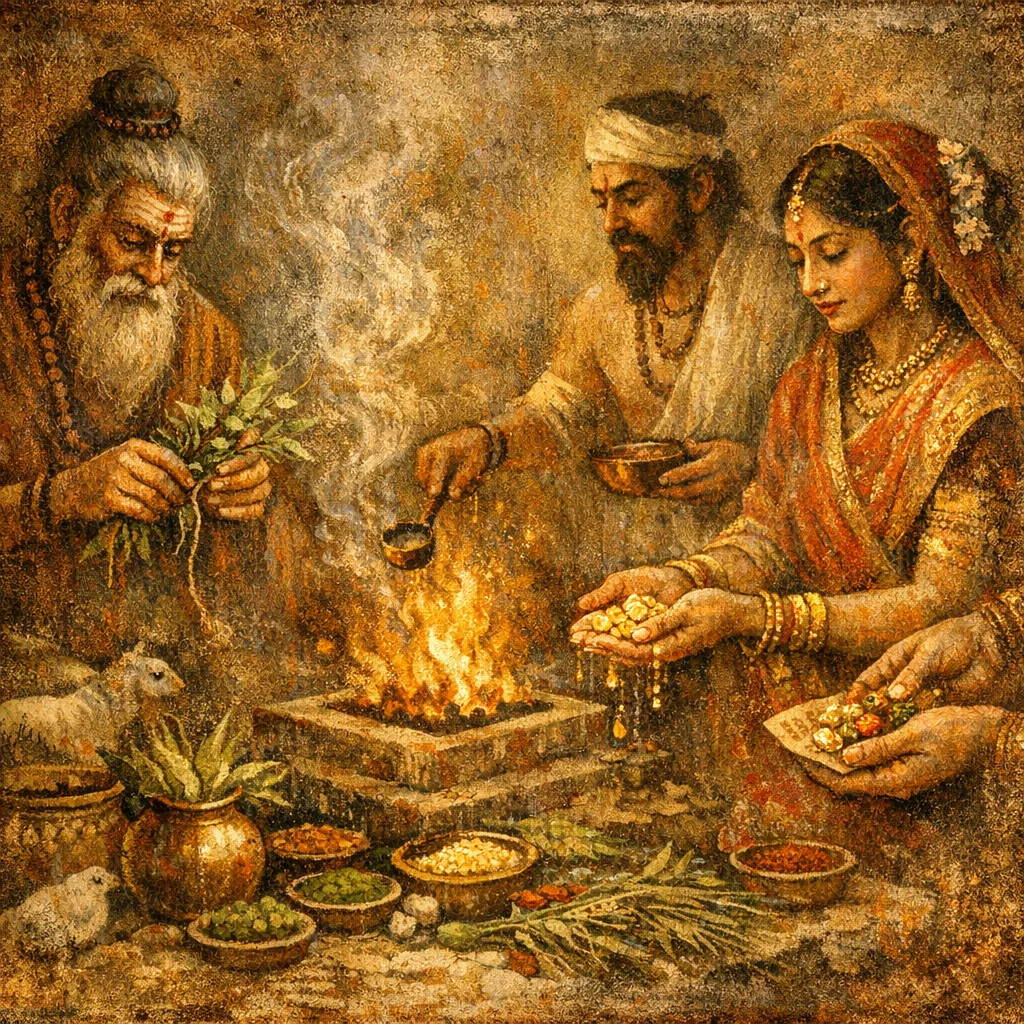
Sukta 135
Rishi: Anukta/late
Devata: Thāmas (staying-strength) / Dundubhi (instrumental power) / protective divine force
Chandas: Mixed/irregular (late, performative prose-verse)
Mantras
Mantra 1
खिलानि । भुगित्यभिगतः शलित्यपक्रान्तः फलित्यभिष्ठितः । दुन्दुभिमाहननाभ्यां जरितरोथामो दैव
To the waste-lands—‘Bhugity’ hath come up; ‘Śality’ hath withdrawn; ‘Phality’ is set firm. With two beatings on the drum, O ye two reciters, (make) divine strength our stay.
Mantra 2
कोशबिले रजनि ग्रन्थेर्धानमुपानहि पादम्। उत्तमां जनिमां जन्यानुत्तमां जनीन्वर्त्मन्यात्
In the store-pit, O Night, from the knot—bind on the grain (and) the foot. Let the best birth, O kinsman, the unsurpassed womenfolk, go upon the path.
Mantra 3
अलाबूनि पृषातकान्यश्वत्थपलाशम्। पिपीलिकावटश्वसो विद्युत्स्वापर्णशफो गोशफो जरितरोऽथामो दैव
Gourds, and the speckled things; the leaf of the Aśvattha; the ant; the banyan-breath; lightning; the fair-leafed, hoofed one; the cow-hoofed: O Singer—then, the divine raw might.
Mantra 4
वीमे देवा अक्रंसताध्वर्यो क्षिप्रं प्रचर । सुसत्यमिद्गवामस्यसि प्रखुदसि
Forth have these Gods advanced. O Adhvaryu, swiftly proceed. Most true indeed—of this man’s cows thou art the opener, thou that diggest them forth.
Mantra 5
पत्नी यदृश्यते पत्नी यक्ष्यमाणा जरितरोऽथामो दैव। होता विष्टीमेन जरितरोऽथामो दैव
When the Wife is seen—when the Wife, about to sacrifice—O Singer, then is the divine might. The Hotṛ, with ordered attendance—O Singer, then is the divine might.
Mantra 6
आदित्या ह जरितरङ्गिरोभ्यो दक्षिणामनयन्। तां ह जरितः प्रत्यायंस्तामु ह जरितः प्रत्यायन्
The Ādityas, verily, O Singer, conveyed the sacrificial fee unto the Aṅgirases. That fee, indeed, O Singer, they brought back again; that, moreover, O Singer, they brought back again.
Mantra 7
तां ह जरितर्नः प्रत्यगृभ्णंस्तामु ह जरितर्नः प्रत्यगृभ्णः । अहानेतरसं न वि चेतनानि यज्ञानेतरसं न पुरोगवामः
That, indeed, O Singer, for us they have received; that, moreover, O Singer, for us they have received. Not other than the days be our discernments; not other than sacrifice—may we be cattle-foremost.
Mantra 8
उत श्वेत आशुपत्वा उतो पद्याभिर्यविष्ठः । उतेमाशु मानं पिपर्ति
And the White one too, swift-winged, and again the youngest, by his paces; yea, this measure he quickly filleth full.
Mantra 9
आदित्या रुद्रा वसवस्त्वेनु त इदं राधः प्रति गृभ्णीह्यङ्गिरः । इदं राधो विभु प्रभु इदं राधो बृहत्पृथु
The Ādityas, Rudras, Vasus follow after thee: accept thou, O Angiras, this bounty set before thee. This bounty is wide and puissant; this bounty is great and broad.
Mantra 10
देवा ददत्वासुरं तद्वो अस्तु सुचेतनम्। युष्मां अस्तु दिवेदिवे प्रत्येव गृभायत्
Let the Gods bestow that lordly power: for you let it be of wholesome mind. Let it be yours day after day; let it, in very truth, lay hold on you again and again.
Mantra 11
त्वमिन्द्र शर्मरिणा हव्यं पारावतेभ्यः । विप्राय स्तुवते वसुवनिं दुरश्रवसे वह
Thou, Indra, who repayest with shelter, bring hither the oblation from far away; bring wealth-winning to the singer as he praiseth thee—yea, to him whose fame is hard to win.
Mantra 12
त्वमिन्द्र कपोताय च्छिन्नपक्षाय वञ्चते । श्यामाकं पक्वं पीलु च वारस्मा अकृणोर्बहुः
Thou, Indra, for the pigeon with clipped wings that wandereth, didst make abundant provision—ripe śyāmāka grain, and pīlu fruit—for the needy one.
Mantra 13
अरंगरो वावदीति त्रेधा बद्धो वरत्रया । इरामह प्रशंसत्यनिरामप सेधति
The creaker ever sounds; bound threefold with a thong. The praiser of Irā proclaims it: it thrusts away sickness, leaving none of ill.
Frequently Asked Questions
For a public protective rite that stabilizes a place or group—using drum-sound and paired recitation to ‘set firm’ divine staying-strength and ward destabilizing influences.
The drum is treated as ritual power in sound-form: its beat seals the spoken charm, projects protection outward, and gathers communal strength through an audible, coordinated act.
The hymn links protection with right order and well-being: after establishing firmness, it affirms ritual success (receipt/validation), prays for cattle-led prosperity, and invokes Indra’s example of providing grain and fruit for need.