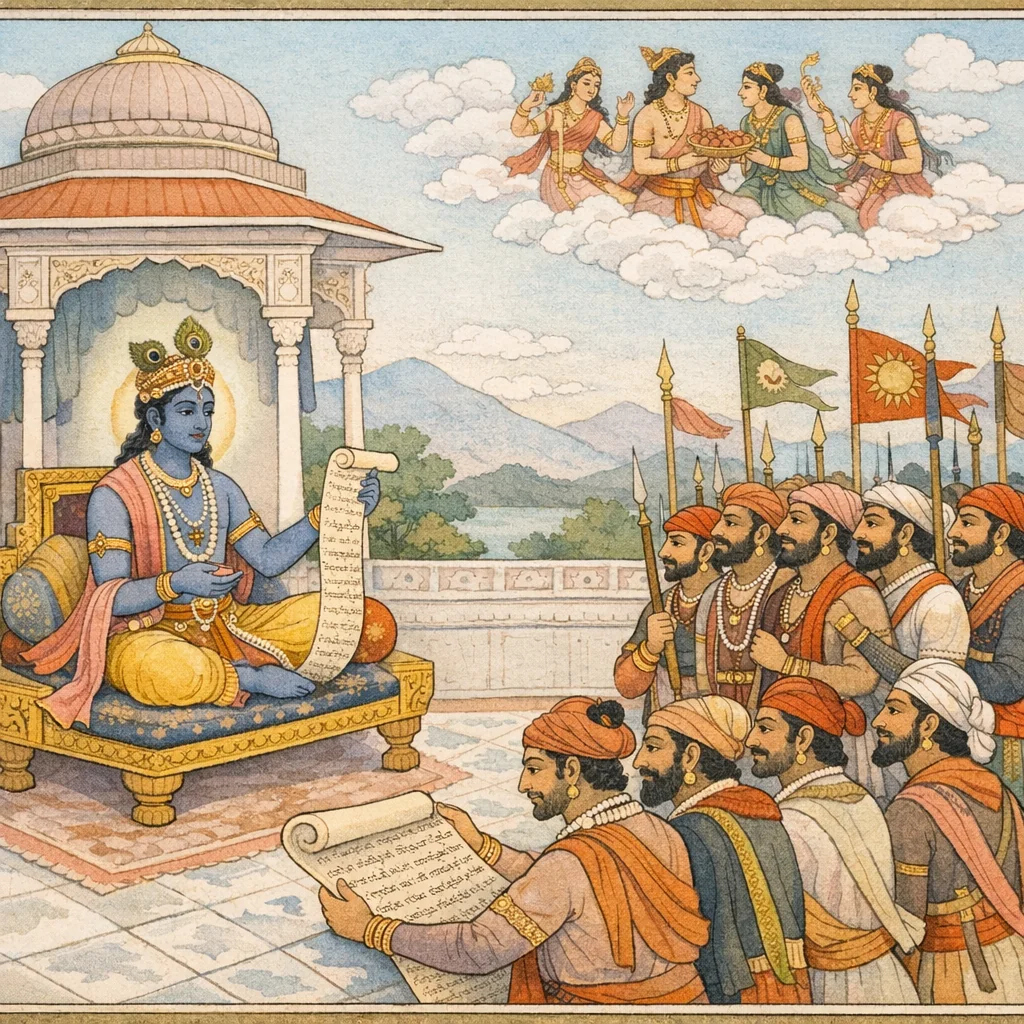
Adhyaya 15
पुनर्जन्म-दैत्यावतार-यादववंशमहिमा (Rebirth, Daitya Incarnations, and the Glory of the Yādava/Vṛṣṇi Line)
Parāśara says that a single hostile being, born as Hiraṇyakaśipu and again as Rāvaṇa, was slain by Viṣṇu yet attained extraordinary enjoyments beyond even the devas—showing the paradoxical fruit of divine contact even in enmity. Maitreya asks: if he did not attain dissolution, how did he return as Śiśupāla and finally gain sāyujya with the eternal Hari? Parāśara then sets a wider historical-theological frame, naming many youths and teachers and then the immeasurable multitude of Yādavas. He explains that mighty Daityas killed in deva–asura wars are reborn among humans as oppressors; to destroy them, the devas descend into Yadu’s line as 101 clans. Among them Viṣṇu is the pramāṇa and rightful sovereign authority, and all Yādavas abide by His command. The chapter ends with the śravaṇa-phala: hearing the origins of the Vṛṣṇis destroys sins and leads to Viṣṇuloka.
Shlokas
Verse 1
हिरण्यकशिपुत्वे च रावणत्वे च विष्णुना अवाप निहतो भोगान् अप्राप्यान् अमरैर् अपि
Even as Hiraṇyakaśipu, and again as Rāvaṇa, though struck down by Lord Viṣṇu, he attained enjoyments—rewards beyond the reach of even the immortals.
Verse 2
न लयं तत्र तेनैव निहतः स कथं पुनः संप्राप्तः शिशुपालत्वे सायुज्यं शाश्वते हरौ
He did not attain dissolution there; struck down by Him alone, how did he again become Śiśupāla—only to gain sāyujya, union with the Eternal Hari?
Verse 3
एतद् इच्छाम्य् अहं श्रोतुं सर्वधर्मभृतां वर कौतूहलपरेणैतत् पृष्टो मे वक्तुम् अर्हसि
I wish to hear this, O best among the upholders of dharma. Since, moved by earnest curiosity, I have asked you, you ought to explain it to me.
Verse 21
तिस्रः कोट्यः सहस्राणाम् अष्टाशीतिशतानि च कुमाराणां गृहाचार्याश् चापयोग्यासु ये रताः
There were three crores, and eighty-eight hundred besides, of youthful students; and among them were also household-teachers—those who, turning away from what is truly fit, were attached to unworthy pursuits.
Verse 22
संख्यानं यादवानां कः करिष्यति महात्मनाम् यत्रायुतानाम् अयुतं लक्षेणास्ते सदाहुकः
Who could ever number the great-souled Yādavas? For in that very line, around Sātyaki, the descendant of Ahuka, stand ten-thousands upon ten-thousands, ever attended by a hundred-thousand.
Verse 23
देवासुरहता ये तु दैतेयाः सुमहाबलाः ते चोत्पन्ना मनुष्येषु जनोपद्रवकारिणः
Those mighty Daiteyas, slain in the wars of Devas and Asuras, were born again among humankind; taking human form, they became the very cause of the people’s affliction and turmoil.
Verse 24
तेषाम् उत्सादनार्थाय भुवि देवा यदोः कुले अवतीर्णाः कुलशतं यत्रैकाभ्यधिकं द्विज
To bring about the destruction of those oppressive forces, O brāhmaṇa, the gods descended upon the earth, taking birth in the lineage of Yadu—where there were a hundred and one clans.
Verse 25
विष्णुस् तेषां प्रमाणे च प्रभुत्वे च व्यवस्थितः निदेशस्थायिनस् तस्य बभूवुः सर्वयादवाः
Among them, Viṣṇu stood established as the very measure of authority and the seat of rightful lordship; and all the Yādavas became steadfast in abiding by His command, in harmony with His sovereign order.
Verse 26
प्रसूतिं वृष्णिवीराणां यः शृणोति नरः सदा स सर्वैः पातकैर् मुक्तो विष्णुलोकं प्रपद्यते
Whoever, at all times, listens to the account of the birth and lineage of the heroic Vṛṣṇis is freed from every sin and attains the world of Viṣṇu, the Supreme Lord.
Frequently Asked Questions
Because Parāśara has implied continued existence without laya (dissolution), raising a doctrinal issue about karmic continuity and the mechanics of rebirth leading to final sāyujya with Hari.
It underscores the supremacy of Hari-sannidhi: contact with Viṣṇu—even through conflict—can yield extraordinary फल, while still distinguishing that final liberation (e.g., sāyujya) follows a further trajectory governed by divine order and karmic maturation.
Parāśara frames cosmic conflict as recurring historically: beings previously slain re-enter human society as disruptive forces (janopadrava), necessitating divinely guided restoration through incarnations and strategic births in sacred lineages.
It means Viṣṇu is the normative authority (pramāṇa) and rightful sovereign center (prabhutva) that orders their power; the Yādavas’ strength is portrayed as legitimate only insofar as it aligns with His command (nideśa).
The text states that regular listening to the Vṛṣṇi origins frees one from all sins (sarva-pātaka-mukti) and leads to Viṣṇuloka—presenting śravaṇa as a bhakti-infused purificatory practice.