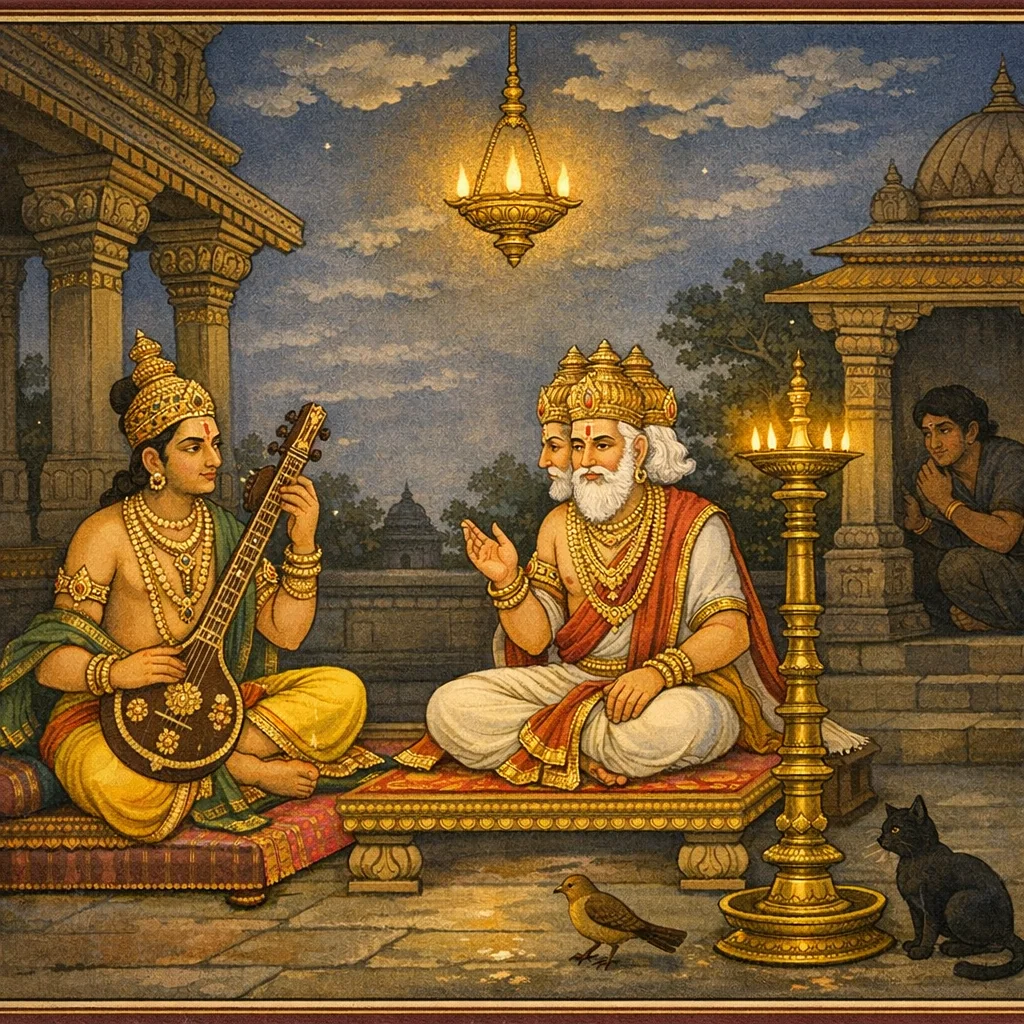
Adhyaya 7
This chapter unfolds as a sequential catalogue of tīrthas within Ayodhyā, spoken with ṛṣi authority. It opens at Kṣīrodaka near Sītākuṇḍa, grounding the site’s holiness in Daśaratha’s putreṣṭi-yajña: a divine vessel of havis appears, and its Vaiṣṇava potency becomes the cause of the name and the kunda’s power to purify sin. The discourse then turns to Bṛhaspati’s kunda, praising its sin-destroying merit, prescribing worship of Bṛhaspati and Viṣṇu, and detailing remedies for Guru-related planetary affliction, including homa and immersion of a golden image of Guru. Next comes Rukmiṇīkuṇḍa, founded by Rukmiṇī, with Viṣṇu abiding in its waters; the annual pilgrimage time (Ūrja kṛṣṇa navamī) is emphasized, along with Lakṣmī-oriented giving and honoring of Brahmins. The origin of Dhanayakṣa tīrtha is then narrated: Harīścandra’s treasure, the guarding Yakṣa Pramanthura, and Viśvāmitra’s consecration that removes foulness and grants fragrance—recasting the place as beauty-conferring and materially auspicious, with stated donation norms and worship of Nidhi-Lakṣmī. The chapter continues through Vasiṣṭhakuṇḍa (with Arundhatī and Vāmadeva), Sāgara-kuṇḍa (merit equal to ocean-bathing on full-moon days), Yoginīkuṇḍa (the 64 yoginīs; aṣṭamī observance), Urvaśīkuṇḍa (a legend of restored beauty after Raibhya’s curse and instruction), and concludes at Ghoṣārka-kuṇḍa, where a king is healed by bathing and a solar hymn; Sūrya grants boons, establishes the tīrtha’s fame, and promises its fruits.
Shlokas
Verse 1
अगस्त्य उवाच । तीर्थमन्यत्प्रवक्ष्यामि क्षीरोदकमिति स्मृतम् । सीताकुण्डाच्च वायव्ये वर्त्तते गुणसुन्दरम् । पुण्यैकनिचयस्थानं सर्वदुःखविनाशनम्
Agastya said: I shall describe another sacred ford, remembered as “Kṣīrodaka”. To the northwest of Sītākuṇḍa it lies, beautiful with auspicious qualities—a place where merit is amassed, and a destroyer of every sorrow.
Verse 2
पुरा दशरथो राजा पुत्रेष्टिनाम नामतः । चकार विधिवद्यज्ञं पुत्रार्थं यत्र चादरात्
Formerly, King Daśaratha performed there, in accordance with proper rite, the sacrifice called Putreṣṭi, earnestly desiring sons.
Verse 3
क्रतुं समापयामास सानन्दो भूरिदक्षिणम् । यज्ञान्ते क्रतुभुक्तत्र मूर्तिमान्समदृश्यत
He joyfully completed the kratu, bestowing abundant priestly gifts (dakṣiṇā). At the close of the yajña, the one who partakes of the offering there appeared in embodied form.
Verse 4
हस्ते कृत्वा हेमपात्रं हविःपूर्णमनुत्तमम् । तस्मिन्हविषि संकीर्णं वैष्णवं तेज उत्तमम् । चतुर्विधं विभज्यैव पत्नीभ्यो दत्तवान्नृपः
Taking in his hand a golden vessel filled with unsurpassed sacrificial oblation, within that offering was mingled the supreme Vaiṣṇava radiance. The king divided it into four portions and gave them to his queens.
Verse 5
यत्र तत्क्षीरसंप्राप्तिर्जाता परमदुर्लभा । क्षीरोदकमिति ख्यातं तत्स्थानं पापनाशनम् । उदकेनाभिव्यक्तं च उत्तमं च फलप्रदम्
Where that exceedingly rare ‘attainment of milk’ occurred, that place became renowned as Kṣīrodaka. It destroys sins; manifested through its waters, it bestows the highest fruits.
Verse 6
तत्र स्नात्वा नरो धीमान्विजितेन्द्रिय आदरात् । सर्वान्कामानवाप्नोति पुत्रांश्च सुबहुश्रुतान्
Bathing there with reverence, a wise person of conquered senses obtains all desired aims—and also sons who are well-educated and greatly learned.
Verse 7
आश्विने शुक्लपक्षस्य एकादश्यां जितव्रतः । तत्र स्नात्वा विधानेन दत्त्वा शक्त्या द्विजन्मने
On the Ekādaśī of the bright fortnight in Āśvina, one who is steadfast in vows should bathe there according to rite, and then give charity to a twice-born person according to one’s capacity.
Verse 8
विष्णुं संपूज्य विधिवत्सर्वान्कामानवाप्नुयात् । पुत्रानवाप्नुयाद्विद्धि धर्मांश्च विधिवन्नरः
By worshipping Viṣṇu in the proper manner, a person attains all desired aims. Know that he also gains worthy sons, and—by due observance—obtains the fruits of dharma as well.
Verse 9
तस्मात्क्षीरोदकस्थानान्नैरृते दिग्दले श्रितम् । ख्यातं बृहस्पतेः कुण्डमुद्दंडाचंडमंडितम्
Therefore, adjoining the place of Kṣīrodaka, on the south‑western side, lies the renowned pond of Bṛhaspati, distinguished by lofty and splendid adornments.
Verse 10
सर्वपापप्रशमनं पुण्यामृततरंगितम् । यत्र साक्षात्सुरगुरुर्निवासं किल निर्ममे
It is a pacifier of all sins, its waters rippling with holy, nectar‑like purity—where indeed the Guru of the gods, Bṛhaspati, is said to have established his very dwelling.
Verse 11
यज्ञं च विधिवच्चक्रे बृहस्पतिरुदारधीः । नानामुनिगणैर्युक्तं रम्यं बहुफलप्रदम् । सुपर्णच्छायसंपन्नं कुण्डं तत्पापिदुर्ल्लभम्
And Bṛhaspati, of noble insight, performed sacrifice there according to rule, accompanied by hosts of diverse sages, making that delightful pond abundant in rewards. Endowed with the shade of Suparṇa, that sacred tank is difficult for the sinful to attain.
Verse 12
इन्द्रादयोऽपि विबुधा यत्र स्नात्वा प्रयत्नतः । मनोभीष्टफलं प्राप्ताः सौंदर्यौदार्यतुंदिलाः
Even Indra and the other gods, having bathed there with due effort, obtained the fruits they desired in their hearts, becoming enriched in beauty and noble generosity.
Verse 13
यत्र स्नानेन दानेन नरो मुच्येत किल्बिषात्
Where, by bathing and by giving charity, a person is freed from sin.
Verse 14
भाद्रे शुक्ले तु पंचम्यां यात्रा तत्र फलप्रदा । अन्यदापि गुरोर्वारे स्नानं बहुफलप्रदम्
In the bright fortnight of Bhādrapada, on the fifth lunar day, pilgrimage there bestows its sacred fruit. And on other occasions too, bathing on Guru’s day (Thursday) grants abundant merit.
Verse 15
बृहस्पतेस्तथा विष्णोः पूजां तत्र य आचरेत् । सर्वपापविनिर्मुक्तो विष्णुलोके स मोदते
Whoever worships there Bṛhaspati and also Viṣṇu is freed from all sins, and rejoices in the world of Viṣṇu.
Verse 16
भवेद्बृहस्पतेः पीडा यस्य गोचरवेधतः । तेनात्र विधिवत्स्नानं कार्यं संकल्पपूर्वकम्
If one suffers affliction from Bṛhaspati due to an adverse astrological transit, then one should bathe here in due observance, preceded by a solemn saṅkalpa (sacred resolve).
Verse 17
होमं कृत्वा गुरोर्मूर्तिः सुवर्णेन विनिर्मिता । स्थित्वा जले प्रदेया वै पीतांबरसमन्विता
After performing the homa (fire-offering), one should have an image of Guru (Bṛhaspati) fashioned in gold; placing it in the water, it should indeed be given as a gift, adorned with yellow garments.
Verse 18
वेदज्ञायातिशुचये स्नात्वा पीडापनुत्तये । होमं च कारयेत्तत्र ग्रहजाप्यविधानतः
Having bathed there to remove affliction, one should have a homa performed there according to the prescribed rite of planetary mantra-recitation, engaging a Veda-knower of exceptional purity.
Verse 19
एवं कृते न संदेहो ग्रहपीडा प्रणश्यति
When it is done in this manner, there is no doubt: the affliction caused by the planets is destroyed.
Verse 20
तद्दक्षिणे मुनिश्रेष्ठ रुक्मिणीकुण्डमुत्तमम् । चकार यत्स्वयं देवी रुक्मिणी कृष्णवल्लभा
To the south of that sacred spot, O best of sages, lies the excellent Rukmiṇī Pond—fashioned by the goddess Rukmiṇī herself, beloved of Kṛṣṇa.
Verse 21
तत्र विष्णुः स्वयं चक्रे निवासं सलिले तदा । वरप्रदानात्स्नेहेन भार्यायाः प्रगुणीकृतम्
There, Viṣṇu Himself then made His dwelling in the waters—graciously arranged and made excellent out of love for His consort, through the granting of a boon.
Verse 22
तत्र स्नानं तथा दानं होमं वैष्णवमंत्रकम् । द्विजपूजां विष्णुपूजां कुर्वीत प्रयतो नरः
There, a disciplined person should perform bathing, charitable giving, and a fire-offering with Vaiṣṇava mantras, and should worship the twice-born as well as worship Viṣṇu.
Verse 23
तत्र सांवत्सरी यात्रा कर्त्तव्या सुप्रयत्नतः । ऊर्जकृष्णनवम्यां च सर्वपापापनुत्तये
There, an annual pilgrimage should be undertaken with great effort; and on the ninth day of the dark fortnight of Ūrja (Kārtika), for the removal of all sins.
Verse 24
पुत्रवाञ्जायते वन्ध्यो यात्रां कृत्वा न संशयः । नारीभिर्वा नरैर्वापि कर्त्तव्यं स्नानमादरात्
A barren person becomes blessed with a child by undertaking the pilgrimage—there is no doubt. Whether woman or man, one should bathe there with reverence.
Verse 25
भुक्त्वा भोगान्समग्रांश्च विष्णुलोके स मोदते । लक्ष्मीकामनया तत्र स्नातव्यं च विशेषतः
Having enjoyed complete pleasures, one rejoices in Viṣṇu’s world. And for the sake of seeking Lakṣmī—prosperity and grace—bathing there is especially to be undertaken.
Verse 26
सर्वकाममवाप्नोति तत्र स्नानेन मानवः । रुक्मिणीश्रीपतिप्रीत्यै दातव्यं च स्वशक्तितः
By bathing there, a person attains all desired aims. And to please Rukmiṇī and Śrīpati (Viṣṇu), one should give charity according to one’s capacity.
Verse 27
कर्त्तव्या विधिवत्पूजा ब्राह्मणानां विशेषतः । ध्येयो लक्ष्मीपतिस्तत्र शंखचक्रगदाधरः
Worship should be performed according to proper rule—especially honoring the brāhmaṇas. There, one should meditate upon the Lord of Lakṣmī, the bearer of conch, discus, and mace.
Verse 28
पीतांबरधरः स्रग्वी नारदादिभिरीडितः । तार्क्ष्यासनो मुकुटवान्महेन्द्रादिविभूषितः
Clad in yellow garments and adorned with a garland, praised by Nārada and other sages, seated upon Tārkṣya (Garuḍa), crowned, and honored with ornaments fit for Indra and the gods—thus is Hari beheld in Ayodhyā.
Verse 29
सर्वकामफलावाप्त्यै वक्षोलक्षितकौस्तुभः । अतसीकुसुमश्यामः कमलामललोचनः
For the attainment of the fruits of all rightful desires, one should remember Him whose chest bears the Kaustubha gem—dark-hued like the flax flower, with pure lotus-like eyes.
Verse 30
एवं कृते न संदेहः सर्वान्कामानवाप्नुयात् । इह लोके सुखं भुक्त्वा हरिलोके स मोदते
When this is done, there is no doubt: one attains all desired ends. Having enjoyed happiness in this world, one rejoices thereafter in Hari’s own realm.
Verse 31
अतः परं प्रवक्ष्यामि तीर्थमन्यदघापहम् । कलिकिल्विषसंहारकारकं प्रत्ययात्मकम्
Next, I shall describe another sacred ford (tīrtha) that removes sin—one that destroys the taints of the Kali age and brings firm conviction through direct spiritual assurance.
Verse 32
परं पवित्रमतुलं सर्वकामार्थसिद्धिदम् । धनयक्षैतिख्यातं परं प्रत्ययकारकम्
It is supremely pure and incomparable, granting success in aims and the fulfillment of all worthy desires. Known as ‘Dhana-Yakṣa’, it bestows the highest certainty and trust in its power.
Verse 33
रुक्मिणीकुण्डवायव्यदिग्दले संस्मृतं शुभम् । हरिश्चन्द्रस्य राजर्षेरासीत्तत्र धनं महत्
In the north-western quarter near Rukmiṇī-kuṇḍa lies an auspicious spot, remembered as sacred. There, the royal sage Hariścandra had a great treasure.
Verse 34
तस्य रक्षार्थमत्यर्थं रक्षितो यक्षौच्चकैः । विश्वामित्रो मुनिः पूर्वं यदा चैव पराजयत्
To guard that treasure with utmost strictness, it was protected by formidable Yakṣas. Formerly, when the sage Viśvāmitra overcame them and defeated them…
Verse 35
हरिश्चंद्रं नरपतिं राज्यसूयकरं परम् । राज्यं जग्राह सकलं चतुरंगबलान्वितम्
King Hariścandra—the ruler, supreme performer of the royal Rājasūya rite—had his entire kingdom seized, together with its fourfold army.
Verse 36
तद्वशेऽदाच्च स मुनिर्धनं सकलमुत्तमम् । तद्रक्षायै प्रयत्नेन यक्षं स्थापितवानसौ
Having brought them under his control, the sage caused all that excellent wealth to be handed over. Then, with deliberate effort for its protection, he installed a Yakṣa as guardian.
Verse 37
प्रमंथुर इति ख्यातं प्रमोदानन्दमंदिरम् । रक्षां विदधतस्तस्य बहुयत्नेन सर्वशः
That guardian became renowned as Pramanthura—an abode of delight and bliss—who, with great exertion in every way, continually maintained protection.
Verse 38
तुतोष स मुनिर्द्धीमान्कदाचिद्विजितेन्द्रियः । उवाच मधुरं वाक्यं प्रीत्या परमया युतः
At that time the wise sage—self-controlled and master of his senses—became pleased, and, filled with supreme affection, spoke sweet words.
Verse 39
विश्वामित्र उवाच । वरं वरय धर्मज्ञ क्षिप्रमेव विमत्सरः । भक्त्या परमया धीर संतुष्टोऽस्मि विशेषतः
Viśvāmitra said: “O knower of dharma, swiftly choose a boon, free from envy. O steadfast one, I am especially pleased by your supreme devotion.”
Verse 40
यक्ष उवाच । वरं प्रयच्छसि यदि विप्रवर्य मदीप्सितम् । ममांगमतिदुर्गंधि शापाच्च नृपतेरभूत् । सुगन्धयितुं ब्रह्मर्षे तत्प्रसीद मुनीश्वर
The Yakṣa said: “If you will grant a boon, O best of brāhmaṇas, grant what I desire. My body has become exceedingly foul-smelling due to a king’s curse. O brahmarṣi, be gracious, O lord of sages—make me fragrant.”
Verse 41
अगस्त्य उवाच । एवमुक्ते तु यक्षेण मुनिर्ध्यानस्थलोचनः । तं विविच्यानया भक्त्या अभिषेकं चकार सः
Agastya said: When the Yakṣa had spoken thus, the sage—his eyes fixed in meditation—considered him, and with such devotion performed an abhiṣeka, the consecratory ablution, for him.
Verse 42
तीर्थोदकेन विधिवत्कृत्वा संकल्पमादरात् । ततः सोऽभूत्क्षणेनैव सुगन्धोत्तरविग्रहः
Using sacred tīrtha-water, and duly making a solemn saṅkalpa with reverence, he then became—within a moment—one whose body was endowed with surpassing fragrance.
Verse 43
तथाभूतः स मधुरं प्रोवाच प्रांजलिस्ततः । पुनः पुरः स्थितो धीमान्विनयावनतस्तदा
Thus transformed, he then spoke sweetly with folded hands; and again, standing before the sage, the wise one bowed down in humility.
Verse 44
यक्ष उवाच । त्वत्कृपाभिरहं धीर जातः सुरभिविग्रहः । एतत्स्थानं यथा ख्यातिं याति सर्वज्ञ तत्कुरु
The Yakṣa said: “By your compassion, O steadfast one, I have attained a fragrant form. O all-knowing one, so act that this place may gain renown.”
Verse 45
त्वत्प्रसादेन विप्रर्षे तथा यत्नं विधेहि वै
Therefore, O brāhmaṇa-sage, by your gracious favor, do indeed undertake the effort to bring this about.
Verse 46
अगस्त्य उवाच । एवमुक्तः क्षणं ध्यात्वा मुनिः स्तिमितलोचनः । यक्षं प्रति प्रसन्नात्मा ह्युवाच श्लक्ष्णया गिरा
Agastya said: Thus addressed, the sage—his eyes steady—pondered for a moment; then, with a serene heart, he spoke to the Yakṣa in gentle words.
Verse 47
विश्वामित्र उवाच । प्रसिद्धिमतुलां यक्ष एतत्स्थानं गमिष्यति । धनयक्ष इति ख्यातिमेतत्तीर्थं गमिष्यति
Viśvāmitra said: “O Yakṣa, this place shall attain incomparable renown. This tīrtha shall become known by the name ‘Dhanayakṣa’.”
Verse 48
सौंदर्य्यदं शरीरस्य परं प्रत्ययकारकम् । यत्र स्नात्वा विधानेन दौर्गंध्यं त्यजति क्षणात् । तत्र स्नानं प्रयत्नेन कर्त्तव्यं पुण्यकांक्षिभिः
That sacred bathing-place bestows beauty upon the body and becomes a supreme ground of inner certainty. By bathing there according to rule, foul odor is cast off in an instant. Therefore, those who seek merit should strive to bathe there with care.
Verse 49
दानं श्रद्धास्वशक्तिभ्यां लक्ष्मीपूजा विशेषतः । तत्र स्नानेन दानेन लक्ष्मीप्रीत्यै विशेषतः
One should give charity with faith, according to one’s capacity, and above all perform worship of Lakṣmī. In that sacred place, bathing and giving are done especially for the delight of Lakṣmī.
Verse 50
पूजया तु निधीनां च नवानामपि सुव्रत । इह लोके सुखं भुक्त्वा परलोके स मोदते
But by worshipping even the nine treasures, O virtuous one, a person enjoys happiness in this world and rejoices in the next as well.
Verse 51
महापद्मस्तथा पद्मः शंखो मकरकच्छपौ । मुकुन्दकुंदनीलाश्च खर्वश्च निधयो नव
The nine treasures are: Mahāpadma, Padma, Śaṅkha, Makara, Kacchapa, Mukunda, Kunda, Nīla, and Kharva.
Verse 52
एतेषामपि कुण्डेऽत्र संनिधिर्भविताऽनघ । एतेषां तु विशेषेण पूजा बहुफलप्रदा
O sinless one, these (nine treasures) will also be present in this very pond. And worship of them here, in particular, bestows abundant fruits.
Verse 53
जलमध्ये प्रकर्त्तव्यं निधिलक्ष्मीप्रपूजनम्
The worship of Nidhi-Lakṣmī should be performed in the midst of the water.
Verse 54
अन्नं बहुविधं देयं वासांसि विविधानि च
Food of many kinds should be given, and garments of various kinds as well.
Verse 55
सुवर्णादि यथाशक्त्या वित्तशाठ्यं विवर्जयेत् । गुप्तं दानं प्रयत्नेन कर्त्तव्यं सुप्रयत्नतः
One should give gold and the like according to one’s ability, avoiding stinginess in wealth. And one should carefully perform charity in a concealed manner—diligently, with great care.
Verse 56
फलानि च सुवर्णानि देयानि च विशेषतः
Fruits and gold, in particular, should be given in charity.
Verse 57
कृष्णपक्षे चतुर्दश्यां स्नानं बहुफलप्रदम् । श्रद्धया परया युक्तैः कर्त्तव्यं श्रद्धयाधिकम्
On the fourteenth lunar day of the dark fortnight, bathing yields abundant fruits. It should be performed by those endowed with the highest faith—indeed, with faith all the more.
Verse 58
माघे कृष्णचतुर्दश्यां यात्रा सांवत्सरी भवेत् । तत्र स्नानं पितॄणान्तु तर्पणं च विशेषतः
On the fourteenth day of the dark fortnight in Māgha, the pilgrimage yields the fruit of an entire year. There one should bathe and, especially, offer tarpaṇa (libations) to the Pitṛs (ancestors).
Verse 59
आब्रह्मस्तम्बपर्यंतं जगत्तृप्यत्विति ब्रुवन् । अपसव्येन विधिवत्तर्प्पयेदंजलित्रयम्
Saying, “May the whole world—from Brahmā down to a blade of grass—be satisfied,” one should duly offer tarpaṇa, wearing the sacred thread in the reverse manner (apasavya), and pour three handfuls of water from joined palms.
Verse 60
एवं कुर्वन्नरो यक्ष न मुह्यति कदाचन । अत्र स्नातो दिवं याति अत्र स्नातः सुखी भवेत्
O Yakṣa, the man who acts in this way is never deluded. Having bathed here, he goes to heaven; having bathed here, he becomes happy.
Verse 61
अत्र स्नातेन ते यक्ष कर्त्तव्यं पूजनं पुरः । त्वत्पूजनेन विधिवन्नृणां पापक्षयो भवेत्
O Yakṣa, after bathing here one should perform worship before you. By worshipping you according to proper rite, people’s sins are destroyed.
Verse 62
नमः प्रमथराजेति पूजामन्त्र उदाहृतः । तीर्थमध्ये प्रकर्त्तव्यं पूजनं श्रवणादिकम्
The worship-mantra is declared as: “Homage to the King of the Pramathas.” In the very midst of the tīrtha, one should perform worship, beginning with acts such as reverent hearing (of the sacred account).
Verse 63
निधिलक्ष्म्यो तथा यक्ष तव पूजा विशेषतः । एवं यः कुरुते धीरः सर्वान्कामानवाप्नुयात्
O Yakṣa, for the gaining of treasures and prosperity (Lakṣmī), your worship is especially efficacious. The steadfast person who does thus attains all desired aims.
Verse 64
धनार्थी धनमाप्नोति पुत्रार्थी पुत्रमाप्नुयात् । मोक्षार्थी मोक्षमाप्नोति तत्किं न यदिहाप्यते
One who seeks wealth obtains wealth; one who seeks a son obtains a son; one who seeks mokṣa obtains mokṣa. What is there here that is not gained?
Verse 65
यस्तु मोहान्नरो यक्ष स्नानं न कुरुते किल । तस्य सांवत्सरं पुण्यं त्वं ग्रहीष्यसि सर्वशः
But, O Yakṣa, the man who—through delusion—does not perform the sacred bath (snāna): you will indeed seize all the merit he has amassed over the year.
Verse 66
इति दत्त्वा वरांस्तस्मै विश्वामित्रो मुनीश्वरः । अन्तर्दधे मुनिवरस्तदा स च तपोनिधिः
Thus, having granted him boons, Viśvāmitra—the lord among sages—then vanished from sight, that foremost ascetic, a very treasury of tapas.
Verse 67
तदाप्रभृति तत्स्थानं परमां ख्यातिमाययौ । तस्य तीर्थस्य सकला भूमिः स्वर्णविनिर्मिता
From that time onward, that place attained the highest renown. The entire ground of that tīrtha became as though fashioned of gold.
Verse 68
दिव्यरत्नौघखचिता समंतादुपशोभिता । एवं यः कुरुते विद्वन्स याति परमां गतिम्
Adorned on every side with heaps of divine jewels and resplendent all around—O learned one, whoever performs it in this manner attains the supreme state.
Verse 69
धनयक्षादुत्तरस्मिन्दिग्भागे संस्थितं द्विज । वसिष्ठकुण्डं विख्यातं सर्वपापापहं सदा
To the north, in the quarter ruled by Kubera, Lord of Wealth, O brāhmaṇa, lies the famed Vasiṣṭha-kuṇḍa, ever removing all sins.
Verse 70
वसिष्ठस्य सदा तत्र निवासः सुतपोनिधेः । अरुन्धती सदा यस्य वर्तते निर्मलव्रता
There ever dwells Vasiṣṭha, a treasure-house of noble austerity; and with him always is Arundhatī, steadfast in her pure vow.
Verse 71
अत्र स्नानं विशेषेण श्राद्धपूर्वमतंद्रितः । यः कुर्यात्प्रयतो धीमांस्तस्य पुण्यमनुत्तमम्
Here one should bathe with special care, first performing śrāddha, without negligence. The wise who do so with discipline gain unsurpassed merit.
Verse 72
वामदेवस्य तत्रैव संनिधिर्वर्ततेऽनघ । वशिष्ठवामदेवौ तु पूजनीयौ प्रयत्नतः
There itself is the holy presence of Vāmadeva, O sinless one. Indeed, Vasiṣṭha and Vāmadeva should be worshipped with earnest effort.
Verse 73
पतिव्रता पूजनीयाऽरुन्धती च विशेषतः । स्नातव्यं विधिना सम्यग्दातव्यं च स्वशक्तितः
Arundhatī, the devoted pativratā, is especially worthy of worship. One should bathe properly according to rule, and give charity according to one’s capacity.
Verse 74
सर्वकामफलप्राप्तिर्जायते नात्र संशयः । अत्र यः कुरुते स्नानं स वशिष्ठसमो भवेत्
Here the fruits of all desires are attained—of this there is no doubt. Whoever bathes here becomes equal to Vasiṣṭha in merit.
Verse 75
भाद्रे मासि सिते पक्षे पंचम्यां नियतव्रतः । तस्य सांवत्सरी यात्रा कर्त्तव्या विधिपूर्विका
In the month of Bhādrapada, in the bright fortnight, on the fifth lunar day, one who keeps a disciplined vow should undertake the annual pilgrimage, duly according to rite.
Verse 76
विष्णुपूजा प्रयत्नेन कर्तव्या श्रद्धयात्र वै । सर्वपापविशुद्धात्मा विष्णुलोके महीयते
Here, worship of Viṣṇu should be performed with earnest effort and with faith. Purified of all sins, the soul is honored in the realm of Viṣṇu.
Verse 77
वसिष्ठकुण्डाद्विप्रेंद्र प्रत्यग्दिग्दलमाश्रितम् । विख्यातं सागरं कुण्डं सर्वकामार्थसिद्धिदम् । यत्र स्नानेन दानेन सर्वकामानवाप्नुयात्
To the west of Vasiṣṭha-kuṇḍa, O best of brāhmaṇas, lies the renowned Sāgara-kuṇḍa, granting success in all aims and desires. By bathing and giving charity there, one obtains all desired fruits.
Verse 78
पौर्णमास्यां समुद्रस्य स्नानाद्यत्पुण्यमाप्नुयात् । तत्पुण्यं पर्वणि स्नातो नरश्चाक्षयमाप्नुयात्
Whatever merit one gains by bathing in the ocean on the full-moon day—one who bathes here on a sacred festival day attains that very merit in imperishable (akṣaya) form.
Verse 79
तस्मादत्र विधानेन स्नातव्यं पुत्रकांक्षया । आश्विने पौर्णमास्यां तु विशेषात्स्नानमाचरेत्
Therefore, one should bathe here according to the prescribed rite, especially when longing for progeny; and on the full-moon day of the month of Āśvina, one should perform the bath with particular care.
Verse 80
एवं कुर्वन्नरो विद्वान्सर्वपापैः प्रमुच्यते । अत्र स्नात्वा नरो दत्त्वा यथाशक्त्या दिवं व्रजेत्
Acting in this way, a wise person is freed from all sins. Having bathed here and given charity according to one’s capacity, a person goes to heaven.
Verse 81
सागरान्नैरृते भागे योगिनीकुण्डमुत्तमम् । यत्राऽसते चतुःषष्टियोगिन्यो जलसंस्थिताः
To the southwest of the ocean lies the excellent Yoginī-kuṇḍa, where sixty-four Yoginīs dwell, abiding within the waters.
Verse 82
सर्वार्थसिद्धिदाः पुंसां स्त्रीणां चैव विशेषतः । परसिद्धिप्रदाः सर्वाः सर्वकामफलप्रदाः
They grant success in all aims to men—and especially to women. All of them bestow higher attainments and grant the fruits of every desire.
Verse 83
आश्विने शुक्लपक्षस्य अष्टम्यां च विशेषतः । स्नातव्यं च प्रयत्नेन योगिनीप्रीतये नृभिः
In the month of Āśvina, especially on the eighth day of the bright fortnight, people should bathe with effort and care, for the delight and propitiation of the Yoginīs.
Verse 84
अत्र स्नानं तथा दानं सर्वं सफलतां व्रजेत् । यक्षिणीप्रभृतयः सिद्धा भवंत्यत्र न संशयः
Here, bathing and likewise charity—all of it becomes fruitful. Yakṣiṇīs and other such accomplished beings become effective here—of this there is no doubt.
Verse 85
योगिनीकुंडतः पूर्वमुर्वशीकुण्डमुत्तमम् । यत्र स्नातो नरो विद्वन्नुर्वशीं दिवि संश्रयेत्
To the east of Yoginī-kuṇḍa is the excellent Urvaśī-kuṇḍa. A wise person who bathes there attains Urvaśī in heaven, gaining celestial enjoyment and association.
Verse 86
पुरा किल मुनिर्धीरो रैभ्यो नाम तपोधनः । चचार हिमवत्पार्श्वे निराहारो जितेन्द्रियः
Once there was a steadfast sage named Raibhya, rich in the treasure of austerity. He wandered near the Himalaya, fasting and with his senses conquered.
Verse 87
तत्तपो विपुलं दृष्ट्वा भीतः सुरपतिस्ततः । उर्वशीं प्रेषयामास तपोविघ्नाय चादरात्
Seeing that vast austerity, the lord of the gods grew afraid. Then, intending to obstruct the penance, he respectfully dispatched Urvaśī.
Verse 88
ततः सा प्रेषिता तेनाजगाम गजगामिनी । उवास हिमवत्पार्श्वे रैभ्याश्रममनुत्तमम्
Then, sent by him, the maiden of elephant-like gait set out and arrived. She took up residence beside the Himalaya, at Raibhya’s unsurpassed hermitage (āśrama).
Verse 89
वनफुल्ललताकुञ्जे मञ्जुकूजद्विहंगमे । किन्नरीकेलिसंगीतस्तिमितांगकुरंगके
In a grove where forest-creepers bloomed, where birds sang sweetly, and where deer stood motionless—stilled by the playful music of the Kinnarīs—she dwelt.
Verse 90
पुन्नागकेशराशोकच्छिन्नकिजल्कपिंजरे । कल्पिते कांचनगिरौ द्वितीय इव वेधसा
Amid a golden-hued thicket—tinted by the pollen of punnāga, kesara, and aśoka blossoms—it seemed as though the Creator himself had fashioned a second “golden mountain”.
Verse 91
सा बभौ कांतिसर्वस्वकोशः कुसुमधन्वनः । उर्वश्यनल्पसामान्यलावण्यामृतवाहिनी
She shone as though she were the very treasury of all radiance for Kāma, the Flower-bowed Lord—a flowing river of beauty’s nectar, rare even among the likes of Urvaśī.
Verse 92
अंगप्रभासुवर्णेन सितमौक्तिकशोभिता । तारुण्यरुचिरत्वेन तारुण्येन विभूषिता
With the golden glow of her limbs, and beautified like white pearls, she was adorned by youth itself—made enchanting by the charm of her fresh adolescence.
Verse 93
विलोमलोचनापांगतरंगधवलत्विषा । नवपल्लवसच्छायं कल्पयन्ती निजाधरम्
With the bright, wave-like shimmer of her sidelong glances, she made her own lips appear as if shaded with the fresh tint of tender new leaves.
Verse 94
कर्णोपलम्बिसंघुष्यद्भृङ्गाढ्यचूतमञ्जरी । सुधागर्भसमुद्भूता पारिजातलता यथा
The mango-blossom cluster by her ear, alive with the hum of bees, seemed like a pārijāta creeper born from the womb of nectar.
Verse 95
तनुमध्या पृथुश्रोणिर्वर्णोद्भिन्नपयोधरा । निःशाणितशरस्येव शक्तिः कुसुमधन्वनः
Slim-waisted and broad-hipped, her full breasts heightened by the radiance of her complexion, she seemed the very power of Kāma of the flower-bow—like the force of a finely whetted arrow.
Verse 96
अपश्यदाश्रमे तस्मिन्मुनिरायतलोचनाम् । नयनानलदाहेन विदग्धेन मनोभुवा
In that hermitage the sage beheld the wide-eyed maiden, even as Mind-born Kāma scorched him with the burning fire of her eyes.
Verse 97
त्रिनेत्रवंचनायैव कल्पितां ललनातनुम् । तामाश्रमलतापुष्पकांचीरचितकुण्डलाम्
Indeed, she had been fashioned in a woman’s form solely to deceive the Three-eyed Lord; and her earrings seemed wrought from the blossoms of creepers within the hermitage.
Verse 98
विलोक्य तां विशालाक्षीं मुनिर्व्याकुलितेन्द्रियः । बभूव रोषसंतप्तः शशाप च बहु ज्वलन्
Seeing that large-eyed woman, the sage—his senses thrown into turmoil—was inflamed with anger; blazing with wrath, he pronounced a curse.
Verse 99
रैभ्य उवाच । कुरूपतां व्रज क्षिप्रं या त्वं सौंदर्यगर्विता । समागता तपोविघ्नहेतवे मम सन्निधौ
Raibhya said: “Go at once into ugliness, you who are proud of your beauty, for you have come into my presence as a cause of hindrance to my austerity.”
Verse 100
अगस्त्य उवाच । इति शप्ता रुषा तेन मुनिना सा शुभेक्षणा । उवाच वनिता भूत्वा प्रांजलिर्मुनिमादरात्
Agastya said: “Thus, cursed in anger by that sage, the fair-eyed one became like a mortal woman, and with joined palms she respectfully addressed the sage.”
Verse 101
उर्वश्युवाच । भगवन्मे प्रसीद त्वं पराधीना यतस्त्वहम् । त्वच्छापस्य कथं मुक्तिर्भविता नियतव्रत
Urvāśī said: “O Blessed one, be gracious to me, for I am under another’s control. O you of steadfast vows, how shall release from your curse come about?”
Verse 102
रैभ्य उवाच । अयोध्यायामस्ति तीर्थं पावनं परमं महत् । तत्र स्नानं कुरुष्वाद्य सौंदर्यं परमाप्नुहि
Raibhya said: “In Ayodhyā there is a supremely great and purifying sacred ford. Bathe there today, and attain unsurpassed beauty.”