Adhyaya 7
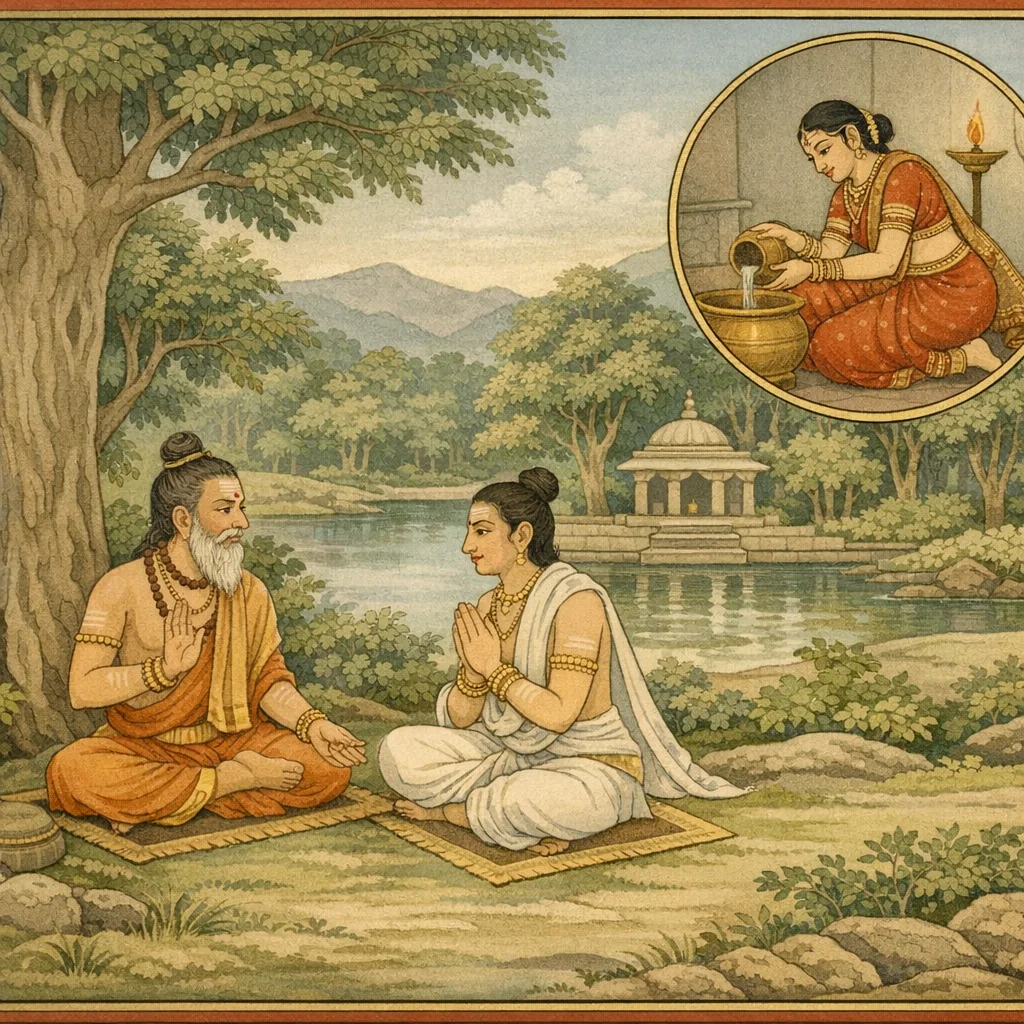
Chapter 7 sets forth a technical liturgical template for worship of Śiva at pradoṣa (the twilight hour). In response to a Brahmin woman’s question, Śāṇḍilya teaches the rite, with Sūta presenting the lineage of transmission. It begins with preparatory disciplines: fasting on the 13th day of the fortnight, bathing before sunset, maintaining purity, and restraining speech. The chapter then details the ritual’s construction—cleansing the worship space, drawing the maṇḍala, arranging implements, invoking the pīṭha, and performing ātmā-śuddhi and bhūta-śuddhi, prāṇāyāma, mātṛkā-nyāsa, and deity visualization. It gives dhyāna descriptions of Śiva in Candrasekhara form and of Pārvatī, and maps āvaraṇa-pūjā directionally with attendant powers, deities, siddhis, and protective figures. Next come the upacāras: abhiṣeka with pañcāmṛta and tīrtha waters with Rudra-sūkta recitation, offerings of flowers (including bilva), incense, lamp, naivedya, homa, and concluding prayers for release from debt, sin, poverty, illness, and fear. The chapter closes with a phala-assertion that Śiva pūjā nullifies extensive wrongdoing, warns of the grave sin of misappropriating Śiva’s property, and recounts the devotees’ tangible success—culminating in the discovery of treasure and further boons—presenting ritual discipline as both ethical rule and means of liberation.
Shlokas
Verse 1
सूत उवाच । इत्युक्ता मुनिना साध्वी सा विप्रवनिता पुनः । तं प्रणम्याथ पप्रच्छ शिवपूजाविधेः क्रमम्
Sūta said: Thus addressed by the sage, that virtuous brāhmaṇa woman again bowed to him and then asked about the step-by-step procedure for Śiva worship.
Verse 2
शांडिल्य उवाच । पक्षद्वये त्रयोदश्यां निराहारो भवेद्यदा । घटीत्रयादस्तमयात्पूर्वं स्नानं समाचरेत्
Śāṇḍilya said: On the thirteenth lunar day of either fortnight, when one undertakes fasting, one should perform bathing three ghaṭīs (about seventy-two minutes) before sunset.
Verse 3
शुक्लांबरधरो धीरो वाग्यतो नियमान्वितः । कृतसंध्याजपविधिः शिवपूजां समारभेत्
Clad in white garments, steady and restrained in speech, established in observances, and having duly completed Sandhyā and japa, one should begin the worship of Śiva.
Verse 4
देवस्य पुरतः सम्यगुपलिप्य नवांभसा । विधाय मंडलं रम्यं धौतवस्त्रादिभिर्बुधः
Before the deity, the wise devotee should properly anoint and cleanse the place with fresh water, and then fashion a beautiful maṇḍala using washed cloth and other pure items.
Verse 5
वितानाद्यैरलंकृत्य फलपुष्पनवांकुरैः । विचित्रपद्ममुद्धृत्य वर्णपंचकसंयुतम्
Adorning it with canopies and the like—with fruits, flowers, and fresh sprouts—one should set forth a wondrous lotus design, furnished with the fivefold colors.
Verse 6
तत्रोपविश्य सुशुभे भक्तियुक्तः स्थिरासने । सम्यक्संपादिताशेष पूजोपकरणः शुचिः
Seated there upon a beautiful, steady seat, endowed with devotion, pure, and having properly arranged all the requisites of worship, one should proceed in readiness.
Verse 7
आगमोक्तेन मंत्रेण पीठमामंत्रयेत्सुधीः । ततः कृत्वात्मशुद्धिं च भूतशुद्ध्यादिकं क्रमात्
With a mantra taught in the Āgamas, the wise practitioner should invoke the sacred seat (pīṭha). Then, in due order, he should perform self-purification and the rites beginning with bhūtaśuddhi, the purification of the elements.
Verse 8
प्राणायामत्रयं कृत्वा बीजवर्णैः सबिंदुकैः । मातृका न्यस्य विधिवद्ध्यात्वा तां देवतां पराम्
Having performed the threefold regulation of breath (prāṇāyāma), and employing the seed-syllables (bīja) together with their nasal bindu, one should duly place the Mātr̥kā letters upon the body by nyāsa; then, according to rule, one should meditate upon that supreme Deity.
Verse 9
समाप्य मातृका भूयो ध्यात्वा चैव परं शिवम् । वामभागे गुरुं नत्वा दक्षिणे गणपं नमेत्
After completing the Mātr̥kā-nyāsa, one should again meditate upon the Supreme Śiva. Then, bowing to the Guru on the left side, one should pay reverence to Gaṇapa (Gaṇeśa) on the right.
Verse 10
अंसोरुयुग्मे धर्मादीन्न्यस्य नाभौ च पार्श्वयोः । अधर्मादीननंतादीन्हृदि पीठे मनुं न्यसेत्
Upon the pair of shoulders and thighs, having placed Dharma and the rest; and at the navel and the sides, having placed Adharma and the rest, and Ananta and the rest—one should place the mantra (manu) upon the heart-seat (pīṭha).
Verse 11
आधारशक्तिमारभ्य ज्ञानात्मानमनुक्रमात् । उक्तक्रमेण विन्यस्य हृत्पद्मे साधुभाविते
Beginning with Ādhāra-Śakti and proceeding in due order up to the very principle of Knowledge, one should arrange the placements in the stated sequence within the heart-lotus that has been well cultivated by practice.
Verse 12
नवशक्तिमये रम्ये ध्यायेद्देवमुमापतिम् । चन्द्रकोटिप्रतीकाशं त्रिनेत्रं चन्द्रशेखरम्
In that delightful inner realm made of nine powers, one should meditate upon the Lord, Umāpati—radiant like ten million moons, the Three-Eyed One, the Moon-crested (Candraśekhara).
Verse 13
आपिंगलजटाजूटं रत्नमौलिविराजितम् । नीलग्रीवमुदारांगं नागहारोपशोभितम्
Meditate on Him whose tawny matted locks are gathered in a crest, whose diadem shines with jewels; whose throat is blue, whose form is noble, and who is adorned with a garland of serpents.
Verse 14
वरदाभयहस्तं च धारिणं च परश्वधम् । दधानं नागवलयकेयूरांगदमुद्रिकम्
He bears hands granting boons and fearlessness, and He holds the axe; He wears serpent-bracelets, armlets, upper-arm ornaments, and rings.
Verse 15
व्याघ्रचर्मपरीधानं रत्नसिंहासने स्थितम् । ध्यात्वा तद्वाम भागे च चिंतयेद्गिरिकन्यकाम्
Meditating on Him clad in tiger-skin and seated upon a jeweled throne, one should then contemplate, on His left side, the Daughter of the Mountain (Pārvatī).
Verse 16
भास्वज्जपाप्रसूनाभामुदयार्कसमप्रभाम् । विद्युत्पुंजनिभां तन्वीं मनोनयननंदिनीम्
One should contemplate the slender Goddess—shining like the radiant hibiscus blossom, glowing like the rising sun, like a mass of lightning, delighting both mind and eyes.
Verse 17
बालेंदु शेखरां स्निग्धां नीलकुंचितकुन्तलाम् । भृंगसंघातरुचिरां नीलालकविराजिताम्
Contemplate Her who bears the crescent moon as a crest, who is lustrous, with dark curling hair—charming like a swarm of bees—and radiant with deep-blue tresses.
Verse 18
मणिकुंडलविद्योतन्मुखमंडलविभ्रमाम् । नवकुम्कुमपंकांक कपोलदलदर्पणाम्
Her face shone with the radiance of gem-studded earrings, and her cheeks—like mirror-like petals—were marked with the fresh, crimson paste of new kuṅkuma.
Verse 19
मधुरस्मितविभ्राजदरुणाधरपल्लवाम् । कंबुकंठीं शिवामुद्यत्कुचपंकजकुड्मलाम्
Her sweet smile made her red lips glow like tender shoots; her neck was like a conch, and that auspicious Śivā bore uplifted breasts like budding lotuses.
Verse 20
पाशांकुशाभयाभीष्टविल सत्सु चतुर्भुजाम् । अनेकरत्नविलसत्कंकणांकितमुद्रिकाम्
She was four-armed, playfully bearing the noose, the goad, the gesture of fearlessness, and the boon-bestowing sign; her hands were adorned with bracelets and rings that glittered with many jewels.
Verse 21
वलित्रयेण विलसद्धेमकांचीगुणान्विताम् । रक्तमाल्यांबरधरां दिव्यचंदनच र्चिताम्
Adorned with the three graceful folds and a shining golden girdle-string, she wore red garlands and red garments, and was anointed with divine sandalpaste.
Verse 22
सर्वसंगीतविद्यासु न मत्तोऽन्यास्ति काचन । मम योगेन तुष्यंति सर्वा अपि सुरस्त्रियः
In all the sciences of music there is none other like me; by the power of my yogic mastery, all the wives of the gods are delighted.
Verse 23
एवं ध्यात्वा महादेवं देवीं च गिरि कन्यकाम् । न्यासक्रमेण संपूज्य देवं गंधादिभिः क्रमात्
Thus, having meditated on Mahādeva and on the Goddess, the Daughter of the Mountain, one should worship the Deity in proper order—performing nyāsa as prescribed, and then offering sandal and the other upacāras step by step.
Verse 24
पंचभिर्ब्रह्मभिः कुर्यात्प्रोक्तस्थानेषु वा हृदि । पृथक्पुष्पांजलिं देहे मूलेन च हदि त्रिधा
With the five Brahmā-mantras one should perform the rite in the stated places—or within the heart. In the body, one should offer separate handfuls of flowers; and with the root-mantra, within the heart, one should make the offering threefold.
Verse 25
पुनः स्वयं शिवो भूत्वा मूलमंत्रेण साधकः । ततः संपूजयेद्देवं बाह्यपीठे पुनः क्रमात्
Then again, the practitioner—becoming Śiva himself through the root-mantra—should thereafter worship the Deity once more, in due order, upon the external seat (altar).
Verse 26
संकल्पं प्रवदेत्तत्र पूजारंभे समाहितः । कृतांजलिपुटो भूत्वा चिंतयेद्धृदि शंकरम्
At the beginning of the worship, composed and attentive, one should declare the saṅkalpa; then, with palms joined in reverence, one should contemplate Śaṅkara within the heart.
Verse 27
ऋणपातकदौर्भाग्यदारिद्र्यविनिवृत्तये । अशेषाघविनाशाय प्रसीद मम शंकर
For the removal of debt, sin, ill-fortune, and poverty—and for the destruction of all wrongdoing—be gracious to me, O Śaṅkara.
Verse 28
दुःखशोकाग्निसंतप्तं संसारभयपीडितम् । बहुरोगाकुलं दीनं त्राहि मां वृषवाहन
Burnt by the fire of sorrow and grief, tormented by fear of saṃsāra, afflicted by many diseases and utterly helpless—save me, O Rider of the Bull (Śiva).
Verse 29
आगच्छ देवदेवेश महादेवाभयंकर । गृहाण सह पार्वत्या तव पूजां मया कृताम्
Come, O Lord of lords, O Mahādeva who bestows fearlessness. Accept—together with Pārvatī—the worship I have performed for You.
Verse 30
इति संकल्प्य विधिवद्ब्राह्मपूजां समाचरेत् । गुरुं गणपतिं चैव यजेत्सव्यापसव्ययोः
Having thus made the resolve (saṅkalpa), one should duly perform the brāhma-pūjā. One should also worship the Guru and Gaṇapati—on the right and left sides, in proper order.
Verse 31
क्षेत्रेशमीशकोणे तु यजेद्वास्तोष्पतिं क्रमात् । वाग्देवीं च यजेत्तत्र ततः कात्यायनीं यजेत्
In the Īśāna corner, one should worship Kṣetreśa; thereafter, in due sequence, one should worship the Lord of the Vāstu. There, one should also worship the Goddess of Speech, and then worship Kātyāyanī.
Verse 32
धर्मं ज्ञानं च वैराग्यमैश्वर्यं च नमोंऽतकैः । स्वरैरीशादिकोणेषु पीठपादाननुक्रमात् । आभ्यां बिंदुविसर्गाभ्यामधर्मादीन्प्रपूजयेत्
With the ‘namo’ syllables and the vowels, one should worship Dharma, Knowledge, Dispassion (Vairāgya), and Sovereignty (Aiśvarya), placing them in the Īśāna and other corners according to the sequence of the pīṭha and its quarters. By the two signs, bindu and visarga, one should duly worship Adharma and the rest (their opposites).
Verse 33
सत्त्वरूपैश्चतुर्दिक्षु मध्येऽनंतं सतारकम् । सत्त्वादींस्त्रिगुणांस्तं तु रूपान्पीठेषु विन्यसेत्
In the four directions one should place the forms of Sattva; and in the center, Ananta together with the tāraka. Then, upon the pīṭhas, one should install the forms constituted by the three guṇas, beginning with Sattva.
Verse 34
अत ऊर्ध्वच्छदे मायां सह लक्ष्म्या शिवेन च
Above that, on the upper covering, one should place Māyā together with Lakṣmī and Śiva.
Verse 35
तदंते चांबुजं भूयः सकलं मंडलत्रयम् । पत्रकेसरकिंजल्कव्याप्तं ताराक्षरैः क्रमात्
At its end, one should again form a lotus comprising the complete set of the three maṇḍalas, its petals, filaments, and pollen pervaded in order by the tāraka-syllables.
Verse 36
पद्मत्रयं तथाभ्यर्च्य मध्ये मंडलमादरात् । वामां ज्येष्ठां च रौद्रीं च भागाद्यैर्दिक्षु पूजयेत्
Having thus worshipped the three lotuses, one should reverently worship the maṇḍala at the center. In the directions, one should worship Vāmā, Jyeṣṭhā, and Raudrī, using the divisions beginning with Bhāga as the prescribed identifiers.
Verse 37
वामाद्या नव शक्तीश्च नवस्वरयुता यजेत् । हृदि बीजत्रयाद्येन पीठमंत्रेण चार्चयेत्
Beginning with Vāmā, one should worship the nine Śaktis, joined with the nine vowels. In the heart (center), one should worship with the pīṭha-mantra, beginning with the three seed-syllables (bīja).
Verse 38
आवृत्तैः प्रथमांगैश्च पंचभिर्मूर्त्तिशक्तिभिः । त्रिशक्तिमूर्त्तिभिश्चान्यैर्निधिद्वयसमन्वितैः
He (Sadāśiva) is to be worshipped as encompassed by the first enclosing circles: by the five powers manifesting as divine forms, and by other form-powers endowed with three energies, together with the pair of treasures (nidhis).
Verse 39
अनंताद्यैः परीताश्च मातृभिश्च वृषादिभिः । सिद्धिभिश्चाणिमाद्याभिरिंद्राद्यैश्च सहायुधैः
He is to be envisioned as surrounded by Ananta and the rest, by the Mother-goddesses, by Vṛṣa and others, by the siddhis beginning with Aṇimā, and by Indra and the other gods, together with their weapons.
Verse 40
वृषभक्षेत्रचंडेशदुर्गाश्च स्कंदनंदिनौ । गणेशः सैन्यपश्चैव स्वस्वलक्षणलक्षिताः
Vṛṣabha, Kṣetrapāla, Caṇḍeśa, and Durgā; Skanda and Nandin; Gaṇeśa and the commander of the forces as well—each is to be installed and worshipped with their own distinct emblems and characteristics.
Verse 41
अणिमा महिमा चैव गरिमा लघिमा तथा । ईशित्वं च वशित्वं च प्राप्तिः प्राकाम्यमेव च
Aṇimā and Mahimā, Garimā and Laghimā; Īśitva and Vaśitva; Prāpti and Prākāmya as well—these are the eight siddhis to be contemplated.
Verse 42
अष्टैश्वर्याणि चोक्तानि तेजोरूपाणि केवलम् । पंचभिर्ब्रह्मभिः पूर्वं हृल्लेखाद्यादिभिः क्रमात
Thus the eight sovereign powers (aiśvaryas) are declared—nothing but radiant forms. Before them, in due order, come the five Brahmās beginning with Hṛllekha and the rest.
Verse 43
अंगैरुमाद्यैरिंद्राद्यैः पूजोक्ता मुनिभिस्तु तैः । उमाचंडेश्वरादींश्च पूजयेदुत्तरादितः
This worship has been taught by those sages—through the divine limbs beginning with Umā and through the deities beginning with Indra. Thereafter, in the succeeding order, one should worship Umā, Caṇḍeśvara, and the others.
Verse 44
एवमावरणैर्युक्तं तेजोरूपं सदाशिवम् । उमया सहितं देवमुपचारैः प्रपूजयेत्
Thus, having arranged the enclosures (āvaraṇas), one should worship Sadāśiva—whose form is pure radiance—together with Umā, honoring the Lord with the full set of ritual services (upacāras).
Verse 45
सुप्रतिष्ठितशंखस्य तीर्थैः पंचामृतैरपि । अभिषिच्य महादेवं रुद्रसूक्तैः समाहितः
With water from sacred tīrthas and also with the five nectars (pañcāmṛta), poured through a well-established conch, one should perform abhiṣeka for Mahādeva, steadfastly attentive while reciting the Rudra-sūktas.
Verse 46
कल्पयेद्विविधैर्मंत्रैरासनाद्युपचारकान् । आसनं कल्पयेद्धैमं दिव्यवस्त्रसमन्वितम्
Using various mantras, one should duly prepare the ritual services (upacāras) beginning with the seat (āsana). One should arrange a golden seat, adorned with splendid cloth.
Verse 47
अर्घ्यमष्टगुणोपेतं पाद्यशुद्धोदकेन च । तेनैवाचमनं दद्यान्मधुपर्कं मधूत्तरम्
One should offer arghya endowed with eight auspicious constituents, along with pādya of purified water. With that same water one should give ācāmana, and then offer madhuparka, made excellent with honey.
Verse 48
पुनराचमनं दत्त्वा स्नानं मंत्रै प्रकल्पयेत् । उपवीतं तथा वासो भूषणानि निवेदयेत् । गंधमष्टांगसंयुक्तं सुपूतं विनिवेदयेत्
After offering ācamana once again, one should arrange the ritual bath with mantras. Then one should present the sacred thread, garments, and ornaments, and offer a well-purified fragrance compounded with the eight auspicious ingredients.
Verse 49
ततश्च बिल्वमंदारकह्लारसरसीरुहम् । धत्तूरकं कर्णिकारं शणपुष्पं च मल्लिकाम्
Thereafter one should offer bilva leaves, mandāra blossoms, kahlāra and lotus from the lake, as well as dhattūra, karṇikāra, śaṇa-flowers, and mallikā (jasmine).
Verse 50
कुशापामार्गतुलसीमाधवीचंपकादिकम् । बृहतीकरवीराणि यथालब्धानि साधकः
The practitioner should offer, as available, kuśa grass, apāmārga, tulasī, mādhavī, campaka and the like, along with bṛhatī and karavīra—whatever can be obtained.
Verse 51
निवेदयेत्सुगंधीनि माल्यानि विविधानि च । धूपं कालागरूत्पन्नं दीपं च विमलं शुभम्
One should offer many kinds of fragrant garlands, incense prepared from black aloe-wood (kālāguru), and a pure, auspicious lamp.
Verse 52
विशेषकम् । अथ पायसनैवेद्यं सघृतं सोपदंशकम् । मोदकापूपसंयुक्तं शर्करागुडसंयुतम्
As a special offering, one should present sweet pāyasa as naivedya, along with ghee and accompanying delicacies—together with modakas and āpūpas, flavored with sugar and jaggery.
Verse 53
मधुनाक्तं दधियुतं जलपानसमन्वितम् । तेनैव हविषा वह्नौ जुहुयान्मंत्रभाविते
Smeared with honey, mixed with curd, and accompanied by drinking-water, with that very oblation one should offer into the sacred fire—consecrated by mantra.
Verse 54
आगमोक्तेन विधिना गुरुवाक्यनियंत्रितः । नैवेद्यं शंभवे भूयो दत्त्वा तांबूलमुत्तमम्
Restrained and guided by the guru’s instruction, following the method taught in the Āgamas, one should again offer naivedya to Śambhu and then present excellent tāmbūla (betel).
Verse 55
धूपं नीराजनं रम्यं छत्रं दर्पणमुत्तमम् । समर्पयित्वा विधिवन्मंत्रैर्वेदिकतांत्रिकैः
Having duly offered incense, delightful nīrājana (waving of lights), a parasol, and an excellent mirror, one should perform the rite properly with Vaidic and Tantric mantras.
Verse 56
यद्यशक्तः स्वयं निःस्वो यथाविभवमर्चयेत् । भक्त्त्या दत्तेन गौरीशः पुष्पमात्रेण तुष्यति
If one is unable and personally poor, let one worship according to one’s means. Gaurī’s Lord is pleased by what is offered with devotion—even by a single flower.
Verse 57
अथांगभूतान्सकलान्गणेशादीन्प्रपूजयेत् । स्तवैर्नानाविधैः स्तुत्वा साष्टांगं प्रणमेद्बुधः
Then one should duly worship all the attendant limbs and members (of the rite), beginning with Gaṇeśa. Having praised them with many kinds of hymns, the wise devotee should bow down with full prostration.
Verse 58
ततः प्रदक्षिणीकृत्य वृषचंडेश्वरादिकान् । पूजां समर्प्य विधिवत्प्रार्थयेद्गिरिजापतिम्
Thereafter, having circumambulated Vṛṣa, Caṇḍeśvara, and the other attendants of Śiva, and having duly offered worship according to rite, one should then pray to Girijā-pati, the Lord of Pārvatī.
Verse 59
जय देव जगन्नाथ जय शंकर शाश्वत । जय सर्व सुराध्यक्ष जय सर्वसुरार्चित
Victory to You, O God, Lord of the universe! Victory to You, O Śaṅkara, the Eternal! Victory to You, ruler of all the gods! Victory to You, worshipped by all the deities!
Verse 60
जय सर्वगुणातीत जय सर्ववरप्रद । जय नित्य निराधार जय विश्वंभराव्यय
Victory to You, who transcend all qualities! Victory to You, bestower of every boon! Victory to You, the Everlasting, needing no support! Victory to You, sustainer of the universe, the Imperishable!
Verse 61
जय विश्वैकवेद्येश जय नागेंद्रभूषण । जय गौरीपते शंभो जय चंद्रार्धशेखर
Victory to You, O Lord, knowable as the one Reality of the universe! Victory to You, adorned with the king of serpents! Victory to You, O Śambhu, Lord of Gaurī! Victory to You, whose crest bears the half-moon!
Verse 62
जय कोट्यर्कसंकाश जयानंतगुणाश्रय
Victory to You, radiant like ten million suns! Victory to You, the very abode of infinite excellences!
Verse 63
जय रुद्र विरूपाक्ष जयाचिंत्य निरंजन । जय नाथ कृपासिंधो जय भक्तार्तिभञ्जन । जय दुस्तरसंसारसागरोत्तारण प्रभो
Victory to You, O Rudra, Wide-Eyed Lord! Victory to You, the Inconceivable, the Stainless! Victory to You, O Nātha, ocean of compassion! Victory to You, remover of devotees’ distress! Victory to You, O Lord, who ferries beings across the hard-to-cross ocean of saṃsāra!
Verse 64
प्रसीद मे महादेव संसारार्त्तस्य खिद्यतः । सर्वपापभयं हृत्वा रक्ष मां परमेश्वर
Be gracious to me, O Mahādeva; I am afflicted by saṃsāra and worn with sorrow. Taking away the fear born of all sins, protect me, O Supreme Lord!
Verse 65
महादारिद्र्यमग्नस्य महापापहतस्य च । महाशोकविनष्टस्य महारोगातुरस्य च
(Be gracious) to one sunk in great poverty, and to one struck down by grievous sin; to one ruined by overwhelming sorrow, and to one afflicted by terrible disease.
Verse 66
ऋणभारपरीतस्य दह्यमानस्य कर्मभिः । ग्रहैः प्रपीड्यमानस्य प्रसीद मम शंकर
Be gracious to me, O Śaṅkara—overwhelmed by the burden of debts, scorched by the fruits of my actions, and tormented by the (adverse) planets.
Verse 67
दरिद्रः प्रार्थयेदेवं पूजांते गिरिजापतिम् । अर्थाढ्यो वापि राजा वा प्रार्थयेद्देवमीश्वरम्
Thus, at the conclusion of worship, let the poor person pray to Girijā-pati in this manner; and likewise, whether one is wealthy or even a king, one should pray to the Lord, the Supreme Ruler.
Verse 68
दीर्घमायुः सदारोग्यं कोशवृद्धिर्बलोन्नतिः । ममास्तु नित्यमानन्दः प्रसादात्तव शंकर
By your grace, O Śaṅkara, may I attain long life, unbroken health, increase of wealth, and rising strength; and may constant bliss ever abide within me.
Verse 69
शत्रवः संक्षयं यांतु प्रसीदन्तु मम ग्रहाः । नश्यन्तु दस्यवो राष्ट्रे जनाः संतु निरापदः
May enemies fall to ruin; may the grahas become favorable to me; may robbers perish within the realm; and may the people remain free from danger.
Verse 70
दुर्भिक्षमारीसंतापाः शमं यांतु महीतले । सर्वसस्यसमृद्धिश्च भूयात्सुखमया दिशः
May famine, epidemics, and afflictions be pacified upon the earth; may every crop abound; and may all directions be filled with well-being.
Verse 71
एवमाराधयेद्देवं प्रदोषे गिरिजापतिम् । ब्राह्मणान्भोजयेत्पश्चाद्दक्षिणाभिश्च तोषयेत्
Thus should one worship the Lord, the consort of Girijā, at the time of Pradoṣa; afterward one should feed the brāhmaṇas and satisfy them with gifts (dakṣiṇā).
Verse 72
सर्वपापक्षयकरी सर्वदारिद्र्यनाशिनी । शिवपूजा मया ख्याता सर्वाभीष्टवरप्रदा
This Śiva-pūjā, as proclaimed by me, destroys all sins, removes every form of poverty, and grants all desired boons.
Verse 73
महापातकसंघातमधिकं चोपपातकम् । शिवद्रव्यापहरणादन्यत्सर्वं निवारयेत्
Even a heap of great sins, and even subsidiary sins besides, can be warded off—everything except the theft of Śiva’s property.
Verse 74
ब्रह्महत्यादिपापानां पुराणेषु स्मृतिष्वपि । प्रायश्चित्तानि दृष्टानि न शिवद्रव्यहारिणाम्
For sins such as brahmahatyā, expiations are indeed seen in the Purāṇas and the Smṛtis; but for those who steal Śiva’s property, none are found.
Verse 75
बहुनात्र किमुक्तेन श्लोकार्धेन ब्रवीम्यहम् । ब्रह्महत्याशतं वापि शिवपूजा विनाशयेत्
What need is there to say much? I state it in half a verse: Śiva worship can destroy even a hundred acts of brahmahatyā.
Verse 76
मया कथितमेतत्ते प्रदोषे शिवपूजनम् । रहस्यं सर्वजंतूनामत्र नास्त्येव संशयः
I have told you this: the worship of Śiva at Pradoṣa is a secret, a most potent teaching for all beings—of this there is no doubt.
Verse 77
एताभ्यामपि बालाभ्यामेवं पूजा विधीयताम् । अतः संवत्सरादेव परां सिद्धिमवाप्स्यथ
Let this worship be performed in this very way even by these two young ones; by this, within a year itself, you will attain the highest accomplishment (siddhi).
Verse 78
इति शांडिल्यवचनमाकर्ण्य द्विजभामिनी । ताभ्यां तु सह बालाभ्यां प्रणनाम मुनेः पदम्
Hearing Śāṇḍilya’s words, the brāhmaṇa lady—together with the two boys—bowed in reverence at the sage’s feet.
Verse 79
विप्रस्त्र्युवाच । अहमद्य कृतार्थास्मि तव दर्शनमात्रतः । एतौ कुमारौ भगवंस्त्वामेव शरणं गतौ
The brāhmaṇa woman said: “Today I am fulfilled merely by your darśana. O Blessed One, these two boys have come to you alone for refuge.”
Verse 80
एष मे तनयो ब्रह्मञ्छुचिव्रत इतीरितः । एष राजसुतो नाम्ना धर्मगुप्तः कृतो मया
“This is my son, O Brahman; he is known as Śucivrata, of pure vow. And this is the prince, whom I have named Dharmagupta.”
Verse 81
एतावहं च भगवन्भवच्चरणकिंकराः । समुद्धरास्मिन्पतितान्घोरे दारिद्र्यसागरे
“These two and I, O Blessed One, are servants at your feet. Lift us up, who have fallen into this dreadful ocean of poverty.”
Verse 82
इति प्रपन्नां शरणं द्विजांगनामाश्वास्य वाक्यैरमृतोपमानैः । उपादिदेशाथ तयोः कुमारयोर्मुनिः शिवाराधनमंत्र विद्याम्
Thus, comforting the brāhmaṇa lady who had taken refuge with nectar-like words, the sage then instructed the two boys in the sacred mantra-knowledge for the worship of Śiva.
Verse 83
अथोपदिष्टौ मुनिना कुमारौ ब्राह्मणी च सा । तं प्रणम्य समामंत्र्य जग्मुस्ते शिवमंदिरात्
Then, after the sage had instructed the two boys and that brāhmaṇa woman, they bowed to him, took leave with reverence, and went on to Śiva’s temple.
Verse 84
ततः प्रभृति तौ बालौ मुनिवर्योपदेशतः । प्रदोषे पार्वतीशस्य पूजां चक्रतुरंजसा
From that time onward, those two boys—following the excellent sage’s instruction—readily performed the worship of Pārvatī’s Lord at pradoṣa time.
Verse 85
एवं पूजयतोर्देवं द्विजराजकुमारयोः । सुखेनैव व्यतीयाय तयोर्मासचतुष्टयम्
As the brāhmaṇa’s son and the prince thus worshipped the Lord, four months passed for them in ease and well-being.
Verse 86
कदाचिद्राजपुत्रेण विनासौ द्विजनंदनः । स्नातुं गतो नदीतीरे चचार बहुलीलया
Once, that brāhmaṇa boy—without the prince—went to bathe at the riverbank and wandered about there with great playfulness.
Verse 87
तत्र निर्झरनिर्घातनिर्भिन्ने वप्र कुट्टिमे । निधानकलशं स्थूलं प्रस्फुरंतं ददर्श ह
There, in the stonework of a mound broken open by the pounding of a waterfall, he saw a large treasure-jar, gleaming brightly.
Verse 88
तं दृष्ट्वा सहसागत्य हर्षकौतुकविह्वलः । दैवोपपन्नं मन्वानो गृहीत्वा शिरसा ययौ
Seeing it, he rushed forward at once, overwhelmed with joy and wonder. Taking it to be a heaven-sent gift, he reverently lifted it upon his head and carried it away.
Verse 89
ससंभ्रमं समानीय निधाय कलशं बलात् । निधाय भवनस्यांते मातरं समभाषत
In great excitement he brought it quickly and, with effort, set the pot down. Placing it at the edge of the house, he then spoke to his mother.
Verse 90
मातर्मातरिमं पश्य प्रसादं गिरिजापतेः । निधानं कुम्भरूपेण दर्शितं करुणात्मना
“Mother, mother—look at this grace of the Lord of Girijā (Śiva)! Out of compassion he has revealed a treasure, appearing in the form of a pot.”
Verse 91
अथ सा विस्मिता साध्वी समाहूय नृपात्मजम् । स्वपुत्रं प्रतिनंद्याह मानयन्ती शिवार्चनम्
Then that virtuous lady, astonished, called the king’s son to her. Blessing her own child, she spoke, honoring the worship of Śiva.
Verse 92
शृणुतां मे वचः पुत्रौ निधानकलशीमिमाम् । समं विभज्य गृह्णीतं मम शासनगौरवात्
“Sons, listen to my words: divide this treasure-pot equally and accept it, honoring the weight of my instruction.”
Verse 93
इति मातुर्वचः श्रुत्वा तुतोष द्विज नंदनः । प्रत्याह राजपुत्रस्तां विस्रब्धः शंकरार्चने
Hearing his mother’s words, the Brahmin’s son was pleased. Then the prince replied to her, with calm confidence grounded in the worship of Śaṅkara.
Verse 94
मातस्तव सुतस्यैव सुकृतेन समागतम् । नाहं ग्रहीतुमिच्छामि विभक्तं धनसंच यम्
“Mother, this has come solely through the merit of your own son. I do not wish to take any divided share of this accumulated wealth.”
Verse 95
आत्मनः सुकृताल्लब्धं स्वयमेव भुनक्त्वसौ । स एव भगवानीशः करिष्यति कृपां मयि
“Let him himself enjoy what he has obtained through his own merit. That very Lord, Bhagavān Īśa, will surely show compassion to me as well.”
Verse 96
एवमर्चयतोः शंभुं भूयोपि परया मुदा । संवत्सरो व्यतीयाय तस्मिन्नेव गृहे तयोः
Thus, as the two continued worshipping Śambhu again and again with supreme joy, a full year passed for them in that very house.
Verse 97
अथैकदा राजसूनुः सह तेन द्विजन्मना । वसंतसमये प्राप्ते विजहार वनां तरे
Then one day, when the spring season had arrived, the king’s son went out to enjoy himself in the forest, together with that twice-born companion.
Verse 98
अथ दूरं गतौ क्वापि वने द्विजनृपात्मजौ । गन्धर्वकन्याः क्रीडंती शतशस्तावपश्यताम्
Then, having gone far away to a place in the forest, the brāhmaṇa’s son and the prince’s son beheld hundreds of Gandharva maidens sporting there.
Verse 99
ताः सर्वाश्चारुसर्वांग्यो विहरंत्यो मनोहरम् । दृष्ट्वा द्विजात्मजो दूरादुवाच नृपनंदनम्
Seeing them all—lovely, well-formed, and delightfully sporting—the brāhmaṇa’s son spoke from a distance to the prince.
Verse 100
इतः पुरो न गंतव्यं विहरंत्यग्रतः स्त्रियः । स्त्रीसंन्निधानं विबुधास्त्यजंति विमलाशयाः
“We should not go forward from here, for women are sporting ahead. The wise, whose intentions are pure, avoid the close company of women.”
Verse 110
तत्र गत्वा वनं सर्वाः संचीय कुसुमोत्करम् । भवत्यः पुनरायांतु तावत्तिष्ठाम्यहं त्विह
“Go there into the forest, all of you, and gather heaps of flowers. Then return again; until then, I shall remain here.”
Verse 120
अस्त्येको द्रविकोनाम गंधर्वाणां कुलाग्रणीः । तस्याहमस्मि तनया नाम्ना चांशुमती स्मृता
“There is one named Dravika, a foremost leader among the Gandharvas. I am his daughter, remembered by the name Aṃśumatī.”
Verse 130
गच्छ स्वभवनं कांत परश्वः प्रातरेव तु । आगच्छ पुनरत्रैव कार्यमस्ति च नो मृषा
“Go to your own home, beloved; but the day after tomorrow, at dawn itself, come back here again. Truly we have a task to accomplish—this is no falsehood.”
Verse 140
तस्य त्वमपि साहाय्यं कुरु गन्धर्वसत्तम । अथासौ निजराज्यस्थो हतशत्रुर्भविष्यति
“You too, O best of Gandharvas, give him your assistance. Then he will be established in his own kingdom, with his enemies destroyed.”
Verse 150
अस्त्राणां च सहस्राणि तूणी चाक्षय्यसायकौ । अभेद्यं वर्म सौवर्णं शक्तिं च रिपुमर्दिनीम्
“[He received] thousands of weapons; two quivers with inexhaustible arrows; an impenetrable golden armor; and a spear that crushes enemies.”
Verse 160
एवमन्ये समाराध्य प्रदोषे गिरिजापतिम् । लभंतेभीप्सितान्कामान्देहांते तु परां गतिम्
Thus others too—having duly worshipped the Lord of Girijā (Śiva) at Pradoṣa—obtain their desired wishes; and at the end of the body, they attain the supreme goal.
Verse 164
ये प्राप्य दुर्लभतरं मनुजाः शरीरं कुर्वंति हंत परमेश्वरपादपूजाम् । धन्यास्त एव निजपुण्यजितत्रिलोकास्तेषां पदांबुजरजो भुवनं पुनाति
Those humans who, having obtained this exceedingly rare human body, alas, perform worship at the feet of the Supreme Lord—blessed indeed are they. By their own merit they have conquered the three worlds; the dust of the lotus-feet of such devotees purifies the entire world.