Adhyaya 2
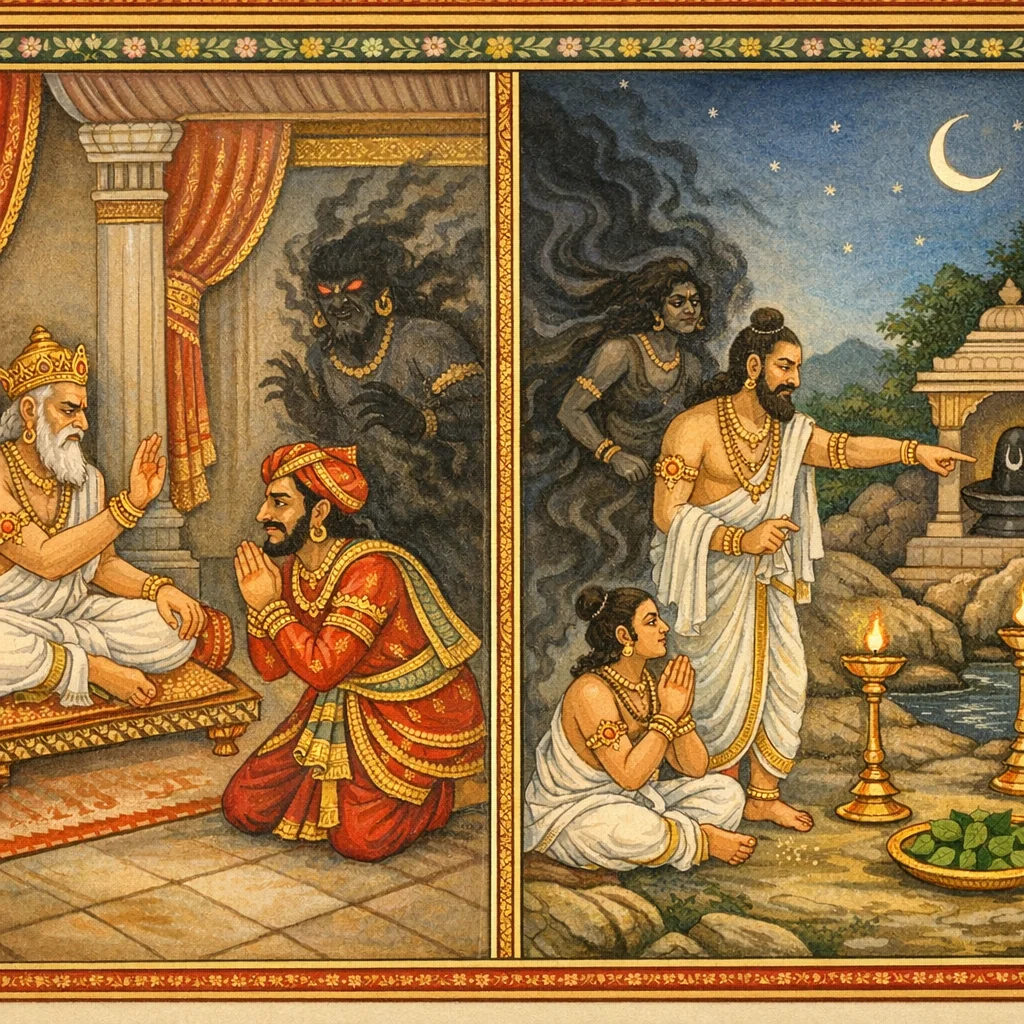
The chapter begins with Sūta’s theological teaching that worship of Śiva has the highest power to purify, serving as the supreme prāyaścitta even for sins deemed persistent and hard to remove. It then praises the Māgha kṛṣṇa caturdaśī observance—fasting (upavāsa), night vigil (jāgaraṇa), darśana of the Śiva-liṅga, and especially offering bilva leaves—declaring its merit comparable to, or greater than, grand sacrifices and long years of bathing at tīrthas. A narrative exemplum follows: a righteous king of the Ikṣvāku line (later called Kalmaṣāṅghri) unknowingly appoints a rākṣasa in disguise, leading to an offense against Vasiṣṭha and a time-bound curse that turns the king into a rākṣasa. In that state he commits a dreadful act (devouring a sage’s son); the bereaved wife utters a powerful śāpa restricting his future conjugal life, and the king is pursued by the personified Brahmahatyā. Seeking release, he wanders through many tīrthas without finding purification until he meets Gautama, who teaches that Gokarṇa is a uniquely efficacious kṣetra: mere entry and darśana can bring immediate cleansing, and rites performed there yield results surpassing what is gained elsewhere over vast spans of time. Thus the chapter binds karma, curse, and repentance to a geography of remedy (Gokarṇa) and to the Śaiva system of vrata and pūjā.
Shlokas
Verse 1
सूत उवाच । अथान्यदपि वक्ष्यामि माहात्म्यं त्रिपुरद्विषः । श्रुतमात्रेण येनाशु च्छिद्यंते सर्वसंशयाः
Sūta said: Now I shall also proclaim another glory (māhātmya) of the Slayer of Tripura, Śiva—by merely hearing it, all doubts are swiftly cut away.
Verse 2
अतः परतरं नास्ति किंचित्पापविशोधनम् । सर्वानंदकरं श्रीमत्सर्वकामार्थसाधम्
Nothing higher than this exists as a purifier of sin. It brings all joy, is auspicious and glorious, and fulfills every desired aim.
Verse 3
दीर्घायुर्विजयारोग्यभुक्तिमुक्तिफलप्रदम् । यदनन्येन भावेन महे शाराधनं परम्
It grants long life, victory, and freedom from disease, and yields the fruits of both enjoyment and liberation—namely, the supreme worship of Maheśa performed with undivided devotion.
Verse 4
आर्द्राणामपि शुष्काणामल्पानां महतामपि । एतदेव विनिर्दिष्टं प्रायश्चितमथोत्तमम्
For sins that are ‘wet’ (fresh) or ‘dry’ (long-standing), whether small or great—this alone is declared to be the excellent expiation (prāyaścitta).
Verse 5
सर्वकालेऽप्यभेद्यानामघानां क्षयकारणम् । महामुनिविनिर्दिष्टैः प्रायश्चित्तैरथोत्तमैः
At all times, this is the cause of the destruction even of sins deemed “unbreakable,” surpassing the excellent expiations (prāyaścitta) prescribed by the great sages.
Verse 6
इयमेव परं श्रेयः सर्वशास्त्रविनिश्चितम् । यद्भक्त्या परमेशस्य पूजनं परमो दयम्
This alone is the highest good—so all the śāstras have concluded: that worship of Parameśa performed with devotion (bhakti) is the supreme gift, the highest act of compassion.
Verse 7
जानताऽजानता वापि येन केनापि हेतुना । यत्किंचिपि देवाय कृतं कर्म विमुक्तिदम्
Whether done knowingly or unknowingly, for whatever reason—any act whatsoever performed for the Deity becomes a giver of release (vimukti).
Verse 8
माघे कृष्णचतुर्द्दश्यामुपवासोऽति दुर्लभः । तत्रापि दुर्लभं मन्ये रात्रौ जागरणं नृणाम्
In the month of Māgha, fasting on the kṛṣṇa-caturdaśī is exceedingly rare; rarer still, I deem, is for men to keep vigil through the night.
Verse 9
अतीव दुर्लभं मन्ये शिवलिंगस्य दर्शनम् । सुदुर्लभतरं मन्ये पूजनं परमेशितुः
Most rare, I deem, is the darśan of the Śiva-liṅga; rarer still, I deem, is the worship of the Supreme Lord, Parameśa.
Verse 10
भवकोटिशतोत्पन्नषुण्यराशिविपाकतः । लभ्यते वा पुनस्तत्र बिल्वपत्रार्चनं विभोः
Even after the vast “void” that results from merits and demerits amassed through hundreds of crores of births has come to fruition, only then—within that sacred setting—does one gain the chance to worship the Lord with bilva leaves.
Verse 11
वर्षाणामयुतं येन स्नातं गंगासरिज्जले । सकृद्बिल्वार्चनेनैव तत्फलं लभते नरः
A person who has bathed in the waters of the river Gaṅgā for ten thousand years attains that very same fruit simply through a single act of worship with bilva leaves.
Verse 12
यानियानि तु पुण्यानि लीनानीह युगेयुगे । माघेऽसितचतुर्दश्यां तानि तिष्ठंति कृत्स्नशः
Whatever merits lie concealed here from age to age—on the fourteenth day of the dark fortnight of Māgha, all of them stand present in their entirety.
Verse 13
एतामेव प्रशंसंति लोके ब्रह्मादयः सुराः । मुनयश्च वशिष्ठाद्या माघेऽसितचतुर्दशीम्
It is this very Caturdaśī of the dark fortnight of Māgha that the gods, beginning with Brahmā, praise throughout the worlds, and the sages too—Vasiṣṭha and the rest.
Verse 14
अत्रोपवासः केनापि कृतः क्रतुशताधिकैः । रात्रौ जागरणं पुण्यं कल्पकोटितपोऽधिकम्
Fasting observed here by anyone surpasses the merit of hundreds of sacrifices; and keeping vigil through the night is holy—greater than austerities performed for ten million kalpas.
Verse 15
एकेन बिल्वपत्रेण शिवलिंगार्चनं कृतम् । त्रैलोक्ये तस्य पुण्यस्य को वा सादृश्यमिच्छति
Even with a single bilva leaf, when worship of the Śivaliṅga is performed—within the three worlds, who could desire or find any merit comparable to that?
Verse 16
अत्रानुवर्ण्यते गाथा पुण्या परमशोभना । गोपनीयापि कारुण्याद्गौतमेन प्रकाशिता
Here is recounted a sacred narrative-verse, most auspicious and splendid; though fit to be kept secret, Gautama revealed it out of compassion.
Verse 17
इक्ष्वाकुवंशजः श्रीमान्राजा परम धार्मिकः । आसीन्मित्रसहोनाम श्रेष्ठः सर्वधनुर्भृताम्
There was a glorious king born in the Ikṣvāku lineage, supremely righteous in dharma, named Mitrasaha—foremost among all who bear the bow.
Verse 18
स राजा सकलास्त्रज्ञः शास्त्रज्ञः श्रुतिपारगः । वीरोऽत्यंतबलोत्साहो नित्योद्योगी दयानिधिः
That king was skilled in every weapon, learned in the śāstras, and fully versed in the Vedas; a hero of immense strength and zeal, ever diligent, an ocean of compassion.
Verse 19
पुण्यानामिव संघातस्तेजसामिव पंजरः । आश्चर्याणामिव क्षेत्रं यस्य मूर्तिर्विराजते
His very form shone forth as though a gathering of merits, as though a frame of splendors—like a field in which wonders themselves take root.
Verse 20
हृदयं दययाक्रांतं श्रियाक्रांतं च तद्वपुः । चरणौ यस्य सामंतचूडामणिमरीचिभिः
His heart was overcome by compassion, and his very body was suffused with royal splendor. The rays from the crest-jewels of his subordinate kings fell upon—indeed illumined—his feet.
Verse 21
एकदा मृगयाकेलिलोलुपः स महीपतिः । विवेश गह्वरं घोरं बलेन महतावृतः
Once, that king—eager for the sport of hunting—entered a dreadful, cavern-like forest depth, surrounded by a great force.
Verse 22
तत्र विव्याध विशिखैः शार्दूलान्गवयान्मृगान् । रुरून्वराहान्महिषान्मृगेंद्रानपि भूरिशः
There he pierced with arrows many beasts—tigers, gayals, deer, antelopes, boars, buffaloes, and even mighty lords among animals—again and again.
Verse 23
स रथी मृगयासक्तो गहनं दंशित श्चरन् । कमपि ज्वलनाकारं निजघान निशाचरम्
That charioteer-king, engrossed in hunting, roamed through the dense wilds—then struck down some night-roaming being, blazing as if made of fire.
Verse 24
तस्यानुजः शुचाविष्टो दृष्ट्वा दूरे तिरोहितः । भ्रातरं निहतं दृष्ट्वा चिंतयामास चेतसा
His younger brother, seized by grief, withdrew and remained at a distance. Seeing his brother slain, he pondered deeply in his mind.
Verse 25
नन्वेष राजा दुर्द्धर्षो देवानां रक्षसामपि । छद्मनैव प्रजेतव्यो मम शत्रुर्न चान्यथा
Indeed, this king is unassailable—even by the devas and the rākṣasas. My enemy must be conquered only through disguise and deception, and by no other means.
Verse 26
इति व्यवसितः पापो राक्षसो मनुजाकृतिः । आससाद नृपश्रेष्ठमुत्पात इव मूर्तिमान्
Having thus resolved, that sinful rākṣasa—taking on a human form—approached the best of kings like a living omen of calamity.
Verse 27
तं विनम्राकृतिं दृष्ट्वा भृत्यतां कर्तुमागतम् । चक्रे महानसाध्यक्षमज्ञानात्स महीपतिः
Seeing him of humble appearance, come seeking service, the king—out of ignorance—appointed him as superintendent of the royal kitchen.
Verse 28
अथ तस्मिन्वने राजा किंचित्कालं विहृत्य सः । निवृत्तो मृगयां हित्वा स्वपुरीं पुनराययौ
Then the king, having spent some time sporting in that forest, ceased from hunting, abandoned the chase, and returned again to his own city.
Verse 29
तस्य राजेंद्रमुख्यस्य मदयंतीतिनामतः । दमयन्ती नलस्येव विदिता वल्लभा सती
For that foremost of kings there was a virtuous beloved wife, known by the name Madayantī—famed like Damayantī, the wife of Nala.
Verse 30
एतस्मिन्समये राजा निमंत्र्य मुनिपुंगवम् । वशिष्ठं गृहमानिन्ये संप्राप्ते पितृवासरे
At that time, the king invited the most excellent of sages, Vasiṣṭha, to his home, for the sacred day of the ancestors had arrived.
Verse 31
रक्षसा सूदरूपेण संमिश्रितनरामिषम् । शाकामिषं पुरः क्षिप्तं दृष्ट्वा गुरुरथाब्रवीत्
A demon disguised as a cook had mixed human flesh into the vegetable dish; seeing it placed before him, the Guru then spoke.
Verse 32
धिग्धिङ्नरामिषं राजं स्त्वयैतच्छद्मकारिणा । खलेनोपहृतं मेऽद्य अतो रक्षो भविष्यसि
“Shame, shame on this human flesh! O King, today this has been presented to me through your deceit; therefore you shall become a demon.”
Verse 33
रक्षःकृतमविज्ञाय शप्त्वैवं स गुरुस्ततः । पुनर्विमृश्य तं शापं चकार द्वादशाब्दिकम्
Not realizing that it was the deed of a demon, the Guru thus cursed him; then, reflecting again, he made that curse last for twelve years.
Verse 34
राजापि कोपितः प्राह यदिदं मे न चेष्टितम् । न ज्ञातं च वृथा शप्तो गुरुं चैव शपाम्यहम्
The king too, angered, said: “This was not done by me, nor was it known to me. I have been cursed without cause—therefore I will curse the Guru as well.”
Verse 35
इत्यपोंजलिनादाय गुरुं शप्तुं समुद्यतः । पतित्वा पादयोस्तस्य मदयन्ती न्यवारयत्
So saying, he took water in his cupped palms and rose to curse the Guru; but Madayantī fell at the Guru’s feet and restrained him.
Verse 36
ततो निवृत्तः शापाच्च तस्या वचनगौरवात् । तत्याज पादयोरंभः पादौ कल्मषतां गतौ
Then, turning back from the curse out of respect for her words, he let the water fall upon his own feet—whereupon his feet became tainted.
Verse 37
कल्मषांघ्रिरिति ख्यातस्ततः प्रभृति पार्थिवः । बभूव गुरुशापेन राक्षसो वनगोचरः
From that time onward the king became known as ‘Kalmaṣāṅghri’ (Tainted-footed); and by the Guru’s curse he became a rākṣasa, roaming the forests.
Verse 38
स बिभ्रद्राक्षसं रूपं घोरं कालां तकोपमम् । चखाद विविधाञ्जंतून्मानुषादीन्वनेचरः
Bearing a dreadful rākṣasa-form, like Death at the end of time, that forest-wanderer devoured various beings—humans and others.
Verse 39
स कदाचिद्वने क्वापि रममाणौ किशोरकौ । अपश्यदंतकाकारो नवोढौ मुनिदंपती
Once, somewhere in the forest, that death-like one saw a youthful newlywed couple—a sage and his wife—sporting in delight.
Verse 40
राक्षसो मानुषाहारः किशोरमुनिनंदनम् । जग्धुं जग्राह शापार्तो व्याघ्रो मृगशिशुं यथा
A man-eating rākṣasa, tormented by a curse, seized the youthful son of the sage to devour him—just as a tiger snatches a fawn.
Verse 41
रक्षोगृहीतं भर्तारं दृष्ट्वा भीताथ तत्प्रिया । उवाच करुणं बाला क्रंदंती भृशवेपिता
Seeing her husband seized by the rākṣasa, his beloved was struck with fear; the young woman spoke piteously, weeping and trembling violently.
Verse 42
भोभो मामा कृथाः पापं सूर्यवंशयशोधर । मदयंतीपतिस्त्वं हि राजेंद्रो न तु राक्षसः
“Alas, alas—do not commit this sin, O bearer of the fame of the Solar dynasty! You are indeed Madayantī’s husband, a lord among kings—not a rākṣasa.”
Verse 43
न खाद मम भर्त्तारं प्राणात्प्रियतमं प्रभो । आर्त्तानां शरणार्त्तानां त्वमेव हि यतो गतिः
“Do not devour my husband, O lord—dearer to me than life itself. For those in distress, for those who seek refuge in their anguish, you alone are the true shelter and final recourse.”
Verse 44
पापानामिव संघातैः किं मे दुष्टैर्जडासुभिः । देहेन चातिभारेण विना भर्त्रा महात्मना
“What use is this body to me—wretched and lifeless—like a heap of sins, a crushing burden, when I am without my great-souled husband?”
Verse 45
मलीमसेन पापेन पांचभौतेन किं सुखम् । बालोयं वेदविच्छांतस्तपस्वी बहुशास्त्रवित्
What happiness can there be in this foul, sinful body made of the five elements? This boy is tranquil, a knower of the Veda, an ascetic, and learned in many śāstras.
Verse 46
अतोऽस्य प्राणदानेन जगद्रक्षा त्वया कृता । कृपां कुरु महाराज बालायां ब्राह्मणस्त्रियाम्
Therefore, by granting him his life, you would be safeguarding the world itself. Show compassion, O great king, to this young brāhmaṇa woman.
Verse 47
अनाथकृपणार्तेषु सघृणाः खलु साधवः । इत्थमभ्यर्थितः सोऽपि पुरुषादः स निर्घृणः
Indeed, the good are compassionate toward the helpless, the poor, and the afflicted. Yet though thus entreated, he—a man-eater—remained merciless.
Verse 48
चखाद शिर उत्कृत्य विप्रपुत्रं दुराशयः । अथ साध्वी कृशा दीना विलप्य भृशदुःखिता
That evil-minded one tore off the brāhmaṇa’s son’s head and devoured him. Then the chaste woman—emaciated and miserable—lamented, overwhelmed by grief.
Verse 49
आहृत्य भर्तुरस्थीनि चितां चक्रे तथोल्बणाम् । भर्तारमनुगच्छंती संविशंती हुताशनम्
Gathering her husband’s bones, she prepared a great funeral pyre; and, following her husband, she entered the fire.
Verse 50
राजानं राक्षसाकारं शापास्त्रेण जघान तम् । रेरे पार्थिव पापात्मंस्त्वया मे भक्षितः पतिः
Seeing the king transformed into a rākṣasa-like form, she struck him down with the weapon of a curse. “Wretched king, sinful-souled one—by you my husband has been devoured!”
Verse 51
अतः पतिव्रतायास्त्वं शापं भुंक्ष्व यथोल्बणम् । अद्यप्रभृति नारीषु यदा त्वमपि संगतः । तदा मृतिस्तवेत्युक्त्वा विवेश ज्वलनं सती
“Therefore, by the power of my pativratā fidelity, endure a curse as fierce as it is deserved. From this day onward, whenever you unite with any woman, death shall be yours.” Saying this, that virtuous woman entered the fire.
Verse 52
सोऽपि राजा गुरोः शापमुपभुज्य कृतावधिम् । पुनः स्वरूपमादाय स्वगृहं मुदितो ययौ
That king too, having borne the guru’s curse for its ordained term, regained his own form and joyfully returned to his home.
Verse 53
ज्ञात्वा विप्रसतीशापं तत्पत्नी रतिलालसम् । पतिं निवारयामास वैधव्यातिबिभ्यती
Knowing the curse of the brāhmaṇa’s virtuous wife, the king’s own queen—seeing him eager for pleasure—kept restraining her husband, fearing widowhood.
Verse 54
अनपत्यः स निर्विण्णो राज्यभोगेषु पार्थिवः । विसृज्य सकलं लक्ष्मीं ययौ भूयोऽपि काननम्
Childless, that king grew disenchanted with the enjoyments of sovereignty. Abandoning all royal splendor, he went once more to the forest.
Verse 55
सूर्यवंशप्रतिष्ठित्यै वशिष्ठो मुनिसत्तमः । तस्यामुत्पादयामास मदयंत्यां सुतोत्तमम्
For the continuance of the Solar dynasty, Vasiṣṭha—the foremost of sages—caused Madayantī to give birth to an excellent son.
Verse 56
विसृष्टराज्यो राजापि विचरन्सकलां महीम् । आयांतीं पृष्ठतोऽपश्यत्पिशाचीं घोररूपिणीम्
Having relinquished his kingdom, the king wandered over the whole earth. Behind him he saw a fearsome piśācī approaching, dreadful in appearance.
Verse 57
सा हि मूर्तिमती घोरा ब्रह्महत्या दुरत्यया । यदासौ शापविभ्रष्टो मुनिपुत्रमभक्षयत्
For that dreadful, embodied figure was brahmahatyā itself—hard to overcome—arisen when he, led astray by a curse, devoured a sage’s son.
Verse 58
तेनात्मकर्मणा यांतीं ब्रह्महत्यां स पृष्ठतः । बुबुधे मुनिवर्याणामुपदेशेन भूपतिः
Through the instruction of the foremost sages, the king realized that the brahmahatyā following behind him was the fruit of his own deed.
Verse 59
तस्या निर्वेशमन्विच्छन्राजा निर्विण्णमानसः । नानाक्षेत्राणि तीर्थानि चचार बहुवत्सरम्
Seeking a place of relief from her pursuit, the king—his mind worn down by remorse—traversed many sacred regions and tīrthas for many years.
Verse 60
यदा सर्वेषु तीर्थेषु स्नात्वापि च मुहुर्मुहुः । न निवृत्ता ब्रह्महत्या मिथिलामाययौ तदा । बाह्योद्यानगतस्तस्याश्चिंतया परयार्दितः
When, even after bathing again and again at all the sacred tīrthas, the sin of brahmin-slaying did not subside, he then went to Mithilā. There, having entered the outer garden, he was tormented by intense anxiety.
Verse 61
ददर्श मुनिमायांतं गौतमं विमलाशयम् । हुताशनमिवाशेषतपस्विजनसेवितम्
He saw the sage Gautama approaching—pure in heart—attended by hosts of ascetics, like the sacred fire served by all.
Verse 62
विवस्वंतमिवात्यंतं घनदोषतमोनुदम् । शशांकमिव निःशंकमवदातगुणोदयम्
He was like the blazing sun that drives away the dense darkness of faults, and like the moon—fearless and serene—manifesting an ascent of spotless virtues.
Verse 63
महेश्वरमिव श्रीमद्द्विजराजकलाधरम् । शांतं शिष्यगणोपेतं तपसामेकभाजनम्
He was like Maheśvara himself—splendid, bearing the crescent moon; tranquil, surrounded by disciples, and a single vessel containing the very essence of austerity (tapas).
Verse 66
गौतम उवाच । कच्चित्ते कुशलं राजन्कच्चित्ते पदमव्ययम्
Gautama said: “O King, are you well? Have you attained a secure and unfailing state?”
Verse 67
कुशलिन्यः प्रजाः कच्चिदवरोधजनोपि वा । किमर्थमिह संप्राप्तो विसृज्य सकलां श्रियम्
“Are your subjects thriving—and even the people of your inner quarters? For what purpose have you come here, setting aside all royal splendor?”
Verse 68
किं च ध्यायसि भो राजन्दीर्घमुष्णं च निःश्वसन्
“And what are you brooding over, O King, as you breathe long and hot sighs?”
Verse 69
अभिनंद्य मुनिः प्रीत्या संस्मितं समभाषत
Having respectfully greeted the sage with joy, he spoke with a gentle smile.
Verse 70
अलक्षिता मदपरैर्भर्त्सयंती पदेपदे । यन्मया शापदग्धेन कृतमहो दुरत्ययम् । न शांतिर्जायते तस्य प्रायश्चित्तसहस्रकैः
Unseen by those intoxicated with pride, she reproaches me at every step. Alas—burned by a curse, I have done a grievous deed, hard to cross over; for it, peace does not arise even through thousands of acts of expiation.
Verse 71
इष्टाश्च विविधा यज्ञाः कोशसर्वस्वदक्षिणाः । सरित्सरांसि स्नातानि यानि पूज्यानि भूतले । निषेवितानि सर्वाणि क्षेत्राणि भ्रमता मया
“I have performed many kinds of sacrifices, giving as dakṣiṇā my treasury and all my wealth. I have bathed in the revered rivers and lakes upon the earth. Wandering, I have resorted to and served all sacred regions—yet still I find no release.”
Verse 72
जप्तान्यखिलमंत्राणि ध्याताः सकलदेवताः । महाव्रतानि चीर्णानि पर्णमूलफलाशिना
I have recited every kind of mantra; I have meditated upon all the deities. I have observed great vows, sustaining myself only on leaves, roots, and fruits.
Verse 73
तानि सर्वाणि कुर्वंति स्वस्थं मां न कदाचन । अद्य मे जन्मसाफल्यं संप्राप्तमिव लक्ष्यते
Yet, though I perform all these, they never truly make me whole. But today it seems as if the purpose of my birth has at last been attained.
Verse 74
यतस्त्वद्दर्शनादेव ममात्मानंदभागभूत् । अन्विच्छंल्लभते क्वापि वर्षपूगैर्मनोरथम्
For by your very sight alone my soul has become a sharer in bliss; and a longing cherished for many years seems, at last, to be found.
Verse 75
इत्येवं जनवादोऽपि संप्राप्तो मयि सत्यताम् । आजन्मसंचितानां तु पुण्यानामुदयोदये
Thus even the saying of the people has proved true in my case, as the stored merits gathered over many births rise again and again into fruition.
Verse 76
यद्भवान्भवभीतानां त्राता नयनगोचरः । कस्माद्देशादिहायातो भवान्भवभयापहः
Since you—the savior of those afraid of worldly existence—have come within my very sight, from what land have you arrived here, you who remove the fear of saṃsāra?
Verse 77
दूरभ्रमणविश्रांतं शंके त्वामिह चागतम् । दृष्ट्वाश्चर्यमिवात्यर्थं मुदितोसि मुखश्रिया
I suspect you have come here weary from long wandering; yet on seeing you, it is as though I behold a wonder—your face radiant, you appear exceedingly joyful.
Verse 78
आनंदयसि मे चेतः प्रेम्णा संभाषणादिव । अद्य मे तव पादाब्जशरणस्य कृतैनसः । शांतिं कुरु महाभाग येनाहं सुखमाप्नुयाम्
You delight my heart, as though by affectionate conversation. Today, I—sinful though I am—have taken refuge at your lotus-feet; O noble one, grant me peace, so that I may attain well-being.
Verse 79
इति तेन समादिष्टो गौतमः करुणानिधिः । समादिदेश घोराणामघानां साधु निष्कृतिम्
Thus entreated by him, Gautama—an ocean of compassion—then prescribed a proper expiation for dreadful sins.
Verse 80
गौतम उवाच । साधु राजेंद्र धन्योऽसि महा घेभ्यो भयं त्यज
Gautama said: Well done, O king; you are blessed. Cast off fear of the great terrors.
Verse 81
शिवे त्रातरि भक्तानां क्व भयं शरणैषिणाम् । शृणु राजन्महाभाग क्षेत्रमन्यत्प्रतिष्ठितम्
When Śiva is the protector of devotees, what fear can there be for those who seek refuge? Listen, O noble king: there is another sacred kṣetra, firmly established in holiness.
Verse 82
महापातकसंहारि गोकर्णाख्यं मनोरमम् । यत्र स्थितिर्न पापानां महद्भ्यो महतामपि
Delightful is the sacred place called Gokarṇa, the destroyer of great sins; there sin finds no foothold at all—whether for ordinary people or even for the great among the great.
Verse 83
स्मृतो ह्यशेषपापघ्नो यत्र संनिहितः शिवः । यथा कैलासशिखरे यथा मंदारमूर्द्धनि
For where Śiva is present, merely remembering that place and Him destroys sins without remainder—just as He abides on the peak of Kailāsa and upon the summit of Mandāra.
Verse 84
निवासो निश्चितः शंभोस्तथा गोकर्णमण्डले । नाग्निना न शशांकेन न ताराग्रहनायकैः
Thus, Śambhu’s residence is firmly established in the precinct of Gokarṇa—unaltered by Fire, nor by the Moon, nor by the lords of stars and planets.
Verse 85
तमो निस्तीर्यते सम्य ग्यथा सवितृदर्शनात् । तथैव नेतरैस्तीर्थैर्न च क्षेत्रैर्मनोरमैः
Just as darkness is wholly dispelled by the sight of the Sun, so too the inner darkness of sin is not removed in the same way by other tīrthas, nor even by delightful sacred regions.
Verse 86
सद्यः पापविशुद्धिः स्याद्यथा गोकर्णदर्शनात् । अपि पापशतं कृत्वा ब्रह्म हत्यादि मानवः
Immediate purification from sin arises from the very sight of Gokarṇa; even one who has committed hundreds of sins—even brahmahatyā and the like—is cleansed thereby.
Verse 87
सकृत्प्रविश्य गोकर्णं न बिभेति ह्यघात्क्वचित् । तत्र सर्वे महात्मानस्तपसा शांतिमागताः
Having entered Gokarṇa even once, one no longer fears sin anywhere; there, all great souls have attained peace through austerity (tapas).
Verse 88
इन्द्रोपेंद्रविरिंच्याद्यैः सेव्यते सिद्धिकांक्षिभिः । तत्रैकेन दिनेनापि यत्कृतं व्रतमुत्तमम्
It is revered by Indra, Upendra (Viṣṇu), Viriñci (Brahmā), and others who seek spiritual attainment (siddhi); and whatever excellent vow is observed there even for a single day—
Verse 89
तदन्यत्राब्दलक्षेण कृतं भवति तत्समम् । यत्रेंद्रब्रह्मविष्ण्वादिदेवानां हितकाम्यया
—that becomes equal in merit only when done elsewhere over a hundred thousand years; for this is the place where, desiring the welfare of Indra, Brahmā, Viṣṇu, and the other gods (devas)—
Verse 90
महाबलाभिधानेन देवः संनिहितः स्वयम् । घोरेण तपसा लब्धं रावणाख्येन रक्षसा
The Lord Himself is present there under the name Mahābala; and this sanctity was obtained through the fierce austerity performed by the rākṣasa named Rāvaṇa.
Verse 91
तल्लिंगं स्थापयामास गोकर्णे गणनायकः । इन्द्रो ब्रह्मा मुकुन्दश्च विश्वेदेवा मरुद्गणाः
That liṅga was installed at Gokarṇa by the leader of Śiva’s gaṇas; and in reverent attendance were Indra, Brahmā, Mukunda (Viṣṇu), the Viśvedevās, and the hosts of the Maruts.
Verse 92
आदित्या वसवो दस्रौ शशांकश्च दिवाकरः । एते विमानगतयो देवास्ते सह पार्षदैः
The Ādityas and the Vasus, the twin Aśvins, and also the Moon and the Sun—these gods, borne upon their celestial vimānas, arrived together with their attendant hosts.
Verse 93
पूर्वद्वारं निषेवन्ते देवदेवस्य शूलिनः । योन्यो मृत्युः स्वयं साक्षाच्चित्रगुप्तश्च पावकः
At the eastern gate they stand in attendance upon Śūlin, the God of gods: Yama and Mṛtyu in person, along with Citragupta and Pāvaka (Agni).
Verse 94
पितृभिः सह रुद्रैश्च दक्षिणद्वारमाश्रितः । वरुणः सरितां नाथो गंगादिसरितां गणैः
At the southern gate stands Varuṇa, lord of rivers, accompanied by the Pitṛs and the Rudras, together with the hosts of rivers beginning with the Gaṅgā.
Verse 95
आसेवते महादेवं पश्चिमद्वारमाश्रितः । तथा वायुः कुबेरश्च देवेशी भद्रकर्णिका
At the western gate they attend upon Mahādeva; there too are Vāyu and Kubera, and the goddess Deveśī Bhadrakarṇikā.
Verse 96
मातृभिश्चंडिकाद्याभिरुत्तरद्वारमाश्रिता । विश्वावसुश्चित्ररथश्चित्रसेनो महाबलः
At the northern gate are stationed the Mothers, beginning with Caṇḍikā; and there are also Viśvāvasu, Citraratha, and the mighty Citrasena.
Verse 97
सह गन्धर्ववर्गैश्च पूजयंति महाबलम् । रंभा घृताची मेना च पूर्वचित्तिस्तिलोत्तमा
Together with the hosts of Gandharvas they worship the Mighty One; and Rambhā, Ghṛtācī, Menā, Pūrvacitti, and Tilottamā—the celestial nymphs—are present as well.
Verse 98
नृत्यंति पुरतः शम्भोरुर्वश्याद्याः सुरस्त्रियः । वशिष्ठः कश्यपः कण्वो विश्वामित्रो महा तपाः
Before Śambhu, the celestial women beginning with Urvaśī dance; and there are the great ascetics—Vasiṣṭha, Kaśyapa, Kaṇva, and Viśvāmitra.
Verse 99
जैमिनिश्च भरद्वाजो जाबालिः क्रतुरंगिराः । एते वयं च राजेंद्र सर्वे ब्रह्मर्षयोऽमलाः
Jaimini, Bharadvāja, Jābāli, Kratu, and Aṅgiras—these, and we as well, O king, are all stainless Brahmarṣis.
Verse 100
देवं महाबलं भक्त्या समंतात्पर्यु पास्महे । मरीचिना सहात्रिश्च दक्षाद्याश्च मुनीश्वराः
With devotion we attend all around the mighty God and serve Him; and with Marīci and Atri, the sage-lords such as Dakṣa also stand in worship.
Verse 110
तथा देव्या भद्रकाल्या शिशुमारेण धीमता । दुर्मुखेन फणींद्रेण मणिनागाह्वयेन च
Likewise, they are accompanied by the goddess Bhadrakālī, by the wise Śiśumāra, by Durmukha the lord of serpents, and by one known as Maṇināga as well.
Verse 120
सर्वेषां शिवलिंगानां सार्वभौमो महाबलः । कृते महाबलः श्वेतस्त्रेतायामतिलोहितः
Among all Śiva-liṅgas, the sovereign lord is Mahābala, mighty in power. In the Kṛta Yuga Mahābala is white; in the Tretā Yuga it is exceedingly red.
Verse 125
लुब्धाः क्रूराः खला मूढाः स्ते नाश्चैवातिकामिनः । ते सर्वे प्राप्य गोकर्णं स्नात्वा तीर्थजलेषु च
Even the greedy, the cruel, the wicked and deluded, thieves, and those driven by excessive lust—upon reaching Gokarṇa and bathing in its sacred tīrtha-waters—(are purified).
Verse 130
यत्किंचिद्वा कृतं कर्म तदनंतफलप्रदम् । व्यतीपातादियोगेषु रविसंक्रमणेषु च
Whatever act is performed in such sanctified times becomes a giver of endless fruit—especially during Vyatīpāta and other yogas, and at the sun’s transitions (saṅkrāntis).
Verse 135
गोकर्णं शिवलोकस्य नृणां सोपानपद्धतिः । शृणु राजन्नहमपि गोकर्णा दधुनागतः
Gokarṇa is for human beings the very stairway-path leading to Śiva’s world. Listen, O King—for I too have just now come from Gokarṇa.
Verse 140
लब्ध्वा च जन्मसाफल्यं प्रयाताः सर्वतोदिशम् । अमुनाद्य नरेंद्रेण जनकेन यियक्षुणा
Having attained the true fruit of human birth, they departed in all directions—(and this was) by this very king, the father, who now wishes to perform a sacrifice (yajña).
Verse 141
निमंत्रितोऽहं संप्राप्तो गोकर्णाच्छिवमंदिरात् । प्रत्यागमं किमप्यंग दृष्ट्वाश्चर्यमहं पथि । महानंदेन मनसा कृतार्थोऽस्मि महीपते
Having been invited, I came from the Śiva-temple at Gokarṇa. On the return journey, dear one, I saw something wondrous upon the road. With a mind filled with great joy, O King, I feel my purpose fulfilled.