Sukta 81
Sukta 10.81
Traditionally associated with the Viśvakarman hymns (exact ascription varies by Anukramaṇī; requires confirmation for 10.81.1).
Viśvakarman (cosmic artisan/creator)
Trishtubh (standard for 10.81; needs verification)
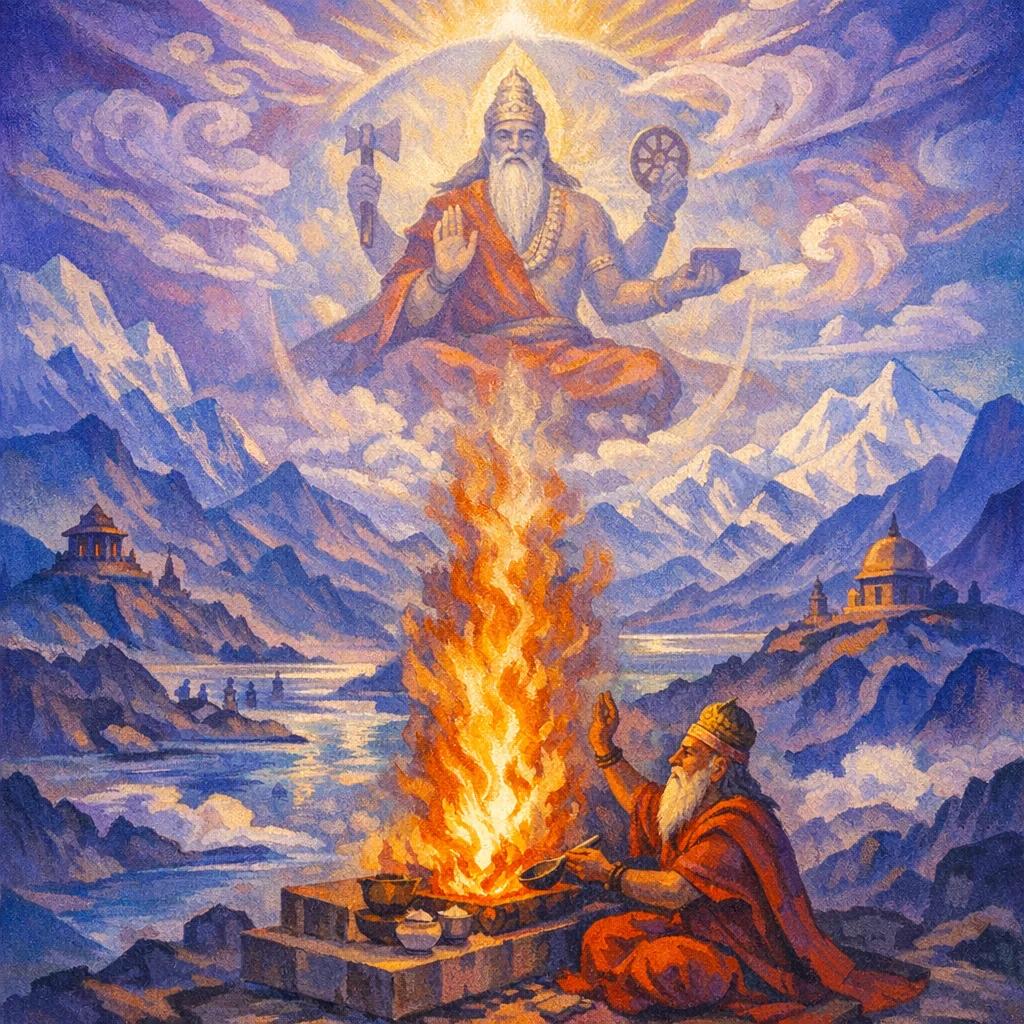
This hymn praises Viśvakarman, the all-fashioning cosmic artisan, as the priestly Seer who “offers up” the worlds and establishes creation from hidden depths. It moves through wonder-filled cosmogonic questioning—how Heaven and Earth were shaped—and culminates in a direct invocation of Viśvakarman as Vācaspati (Lord of Speech) to accept the worship and grant welfare and protection.
Mantras
Mantra 1
य इमा विश्वा भुवनानि जुह्वदृषिर्होता न्यसीदत्पिता नः । स आशिषा द्रविणमिच्छमानः प्रथमच्छदवराँ आ विवेश ॥
He who offers up all these worlds in the sacrifice—the Seer, the Priest—has sat down within us as our Father. Seeking the plenitude by the power of blessing, he entered first into the lower realms, veiling them, to found the work of creation in the depths.
Mantra 2
किं स्विदासीदधिष्ठानमारम्भणं कतमत्स्वित्कथासीत् । यतो भूमिं जनयन्विश्वकर्मा वि द्यामौर्णोन्महिना विश्वचक्षाः ॥
What indeed was the base, what the support, and in what manner was it? From where, as he brought forth the Earth, did Viśvakarman—seeing everywhere—wrap the Heaven around by his vast power?
Mantra 3
विश्वतश्चक्षुरुत विश्वतोमुखो विश्वतोबाहुरुत विश्वतस्पात् । सं बाहुभ्यां धमति सं पतत्रैर्द्यावाभूमी जनयन्देव एकः ॥
With eyes on every side, with face on every side, with arms on every side and feet on every side—the One God, bringing forth Heaven and Earth, sets the worlds in motion and breathes them together with his arms, and with his wings of power.
Mantra 4
किं स्विद्वनं क उ स वृक्ष आस यतो द्यावापृथिवी निष्टतक्षुः । मनीषिणो मनसा पृच्छतेदु तद्यदध्यतिष्ठद्भुवनानि धारयन् ॥
What was the wood, and what the tree from which they shaped out Heaven and Earth? The thinkers question in the mind that Mystery—what it was that stood over all the worlds, upholding them.
Mantra 5
या ते धामानि परमाणि यावमा या मध्यमा विश्वकर्मन्नुतेमा । शिक्षा सखिभ्यो हविषि स्वधावः स्वयं यजस्व तन्वं वृधानः ॥
O Viśvakarman, whatever thy highest seats, thy lowest, and thy middle—teach these to the comrades in the offering, O self-powered one. Do thou thyself sacrifice, increasing thy body of manifestation, so that the work may be fulfilled in us.
Mantra 6
विश्वकर्मन्हविषा वावृधानः स्वयं यजस्व पृथिवीमुत द्याम् । मुह्यन्त्वन्ये अभितो जनास इहास्माकं मघवा सूरिरस्तु ॥
O Viśvakarman, growing by the offering, do thou thyself sacrifice Heaven and Earth. Let other men around wander in confusion; here let our giver of plenitude, our illumined leader (sūri), be established.
Mantra 7
वाचस्पतिं विश्वकर्माणमूतये मनोजुवं वाजे अद्या हुवेम । स नो विश्वानि हवनानि जोषद्विश्वशम्भूरवसे साधुकर्मा ॥
Today, for help in the plenitude of force (vāja), we call Viśvakarman, Lord of the Word, swift-driven by the mind. May he accept all our callings—he who brings universal well-being—he of right and accomplished works, for our protection.
Frequently Asked Questions
Viśvakarman is the “all-maker,” a divine artisan who fashions and upholds the worlds. In this hymn he is also invoked as Vācaspati, the Lord of Speech, who perfects works and grants well-being.
It is a poetic way to ask about the ultimate cause of creation. The verse suggests that ordinary material explanations are inadequate, pointing to a deeper, mysterious creative intelligence behind the cosmos.
It can be recited in fire offerings or at the start of important work to pray for ordered creation, skillful accomplishment, effective speech, and protection—asking Viśvakarman to accept the worship and bring universal welfare.