Sukta 79
Sukta 10.79
Not explicitly named in this single verse; appears to describe a mighty immortal force active among mortals (often interpreted in RV 10.79 as Agni or a consuming cosmic power—requires hymn-level identification)
Triṣṭubh (probable; needs confirmation)
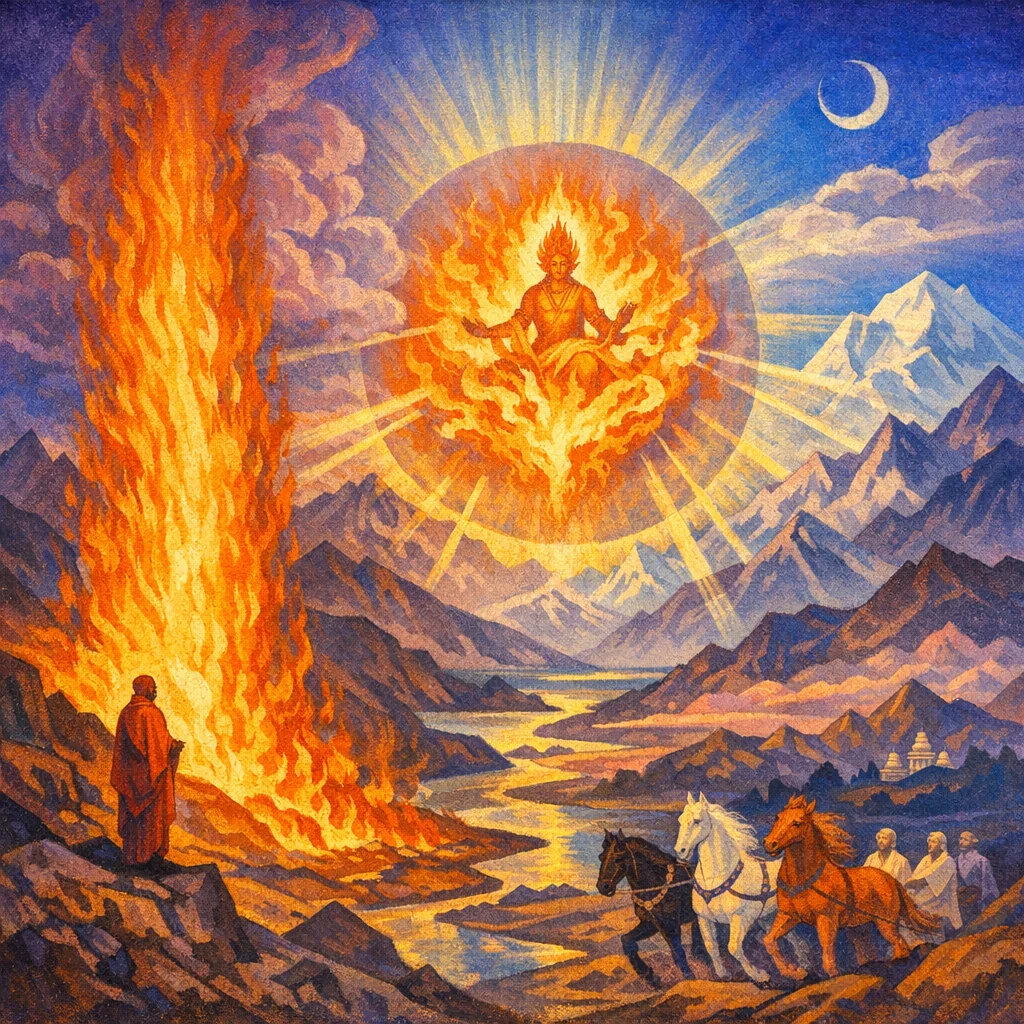
This hymn contemplates a terrifying yet beneficent immortal Power moving among mortals—most coherently identified as Agni in his consuming, transforming aspect. It describes the Fire as an all-devouring “embryo” that feeds on his two Mothers (Heaven and Earth), then as a yoking force that disciplines divergent energies and culminates in harmony and right-order (ṛta) under Mitra and the Vasus.
Mantras
Mantra 1
अपश्यमस्य महतो महित्वममर्त्यस्य मर्त्यासु विक्षु । नाना हनू विभृते सं भरेते असिन्वती बप्सती भूर्यत्तः ॥
I beheld the greatness of this Mighty One, the Immortal moving among the mortal peoples. Two jaws, diverse and upheld, bring together and bear; she does not cease, she labours and devours much.
Mantra 2
गुहा शिरो निहितमृधगक्षी असिन्वन्नत्ति जिह्वया वनानि । अत्राण्यस्मै पड्भिः सं भरन्त्युत्तानहस्ता नमसाधि विक्षु ॥
Within the secret cave the head is placed, and the two eyes are set apart. Not being pressed outward, he yet eats the forests with his tongue. For him, the peoples, hands lifted in adoration, gather together the offerings with their steps and establish them among the clans. (Inner sense) In the hidden subconscient the summit of consciousness is lodged and the dual vision is differentiated; the inner Fire, without external compulsion, consumes the growths of ignorance by the discerning tongue. Then the human energies, uplifted in surrender, collect the materials of the sacrifice—step by step—and found the work of the Truth in the life-powers.
Mantra 3
प्र मातुः प्रतरं गुह्यमिच्छन्कुमारो न वीरुधः सर्पदुर्वीः । ससं न पक्वमविदच्छुचन्तं रिरिह्वांसं रिप उपस्थे अन्तः ॥
Seeking what is more hidden than the Mother, the Youth crawled like a plant over the wide expanses. He found, as it were, the ripe stalk—shining—licking within the enemy’s lap. (Inner sense) The young soul-force, yearning for the deeper secret behind Nature (the Mother), moves through the vast fields of experience; it discovers the mature, radiant Fire/Will already active within the grasp of hostile powers, and brings it to light by persistent inner contact.
Mantra 4
तद्वामृतं रोदसी प्र ब्रवीमि जायमानो मातरा गर्भो अत्ति । नाहं देवस्य मर्त्यश्चिकेताग्निरङ्ग विचेताः स प्रचेताः ॥
This truth of you two, O Heaven and Earth, I proclaim: the embryo, being born, consumes the two Mothers. I, a mortal, do not fully know the god; Agni indeed is the discerning one—he is the one with foreknowledge. (Inner sense) The law of the two worlds is this: the growing inner Fire feeds upon and transforms both the material and the mental nature that bore it. The surface mind cannot measure the divine working; Agni is the true discriminating intelligence and the power that knows in advance the right formation of the work.
Mantra 5
यो अस्मा अन्नं तृष्वादधात्याज्यैर्घृतैर्जुहोति पुष्यति । तस्मै सहस्रमक्षभिर्वि चक्षेऽग्ने विश्वतः प्रत्यङ्ङसि त्वम् ॥
Who places food for him in the threefold (supports), who offers with clarified ghee and nourishes—toward him you look with a thousand eyes, O Agni; from every side you are turned. (Inner sense) Whoever establishes the sustaining substance in the triple foundation of the being and feeds the flame with luminous oblation, for him the divine Will opens an all-around vision: Agni becomes the many-eyed awareness, turning from all directions to protect and guide the work.
Mantra 6
किं देवेषु त्यज एनश्चकर्थाग्ने पृच्छामि नु त्वामविद्वान् । अक्रीळन्क्रीळन्हरिरत्तवेऽदन्वि पर्वशश्चकर्त गामिवासिः ॥
What offence of abandonment among the gods have you done, O Agni? I ask you now, not knowing. Not playing—yet playing—the tawny one, to eat, has cut (it) joint by joint, like a knife a cow. (Inner sense) What deviation in the divine workings has occurred, O Fire?—the seeker questions in ignorance. For the force that should delight in right movement can also, when misdirected, become a consuming power that dismembers experience stage by stage; therefore discernment is needed so that Agni’s energy cuts away ignorance, not the true substance of the being.
Mantra 7
विषूचो अश्वान्युयुजे वनेजा ऋजीतिभी रशनाभिर्गृभीतान् । चक्षदे मित्रो वसुभिः सुजातः समानृधे पर्वभिर्वावृधानः ॥
The forest-born one yoked the horses that go in different directions, held by straight-going reins. Mitra, well-born with the Vasus, beheld; growing by the joints, he came to a common rightness. (Inner sense) The force arising from the vital depths harnesses the divergent energies of the being and holds them with right-guiding disciplines. Then the harmonizing power (Mitra), supported by the Vasu-forces, perceives and establishes concord; by successive stages it increases into a unified right order.
Frequently Asked Questions
The hymn’s imagery best fits Agni: an immortal power among mortals, a consuming and transforming fire, and a divine knower (vicetā/pracetā). The last verse also brings in Mitra, highlighting harmony as the outcome.
On the cosmic level, Agni (or the divine Fire) is born within the worlds and then transforms them by his heat and power. In inner terms, awakened spiritual fire reshapes both our physical nature and our mind that originally ‘bore’ it.
The ‘horses’ symbolize scattered drives and energies. The hymn says the divine force disciplines and guides them with straight ‘reins’ so they move toward a common rightness, culminating in concord associated with Mitra.