Sarga 35
गङ्गाजन्मवर्णनम् / The Origin of the Ganga (Tripathagā Narrative)
बालकाण्ड
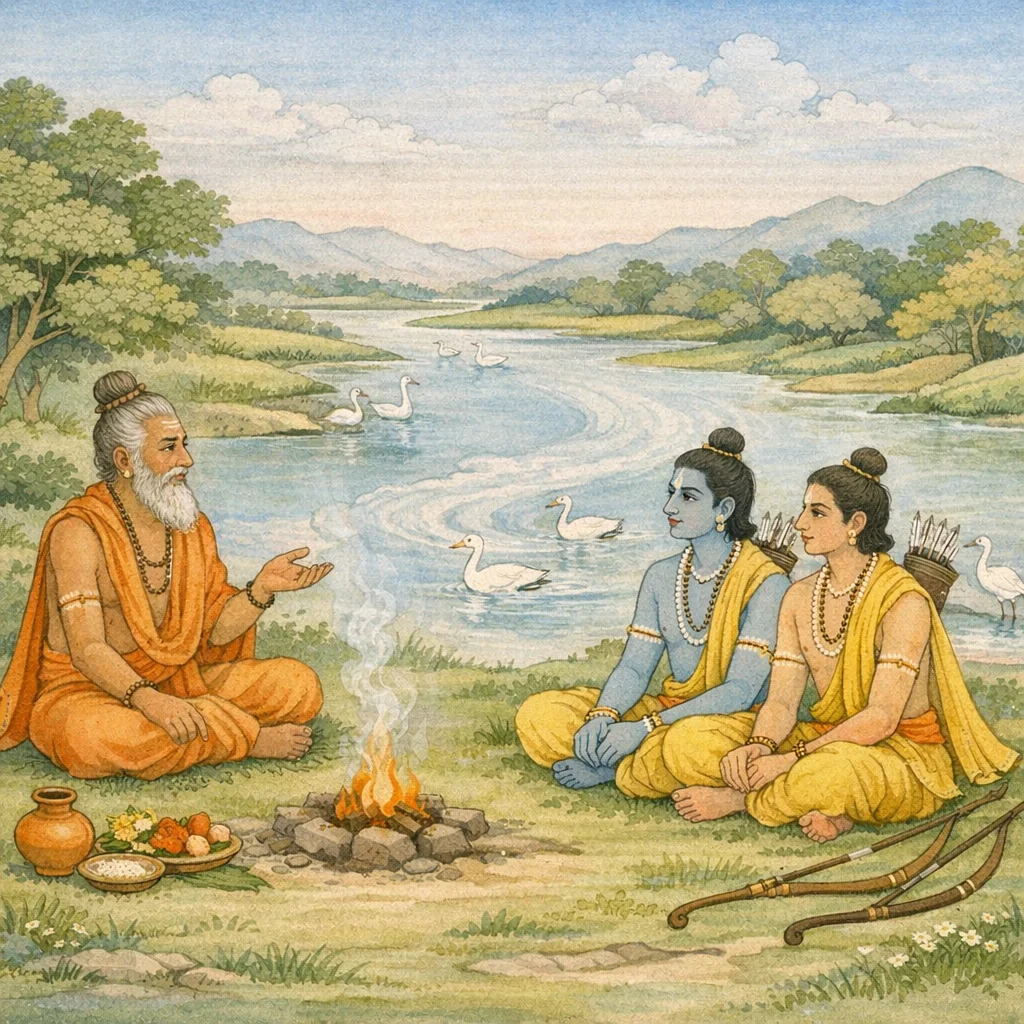
At dawn on the bank of the Śoṇa (Sona) River, Viśvāmitra rouses Rāma for the morning rites and to continue their journey. When the observances are completed, Rāma asks how they will cross the deep Śoṇa, marked by sandbanks; Viśvāmitra directs them to follow the well-known route once taken by earlier sages. After traveling for half a day through varied forests, they reach the Jahnavī (the Gaṅgā), revered by ascetics and enlivened by swans and cranes. They camp on her bank, bathe, offer tarpaṇa to the ancestors, perform the agnihotra, and partake of the sanctified remnants, standing around Viśvāmitra in a purified riverside place. Rāma then asks why the Gaṅgā is called tripathagā, and how she traversed and purified the three worlds before entering the ocean. Prompted by this, Viśvāmitra begins the account of her origin: Himavān, king of mountains and a vast store of ores, and his wife Manoramā (daughter of Meru) have two daughters—Gaṅgā, the elder, and Umā. The gods request Gaṅgā for a divine purpose; Himavān, abiding by dharma and for the welfare of the three worlds, gives her, and the gods depart fulfilled. Umā undertakes severe austerities and is given in marriage to Rudra. Viśvāmitra concludes by affirming Gaṅgā’s ascent to heaven as a sin-cleansing divine river.
Shlokas
Verse 1
उपास्य रात्रिशेषं तु शोणाकूले महर्षिभि:।निशायां सुप्रभातायां विश्वामित्रोऽभ्यभाषत।।1.35.1।।
Having spent the remainder of the night in reverent observance on the bank of the Śoṇā with the great seers, at the auspicious dawn Viśvāmitra spoke.
Verse 2
सुप्रभाता निशा राम पूर्वा सन्ध्या प्रवर्तते।उत्तिष्ठोत्तिष्ठ भद्रं ते गमनायाभिरोचय ।।1.35.2।।
“Rāma, the night has brightened into dawn; the morning sandhyā for rites has begun. Rise, rise—may auspiciousness attend you. Prepare yourself to set out on the journey.”
Verse 3
तच्छ्रुत्वा वचनं तस्य कृत्वा पौर्वाह्णिकीं क्रियाम् ।गमनं रोचयामास वाक्यं चेदमुवाच ह।।1.35.3।।
Hearing his words, Rāma performed the forenoon rites, made himself ready to proceed, and then spoke these words.
Verse 4
अयं शोणश्शुभजलोऽगाध: पुलिनमण्डित:।कतरेण पथा ब्रह्मन् सन्तरिष्यामहे वयम्।।1.35.4।।
O knower of Brahman, this Śoṇa river bears auspicious waters, is deep, and is adorned with sandbanks. By which route shall we cross it?
Verse 5
एवमुक्तस्तु रामेण विश्वामित्रोऽब्रवीदिदम् ।एष पन्था मयोद्दिष्टो येन यान्ति महर्षय:।।1.35.5।।
Thus addressed by Rāma, Viśvāmitra replied: “This is the route I have indicated—the very path by which the great ṛṣis proceed.”
Verse 6
एवमुक्ता महर्षयो विश्वामित्रेण धीमता।पश्यन्तस्ते प्रयाता वै वनानि विविधानि च।।1.35.6।।
So instructed by the wise Viśvāmitra, those great ṛṣis continued onward, observing the many kinds of forests along the way.
Verse 7
ते गत्वा दूरमध्वानं गतेऽर्धदिवसे तदा।जाह्नवीं सरितां श्रेष्ठां ददृशुर्मुनिसेविताम्।।1.35.7।।
After traversing a long stretch of road, and when half the day had passed, they beheld the Jahnavī—the best among rivers—revered and frequented by sages.
Verse 8
तां दृष्ट्वा पुण्यसलिलां हंससारससेविताम्।बभूवुर्मुदिता स्सर्वे मुनयस्सह राघवा:।।1.35.8।।
Seeing that river with holy waters, graced by swans and cranes, all the sages—together with the Rāghavas—were filled with joy.
Verse 9
तस्यास्तीरे ततश्चक्रुस्त आवासपरिग्रहम्।ततस्स्नात्वा यथान्यायं सन्तर्प्य पितृदेवता:।।1.35.9।।हुत्वा चैवाग्निहोत्राणि प्राश्य चामृतवद्धवि: ।विविशुर्जाह्नवीतीरे शुचौ मुदितमानसा:।।1.35.10।।विश्वामित्रं महात्मानं परिवार्य समन्तत:।
Then, upon that river’s bank, they set up a temporary dwelling. Bathing as prescribed and offering water-rites to the ancestral deities, they performed the agnihotra fires; and having partaken of the remaining oblations—like nectar—glad of heart, they went on to the pure bank of the Jāhnavī, surrounding the great-souled Viśvāmitra on every side.
Verse 10
तस्यास्तीरे ततश्चक्रुस्त आवासपरिग्रहम्।ततस्स्नात्वा यथान्यायं सन्तर्प्य पितृदेवता:।।1.35.9।।हुत्वा चैवाग्निहोत्राणि प्राश्य चामृतवद्धवि: ।विविशुर्जाह्नवीतीरे शुचौ मुदितमानसा:।।1.35.10।।विश्वामित्रं महात्मानं परिवार्य समन्तत:।
Then, on that riverbank, they established a place to stay. Bathing according to custom, they offered the due libations to the ancestral deities; they performed the agnihotra rites and partook of the oblation-remnants, nectar-like in purity. With joyful minds they entered the sacred bank of the Jahnavī, surrounding the great-souled Viśvāmitra on all sides.
Verse 11
अथ तत्र तदा रामो विश्वामित्रमथाब्रवीत्।।1.35.11।। भगवन् श्रोतुमिच्छामि गङ्गां त्रिपथगां नदीम्।त्रैलोक्यं कथमाक्रम्य गता नदनदीपतिम्।।1.35.12।।
Then and there Rāma said to Viśvāmitra: “Venerable Bhagavān, I wish to hear of the river Gaṅgā, who flows along the three paths. How did she traverse the three worlds and then reach the lord of rivers, the sea?”
Verse 12
अथ तत्र तदा रामो विश्वामित्रमथाब्रवीत्।।1.35.11।। भगवन् श्रोतुमिच्छामि गङ्गां त्रिपथगां नदीम्।त्रैलोक्यं कथमाक्रम्य गता नदनदीपतिम्।।1.35.12।।
Urged by Rāma’s words, the great sage Viśvāmitra began to recount the birth of the Gaṅgā, and thereafter her course and her widening flow.
Verse 13
चोदितो रामवाक्येन विश्वामित्रो महामुनि:।वृद्धिं जन्म च गङ्गाया वक्तुमेवोपचक्रमे।।1.35.13।।
Urged by Rāma’s words, the great sage Viśvāmitra began to recount the birth of the Gaṅgā, and thereafter her course and her widening flow.
Verse 14
शैलेन्द्रो हिमवान्नाम धातूनामाकरो महान्।तस्य कन्याद्वयं राम रूपेणाप्रतिमं भुवि।।1.35.14।।
“O Rāma, the lord of mountains named Himavān is a vast treasure-house, a mighty mine of metals and minerals. He had two daughters, unmatched in beauty upon the earth.”
Verse 15
या मेरुदुहिता राम तयोर्माता सुमध्यमा।नाम्ना मनोरमा नाम पत्नी हिमवत: प्रिया।।1.35.15।।
“O Rāma, their mother—slender-waisted—was the daughter of Meru, the beloved wife of Himavān, renowned by the name Manoramā.”
Verse 16
तस्यां गङ्गेयमभवज्ज्येष्ठा हिमवतस्सुता।उमा नाम द्वितीयाभून्नाम्ना तस्यैव राघव।।1.35.16।।
“From her was born this Gaṅgā, the eldest daughter of Himavān. The second daughter, O Rāghava, was born to him and was known by the name Umā.”
Verse 17
अथ ज्येष्ठां सुरास्सर्वे देवतार्थचिकीर्षया। शैलेन्द्रं वरयामासुर्गङ्गां त्रिपथगां नदीम्।।1.35.17।।
“Thereafter all the gods, wishing to accomplish a divine purpose, sought from the mountain-lord his eldest daughter—Gaṅgā, the river who moves along the three paths.”
Verse 18
ददौ धर्मेण हिमवान् तनयां लोकपावनीम्।स्वच्छन्दपथगां गङ्गां त्रैलोक्यहितकाम्यया।।1.35.18।।
Wishing the welfare of the three worlds, Himavān—acting in accordance with dharma—gave his daughter Gaṅgā, the purifier of the worlds, who flows along her own free course.
Verse 19
प्रतिगृह्य ततो देवास्त्रिलोकहितकारिण:।गङ्गामादाय तेऽगच्छन् कृतार्थेनान्तरात्मना।।1.35.19।।
Then the gods, intent on the good of the three worlds, received Gaṅgā; taking her with them, they departed with hearts inwardly fulfilled.
Verse 20
या चान्या शैलदुहिता कन्यासीद्रघुनन्दन।उग्रं सा व्रतमास्थाय तपस्तेपे तपोधना।।1.35.20।।
And Himavān’s other daughter, O delight of the Raghu line, was a maiden whose wealth was austerity; adopting a severe vow, she practiced intense tapas.
Verse 21
उग्रेण तपसा युक्तां ददौ शैलवरस्सुताम्।रुद्रायाप्रतिरूपाय उमां लोकनमस्कृताम्।।1.35.21।।
Himavān, best of mountains, gave his daughter Umā—endowed with severe austerity and revered by the world—to Rudra, the peerless one.
Verse 22
एते ते शैलराजस्य सुते लोकनमस्कृते।गङ्गा च सरितां श्रेष्ठा उमादेवी च राघव।।1.35.22।।
O Rāghava, these are the two daughters of the king of mountains, revered by the world—Gaṅgā, foremost among rivers, and also the goddess Umā.
Verse 23
एतत्ते सर्वमाख्यातं यथा त्रिपथगा नदी।खं गता प्रथमं तात गतिं गतिमतां वर ।।1.35.23।।
O child, best among the swift, I have told you all this—how the three-pathed river Gaṅgā first reached the sky.
Verse 24
सैषा सुरनदी रम्या शैलेन्द्रस्य सुता तदा।सुरलोकं समारूढा विपापा जलवाहिनी।।1.35.24।।
Thus that lovely divine river—Himavān’s daughter—then ascended to the world of the gods, a sin-dispelling stream bearing her waters onward.
Frequently Asked Questions
The pivotal action is not a conflict-choice but a dharmic procedure: the group’s transition from travel to sanctified conduct—bathing, pitṛ offerings, and agnihotra—showing that movement through geography is ethically framed by ritual responsibility and purity before receiving sacred narration.
Rāma’s inquiry models disciplined curiosity: cosmology is approached through respectful questioning, and knowledge is transmitted as ākhyāna by an authoritative teacher. The narrative links sacred geography (Ganga) with welfare ethics—Himavān’s gift is explicitly for triloka-hita, presenting generosity aligned with duty as a world-sustaining act.
Key landmarks include the Śoṇa River (as a crossing point and travel marker) and the Jahnavī/Ganga (as an ascetic-frequented sacred river). Cultural practices highlighted are dawn sandhyā observance, pitṛ-tarpaṇa (ancestral oblations), agnihotra, and the riverside āvāsa (ritualized encampment) that frames the reception of sacred history.