Sarga 48
अयोध्यायाः शोकवर्णनम् (Ayodhya’s Lament and Civic Desolation)
अयोध्याकाण्ड
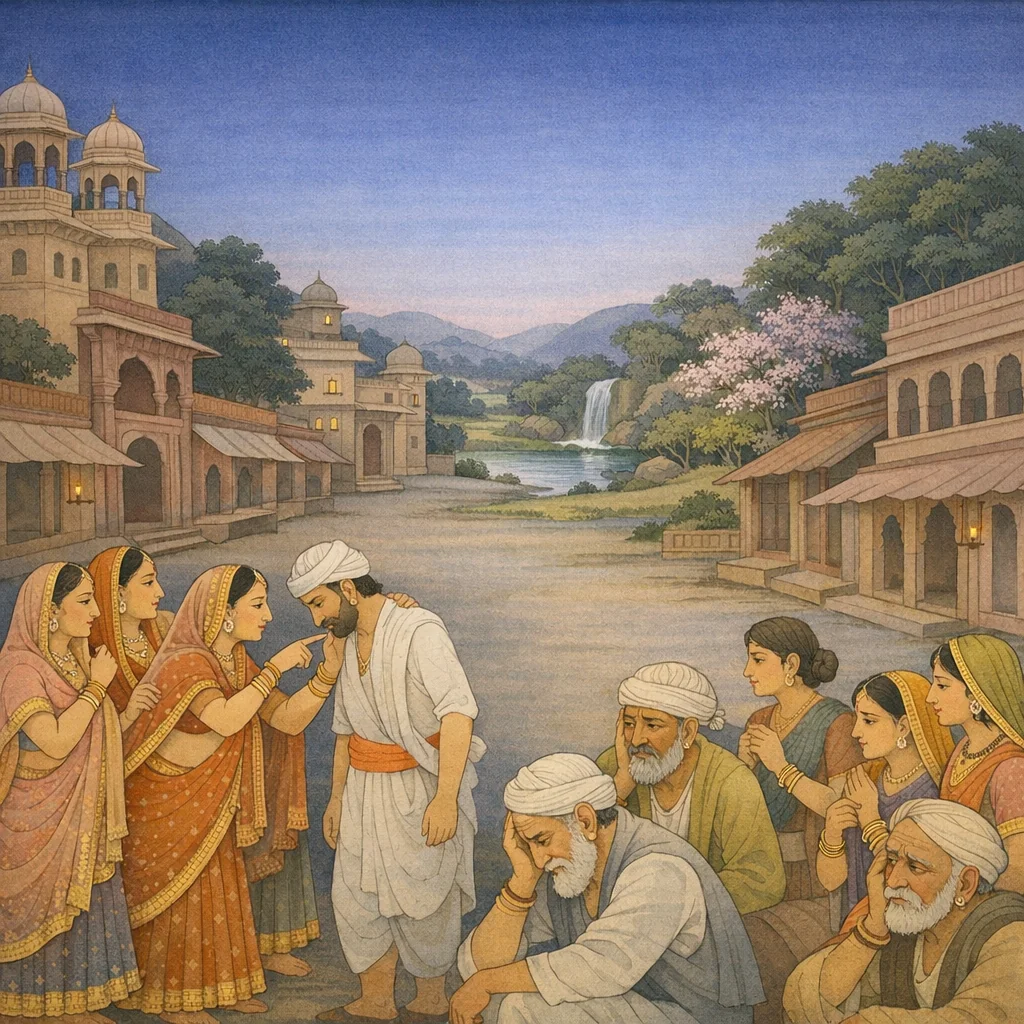
Sarga 48 portrays Ayodhyā after the citizens have followed Rāma and then returned. The people are shown blinded by tears and longing for death, as though their very life-breath were departing. Home life collapses: households weep, women rebuke their husbands with sharp words, and the usual signs of prosperity—trade, cooking, festivities, even joy at childbirth—lose all meaning. At the same time, the text exalts those who go with Rāma—Lakṣmaṇa together with Sītā—and imagines nature itself as a hospitable realm. Forests, rivers, mountains, flowering trees, and waterfalls will “honor” Rāma like a beloved guest, offering unseasonal blossoms and pure waters. Women propose a division of service—women to Sītā, men to Rāma—so that exile becomes a moving community of care. The chapter then turns political: citizens denounce Kaikeyī’s unrighteous rule, foresee ruin in a leaderless kingdom, and anticipate Daśaratha’s death and the lamentation to follow. Rāma’s virtues are gathered in a concentrated encomium. As evening falls, ritual fires and scriptural recitation cease, markets close, and Ayodhyā appears starless, darkened, and diminished like an ocean with reduced waters—an urban image of dharmic depletion.
Shlokas
Verse 1
तेषामेवं विषण्णानां पीडितानामतीव च।बाष्पविप्लुतनेत्राणां सशोकानां मुमूर्षया।।2.48.1।।अनुगम्य निवृत्तानां रामं नगरवासिनाम्।उद्गतानीव सत्वानि बभूवुरमनस्विनाम्।।2.48.2।।
Having followed Rama and then returned to the city, the citizens were utterly dejected and deeply afflicted. Their eyes overflowed with tears; crushed by grief and a longing for death, they seemed as though their very life-breath had departed and their minds were emptied of resolve.
Verse 2
तेषामेवं विषण्णानां पीडितानामतीव च।बाष्पविप्लुतनेत्राणां सशोकानां मुमूर्षया।।2.48.1।।अनुगम्य निवृत्तानां रामं नगरवासिनाम्।उद्गतानीव सत्वानि बभूवुरमनस्विनाम्।।2.48.2।।
Having followed Rama and then returned to the city, the citizens were utterly dejected and deeply afflicted. Their eyes overflowed with tears; crushed by grief and a longing for death, they seemed as though their very life-breath had departed and their minds were emptied of resolve.
Verse 3
स्वं स्वं निलयमागम्य पुत्रदारैस्समावृता।अश्रूणि मुमुचुस्सर्वे बाष्पेण पिहिताननाः।।2.48.3।।
Returning each to their own home, surrounded by sons and wives, they all broke down in tears, their faces veiled by weeping.
Verse 4
न चाहृष्यन् नचामोदन् वणिजो न प्रसारयन्।न चाशोभन्त पण्यानि नापचन् गृहमेधिनः।।2.48.4।।
No one rejoiced, no one felt glad; the merchants did not set out their wares for sale. The market-goods had no splendor, and householders did not even cook.
Verse 5
नष्टं दृष्ट्वा नाभ्यनन्दन् विपुलं वा धनागमम्।पुत्रं प्रथमजं लब्ध्वा जननी नाभ्यनन्दत।।2.48.5।।
Seeing loss, they did not grieve; gaining great wealth, they did not rejoice. Even a mother, obtaining her first-born son, felt no happiness.
Verse 6
गृहे गृहे रुदन्त्यश्च भर्तारं गृहमागतम्।व्यगर्हयन्त दुःखार्ता वाग्भिस्तोत्रैरिव द्विपान्।।2.48.6।।
In house after house, women wept; and when their husbands returned home, they reproached them in grief—words striking like elephant-goads.
Verse 7
किं नु तेषां गृहैः कार्यं किं दारै: किं धनेन वा।पुत्रैर्वा किं सुखैर्वापि ये न पश्यन्ति राघवम्।।2.48.7।।
What use are houses to them—what use are spouses or wealth? What use are children or pleasures for those who do not behold Rāghava (Rāma)?
Verse 8
एकः सत्पुरुषो लोके लक्ष्मण स्सह सीतया।योऽनुगच्छति काकुत्स्थं रामं परिचरन् वने।।2.48.8।।
Lakṣmaṇa alone is the truly blessed and noble man in the world—he who, together with Sītā, follows Rāma of the Kakutstha line and serves him in the forest.
Verse 9
आपगाः कृतपुण्यास्ता पद्मिन्यश्च सरांसि च।येषु स्नास्यति काकुत्स्थो विगाह्य सलिलं शुचि।।2.48.9।।
Blessed are those rivers, lotus-ponds, and lakes—surely they have earned merit—for it is in their pure waters that Kakutstha (Rāma) will enter and bathe.
Verse 10
शोभयिष्यन्ति काकुत्स्थमटव्यो रम्यकाननाः।आपगाश्च महानूपाः सानुमन्तश्च पर्वताः।।2.48.10।।
Forests rich with lovely groves, broad-flowing rivers, and mountains with gentle slopes will lend added splendour to Kakutstha’s scion, Rama, in his forest-dwelling.
Verse 11
काननं वापि शैलं वा यं रामोऽधिगमिष्यति।प्रियातिथिमिव प्राप्तं नैनं शक्ष्यन्त्यनर्चितुम्।।2.48.11।।
Whatever forest or mountain Rama approaches will receive him like a beloved guest; it will not be able to leave him without honour.
Verse 12
विचित्रकुसुमापीडा बहुमञ्जरि धारिणः।राघवं दर्शयिष्यन्ति नगा भ्रमरशालिनः।।2.48.12।।
Trees crowned with varied blossoms and heavy with many clusters, alive with bees, will present themselves to Rāghava as though to greet him.
Verse 13
अकाले चापि मुख्यानि पुष्पाणि च फलानि च।दर्शयिष्यन्त्यनुक्रोशाद्गिरयो राममागतम्।।2.48.13।।
Out of compassion, even out of season, the mountains will show Rama, when he arrives, their finest flowers and fruits.
Verse 14
प्रस्रविष्यन्ति तोयानि विमलानि महीधराः।विदर्शयन्तो विविधान् भूयश्चित्रांश्च निर्झरान्।।2.48.14।।
The mountains will send forth clear waters, revealing again and again many kinds of lovely cascades and waterfalls.
Verse 15
पादपाः पर्वताग्रेषु रमयिष्यन्ति राघवम्।यत्र रामो भयं नात्र नास्ति तत्र पराभवः।।2.48.15।।
Trees upon the mountain peaks will delight Rāghava. Where Rama is, there is no fear; and where he is, there is no dishonour or defeat.
Verse 16
स हि शूरो महाबाहुः पुत्रो दशरथस्य च।पुरा भवति नोदूरादनुगच्छाम राघवम्।।2.48.16।।
He is indeed a valiant, mighty-armed son of Daśaratha. Before he goes too far from us, let us follow Rāghava.
Verse 17
पादच्छाया सुखा भर्तुस्तादृशस्य महात्मनः।स हि नाथो जनस्यास्य स गति स्सपरायणम्।।2.48.17।।
Even the shade of the feet of such a great-souled lord is happiness. He alone is the protector of this people—he is their course, their goal, their highest refuge.
Verse 18
वयं परिचरिष्यामः सीतां यूयं तु राघवम्।इति पौरस्त्रियो भर्तृ़न् दुखार्तास्तत्तदब्रुवन्।।2.48.18।।
“We shall attend upon Sītā; you, then, attend upon Rāghava.” Thus the women of the city, tormented by grief, spoke in various ways to their husbands.
Verse 19
युष्माकं राघवोऽरण्ये योगक्षेमं विधास्यति।सीता नारीजनस्यास्य योगक्षेमं करिष्यति।।2.48.19।।
In the forest, Rāghava will provide for your welfare and safety; and Sītā likewise will ensure the security and well-being of the womenfolk.
Verse 20
को न्वनेनाऽप्रतीतेन सोत्कण्ठितजनेन च।सम्प्रियेतामनोज्ञेन वासेन हृतचेतसा।।2.48.20।।
With people choking in grief, and with life here rendered joyless and unbearable—whose mind, seized by distress, could possibly take pleasure in living in such a place?
Verse 21
कैकेय्या यदि चे द्राज्यं स्यादधर्म्यमनाथवत्।न हि नो जीवितेनार्थः कुतः पुत्रैः कुतो धनैः।।2.48.21।।
If this kingdom were to fall under Kaikeyī in an unrighteous way, leaving us like the unprotected, then life itself holds no value for us—what then of children, and what of wealth?
Verse 22
यया पुत्रश्च भर्ता च त्यक्तावैश्वर्यकारणात्।कं सा परिहरेदन्यं कैकेयी कुलपांसनी।।2.48.22।।
She who, for the sake of power and splendor, cast aside both son and husband—whom would that Kaikeyī, the disgrace of her lineage, ever spare?
Verse 23
कैकेय्या न वयं राज्ये भृतका निवसेमहि।जीवन्त्या जातु जीवन्त्यः पुत्रैरपि शपामहे।।2.48.23।।
So long as Kaikeyī lives, we—while we live—will never dwell in this kingdom as hirelings; we swear it, even upon our children.
Verse 24
या पुत्रं पार्थिवेन्द्रस्य प्रवासयति निर्घृणा।कस्तां प्राप्य सुखं जीवेदधर्म्यां दुष्टचारिणीम्।।2.48.24।।
She who, without compassion, has driven into exile the son of the lord of the earth—who could live happily under her, unrighteous and of wicked conduct?
Verse 25
उपद्रुतमिदं सर्वमनालम्बमनायकम्।कैकेय्या हि कृते सर्वं विनाशमुपयास्यति।।2.48.25।।
This entire realm is struck by calamity—without support and without a true leader; for Kaikeyī’s sake, all of it is bound to move toward ruin.
Verse 26
न हि प्रव्रजिते रामे जीविष्यति महीपतिः।मृते दशरथे व्यक्तं विलापस्तदनन्तरम्।।2.48.26।।
With Rāma sent away, the king will not survive for long; and when Daśaratha dies, what follows will plainly be lamentation.
Verse 27
ते विषं पिबतालोड्य क्षीणपुण्या स्सुदुर्गताः।राघवं वानुगच्छध्वमश्रुतिं वापि गच्छत।।2.48.27।।
You who have fallen into grievous straits, as though your merits were spent—drink poison if you wish; or follow Rāghava; or else depart to some unknown place.
Verse 28
मिथ्याप्रव्राजितो राम स्ससीत स्सहलक्ष्मणः।भरते सन्निसृष्टास्स्म स्सौनिके पशवो यथा।।2.48.28।।
Rāma—together with Sītā and Lakṣmaṇa—has been deceitfully driven into exile; and we have been handed over to Bharata like cattle delivered to a butcher.
Verse 29
पूर्णचन्द्रानन श्श्यामो गूढजत्रुररिन्दमः।आजानुबाहुः पद्माक्षो रामो लक्ष्मणपूर्वजः।।2.48.29।।पूर्वाभिभाषी मधुर स्सत्यवादी महाबलः।सौम्यस्सर्वस्य लोकस्य चन्द्रवत्प्रियदर्शनः।।2.48.30।।नूनं पुरुषशार्दूलो मत्तमातङ्गविक्रमः।शोभयिष्यत्यरण्यानि विचरन् स महारथः।।2.48.31।।
Rāma—elder brother of Lakṣmaṇa—dark-hued, with a face like the full moon; broad-shouldered, a subduer of foes, lotus-eyed, and long-armed down to the knees.
Verse 30
पूर्णचन्द्रानन श्श्यामो गूढजत्रुररिन्दमः।आजानुबाहुः पद्माक्षो रामो लक्ष्मणपूर्वजः।।2.48.29।।पूर्वाभिभाषी मधुर स्सत्यवादी महाबलः।सौम्यस्सर्वस्य लोकस्य चन्द्रवत्प्रियदर्शनः।।2.48.30।।नूनं पुरुषशार्दूलो मत्तमातङ्गविक्रमः।शोभयिष्यत्यरण्यानि विचरन् स महारथः।।2.48.31।।
He is the first to greet and speak, gentle and sweet by nature, truthful in speech, mighty in strength—beloved by all people, and lovely to behold like the moon.
Verse 31
पूर्णचन्द्रानन श्श्यामो गूढजत्रुररिन्दमः।आजानुबाहुः पद्माक्षो रामो लक्ष्मणपूर्वजः।।2.48.29।।पूर्वाभिभाषी मधुर स्सत्यवादी महाबलः।सौम्यस्सर्वस्य लोकस्य चन्द्रवत्प्रियदर्शनः।।2.48.30।।नूनं पुरुषशार्दूलो मत्तमातङ्गविक्रमः।शोभयिष्यत्यरण्यानि विचरन् स महारथः।।2.48.31।।
Surely that great charioteer—tiger among men, with the prowess of an intoxicated elephant—will lend beauty even to the forests as he roams there.
Verse 32
तास्तथा विलपन्त्यस्तु नगरे नागरस्त्रियः।चुक्रुशु र्दुःखसन्तप्ता मृत्योरिव भयागमे।।2.48.32।।
Thus the city-women lamented; scorched by grief, they cried out as though terror had come upon them like the approach of death.
Verse 33
इत्येवं विलपन्तीनां स्त्रीणां वेश्मसु राघवम्।जगामास्तं दिनकरो रजनी चाभ्यवर्तत।।2.48.33।।
While the women in their homes lamented thus over Rāghava, the sun went down to its setting, and night arrived.
Verse 34
नष्टज्वलनसन्तापा प्रशान्ताध्यायसत्कथा।तिमिरेणाभिलिप्तेव सा तदा नगरी बभौ।।2.48.34।।
Then the city appeared as though smeared with darkness: the warmth of sacred fires had vanished, and the study of holy texts and recitations had fallen silent.
Verse 35
उपशान्तवणिक्पण्या नष्टहर्षा निराश्रया।अयोध्या नगरी चासीन्नष्टतारमिवाम्बरम्।।2.48.35।।
With traders’ markets fallen silent, joy destroyed and support withdrawn, the city of Ayodhyā looked like a sky bereft of stars.
Verse 36
तथा स्त्रियो रामनिमित्तमातुरायथा सुते भ्रातरि वा विवासिते।विलप्य दीना रुरुदुर्विचेतसस्सूतैर्हि तासामधिको हि सोऽभवत्।।2.48.36।।
For Rāma’s sake the women were stricken with grief, as though a son or a brother had been banished. Lamenting, wretched and bewildered, they wept aloud; for to them he truly was more than their own sons.
Verse 37
प्रशान्तगीतोत्सवनृत्तवादनाव्यपास्तहर्षा पिहितापणोदया।तदा ह्ययोध्या नगरी बभूव सामहार्णव स्सङ्क्षपितोदको यथा।।2.48.37।।
With songs, festivals, dance, and instrumental music stilled, joy driven out, and the market-stalls shut, the city of Ayodhyā then appeared like the great ocean when its waters have receded.
Frequently Asked Questions
The sarga frames an ethical crisis of political legitimacy: citizens consider life in Ayodhyā “disagreeable” without Rāma and reject the prospect of Kaikeyī’s adharmic rule, even swearing not to live as servants under it (2.48.20–25).
The chapter teaches that social well-being depends on dharma rather than material abundance: when righteousness and rightful leadership are perceived as removed, joy, ritual continuity, and economic life collapse, while service and hospitality become the community’s remaining moral resources (2.48.3–7; 2.48.18–19; 2.48.34–37).
Ayodhyā is portrayed through cultural markers—markets, household cooking, sacrificial fires, and scriptural recitation—while the forest landscape is mapped via rivers, lotus-pools, mountains with slopes, flowering trees with bees, and waterfalls, all imagined as offering atithi-like hospitality to Rāma (2.48.9–15; 2.48.34–35).