Sarga 103
पिण्डदानदर्शनम् — The Queens Behold Rama’s Śrāddha Offering
अयोध्याकाण्ड
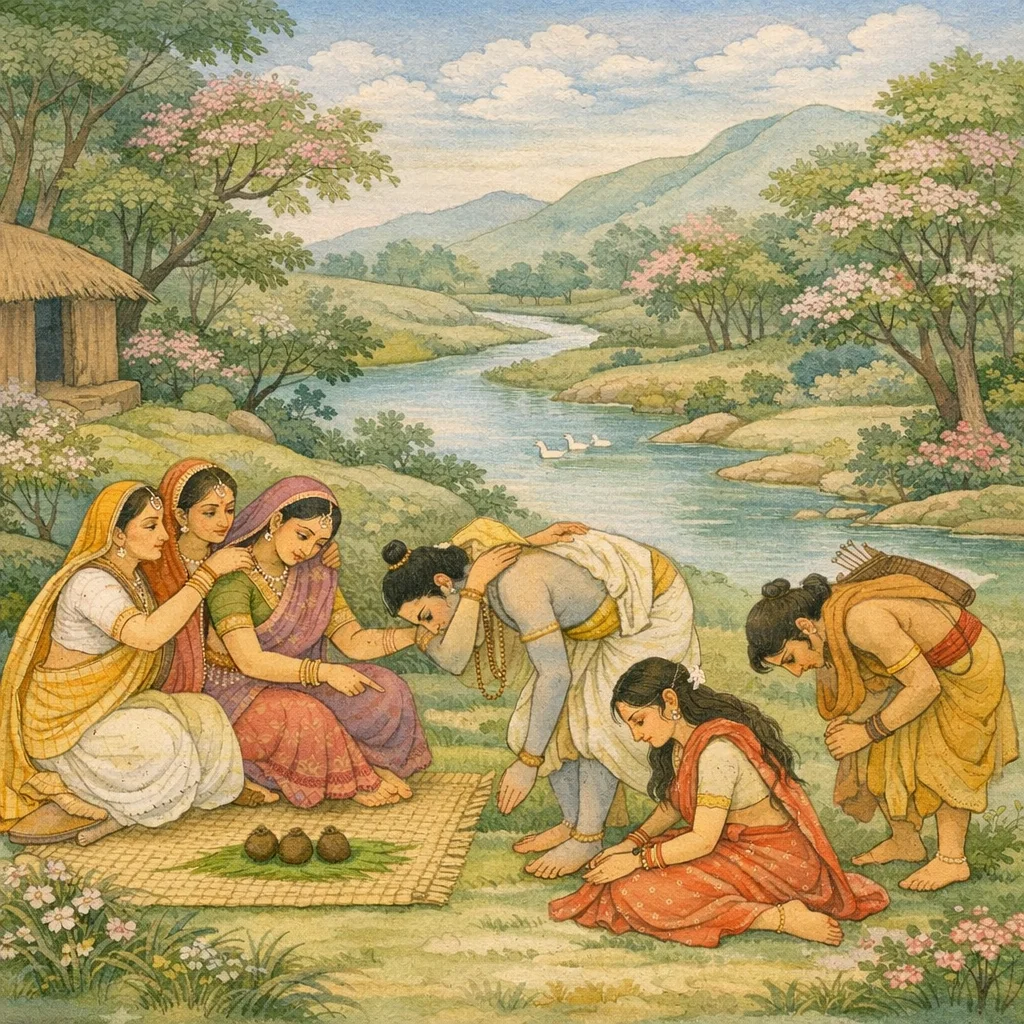
Vasiṣṭha walks on toward the tīrtha by the Mandākinī, leading Daśaratha’s queens who long to see Rāma. They reach the bathing place used by Rāma and Lakṣmaṇa. Kauśalyā, weeping and worn by grief, points to the sacred forest-side spot where the three exiles have been forced to live in hardship. She speaks of Lakṣmaṇa’s tireless service in fetching water for Rāma and wishes he might be spared such degrading toil. Kauśalyā then beholds the piṇḍa—cakes of iṅgudī pulp—set upon darbha grass with the tips turned southward, offered by Rāma to his father in the śrāddha rite. The contrast between Daśaratha’s former imperial luxury and this austere forest offering draws from her a lament: she doubts such food is fit for a “god-like” king and declares that nothing is more painful than Rāma’s reduced condition. A proverb follows—“as a man’s food is, so is the food of his gods”—felt here as tragically proven. The co-wives console Kauśalyā and behold Rāma in the āśrama, radiant yet like a god “fallen from heaven.” The mothers weep; Rāma rises, reverently touches their feet, and they wipe the dust from his back. Lakṣmaṇa also bows, and the queens extend to him the same motherly affection. Sītā, stricken with sorrow, clings to her mothers-in-law’s feet; Kauśalyā embraces her as a daughter and mourns her trials, likening grief to fire kindled by the araṇi that consumes its own support. Rāma then clasps Vasiṣṭha’s feet and sits beside him; Bharata sits nearby with folded hands, and all wonder what he will say. Rāma, Lakṣmaṇa, and Bharata, surrounded by friends, shine like three sacrificial fires encircled by officiants.
Shlokas
Verse 1
वसिष्ठः पुरतः कृत्वा दारान्दशरथस्य च।अभिचक्राम तं देशं रामदर्शनतर्षितः।।2.103.1।।
Vasiṣṭha, placing Daśaratha’s wives at the front, set out toward that place, yearning to behold Rāma.
Verse 2
राजपत्न्यश्च गच्छन्त्यो मन्दं मन्दाकिनीं प्रति।ददृशु स्तत्र तत् तीर्थं रामलक्ष्मणसेवितम्।।2.103.2।।
The king’s wives, walking slowly toward the Mandākinī, beheld there that sacred bathing-place (tīrtha) frequented by Rama and Lakshmana.
Verse 3
कौसल्या बाष्पपूर्णेन मुखेन परिशुष्यता।सुमित्रामब्रवीद्दीना याश्चान्या राजयोषितः।।2.103.3।।
Kausalyā—her face flooded with tears and wasted by grief—spoke desolately to Sumitrā and to the other royal wives.
Verse 4
इदं तेषामनाथानां क्लिष्टमक्लिष्टकर्मणाम्।वने प्राक्कलनं तीर्थं ये ते निर्विषयीकृताः।।2.103.4।।
This is that sacred ford to the east in the forest—linked with those helpless ones who, though afflicted, were untiring in their deeds, and who were driven out from their realm, stripped of their domain.
Verse 5
इत स्सुमित्रे पुत्रस्ते सदा जलमतन्द्रितः।स्वयं हरति सौमित्रिर्मम पुत्रस्य कारणात्।।2.103.5।।
O Sumitrā, from here your son Saumitri—ever diligent—himself fetches water continually, for the sake of my son.
Verse 6
जघन्यमपि ते पुत्रः कृतवान् न तु गर्हितः।भ्रातुर्यदर्थरहितं सर्वं तद् गर्हितंं गुणैः।।2.103.6।।
Even if your son has done what seems menial, he is not blameworthy; for whatever he does for his brother’s good is, in truth, ennobled by virtue.
Verse 7
अद्यायमपि ते पुत्रः क्लेशानामतथोचितः।नीचानर्थ समाचारं सज्जं कर्म प्रमुञ्चतु।।2.103.7।।
Even today, this son of yours—unaccustomed to suffering and not meant for it—should give up this harsh and degrading task that has been imposed upon him.
Verse 8
दक्षिणाग्रेषु दर्भेषु सा ददर्श महीतले।पितुरिङ्गुदिपिण्याकं न्यस्तमायतलोचना।।2.103.8।।
Large-eyed Kausalyā saw upon the ground the cakes of iṅgudī pulp placed for his father on darbha grass whose tips were set toward the south.
Verse 9
तं भूमौ पितुरार्तेन न्यस्तं रामेण वीक्ष्य सा।उवाच देवी कौसल्या सर्वा दशरथस्त्रियः।।2.103.9।।
Seeing the offering set on the ground for his father by grief-stricken Rāma, Queen Kausalyā spoke, addressing all the wives of Daśaratha.
Verse 10
इदमिक्ष्वाकुनाथस्य राघवस्य महात्मनः।राघवेण पितुर्दत्तं पश्यतैतद्यथाविधि।।2.103.10।।
Behold, in due rite, this offering that Rāghava (Rāma) has given to his father—Daśaratha, the great-souled lord of the Ikṣvāku line.
Verse 11
तस्य देवसमानस्य पार्थिवस्य महात्मनः।नैतदौपयिकं मन्ये भुक्तभोगस्य भोजनम्।।2.103.11।।
I do not think this food is fitting for that great king, god-like in stature, who once enjoyed every luxury.
Verse 12
चतुरन्तां महीं भुक्त्वा महेन्द्रसदृशो विभुः।कथमिङ्गुदिपिण्याकं स भुक्ते वसुधाधिपः।।2.103.12।।
How can the lord of the earth—mighty, Indra-like—who once enjoyed dominion over the whole land, partake of a cake made from iṅgudī pulp?
Verse 13
अतो दुःखतरं लोके न किञ्चित्प्रतिभाति मा।यत्र रामः पितुर्दद्यादिङ्गुदिक्षोदमृद्धिमान्।।2.103.13।।
Nothing in this world seems more painful to me than this: that Rāma—once prosperous—must offer his father a cake of crushed iṅgudī.
Verse 14
रामेणेङ्गुदिपिण्याकं पितुर्दत्तं समीक्ष्य मे।कथं दुःखेन हृदयं न स्फोटति सहस्रधा।।2.103.14।।
Seeing Rama offer his father a simple cake made from iṅgudī pulp, how does my heart not shatter into a thousand pieces from grief?
Verse 15
श्रुतिस्तु खल्वियं सत्या लौकिकी प्रतिभाति मा।यदन्नः पुरुषो भवति तदन्नास्तस्य देवताः।।2.103.15।।
A common saying now strikes me as true: whatever food a person lives on, the deities connected with him partake of that very food.
Verse 16
एवमार्तां सपत्न्यस्ता जग्मुराश्वास्य तां तदा।ददृशुश्चाश्रमे रामं स्वर्गच्युतमिवामरम्।।2.103.16।।
Having thus consoled the grief-stricken Kausalyā, the co-wives then went on; and at the hermitage they saw Rāma, like a god fallen from heaven.
Verse 17
सर्वभोगैः परित्यक्तं रामं सम्प्रेक्ष्य मातरः।आर्ता मुमुचुरश्रूणि सस्वरं शोककर्शिताः।।2.103.17।।
Seeing Rama forsaken of every royal comfort, the mothers—worn down by grief—cried aloud and let their tears stream forth.
Verse 18
तासां रामस्समुत्थाय जग्राह चरणान् शुभान्।मात्रूणां मनुजव्याघ्रस्सर्वासां सत्यसङ्गरः।।2.103.18।।
Rama—tiger among men, steadfast in truth—rose and, in reverence, clasped the auspicious feet of all his mothers.
Verse 19
ताः पाणिभि स्सुखस्पर्शैर्मृद्वङ्गुलितलै श्शुभैः।प्रममार्जू रजः पृष्ठाद्रामस्यायतलोचनाः।।2.103.19।।
Those large-eyed queens, with auspicious hands—soft-fingered and gentle to the touch—wiped the dust from Rama’s back.
Verse 20
सौमित्रिरपि ता स्सर्वा मातृ़स्सम्प्रेक्ष्य दुःखितः।अभ्यवादयतासक्तं शनै रामादनन्तरम्।।2.103.20।।
Lakshmana too, seeing all those mothers, was overcome with sorrow; following after Rama, he slowly bowed to them in devoted reverence.
Verse 21
यथा रामे तथा तस्मिन्सर्वा ववृतिरे स्त्रियः।वृत्तिं दशरथाज्जाते लक्ष्मणे शुभलक्षणे।।2.103.21।।
Just as they did with Rāma, so too all the queens treated Lakṣmaṇa—Daśaratha’s son, marked by auspicious signs—with the same affection and regard.
Verse 22
सीताऽपि चरणांस्तासामुपसङ्गृह्य दुःखिता।श्वश्रूणामश्रुपूर्णाक्षी सा बभूवाग्रतः स्थिता।।2.103.22।।
Sītā too, sorrowing, clasped the feet of her mothers-in-law; with tear-filled eyes, she stood before them.
Verse 23
तां परिष्वज्य दुःखार्तां माता दुहितरं यथा।वनवासकृशां दीनां कौसल्या वाक्यमब्रवीत्।।2.103.23।।
Embracing Sītā—wretched, grief-stricken, and emaciated from forest-dwelling—Kausalyā spoke to her, as a mother would to her own daughter.
Verse 24
विदेहराजस्य सुता स्नुषा दशरथस्य च।रामपत्नी कथं दुःखं सम्प्राप्ता निर्जने वने।।2.103.24।।
How has she—daughter of the king of Videha, daughter-in-law of Daśaratha, and wife of Rāma—come to such suffering in a lonely forest?
Verse 25
पद्ममातपसन्तप्तं परिक्लिष्टमिवोत्पलम्।काञ्चनं रजसा ध्वस्तं क्लिष्टं चन्द्रमिवाम्बुदैः।।2.103.25।।मुखं ते प्रेक्ष्य मां शोको दहत्यग्निरिवाऽश्रयम्।भृशं मनसि वैदेहि व्यसनारणिसम्भवः।।2.103.26।।
Your face appears like a lotus scorched by the sun, like a water-lily withered; like gold sullied by dust, like the moon dimmed by clouds.
Verse 26
पद्ममातपसन्तप्तं परिक्लिष्टमिवोत्पलम्।काञ्चनं रजसा ध्वस्तं क्लिष्टं चन्द्रमिवाम्बुदैः।।2.103.25।।मुखं ते प्रेक्ष्य मां शोको दहत्यग्निरिवाऽश्रयम्।भृशं मनसि वैदेहि व्यसनारणिसम्भवः।।2.103.26।।
Seeing your face, O Vaidehī, sorrow burns me fiercely in my heart—like fire born of the arani-sticks of calamity, consuming even its own support.
Verse 27
ब्रुवन्त्यामेवमार्तायां जनन्यां भरताग्रजः।पादावासाद्य जग्राह वसिष्ठस्य च राघवः।।2.103.27।।
As his anguished mother spoke thus, Rāghava—Bharata’s elder brother—approached Vasiṣṭha and reverently grasped his feet.
Verse 28
पुरोहितस्याग्निसमस्य वै तदा बृहस्पतेरिन्द्रमिवामराधिपः।प्रगृह्य पादौ सुसमृद्धतेजसस्सहैव तेनोपविवेश राघवः।।2.103.28।।
Then Rāghava, having clasped the feet of that family priest whose brilliance was like fire, sat down beside him—just as Indra, lord of the gods, does beside Bṛhaspati.
Verse 29
ततो जघन्यं सहितै स्समन्त्रिभिः पुरप्रधानैश्च सहैव सैनिकैः।जनेन धर्मज्ञतमेन धर्मवानुपोपविष्टो भरत स्तदाऽग्रजम्।।2.103.29।।
Thereafter, righteous Bharata sat close to his elder brother; behind him sat counsellors, leading citizens, soldiers, and men most versed in dharma.
Verse 30
उपोपविष्ट स्तु तदा स वीर्यवांस्तपस्विवेषेण समीक्ष्य राघवम्।श्रिया ज्वलन्तं भरतः कृताञ्जलिर्यथा महेन्द्रः प्रयतः प्रजापतिम्।।2.103.30।।
Then the mighty Bharata, seeing Rāghava clad in an ascetic’s garb yet blazing with majesty, sat near him with folded palms—like Mahendra, purified, seated near Prajāpati.
Verse 31
किमेष वाक्यं भरतोऽद्य राघवं प्रणम्य सत्कृत्य च साधु वक्ष्यति।इतीव तस्यार्यजनस्य तत्त्वतो बभूव कौतूहलमुत्तमं तदा।।2.103.31।।
Then a profound curiosity arose among the noble people: “Having bowed to Rāghava and honored him, what worthy words will Bharata speak today?”
Verse 32
स राघव स्सत्यधृति श्च लक्ष्मणो महानुभावो भरत श्च धार्मिकः।वृताः सुहृद्भि श्च विरेजुरध्वरे यथा सदस्यै स्सहितास्त्रयोऽग्नयः।।2.103.32।।
Rāma, steadfast in truth, Lakṣmaṇa of great stature, and righteous Bharata—surrounded by their well-wishers—shone in that rite like three sacrificial fires attended by the officiants.
Frequently Asked Questions
The pivotal action is Rāma’s performance of pitṛ-rites (piṇḍadāna) for Daśaratha under exile conditions, highlighting how dharma is upheld even when resources are meager and the performer is personally distressed.
Kauśalyā’s lament and the proverb about ‘a man’s food and his gods’ underscore the moral realism of dharma: ritual duty persists amid suffering, and grief becomes a lens that reveals impermanence, status-reversal, and the ethical nobility of endurance.
The Mandākinī-associated tīrtha and the āśrama setting frame the scene; culturally, the śrāddha protocol is signaled through darbha grass oriented southward and the piṇḍa offering, with araṇi imagery used to interpret grief as a self-consuming fire.