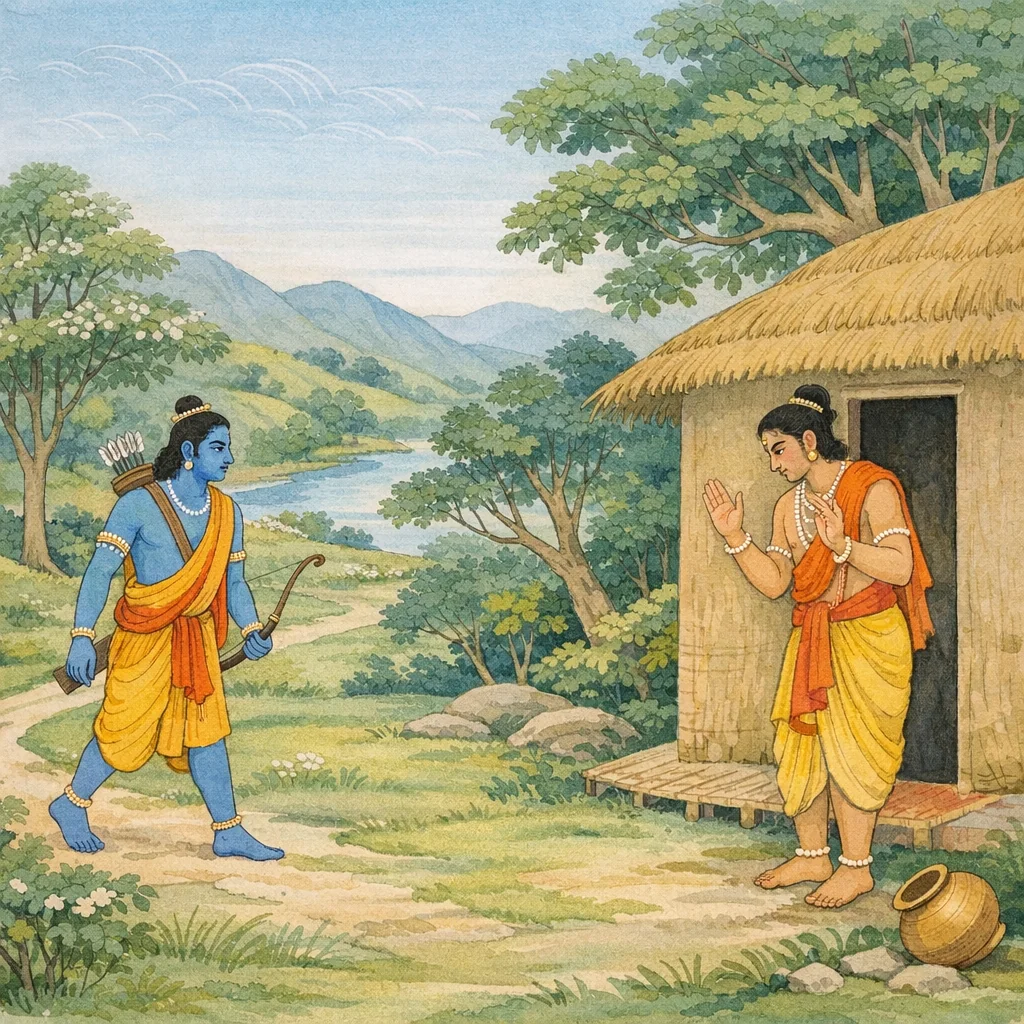
Sarga 59
अरण्यकाण्डे एकोनषष्टितमः सर्गः — Maricha’s Mimic Cry and the Rama–Lakshmana–Sita Confrontation
अरण्यकाण्ड
This sarga recounts the immediate aftermath of the deceptive cry from the forest. Rama returns from the chase and sees Lakshmana arriving without Sita; ominous bodily signs and dark foreboding make him suspect grave danger. Lakshmana explains that he did not leave Sita of his own will. A voice, as though Rama’s—“Ha Sita, ha Lakshmana, save me”—reached her ears, and in fear and love she compelled Lakshmana to go. He had tried to reassure her, declaring Rama invincible and discerning the cry as a rakshasa’s imitation. But Sita, deluded by panic, accuses Lakshmana of impure intent and even of a political conspiracy with Bharata, recasting his reluctance as hidden hostility. Lakshmana departs the hermitage in anger and reports to Rama; Rama censures him for disobedience and for leaving Sita against his command. Rama then lays out the truth: the “deer” was the rakshasa Maricha, who, struck by Rama’s arrow, mimicked Rama’s voice to lure Lakshmana away—thus the ruse succeeded, and Sita was left vulnerable.
Shlokas
Verse 1
अथाश्रमादुपावृत्तमन्तरा रघुनन्दनः।परिपप्रच्छ सौमित्रिं रामो दुःखार्दितं पुनः।।।।
Then Rama, the joy of the Raghu line, overwhelmed by grief, again questioned Saumitri (Lakshmana) as he returned from the hermitage.
Verse 2
तमुवाच किमर्थं त्वमागतोऽपास्य मैथिलीम्।यदा सा तव विश्वासाद्वने विरहिता मया।।।।
She said to him: “Why have you come here, leaving Maithilī behind, when I left her alone in the forest, trusting in you?”
Verse 3
दृष्ट्वैवाभ्यागतं त्वां मे मैथिलीं त्यज्य लक्ष्मण।शङ्कमानं महत्पापं यत्सत्यं व्यथितं मनः।।।।
The moment I saw you return, O Lakṣmaṇa, having left Maithilī behind, my mind was shaken; my dreadful suspicion proved true, and my heart was pained.
Verse 4
स्फुरते नयनं सव्यं बाहुश्च हृदयं च मे।दृष्ट्वा लक्ष्मण दूरे त्वां सीताविरहितं पथि।।।।
Seeing you from afar on the path, O Lakṣmaṇa—without Sītā—my left eye, my arm, and my heart began to throb, as if warning of misfortune.
Verse 5
एवमुक्तन्तु सौमित्रिर्लक्ष्मणश्शुभलक्षणः।भूयो दुःखसमाविष्टो दुःखितं राममब्रवीत्।।।।
Thus addressed, Saumitri Lakṣmaṇa—marked by auspicious qualities—was overcome by even greater sorrow, and spoke to the grief-stricken Rāma.
Verse 6
न स्वयं कामकारेण तां त्यक्त्वाहमिहागतः।प्रचोदित स्तयैवोग्रैस्त्वत्सकाशमिहागतः।।।।
I did not come here of my own will after leaving her; driven by her harsh words alone, I have come to you.
Verse 7
आर्येणेव पराक्रुष्टं हासीते लक्ष्मणेति च।परित्राहीति यद्वाक्यं मैथिल्यास्तच्छ्रुतिं गतम्।।।।
A loud cry reached Maithilī’s ears, as though from you yourself: “Alas, Sītā! Alas, Lakṣmaṇa! Save me!”
Verse 8
सा तमार्तस्वरं श्रुत्वा तव स्नेहेन मैथिली।गच्छ गच्छेति मामाह रुदन्ती भयविह्वला।।।।
Hearing that anguished cry, Maithilī—out of love for you—begged me again and again, weeping and shaken with fear: “Go, go!”
Verse 9
प्रचोद्यमानेन मया गच्छेति बहुशस्तया।प्रत्युक्ता मैथिली वाक्यमिदं त्वत्प्रत्ययान्वितम्।।।
As she repeatedly urged me, saying “Go!”, I answered Maithilī with these words, meant to strengthen her confidence in you.
Verse 10
न तत्पश्याम्यहं रक्षो यदस्य भयमावहेत्।निर्वृता भव नास्त्येतत्केनाप्येवमुदाहृतम्।।।।
I do not see any such demon who could bring fear upon him. Be calm—this is not so; someone has spoken thus only to mislead.
Verse 11
विगर्हितं च नीचं च कथमार्योऽभिधास्यति।त्राहीति वचनं सीते यस्त्रायेत्रिदशानपि।।।।
O Sita, how could a noble man utter such blameworthy, base words—“Save me!”—when he is one who can protect even the gods?
Verse 12
किं निमित्तं तु केनापि भ्रातुरालम्ब्य मे स्वरम्।राक्षसेनेरितं वाक्यं त्राहि त्राहीति शोभने।।।।
O fair lady, for some purpose a rākṣasa, imitating my brother’s voice, uttered the words, “Save me, save me.”
Verse 13
विस्वरं व्याहृतं वाक्यं लक्ष्मण त्राहि मामिति।न भवत्या व्यथा कार्या कुनारीजनसेविता।।।।
“Lakshmana, save me!”—these words were spoken in a distorted voice. You should not be shaken by anxiety like a common, foolish woman.
Verse 14
अलं वैक्लब्यमालम्ब्य स्वस्था भव निरुत्सुका।न सोऽस्ति त्रिषु लोकेषु पुमान्वै राघवं रणे।।।।जातो वा जायमानो वा संयुगे यः पराजयेत्।न जय्यो राघवो युद्धे देवैश्शक्रपुरोगमैः।।।।
Do not give way to confusion; be steady and free from despair. In the three worlds there is no man who can defeat Rāghava in battle.
Verse 15
अलं वैक्लब्यमालम्ब्य स्वस्था भव निरुत्सुका।न सोऽस्ति त्रिषु लोकेषु पुमान्वै राघवं रणे।।3.59.14।।जातो वा जायमानो वा संयुगे यः पराजयेत्।न जय्यो राघवो युद्धे देवैश्शक्रपुरोगमैः।।3.59.15।।
Whether already born or yet to be born, whoever might defeat him in combat—such a one does not exist; Rāghava cannot be conquered in war even by the gods led by Śakra.
Verse 16
एवमुक्ता तु वैदेही परिमोहितचेतना।उवाचाश्रूणि मुञ्चन्ती दारुणं मामिदं वचः।।।।
Though spoken to thus, Vaidehī—her mind clouded—shed tears and spoke these harsh words to me.
Verse 17
भावो मयि तवात्यर्थं पाप एव निवेशितः।विनष्टे भ्रातरि प्राप्तुं न च त्वं मामवाप्स्यसि।।।।
Your intention toward me is utterly sinful—set on taking me when your brother is destroyed; yet you shall not obtain me.
Verse 18
सङ्केताद्भरतेन त्वं रामं समनुगच्छसि।क्रोशन्तं हि यथात्यर्थं नैवमभ्यवपद्यसे।।।।
You must be following Rāma at Bharata’s signal; for though he cries out in utter distress, you do not hasten to him as you should.
Verse 19
रिपुः प्रच्छन्नचारी त्वं मदर्थमनुगच्छसि।राघवस्यान्तरप्रेप्सुस्तथैनं नाभिपद्यसे।।।।
You are an enemy moving in disguise, following for my sake; seeking an opening against Rāghava, you therefore do not go to him now.
Verse 20
एवमुक्तो हि वैदेह्या संरब्धो रक्तलोचनः।क्रोधात्प्रस्फुरमाणोष्ठ आश्रमादभिनिर्गतः।।।।
Thus addressed by Vaidehī, I—angered, eyes reddened, lips trembling with wrath—came out from the hermitage.
Verse 21
एवं ब्रुवाणं सौमित्रिं रामस्सन्तापमोहितः।अब्रवीद्दुष्कृतं सौम्य तां विना यत्त्वमागतः।।।।
As Saumitri spoke thus, Rāma—bewildered by grief—said: “O gentle one, it was a wrongful act that you came here leaving her behind.”
Verse 22
जानन्नपि समर्थं मां रक्षसां विनिवारणे।अनेन क्रोधवाक्येन मैथिल्या निस्सृतो भवान्।।।।
Even knowing me to be able to ward off the rākṣasas, you came out because of Maithilī’s angry words.
Verse 23
न हि ते परितुष्यामि त्यक्त्वा यद्यासि मैथिलीम्।क्रुद्धायाः परुषं श्रुत्वा तां विहाय त्वमागतः।।।।
I cannot be satisfied with you, for you came here leaving Maithilī behind, abandoning her merely upon hearing her harsh words spoken in anger.
Verse 24
सर्वथा त्वविनीतं ते सीतया यत्प्रचोदितः।क्रोधस्य वशमापन्नो नाकरोश्शासनं मम।।।।
In every way this was improper on your part: provoked by Sītā, you fell under the sway of anger and did not carry out my command.
Verse 25
असौ हि राक्षसश्शेते शरेणाभिहतो मया।मृगरूपेण येनाहमाश्रमादपवाहितः।।।।
That rākṣasa lies there, struck down by my arrow—the one who, taking the form of a deer, lured me away from the hermitage.
Verse 26
विकृष्य चापं परिधाय सायकं सलीलबाणेन च ताडितो मया।मार्गीं तनुं त्यज्य स विक्लबस्वरो बभूव केयूरधरस्सराक्षसः।।।।
Drawing my bow and setting the arrow, I struck him with an effortless shot. Casting off the body of a deer, that rākṣasa—wearing an armlet—appeared, crying out in a faltering, anguished voice.
Verse 27
शराहतेनैव तदार्तया गिरा स्वरं समालम्ब्य सुदूरसुश्रवम्।उदाहृतं तद्वचनं सुदारुणं त्वमागतो येन विहाय मैथिलीम्।।।।
The instant he was struck by the arrow, in distress he assumed your voice—audible even from far away—and uttered those dreadful words. Hearing them, you came here, leaving Maithilī behind.
Frequently Asked Questions
The dharma-sankat is Lakshmana’s choice between obeying Rama’s protective instruction to guard Sita and responding to an apparent emergency cry in Rama’s voice; the sarga shows how deception weaponizes compassion and duty to force a breach in protection.
The episode teaches that fear and grief can corrupt judgment, producing unjust suspicion and rash action; it also emphasizes that dharma requires steadiness (svāsthya) and discernment when appearances are manipulated by hostile agents.
The ashrama (forest hermitage) functions as the key cultural landmark—an ascetic refuge whose safety depends on disciplined guardianship—while the surrounding forest space enables rakshasa illusion, distance-audible cries, and tactical separation.