Sarga 44
मारीचवधः — The Slaying of Maricha (Golden Deer Deception)
अरण्यकाण्ड
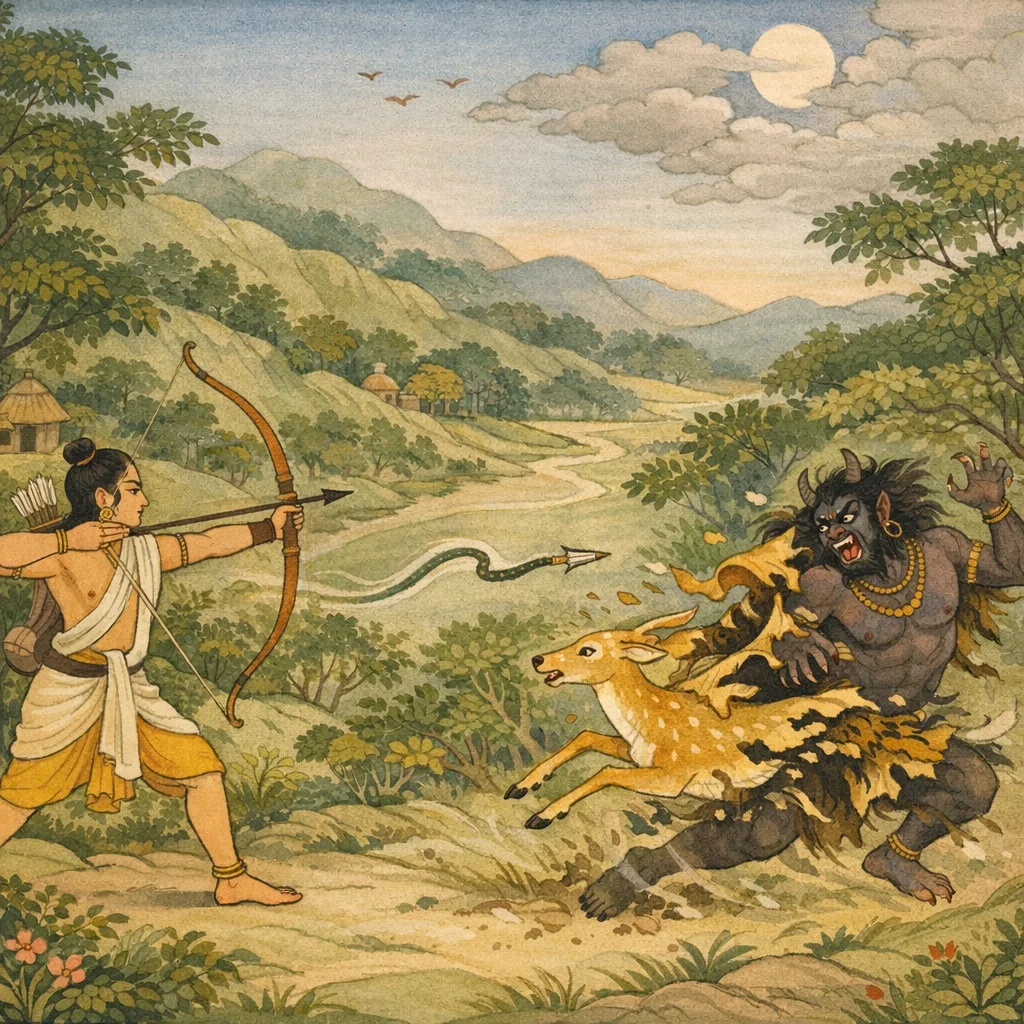
Sarga 44 recounts Rama’s tactical pursuit and slaying of Maricha in the guise of the golden deer, revealing how māyā distorts sight and the sense of distance. Rama arms himself—fastening a golden-handled sword and taking up his triple-curved bow with two quivers—and chases the alluring deer as it repeatedly appears and vanishes, drawing him far from the hermitage. The deception is framed through an extended simile: the autumn moon intermittently veiled by clouds. When the deer reappears from a cluster of trees, Rama resolves to kill it and releases a Brahma-created arrow, hissing like a serpent; it pierces the deer-body and tears Maricha’s heart. As Maricha falls, he sheds the artificial form and rises as a huge rākṣasa, then performs his final act of psychological warfare—mimicking Rama’s voice to cry, “Ha Sita, Ha Lakshmana,” to provoke Sita into sending Lakshmana away so Ravana may abduct her in solitude. Though Rama recognizes the illusion, as Lakshmana had warned, fear and urgency seize him. Taking venison from another deer, he hastens back toward Janasthana, and the chapter turns from the chase to the shadow of impending loss.
Shlokas
Verse 1
तथा तु तं समादिश्य भ्रातरं रघुनन्दनः।बबन्धासिं महातेजा जाम्बूनदमयत्सरुम्।।।।
Thus, having instructed his brother, the glorious Rāma—delight of the Raghu line—fastened at his waist his sword with a golden hilt.
Verse 2
तत स्त्र्यवनतं चापमादायाऽत्मविभूषणम्।आबध्य च कलापौ द्वौ जगामोदग्रविक्रमः।।।।
Then Rāma, of indomitable prowess, took up his bow—curved in three places like an ornament upon him—fastened two quivers, and set out.
Verse 3
तं वञ्चयानो राजेन्द्रमापतन्तं निरीक्ष्यवै।बभूवान्तर्हितस्त्रासात्पुनस्सन्दर्शनेऽभवत्।।च।।बद्धासिर्धनुरादाय प्रदुद्राव यतो मृगः।
Deceiving the kingly Rāma, the deer saw him rushing forward; out of fear it vanished from sight, and then appeared again. Sword fastened and bow in hand, Rāma ran after it wherever the deer fled.
Verse 4
तं स्म पश्यति रूपेण द्योतमानमिवाग्रतः।।।।अवेक्ष्यावेक्ष्य धावन्तं धनुष्पाणिर्महावने।अतिवृत्तमिषोः पाताल्लोभयानं कदाचन।।।।शङ्कितन्तु समुद्भ्रान्तमुत्पतन्तमिवाम्बरे।दृश्यमानमदृश्यं च वनोद्देशेषु केषुचित्।।।।छिन्नाभ्रैरिव संवीतं शारदं चन्द्रमण्डलम्।
Rāma, bow in hand, kept seeing that radiant creature ahead. Again and again he watched it run through the vast forest—sometimes slipping beyond the reach of his arrow, sometimes enticing him onward. Alarmed and bewildered, it seemed to leap up as if taking to the sky; in some stretches of woodland it would appear and then vanish. It was like the autumn moon, now veiled and now revealed by scattered clouds.
Verse 5
तं स्म पश्यति रूपेण द्योतमानमिवाग्रतः।।3.44.4।।अवेक्ष्यावेक्ष्य धावन्तं धनुष्पाणिर्महावने।अतिवृत्तमिषोः पाताल्लोभयानं कदाचन।।3.44.5।।शङ्कितन्तु समुद्भ्रान्तमुत्पतन्तमिवाम्बरे।दृश्यमानमदृश्यं च वनोद्देशेषु केषुचित्।।3.44.6।।छिन्नाभ्रैरिव संवीतं शारदं चन्द्रमण्डलम्।
Thereupon, after slaying that rākṣasa in the guise of a deer and hearing that very cry, an intense fear born of despair entered into Rāma.
Verse 6
तं स्म पश्यति रूपेण द्योतमानमिवाग्रतः।।3.44.4।।अवेक्ष्यावेक्ष्य धावन्तं धनुष्पाणिर्महावने।अतिवृत्तमिषोः पाताल्लोभयानं कदाचन।।3.44.5।।शङ्कितन्तु समुद्भ्रान्तमुत्पतन्तमिवाम्बरे।दृश्यमानमदृश्यं च वनोद्देशेषु केषुचित्।।3.44.6।।छिन्नाभ्रैरिव संवीतं शारदं चन्द्रमण्डलम्।
Then Rāghava slew another spotted deer, took its meat, and—hurrying—rushed toward Jana-sthāna.
Verse 7
मुहुर्तादेव ददृशे मुहुर्दूरात्प्रकाशते।।।।दर्शनादर्शनादेवं सोऽपाकर्षत राघवम्।सुदूरमाश्रमस्यास्य मारीचो मृगतां गतः।।।।
For a moment it would be seen, and the next moment it would show itself far away. By thus appearing and disappearing, Mārīca—having assumed the form of a deer—drew Rāghava far from that hermitage.
Verse 8
मुहुर्तादेव ददृशे मुहुर्दूरात्प्रकाशते।।3.44.7।।दर्शनादर्शनादेवं सोऽपाकर्षत राघवम्।सुदूरमाश्रमस्यास्य मारीचो मृगतां गतः।।3.44.8।।
Thus, by appearing and vanishing again and again, Mārīca—having assumed the form of a deer—lured Rāghava (Rāma) far away from this hermitage.
Verse 9
आसीत् क्रुद्धस्तु काकुत्स्थो विवशस्तेन मोहितः।अथावतस्थे संभ्रान्तश्चायामाश्रित्य शाद्वले।।।।
Deluded by that deer, Kākutstha grew weary and inflamed with anger. Then, bewildered, he paused upon the green grass, taking refuge in the shade.
Verse 10
स तमुन्मादयामास मृगरूपो निशाचरः।मृगैः परिवृतो वन्यैरदूरात्प्रत्यदृश्यत।।।।
That night-roaming demon, taking the form of a deer, deliberately drew Rāma’s attention; surrounded by forest creatures, he appeared again nearby.
Verse 11
गृहीतुकामं दृष्ट्वैवं पुनरेवाभ्यधावत।तत्क्षणादेव संत्रासात्पुनरन्तर्हितोऽभवत्।।।।
Seeing that Rāma meant to seize him, the deer bolted once more; and in that very instant, out of fear, he vanished again from sight.
Verse 12
पुनरेव ततो दूराद्वृक्षषण्डाद्विनिस्सृतम्।दृष्ट्वा रामो महातेजास्तं हन्तुं कृतनिश्चयः।।।।
Then again, from far off, Rāma the radiant saw it emerge from a thicket of trees—and he resolved to kill it.
Verse 13
भूयस्तु शरमुद्धृत्य कुपितस्तत्र राघवः।सूर्यरश्मिप्रतीकाशं ज्वलन्तमरिमर्दनः।।।।सन्धाय सुदृढे चापे विकृष्य बलवद्बली।तमेव मृगमुद्दिश्य श्वसन्तमिव पन्नगम्।।।।मुमोच ज्वलितं दीप्तमस्त्रं ब्रह्मविनिर्मितम्।
Then Rāghava, enraged, lifted an arrow blazing like the sun’s rays. The mighty destroyer of foes set it upon his firm bow, drew with full force, and aiming at that deer, released the burning, radiant missile—Brahmā’s own creation—hissing like a serpent.
Verse 14
भूयस्तु शरमुद्धृत्य कुपितस्तत्र राघवः।सूर्यरश्मिप्रतीकाशं ज्वलन्तमरिमर्दनः।।3.44.13।।सन्धाय सुदृढे चापे विकृष्य बलवद्बली।तमेव मृगमुद्दिश्य श्वसन्तमिव पन्नगम्।।3.44.14।।मुमोच ज्वलितं दीप्तमस्त्रं ब्रह्मविनिर्मितम्।
Then Rāghava, enraged, lifted an arrow blazing like the sun’s rays. The mighty destroyer of foes set it upon his firm bow, drew with full force, and aiming at that deer, released the burning, radiant missile—Brahmā’s own creation—hissing like a serpent.
Verse 15
शरीरं मृगरूपस्य विनिर्भिद्य शरोत्तमः।।।।मारीचस्यैव हृदयं बिभेदाशनिसन्निभः।
The excellent arrow, like a thunderbolt, pierced the body of the one in deer-form and tore through Mārīca’s very heart.
Verse 16
तालमात्रमथोत्प्लुत्य न्यपतत्सशरातुरः।।।।विनदन्भैरवं नादं धरण्यामल्पजीवितः।
Then Mārīca, writhing in pain from the arrow, sprang up to the height of a palm tree; roaring a dreadful cry, he fell upon the earth with but little life remaining.
Verse 17
म्रियमाणस्तु मारीचो जहौ तां कृत्रिमां तनुम्।।।।स्मृत्वा तद्वचनं रक्षो दध्यौ केन तु लक्ष्मणम्।इह प्रस्थापयेत्सीता शून्ये तां रावणो हरेत्।।।।
As he lay dying, Mārīca cast off that artificial body—the deer-form. Remembering Rāvaṇa’s instructions, the rākṣasa pondered: by what device might Sītā send Lakṣmaṇa away from here, so that Rāvaṇa could seize her when she is left alone?
Verse 18
म्रियमाणस्तु मारीचो जहौ तां कृत्रिमां तनुम्।।3.44.17।।स्मृत्वा तद्वचनं रक्षो दध्यौ केन तु लक्ष्मणम्।इह प्रस्थापयेत्सीता शून्ये तां रावणो हरेत्।।3.44.18।।
As he lay dying, Mārīca cast off that artificial body—the deer-form. Remembering Rāvaṇa’s instructions, the rākṣasa pondered: by what device might Sītā send Lakṣmaṇa away from here, so that Rāvaṇa could seize her when she is left alone?
Verse 19
स प्राप्तकालमाज्ञाय चकार च तत स्वनम्।सदृशं राघवस्येह हा सीते लक्ष्मणेति च।।।।
Recognizing that the moment had arrived, he then produced a cry here, imitating Rāghava’s voice: “Alas, Sītā! Alas, Lakṣmaṇa!”
Verse 20
तेन मर्मणि निर्विद्धं शरेणानुपमेन हि।मृगरूपं तु तत्त्यक्त्वा राक्षसं रूपमास्थितः।।।।चक्रे स सुमहाकायं मारीचो जीवितं त्यजन्।
Pierced in a vital spot by that matchless arrow, Mārīca abandoned the deer-form and assumed his rākṣasa shape; relinquishing life, he manifested his huge body.
Verse 21
तं दृष्ट्वा पतितं भूमौ राक्षसं घोरदर्शनम्।।।।रामो रुधिरसिक्ताङ्गं चेष्टमानं महीतले।जगाम मनसा सीतां लक्ष्मणस्य वचस्स्मरन्।।।।
Seeing that dreadful-looking rākṣasa fallen on the ground, his limbs drenched in blood and still twitching upon the earth, Rāma—remembering Lakṣmaṇa’s words—turned his mind at once toward Sītā.
Verse 22
तं दृष्ट्वा पतितं भूमौ राक्षसं घोरदर्शनम्।।3.44.21।।रामो रुधिरसिक्ताङ्गं चेष्टमानं महीतले।जगाम मनसा सीतां लक्ष्मणस्य वचस्स्मरन्।।3.44.22।।
Crying out loudly, “Alas, Sītā! Alas, Lakṣmaṇa!”, this rākṣasa has died. When Sītā hears that cry, how will she fare? And what state will mighty-armed Lakṣmaṇa fall into? Thinking thus, righteous Rāma’s hair stood on end.
Verse 23
मारीचस्य तु मायैषा पूर्वोक्तं लक्ष्मणेन तु।तत्तथा ह्यभवच्चाद्य मारीचोऽयं मया हतः।।।।
This indeed is Mārīca’s illusion—just as Lakṣmaṇa had foretold. And so it has happened today: this Mārīca has been slain by me.
Verse 24
हा सीते लक्ष्मणेत्येवमाक्रुश्य च महास्वरम्।ममार राक्षसस्सोऽयं श्रुत्वा सीता कथं भवेत्।।।।लक्ष्मणश्च महाबाहुः कामवस्थां गमिष्यति।इति सञ्चिन्त्य धर्मात्मा रामो हृष्टतनूरुहः।।।।
Crying out loudly, “Alas, Sītā! Alas, Lakṣmaṇa!”, this rākṣasa has died. When Sītā hears that cry, how will she fare? And what state will mighty-armed Lakṣmaṇa fall into? Thinking thus, righteous Rāma’s hair stood on end.
Verse 25
हा सीते लक्ष्मणेत्येवमाक्रुश्य च महास्वरम्।ममार राक्षसस्सोऽयं श्रुत्वा सीता कथं भवेत्।।3.44.24।।लक्ष्मणश्च महाबाहुः कामवस्थां गमिष्यति।इति सञ्चिन्त्य धर्मात्मा रामो हृष्टतनूरुहः।।3.44.25।।
“And mighty-armed Lakṣmaṇa too will be driven into a dreadful plight.” Thinking thus, righteous-souled Rāma felt the hair upon his body stand on end.
Verse 26
तत्र रामं भयं तीव्रमाविवेश विषादजम्।राक्षसं मृगरूपं तं हत्वा श्रुत्वा च तत्स्वरम्।।।।
Thereupon, after slaying that rākṣasa in the guise of a deer and hearing that very cry, an intense fear born of despair entered into Rāma.
Verse 27
निहत्य पृषतं चान्यं मांसमादाय राघवः।त्वरमाणो जनस्थानं ससाराभिमुखस्तदा।।।।
Then Rāghava slew another spotted deer, took its meat, and—hurrying—rushed toward Jana-sthāna.
Frequently Asked Questions
The chapter stages a dharma-pressure scenario: Rama’s protective role is challenged by a visually compelling illusion that lures him away from the hermitage. The pivotal action is the decision to pursue and kill the deceptive deer-form, which resolves an immediate threat but creates strategic vulnerability through separation.
The sarga teaches māyā-viveka—discernment amid illusion—and the importance of heeding prudent counsel. Even when deception is correctly identified (as Rama recalls Lakshmana’s earlier warning), its psychological effects can still destabilize judgment and timing, producing cascading consequences.
The forest tract around the hermitage and Janasthana functions as a liminal cultural zone where ascetic safety meets rākṣasa predation. The repeated appearing/disappearing across forest patches and a tree-cluster (vṛkṣa-ṣaṇḍa) maps the terrain as an instrument of narrative deception and tactical separation.