Adhyaya 165: Yuga Durations, Dharma Across the Four Yugas, and the Onset of Cosmic Dissolution
युगधर्मवर्णनं तथा प्रलयलक्षणम्
Speaker: Lord Matsya, King (Ravinandana / Suryavansha descendant)
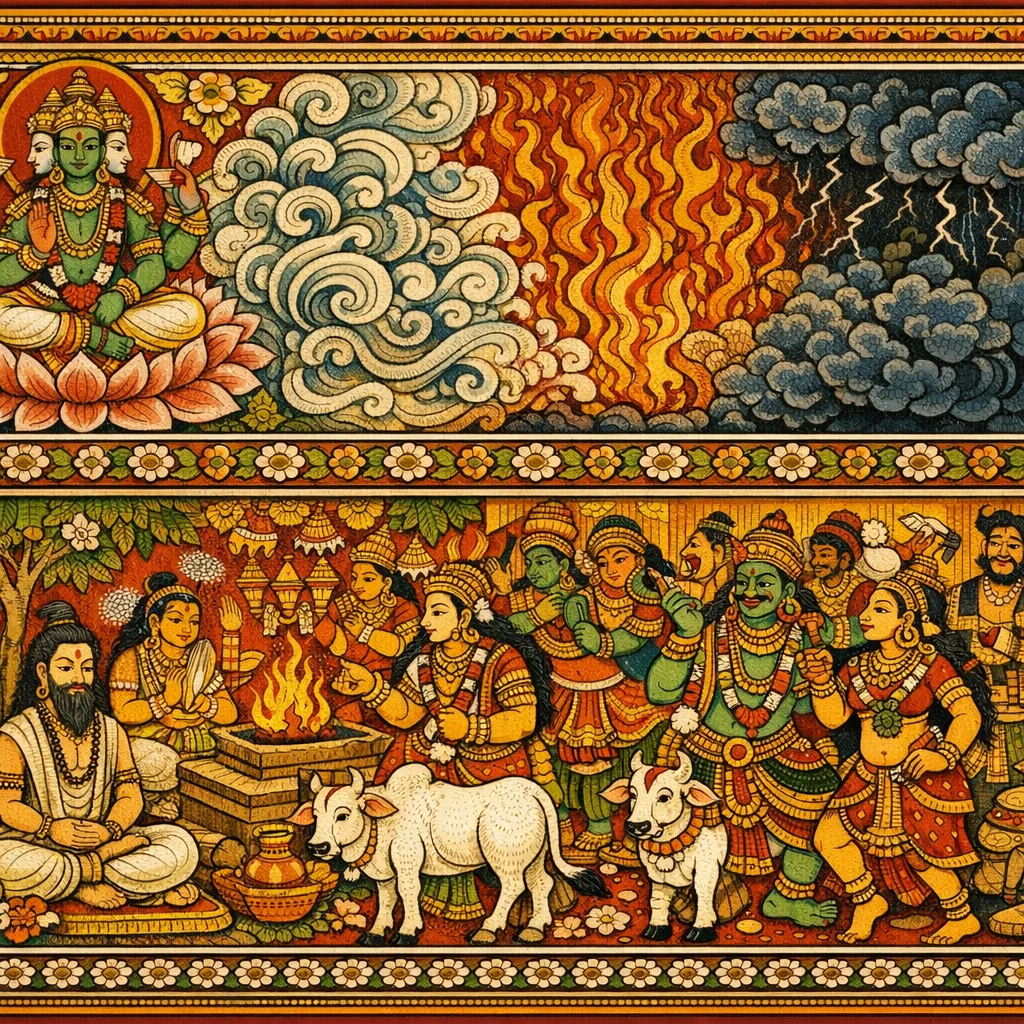
Matsya continues a didactic samvāda with the king, defining yuga measures including sandhyā and sandhyāṃśa, and describing the ethical-social state of each age: Kṛta is dharma-complete with stable varṇa duties; Tretā and Dvāpara become progressively distorted; Kali is adharma-dominant, with truth, austerity, vows, and the āśramas weakened and inverted. He then places these ages within the larger cosmological clock—12,000 divine years per mahāyuga and 1,000 mahāyugas per day of Brahmā—and explains the end-of-day dissolution (pralaya), when the Lord withdraws the elements, manifesting as sun, wind, fire, and cloud to dismantle embodied life and the worlds.
Key Concepts
Shlokas in Adhyaya 165
Verse 1
*मत्स्य उवाच चत्वार्याहुः सहस्राणि वर्षाणां तु कृतं युगम् तस्य तावच्छती संध्या द्विगुणा रविनन्दन //
Matsya said: The sages declare that the Kṛta Yuga consists of four thousand years. Its twilight period (sandhyā) is of that many hundreds of years, and the concluding twilight (sandhyāṃśa) is twice that, O descendant of the Sun.
Verse 2
यत्र धर्मश्चतुष्पादस् त्व् अधर्मः पादविग्रहः स्वधर्मनिरताः सन्तो जायन्ते यत्र मानवाः //
Where Dharma stands firm on all four feet, while Adharma is crippled—deprived of its footing—there are born virtuous people devoted to their own rightful duties.
Verse 3
विप्राः स्थिता धर्मपरा राजवृत्तौ स्थिता नृपाः कृष्यामभिरता वैश्याः शूद्राः शुश्रूषवः स्थिताः //
Brahmins remain firmly devoted to dharma; kings remain established in the proper conduct of rule; Vaishyas remain engaged in agriculture; and Shudras remain steady in service and attendance.
Verse 4
तदा सत्यं च शौचं च धर्मश्चैव विवर्धते सद्भिराचरितं कर्म क्रियते ख्यायते च वै //
Then truthfulness and purity increase, and dharma flourishes as well; the deeds practiced by the virtuous are performed (by others) and indeed become widely renowned.
Verse 5
एतत्कार्तयुगं वृत्तं सर्वेषामपि पार्थिव प्राणिनां धर्मसङ्गानाम् अपि वै नीचजन्मनाम् //
O king, such was the conduct of the Kṛta (Satya) Yuga: for all living beings—indeed even for those of low birth—there was association with Dharma (righteousness) and adherence to it.
Verse 6
त्रीणि वर्षसहस्राणि त्रेतायुगमिहोच्यते तस्य तावच्छती संध्या द्विगुणा परिकीर्त्यते //
Here, the Tretā Yuga is said to last three thousand years; its twilight period (sandhyā) is stated to be of that many hundreds, and the concluding twilight (sandhyāṃśa) is declared to be double that.
Verse 7
द्वाभ्यामधर्मः पादाभ्यां त्रिभिर्धर्मो व्यवस्थितः यत्र सत्यं च सत्त्वं च त्रेताधर्मो विधीयते //
In the Tretā age, adharma stands on two feet, while dharma is established on three. There, truthfulness and purity of being (sattva) prevail—thus the dharma of Tretā is ordained.
Verse 8
त्रेतायां विकृतिं यान्ति वर्णास्त्वेते न संशयः चातुर्वर्ण्यस्य वैकृत्याद् यान्ति दौर्बल्यमाश्रमाः //
In the Tretā Yuga, these social classes (varṇas) indeed fall into distortion—there is no doubt. And because the fourfold social order becomes corrupted, the stages of life (āśramas) also lapse into weakness and decline.
Verse 9
एषा त्रेतायुगगतिर् विचित्रा देवनिर्मिता द्वापरस्य तु या चेष्टा तामपि श्रोतुमर्हसि //
“Such is the wondrous course of the Tretā Yuga, fashioned by the gods. Now you should also hear about the mode of conduct that belongs to the Dvāpara Yuga.”
Verse 10
द्वापरं द्वे सहस्रे तु वर्षाणां रविनन्दन तस्य तावच्छती संध्या द्विगुणा युगमुच्यते //
O descendant of the Sun (Ravinandana), the Dvāpara Yuga lasts for two thousand years; its twilight period (sandhyā) is of the same measure in hundreds, and the yuga is said to be double when the junctions (dawn and dusk) are included.
Verse 11
तत्र चार्थपराः सर्वे प्राणिनो रजसा हताः सर्वे नैष्कृतिकाः क्षुद्रा जायन्ते रविनन्दन //
There, all living beings become wholly intent on material gain, struck down by passion (rajas). All are born petty and unscrupulous—O son of the Sun (Ravi).
Verse 12
द्वाभ्यां धर्मः स्थितः पद्भ्याम् अधर्मस्त्रिभिरुत्थितः विपर्ययाच्छनैर्धर्मः क्षयमेति कलौ युगे //
In the Kali Yuga, Dharma stands only on two feet, while Adharma rises on three. Through this reversal, Dharma gradually declines and goes to ruin.
Verse 13
ब्राह्मण्यभावस्य ततस् तथौत्सुक्यं विशीर्यते व्रतोपवासास्त्यज्यन्ते द्वापरे युगपर्यये //
Then the very disposition of brahminical virtue declines, and with it the zeal for sacred duties withers away; at the close of the Dvāpara Yuga, vows and fasts are abandoned.
Verse 14
तथा वर्षसहस्रं तु वर्षाणां द्वे शते अपि संध्यया सह संख्यातं क्रूरं कलियुगं स्मृतम् //
Likewise, Kali-yuga is remembered as a cruel age, reckoned together with its twilight period (sandhyā) as one thousand years plus a further two hundred years.
Verse 15
यत्राधर्मश्चतुष्पादः स्याद्धर्मः पादविग्रहः कामिनस्तपसा हीना जायन्ते तत्र मानवाः //
Where unrighteousness stands firm on all four legs, and righteousness is left crippled—reduced to a single, broken footing—there human beings are born driven by desire, and devoid of austerity and self-discipline.
Verse 16
नैवातिसात्त्विकः कश्चिन् न साधुर्न च सत्यवाक् नास्तिका ब्रह्मभक्ता वा जायन्ते तत्र मानवाः //
There, no one is truly sāttvika; none is virtuous or even truthful in speech. In that place (or time), people are born either as unbelievers (nāstikas) or as devotees of Brahman (the Supreme).
Verse 17
अहंकारगृहीताश्च प्रक्षीणस्नेहबन्धनाः विप्राः शूद्रसमाचाराः सन्ति सर्वे कलौ युगे //
In the Kali age, all brāhmaṇas become seized by ego; their bonds of affection are worn away, and they adopt the conduct and manners associated with śūdras.
Verse 18
आश्रमाणां विपर्यासः कलौ सम्परिवर्तते वर्णानां चैव संदेहो युगान्ते रविनन्दन //
In the age of Kali, the order of the āśramas becomes inverted and thoroughly disturbed; and at the end of the age, O son of the Sun, even the distinctions of the varṇas fall into doubt and confusion.
Verse 19
विद्याद्द्वादशसाहस्रीं युगाख्यां पूर्वनिर्मिताम् एवं सहस्रपर्यन्तं तदहर्ब्राह्ममुच्यते //
One should understand the Yuga—previously established—as consisting of twelve thousand (years, in divine reckoning). In this manner, up to a thousand (such Yugas), that total is called a ‘day of Brahmā’.
Verse 20
ततो ऽहनि गते तस्मिन् सर्वेषामेव जीविनाम् शरीरनिर्वृतिं दृष्ट्वा लोकसंहारबुद्धितः //
Then, when that day had passed, seeing that the bodies of all living beings had become inert and lifeless, he—concluding in his mind that the dissolution of the world had arrived—became convinced of universal destruction.
Verse 21
देवतानां च सर्वासां ब्रह्मादीनां महीपते दैत्यानां दानवानां च यक्षराक्षसपक्षिणाम् //
O king, (this pertains) to all the gods beginning with Brahmā, and also to the Daityas and Dānavas, and to the Yakṣas, Rākṣasas, and the bird-like beings.
Verse 22
गन्धर्वाणामप्सरसां भुजंगानां च पार्थिव पर्वतानां नदीनां च पशूनां चैव सत्तम तिर्यग्योनिगतानां च सत्त्वानां कृमिणां तथा //
“Of the Gandharvas and Apsarases, of the serpents too, O best of kings; of the mountains and rivers upon the earth; and of beasts as well—indeed, of all creatures belonging to the animal realm, including worms likewise.”
Verse 23
महाभूतपतिः पञ्च हृत्वा भूतानि भूतकृत् जगत्संहरणार्थाय कुरुते वैशसं महत् //
The Lord of the five great elements—the Creator of beings—withdraws the elements back into Himself; for the purpose of dissolving the world, He brings about a vast and dreadful destruction.
Verse 24
भूत्वा सूर्यश्चक्षुषी चाददानो भूत्वा वायुः प्राणिनां प्राणजालम् भूत्वा वह्निर्निर्दहन्सर्वलोकान् भूत्वा मेघो भूय उग्रो ऽप्यवर्षत् //
Becoming the Sun, he seized away the eyes (the power of sight); becoming the Wind, he drew out the very web of living beings’ breath; becoming Fire, he burned all the worlds; and becoming a cloud once more—fierce indeed—he poured down rain again.
Frequently Asked Questions
Adhyāya 165 teaches that cosmic time (yugas and Brahmā’s day) and human order (dharma, truth, purity, varṇa-āśrama conduct) mirror each other: as yugas progress, dharma loses its “feet,” social duties distort, and spiritual disciplines like vows and fasting decline—culminating in Kali. The chapter then frames this moral decline within the larger cosmological cycle, explaining that after a thousand yuga-cycles (a day of Brahmā), dissolution begins as the Lord withdraws the elements back into Himself.
This chapter is primarily Dharma and Creation/Cosmology. It details yuga-dharma (ethical and social characteristics of Kṛta, Tretā, Dvāpara, Kali), the degeneration of varṇa-āśrama norms, and the cosmological calculation of mahāyuga and Brahmā’s day, followed by pralaya (world dissolution) through elemental withdrawal. Vāstu or architectural prescriptions are not the focus in Adhyāya 165.
Matsya uses a ‘feet’ metaphor: in Kṛta, dharma is fully established (four feet) and adharma is crippled; in Tretā, dharma stands on three while adharma gains strength; in Dvāpara, beings become rajas-driven and artha-focused; and in Kali, adharma rises strongly while dharma is reduced and declines further, with truthfulness, austerity, and disciplined conduct becoming rare.