Adhyaya 89: The Rite of Donating the ‘Mountain of Ghee’ (Ghṛtācala-dāna) and Its Shaiva Merit
घृताचलदानविधिः
Speaker: ईश्वर (The Lord), Implied listener within the Purāṇic dialogue frame
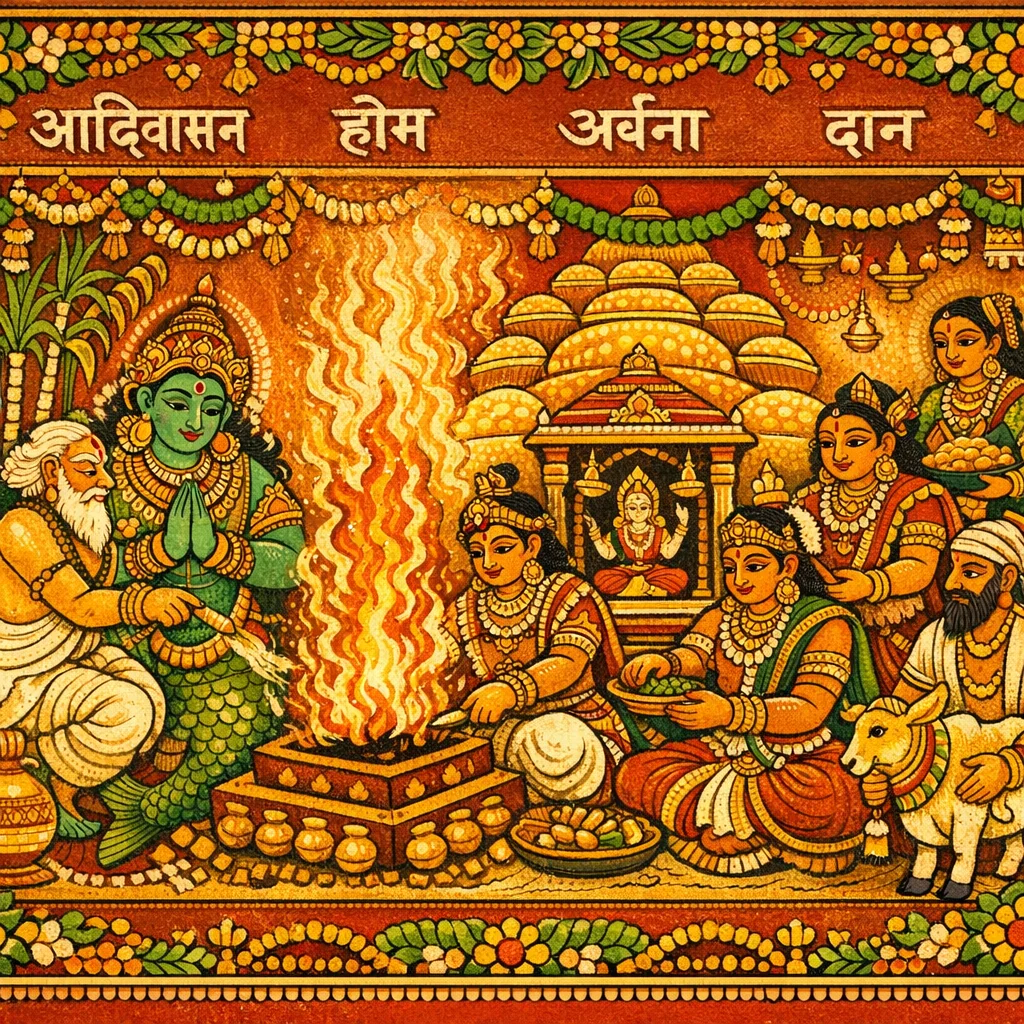
The Lord continues in a prescriptive voice, proclaiming the unsurpassed Ghṛtācala—the “Mountain of Ghee”—as a sin-destroying rite. He sets three grades by the number of ghee pots, and offers a workable option for modest means by proportionally reducing the viṣkambha/parvata components. He details the auspicious setup: rice bowls placed on a kumbha, a compact raised mound wrapped in white cloth, adorned with sugarcane and fruits, with the remaining material shaped like a mountain of grain. After adhivāsana, homa, and worship of the deities, the donor presents the Ghṛtācala at dawn to the guru and similarly apportions shares to the ṛtviks. Grounding the rite in Shaiva theology—ghee as tejas and ambrosia—he promises the फल: attainment of Śaṅkara-loka and celestial enjoyment until the end-of-cycle dissolution.
Key Concepts
Shlokas in Adhyaya 89
Verse 1
*ईश्वर उवाच अतः परं प्रवक्ष्यामि घृताचलमनुत्तमम् तेजो ऽमृतमयं दिव्यं महापातकनाशनम् //
The Lord said: “Now I shall declare the unsurpassed Ghṛtācala—divine, radiant, made of deathless essence, and a destroyer of the gravest sins.”
Verse 2
विंशत्या घृतकुम्भानाम् उत्तमः स्याद्घृताचलः दशभिर्मध्यमः प्रोक्तः पञ्चभिस्त्वधमः स्मृतः //
A ‘mountain of ghee’ (ghṛtācala) is considered the best when it consists of twenty pots of ghee; with ten it is declared to be of middling grade; and with five it is remembered as the lowest grade.
Verse 3
अल्पवित्तो ऽपि यः कुर्याद् द्वाभ्यामिह विधानतः विष्कम्भपर्वतांस्तद्वच् चतुर्भागेण कल्पयेत् //
Even a person of limited means, if he undertakes (the construction) here according to the prescribed method, may make the viṣkambha-parvatas with only two parts; likewise, he should proportion and arrange them by dividing into four parts (a quarter-based scheme).
Verse 4
शालितण्डुलपात्राणि कुम्भोपरि निवेशयेत् कारयेत्संहतानुच्चान् यथाशोभं विधानतः //
One should place the bowls containing rice-grains upon the ritual pot (kumbha), arranging them compactly and slightly raised, according to the prescribed method, so that the arrangement appears auspicious and pleasing.
Verse 5
वेष्टयेच्छुक्लवासोभिर् इक्षुदण्डफलादिकैः धान्यपर्वतवच्छेषं विधानमिह पठ्यते //
One should wrap (it) with white cloths, together with sugarcane-stalks, fruits, and the like; and whatever remains should be arranged like a “mountain of grains”—such is the procedure taught here.
Verse 6
अधिवासनपूर्वं च तद्वद्धोमसुरार्चनम् प्रभातायां तु शर्वर्यां गुरवे तं निवेदयेत् विष्कम्भपर्वतांस्तद्वद् ऋत्विग्भ्यः शान्तमानसः //
After first performing the rite of adhivāsana, one should likewise carry out the fire-offering (homa) and the worship of the deities. Then, at daybreak after the night, with a composed mind, he should present it to the preceptor (guru); and in the same manner he should offer the viṣkambha and parvata portions to the officiating priests (ṛtvij).
Verse 7
संयोगाद्घृतमुत्पन्नं यस्मादमृततेजसोः तस्माद्धृतार्चिर्विश्वात्मा प्रीयतामत्र शंकरः //
Since ghee (ghṛta) arises from the union of those two radiant, ambrosial essences, therefore may Śaṅkara—whose flame is fed by ghee, the Self of the universe—be pleased here by this offering.
Verse 8
यस्मात्तेजोमयं ब्रह्म घृते तद्विद्ध्यवस्थितम् घृतपर्वतरूपेण तस्मात्त्वं पाहि नो ऽनिशम् //
Since the radiant Brahman is to be known as abiding in ghee (ghṛta), and since You manifest in the form of a “mountain of ghee,” therefore protect us unceasingly.
Verse 9
अनेन विधिना दद्याद् घृताचलमनुत्तमम् महापातकयुक्तो ऽपि लोकमाप्नोति शांकरम् //
If one gives the unsurpassed “mountain of ghee” (ghṛtācala) according to this prescribed procedure, then even a person burdened with great sins attains the world of Śaṅkara (Śiva).
Verse 10
हंससारसयुक्तेन किङ्किणीजालमालिना विमानेनाप्सरोभिश्च सिद्धविद्याधरैर् वृतः विहरेत्पितृभिः सार्धं यावदाभूतसंप्लवम् //
Mounted in a celestial chariot (vimāna) yoked with swans (haṃsa) and sārasas (cranes), adorned with garlands of tinkling bells, and surrounded by apsarases as well as Siddhas and Vidyādharas, he would sport together with the Pitṛs (ancestral spirits) until the cosmic dissolution (pralaya).
Frequently Asked Questions
It teaches the prescribed method (vidhi) for performing Ghṛtācala-dāna—constructing a mountain-like offering of ghee with auspicious arrangement, completing adhivāsana, homa, and deity worship, and then donating it at dawn to the guru with portions to ṛtviks—promising Shaiva merit and expiation even for grave sins.
This chapter is primarily Dharma/ritual practice (dāna-vidhi and prāyaścitta-style expiation). It does not focus on Vastu/architecture measurements or genealogy; instead it details materials, proportions, sequencing of rites, and the spiritual फल of reaching Śaṅkara’s world.
The best (uttama) Ghṛtācala uses twenty pots of ghee, the middling (madhyama) uses ten, and the lowest (adhama) uses five. The text also allows scaled construction for those of limited means via proportional components.
Key steps include: arranging rice-grain bowls on a ritual kumbha in a compact, elevated, auspicious manner; wrapping with white cloth and decorating with sugarcane stalks and fruits; shaping remaining items like a grain-mountain; performing adhivāsana, homa, and deva-arcana; then offering to the guru at dawn and distributing viṣkambha/parvata portions to ṛtviks.