Adhyaya 74: The Kalyāṇa-Saptamī (Viśoka-Saptamī) Sun-Vow: Procedure, Mantras, and Fruits
कल्याणसप्तमी (विशोकसप्तमी) व्रतविधानम्
Speaker: Brahmā, Īśvara (the Lord)
Brahmā asks the Lord for a vrata that enables beings to cross saṃsāra and grants svarga, ārogya, and sukha. The Lord answers by teaching Saptamī observances devoted to Sūrya, declaring Kalyāṇa-saptamī/Viśoka-saptamī especially meritorious. The auspicious condition is Śukla-saptamī falling on a Sunday. He then gives the rite in order: a milk-bath, white garments, an eight-petaled lotus maṇḍala, installation of Sūrya’s names by the directions, mantra-worship and offerings (including jaggery and salt), formal dismissal, and honoring Brāhmaṇas with gifts (a sesame vessel and gold). The next day brings communal eating and further dāna (a ghee vessel, gold, and a water-pot). The observance is repeated monthly and culminates in the thirteenth month with the gift of thirteen adorned milch cows. Its fruits are total sin-removal, honor in Sūrya-loka, and abundant longevity, health, and prosperity; even hearing or reciting the account yields pāpa-kṣaya.
Key Concepts
Shlokas in Adhyaya 74
Verse 1
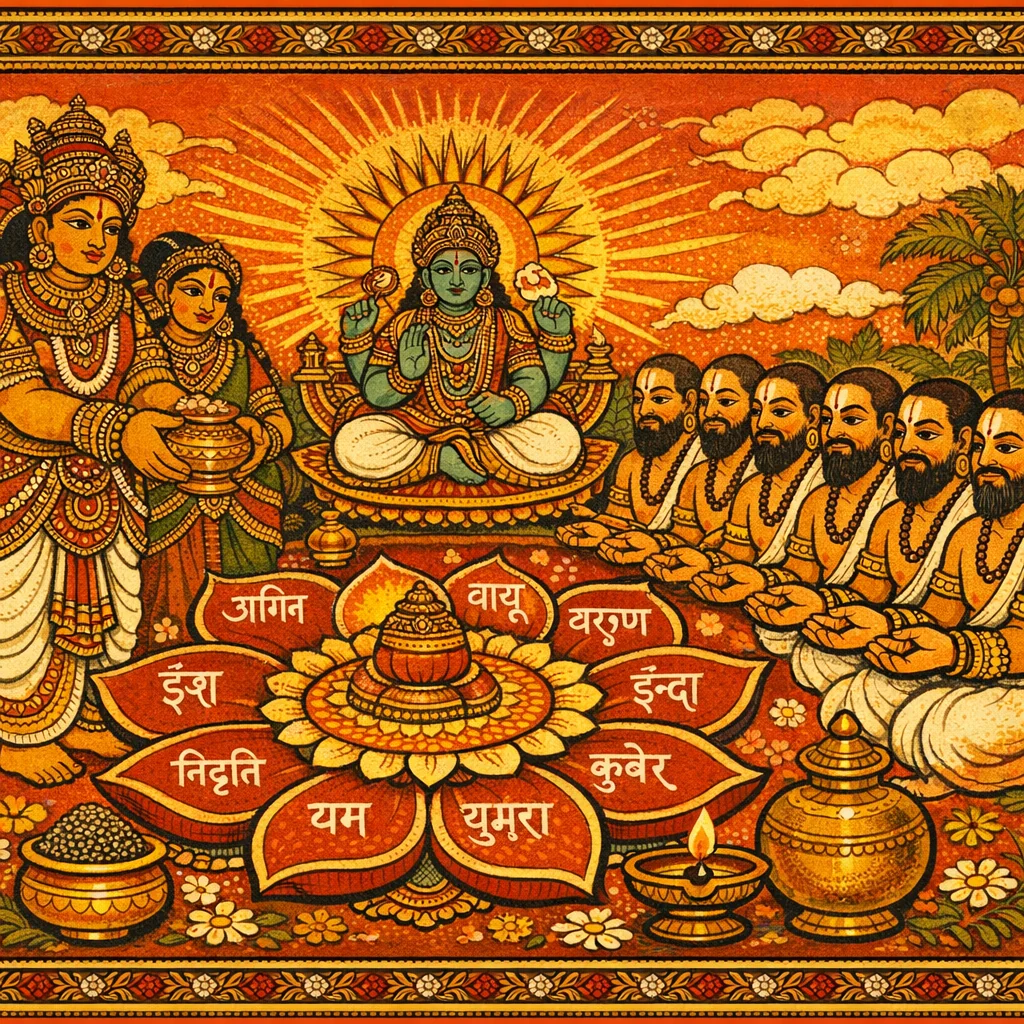
*ब्रह्मोवाच भगवन् भवसंसारसागरोत्तारकारक किंचिद्व्रतं समाचक्ष्व स्वर्गारोग्यसुखप्रदम् //
Brahmā said: “O Blessed Lord, you who cause beings to cross the ocean of saṃsāra, please describe some vow (vrata) that bestows heaven, health, and happiness.”
Verse 2
*ईश्वर उवाच सौरं धर्मं प्रवक्ष्यामि नाम्ना कल्याणसप्तमीम् विशोकसप्तमीं तद्वत् फलाढ्यां पापनाशिनीम् //
The Lord said: “I shall expound the Sun-related religious observance, named ‘Kalyāṇa-saptamī’, also called ‘Viśoka-saptamī’—rich in merit and a destroyer of sins.”
Verse 3
शर्करासप्तमीं पुण्यां तथा कमलसप्तमीम् मन्दारसप्तमीं तद्वच् छुभदां शुभसप्तमीम् //
Likewise, one should observe the meritorious Śarkarā-saptamī (Sugar-Saptamī), the Kamala-saptamī (Lotus-Saptamī), the Mandāra-saptamī, and similarly the auspicious, boon-bestowing Śubha-saptamī.
Verse 4
सर्वानन्तफलाः प्रोक्ताः सर्वा देवर्षिपूजिताः विधानमासां वक्ष्यामि यथावदनुपूर्वशः //
All these observances are declared to yield endless results; all are honored by gods and seer-sages. I shall now explain their proper procedure, correctly and in due sequence.
Verse 5
यदा तु शुक्लसप्तम्याम् आदित्यस्य दिनं भवेत् सा तु कल्याणिनी नाम विजया च निगद्यते //
But when the bright fortnight’s seventh lunar day (Śukla-saptamī) coincides with Sunday—the day of Āditya (the Sun)—that tithi is called “Kalyāṇinī,” and it is also spoken of as “Vijayā” (the victory-giving day).
Verse 6
प्रातर्गव्येन पयसा स्नानमस्यां समाचरेत् ततः शुक्लाम्बरः पद्मम् अक्षताभिः प्रकल्पयेत् //
In the morning one should bathe here with cow’s milk; then, clad in white garments, one should prepare a lotus offering with unbroken rice grains (akṣata).
Verse 7
प्राङ्मुखो ऽष्टदलं मध्ये तद्वद्वृत्तां च कर्णिकाम् पुष्पाक्षताभिर्देवेशं विन्यसेत्सर्वतः क्रमात् //
Facing east, one should arrange in the center an eight-petalled lotus, and likewise a circular pericarp (karṇikā). Then, with flowers and unbroken rice grains (akṣata), one should install the Lord of the gods on all sides in due order.
Verse 8
पूर्वेण तपनायेति मार्तण्डायेति चानले याम्ये दिवाकरायेति विधात्र इति नैरृते //
In the eastern direction he is called Tapana; in the south-east, the fire-quarter, he is called Mārtaṇḍa; in the south he is called Divākara; and in the south-west, the Nairṛta quarter, he is called Vidhātṛ.
Verse 9
पश्चिमे वरुणायेति भास्करायेति चानिले सौम्ये विकर्तनायेति रवये चाष्टमे दले //
In the western direction one should invoke (the deity) with the mantra “to Varuṇa”; in the quarter of Vāyu (the wind-direction) with “to Bhāskara”; in the northern (saumya) quarter with “to Vikartana”; and on the eighth petal (of the lotus-diagram) with “to Ravi.”
Verse 10
आदावन्ते च मध्ये च नमो ऽस्तु परमात्मने मन्त्रैरेभिः समभ्यर्च्य नमस्कारान्तदीपितैः //
At the beginning, at the end, and in the middle—may there be obeisance to the Supreme Self (Paramātman). Having duly worshipped with these mantras, made resplendent by concluding salutations, one should proceed accordingly.
Verse 11
शुक्लवस्त्रैः फलैर्भक्ष्यैर् धूपमाल्यानुलेपनैः स्थण्डिले पूजयेद्भक्त्या गुडेन लवणेन च //
With white garments, fruits, edible offerings, incense, garlands, and unguents, one should worship with devotion upon a prepared earthen altar (sthaṇḍila), offering also jaggery (guda) and salt.
Verse 12
ततो व्याहृतिमन्त्रेण विसृजेद्द्विजपुंगवान् शक्तितः पूजयेद्भक्त्या गुडक्षीरघृतादिभिः तिलपात्रं हिरण्यं च ब्राह्मणाय निवेदयेत् //
Thereafter, with the mantra of the Vyāhṛtis (the sacred utterances), he should ritually dismiss the foremost among the twice-born, the Brāhmaṇas. According to his means, he should honor them with devotion by offerings of jaggery (guda), milk, ghee (ghṛta), and the like; and he should present to a Brāhmaṇa a vessel of sesame and also gold.
Verse 13
एवं नियमकृत्सुप्त्वा प्रातरुत्थाय मानवः कृतस्नानजपो विप्रैः सहैव घृतपायसम् //
Thus, having slept after observing the prescribed restraint, the man rises in the morning; having completed his bath and recitation (japa), he then (offers/partakes of) ghee-rich pāyasa (rice cooked in milk) together with the Brāhmaṇas.
Verse 14
भुक्त्वा च वेदविदुषे बिडालव्रतवर्जिते घृतपात्रं सकनकं सोदकुम्भं निवेदयेत् //
After eating, one should present to a Veda-knowing learned man—free from the “cat-like vow” (biḍāla-vrata, hypocritical conduct)—a vessel of ghee (ghṛta) together with gold, and a water-pot filled with water.
Verse 15
प्रीयतामत्र भगवान् परमात्मा दिवाकरः अनेन विधिना सर्वं मासि मासि व्रतं चरेत् //
May the Blessed Divākara, the Sun—Paramātman, the Supreme Self—be pleased here. Following this method, one should duly observe this vow month after month.
Verse 16
ततस्त्रयोदशे मासि गा वै दद्यात्त्रयोदश वस्त्रालंकारसंयुक्ताः सुवर्णास्याः पयस्विनीः //
Then, in the thirteenth month, one should indeed give thirteen cows—each adorned with garments and ornaments—milch cows whose faces are decorated with gold.
Verse 17
एकामपि प्रदद्याद्वा वित्तहीनो विमत्सरः न वित्तशाठ्यं कुर्वीत यतो मोहात्पतत्यधः //
Even if he has little wealth, let him give at least something, free from envy. He should not practice deceit regarding money, for through such delusion one falls downward.
Verse 18
अनेन विधिना यस्तु कुर्यात्कल्याणसप्तमीम् सर्वपापविनिर्मुक्तः सूर्यलोके महीयते आयुरारोग्यमैश्वर्यम् अनन्तमिह जायते //
Whoever performs the auspicious Kalyāṇa-Saptamī in this prescribed manner becomes freed from all sins, is honored in the realm of the Sun, and in this very world gains boundless longevity, health, and prosperity.
Verse 19
सर्वपापहरा नित्यं सर्वदैवतपूजिता सर्वदुष्टोपशमनी सदा कल्याणसप्तमी //
Kalyāṇa-Saptamī ever removes all sins; it is revered by all the gods; it pacifies every form of wickedness, and is always auspicious.
Verse 20
इमामनन्तफलदां यस्तु कल्याणसप्तमीम् शृणोति पठते चेह सर्वपापैः प्रमुच्यते //
Whoever, here in this world, listens to or recites this Kalyāṇa-Saptamī—bestowing endless fruits—becomes freed from all sins.
Frequently Asked Questions
It instructs the full procedure (vidhi) of the Sun-observance called Kalyāṇa-saptamī/Viśoka-saptamī—especially when Śukla-saptamī falls on Sunday—covering purification, lotus-maṇḍala worship with Sūrya’s directional names, Brāhmaṇa-honoring gifts, monthly repetition, and the concluding thirteenth-month cow-dāna, along with the promised fruits of sin-removal, health, longevity, and prosperity.
Primarily Dharma in the form of vrata-vidhi and dāna-ethics. It also touches a Vastu-like ritual geometry through the eight-petalled lotus maṇḍala and directional placement (dik-vinyāsa) of Sūrya’s epithets. Genealogy and creation narratives are not the focus in this chapter.
When the bright fortnight’s seventh lunar day (Śukla-saptamī) coincides with Sunday (Āditya’s day). That conjunction is called Kalyāṇinī and is also termed Vijayā.
East: Tapana; South-East: Mārtaṇḍa; South: Divākara; South-West: Vidhātṛ; West: (invoked with) “to Varuṇa”; North-West (Vāyu quarter): Bhāskara; North: Vikartana; eighth petal: Ravi.