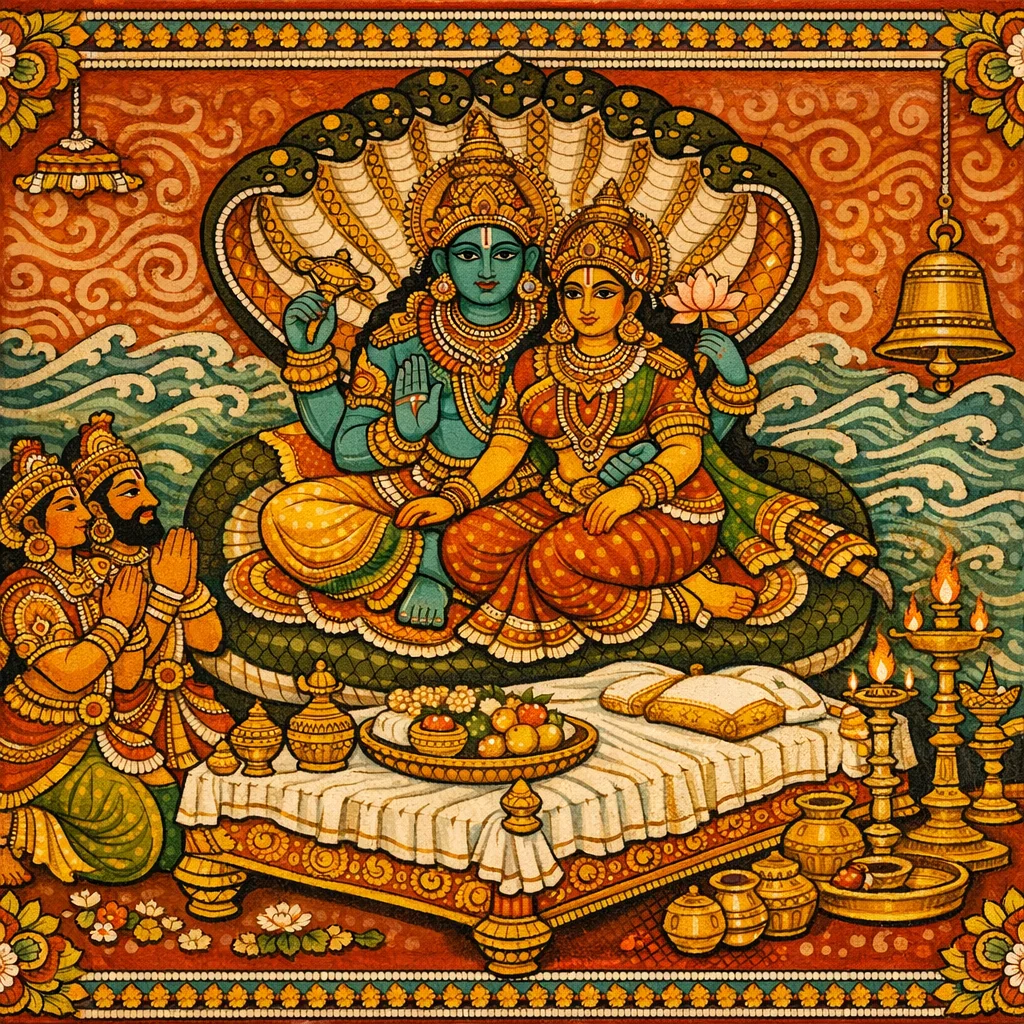
Adhyaya 71: The Aśūnyaśayana Vrata (Vow of the Unempty Bed): Worship of Viṣṇu for Marital Harmony and Household Prosperity
अशून्यशयनव्रतविधानम्
Speaker: Brahmā, Śrī Bhagavān (Keśava/Viṣṇu/Madhusūdana)
Brahmā asks about (1) expiation for a man who, through delusion or intoxication, approaches another’s wife, and (2) a dharmic means to prevent the sorrow and suffering born of separation between man and woman. The Lord replies by describing Keśava abiding with Lakṣmī in the Kṣīra-sāgara on the Dvitīyā tithi of the dark fortnight of Śrāvaṇa, declaring that worship on this day fulfills desires and yields vast merit. He names the observance Aśūnyaśayana and gives worship-mantras that pray for the safeguarding of household life, the sacred fires, the support of gods and ancestors, and unbroken marital unity. The rite is completed with devotional praise through music (or a bell), prescribed food restrictions for a set period, and an elaborate gift: a specially adorned bed with associated comforts offered to a qualified Vaiṣṇava brāhmaṇa, while honoring one’s wife and home. The chapter ends with a phala-śruti promising non-separation, continued auspiciousness, and long honor in Viṣṇu-loka.
Key Concepts
Shlokas in Adhyaya 71
Verse 1
*ब्रह्मोवाच मोहाद्वापि मदाद्वापि यः परस्त्रीं समाश्रयेत् तस्यापि निष्कृतिं देव वद सर्वकृपाकर //
Brahmā said: O God, even if a man, through delusion or intoxication, approaches another man’s wife—tell me the expiation (niṣkṛti) for him as well, O you who are the source of all compassion.
Verse 2
भगवन्पुरुषस्येह स्त्रियाश्च विरहादिकम् शोकव्याधिभयं दुःखं न भवेद्येन तद्वद //
O Blessed Lord, please explain that by which, in this world, a man and a woman may not fall into grief, illness, fear, and suffering arising from separation and similar causes.
Verse 3
*श्रीभगवानुवाच श्रावणस्य द्वितीयायां कृष्णायां मधुसूदनः क्षीरार्णवे सपत्नीकः सदा वसति केशवः //
The Blessed Lord said: On the second lunar day (Dvitiya) of the dark fortnight in the month of Śrāvaṇa, Madhusūdana—Keśava—ever dwells in the Ocean of Milk, together with His consort.
Verse 4
तस्यां सम्पूज्य गोविन्दं सर्वान्कामान्समश्नुते गोभूहिरण्यदानादि सप्तकल्पशतानुगम् //
By duly worshipping Govinda there, one attains the fulfilment of all desires; and the merit of gifts—such as cows, land, and gold—follows the devotee for seven hundred kalpas.
Verse 5
अशून्यशयनं नाम द्वितीया संप्रकीर्तिता तस्यां सम्पूजयेद्विष्णुम् एभिर्मन्त्रैर्विधानतः //
The second lunar day is proclaimed as the rite called “Aśūnyaśayana” (the vow of an unempty bed). On that day, one should duly worship Lord Viṣṇu, employing these mantras according to the prescribed procedure.
Verse 6
श्रीवत्सधारिञ्छ्रीकान्त श्रीधामञ्छ्रीपते ऽव्यय गार्हस्थ्यं मा प्रणाशं मे यातु धर्मार्थकामदम् //
O bearer of the Śrīvatsa mark, O beloved of Śrī, O abode of splendor—O Lord of Lakṣmī, imperishable One—may my householder life not come to ruin; may it remain for me as the giver of dharma, artha, and kāma.
Verse 7
अग्नयो मा प्रणश्यन्तु देवताः पुरुषोत्तम पितरो मा प्रणश्यन्तु मास्तु दाम्पत्यभेदनम् //
O Puruṣottama, may my sacred fires not perish; may the deities not forsake me; may my ancestors (pitṛs) not be lost to me—and may there never be a rupture in my marital union.
Verse 8
लक्ष्म्या वियुज्यते देव न कदाचिद्यथा भवान् तथा कलत्रसम्बन्धो देव मा मे वियुज्यताम् //
O Lord, just as You are never, at any time, separated from Lakṣmī, so too—O God—may my bond with my spouse never be severed.
Verse 9
लक्ष्म्या न शून्यो वरद शय्यां त्वं शयनं गतः शय्या ममाप्यशून्यास्तु तथैव मधुसूदन //
O bestower of boons, when You go to rest upon the couch, may it not be empty of Lakṣmī. And may my own couch likewise not be devoid (of You), O Madhusūdana.
Verse 10
गीतवादित्रनिर्घोषं देवदेवस्य कीर्तयेत् घण्टा भवेदशक्तस्य सर्ववाद्यमयी यतः //
One should glorify Devadeva with the resonant sounds of singing and musical instruments. If one is unable (to arrange many instruments), a bell may be used instead, for the bell is regarded as embodying the essence of all instruments.
Verse 11
एवं सम्पूज्य गोविन्दम् अश्नीयात्तैलवर्जितम् नक्तमक्षारलवणं यावत्तत्स्याच्चतुष्टयम् //
Thus, having duly worshipped Govinda, one should eat food free from oil; and one should take the night-meal without alkaline additives (akṣāra) and without salt—maintaining this discipline for a set of four (days/nights).
Verse 12
ततः प्रभाते संजाते लक्ष्मीपतिसमन्विताम् दीपान्नभाजनैर्युक्तां शय्यां दद्याद्विलक्षणाम् //
Then, when morning has come, one should present as a gift an exceptional bed—adorned with (the image of) Viṣṇu, the Lord of Lakṣmī, and furnished with lamps and vessels of food.
Verse 13
पादुकोपानहच्छत्त्रचामरासनसंयुताम् अभीष्टोपस्करैर्युक्तां शुक्लपुष्पाम्बरावृताम् //
Furnished with sandals and shoes, a parasol, a chāmara (fly-whisk), and a seat—provided with all desired accessories—the offering should be covered with white flowers and clothed in white garments.
Verse 14
सोपधानकविश्रामां फलैर्नानाविधैर्युताम् तथाभरणधान्यैश्च यथाशक्त्या समन्विताम् //
One should provide it with pillows and a place of rest, supply many kinds of fruits, and also, according to one’s capacity, accompany it with ornaments and grains.
Verse 15
अव्यङ्गाङ्गाय विप्राय वैष्णवाय कुटुम्बिने दातव्या वेदविदुषे भावेनापतिताय च //
One should give charity to a brāhmaṇa whose limbs are unimpaired, who is a Vaiṣṇava devoted to Viṣṇu, a householder, learned in the Vedas, and not fallen from right conduct—giving with sincere faith and reverence.
Verse 16
तत्रोपविश्य दाम्पत्यम् अलंकृत्य विधानतः पत्न्यास्तु भाजनं दद्याद् भक्ष्यभोज्यसमन्वितम् //
Seated there, the husband should, according to the prescribed rule, honor and adorn the marital state; and he should then give his wife a vessel filled with both dainties (snacks) and foods for the meal.
Verse 17
ब्राह्मणस्यापि सौवर्णीम् उपस्करसमन्विताम् प्रतिमां देवदेवस्य सोदकुम्भां निवेदयेत् //
One should offer, even to a Brāhmaṇa, a golden image of the God of gods, furnished with the requisite accessories, together with a water-pot.
Verse 18
एवं यस्तु पुमान्कुर्याद् अशून्यशयनं हरेः वित्तशाठ्येन रहितो नारायणपरायणः //
Thus, the man who performs Hari’s Aśūnyaśayana observance—free from deceit regarding wealth and wholly devoted to Nārāyaṇa—truly fulfills this rite and its intended merit.
Verse 19
न तस्य पत्न्या विरहः कदाचिदपि जायते नारी वा विधवा ब्रह्मन् यावच्चन्द्रार्कतारकम् न विरूपौ न शोकार्तौ दम्पती भवतः क्वचित् //
O Brahman, for him there never arises separation from his wife; the woman does not become a widow so long as the moon, sun, and stars endure. The couple is never disfigured, nor afflicted by grief, at any time.
Verse 20
न पुत्रपशुरत्नानि क्षयं यान्ति पितामह सप्त कल्पसहस्राणि सप्त कल्पशतानि च कुर्वन्नशून्यशयनं विष्णुलोके महीयते //
O Grandsire, neither sons, nor cattle, nor jewels go to ruin. By performing Aśūnyaśayana—making the bed not empty, that is, offering a bed to a worthy person—one is honored in Viṣṇu’s world for seven thousand kalpas and also seven hundred kalpas.
Frequently Asked Questions
The chapter primarily teaches the Aśūnyaśayana Vrata, a Vaiṣṇava observance performed on the Kṛṣṇa-pakṣa Dvitīyā of Śrāvaṇa. Through Keśava–Lakṣmī worship, specific mantras, disciplined conduct, and śayyā-dāna (gift of an auspicious bed and comforts) to a worthy Vaiṣṇava brāhmaṇa, the practitioner seeks protection of household life and freedom from marital separation, grief, and misfortune.
Adhyāya 71 is primarily Dharma-focused, especially vrata-vidhi (ritual observance), household ethics (gārhasthya), and dāna (charity). It does not teach Vāstu measurements, Rājadharma/statecraft, or genealogies here; instead it centers on Viṣṇu–Lakṣmī devotion, marital auspiciousness, and the ritual logic of preventing separation-related suffering.