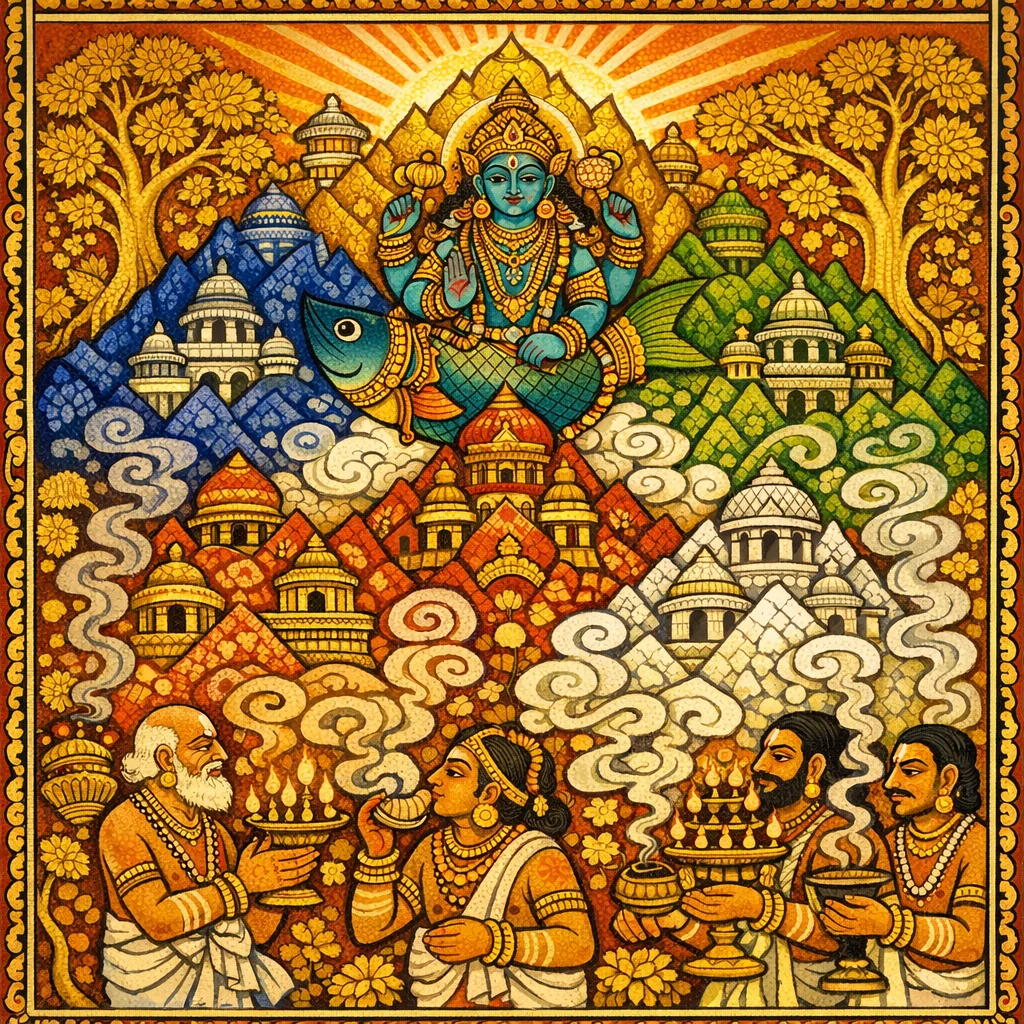
Adhyaya 90: Ritual Procedure and Merit of Donating the Ratnācala (Gem-Mountain)
रत्नाचलदानविधिः
Speaker: Īśvara (Lord), King (Narādhipa)
Continuing the dāna-centered instruction, the Lord speaks to the king and presents the Ratnācala, an unsurpassed symbolic mountain fashioned of jewels. He defines size classes with proportionate side-mountains, and prescribes a directional plan for Gandhamādana, assigning distinct gems to each quarter. The rite is to be arranged like earlier “mountain” gifts (especially the grain-mountain), then followed by āvāhana of golden trees and deities, morning worship with flowers and fragrances, and mantra recitation to the guru and priests. The chapter ends with mantric praise of the steadfast jewel-mountain and a phala-śruti: gem-dāna pleases Hari, grants Viṣṇu’s world, enduring prosperity and rulership, and destroys even grievous sins.
Key Concepts
Shlokas in Adhyaya 90
Verse 1
*ईश्वर उवाच अतः परं प्रवक्ष्यामि रत्नाचलमनुत्तमम् मुक्ताफलसहस्रेण पर्वतः स्यादनुत्तमः //
The Lord said: “Now, next, I shall describe the unsurpassed Ratnācala (Gem-Mountain). A mountain endowed with thousands of pearls is indeed called ‘unsurpassed.’”
Verse 2
मध्यमः पञ्चशतिकस् त्रिशतेनाधमः स्मृतः चतुर्थांशेन विष्कम्भपर्वताः स्युः समन्ततः //
The ‘middling’ measure is said to be five hundred (yojanas), and the ‘lower’ measure is remembered as three hundred. On every side, the Viṣkambha mountains are to be measured by one-fourth of the relevant standard.
Verse 3
पूर्वेण वज्रगोमेदैर् दक्षिणेनेन्द्रनीलकैः पद्मरागयुतः कार्यो विद्वद्भिर्गन्धमादनः //
The wise should fashion (or delineate) Gandhamādana so that on its eastern side are diamond and gomeda gems, on its southern side Indranīla (blue sapphire), and it is furnished with padmarāga (ruby).
Verse 4
वैदूर्यविद्रुमैः पश्चात् सम्मिश्रो विमलाचलः पद्मरागैः ससौवर्णैर् उत्तरेण च विन्यसेत् //
To the west, one should place the Vimalācala stone mixed with vaidūrya (cat’s-eye) and vidruma (coral); and to the north, one should set padmarāga (ruby) together with gold.
Verse 5
धान्यपर्वतवत्सर्वम् अत्रापि परिकल्पयेत् तद्वदावाहनं कुर्याद् वृक्षान्देवांश्च काञ्चनान् //
Here too, one should arrange everything in the manner of a “mountain of grain”; and in the same way one should perform the āvāhana (invocation) of the trees and of the deities fashioned in gold.
Verse 6
पूजयेत्पुष्पगन्धाद्यैः प्रभाते च विमत्सरः पूर्ववद्गुरुऋत्विग्भ्य इमान्मन्त्रानुदीरयेत् //
Free from envy, one should worship in the morning with flowers, fragrances, and the like; and then, as prescribed earlier, one should recite these mantras to the guru and the officiating priests (ṛtvij).
Verse 7
यदा देवगणाः सर्वे सर्वरत्नेष्ववस्थिताः त्वं च रत्नमयो नित्यं नमस्ते ऽस्तु सदाचल //
When all the hosts of gods abide amid every kind of jewel, you too—ever formed of jewels—remain the eternally unmoving One. Salutations to you, O steadfast mountain!
Verse 8
यस्माद्रत्नप्रदानेन तुष्टिं प्रकुरुते हरिः सदा रत्नप्रदानेन तस्मान्नः पाहि पर्वत //
Since Hari (Viṣṇu) is ever pleased by the gift of gems, therefore, O Parvata, protect us—who are devoted to the giving of jewels.
Verse 9
अनेन विधिना यस्तु दद्याद्रत्नमयं गिरिम् स याति विष्णुसालोक्यम् अमरेश्वरपूजितः //
Whoever, following this prescribed procedure, donates a “mountain” made of jewels attains Viṣṇu-sālokya—residence in the same world as Viṣṇu—honored and worshipped by the lordly gods.
Verse 10
यावत्कल्पशतं साग्रं वसेच्चेह नराधिप रूपारोग्यगुणोपेतः सप्तद्वीपाधिपो भवेत् //
O king, he who dwells here for a full hundred kalpas (and more) becomes endowed with beauty, health, and excellence of character, and attains sovereignty over the seven continents (saptadvīpas).
Verse 11
ब्रह्महत्यादिकं किंचिद् यदत्रामुत्र वा कृतम् तत्सर्वं नाशमायाति गिरिर्वज्रहतो यथा //
Whatever sin—beginning with brahmin-slaying—has been committed, whether in this world or in the next, all of it perishes, just as a mountain is shattered when struck by a thunderbolt (vajra).
Frequently Asked Questions
The chapter teaches the procedure (vidhi) for creating and donating a Ratnācala—an emblematic mountain made of jewels—by defining size standards, prescribing directional placement of specific gems on Gandhamādana, and completing the rite through āvāhana, morning pūjā, and mantra recitation. It frames gem-dāna as a direct means of pleasing Hari (Viṣṇu) and accruing exceptional religious merit.
The focus is primarily Dharma in the form of dāna-vidhi (ritual gifting) and its phala (results). There is also a Vāstu-like element in the directional (east/south/west/north) specification of materials—gem placement functioning like a mandalic spatial design. Genealogy and creation narratives are not central in this adhyāya.