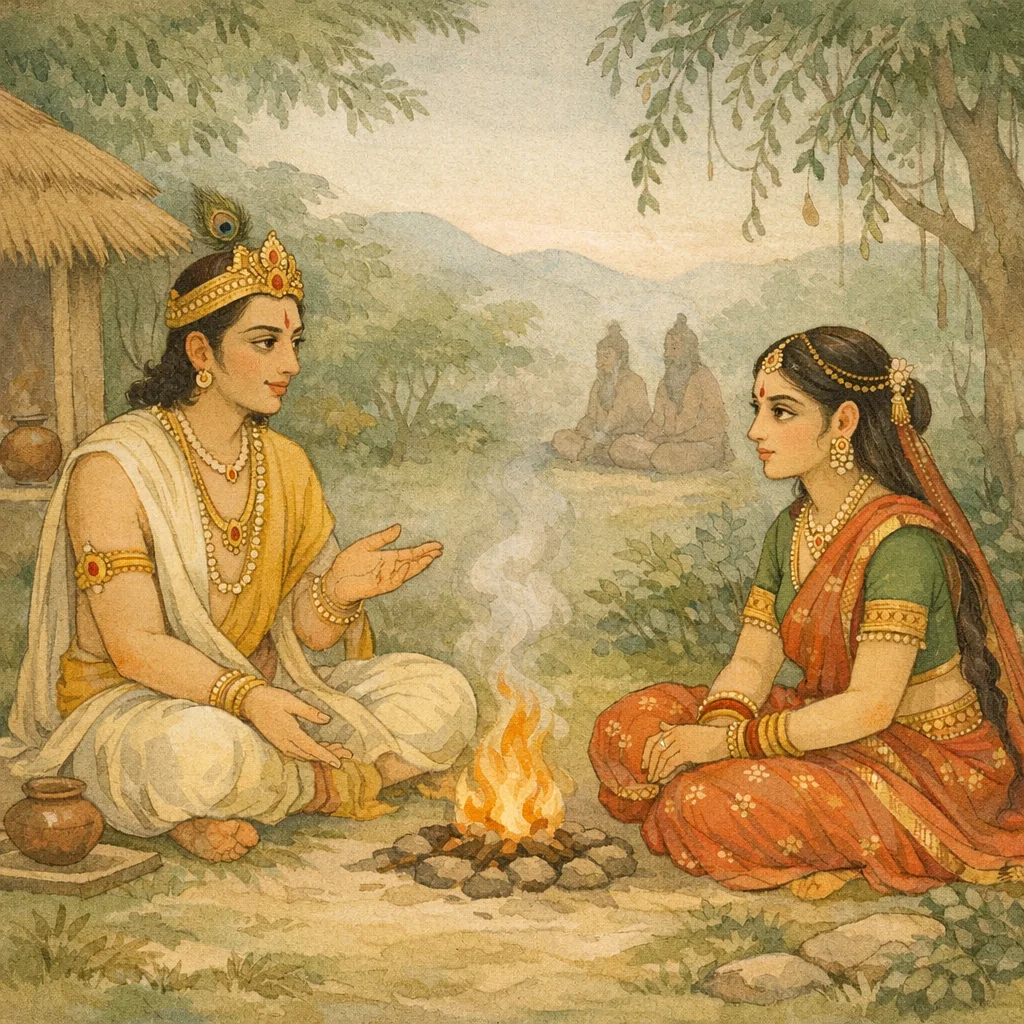
Adhyaya 31
Draupadī’s Lament and Theodicy: Dharma, Dice, and Īśvara’s Governance (Āraṇyaka-parva 31)
Upa-parva: Draupadī–Yudhiṣṭhira Saṃvāda (Determinism, Dharma, and the Dice Catastrophe)
Draupadī addresses Yudhiṣṭhira with reverence to Dhātṛ and Vidhātṛ, asserting that his disposition toward ancestral conduct has been disrupted by delusion. She observes that prosperity often does not follow from dharma, non-cruelty, patience, or straightforwardness, and highlights the disproportion between Yudhiṣṭhira’s virtue and his suffering. She catalogues his continuous dharmic practices—service to brāhmaṇas and elders, offerings to gods and ancestors, hospitality, distribution of goods, and performance of sacrifices—arguing that even in forest exile his dharma has not diminished. The discourse then introduces a ‘purātana itihāsa’ thesis: the world stands under Īśvara’s control rather than its own; Dhātṛ apportions pleasure and pain, and beings move as if constrained, like objects set in motion. Multiple metaphors (puppet-like motion, threaded jewels, wind-driven grass) illustrate determinism and limited agency. Draupadī ends by criticizing the apparent asymmetry whereby the unrighteous prosper, questioning whether Īśvara is implicated if karma does not reach its agent, and expressing compassion for the weak when power determines outcomes.
Chapter Arc: वनवास की धूलि में भी राजसभा का प्रश्न उठता है: द्रौपदी (यज्ञसेनकुमारी) अपनी वाणी की विचित्र, मनोहर पदावली से युधिष्ठिर को धर्म और भाग्य के संबंध में टटोलती है—क्या निष्काम कर्म सचमुच सार्थक है? → युधिष्ठिर अपने आचरण का आधार स्पष्ट करते हैं—वे कर्मफल की लालसा से नहीं, ‘देय है इसलिए देता हूँ, यष्टव्य है इसलिए यज्ञ करता हूँ’ इस भाव से धर्म का अनुष्ठान करते हैं; द्रौपदी के भीतर उठती पीड़ा और संशय के सामने वे शिष्टाचार-परंपरा, ऋषि-प्रमाण और गृहस्थ-धर्म की मर्यादा का स्मरण कराते हैं। → युधिष्ठिर निर्णायक वचन कहते हैं: ‘धर्म निष्फल नहीं होता, अधर्म भी फल दिए बिना नहीं रहता’—विद्या और तपस्या के प्रत्यक्ष फल जैसे दिखते हैं, वैसे ही धर्म-अधर्म का फल भी अवश्य घटित होता है; साथ ही वे द्रौपदी को ईश्वर पर आक्षेप न करने, धाता/ईश्वर को नमस्कार कर सीखने और देवताओं की गूढ़ माया तथा तपसा-शुद्ध दृष्टि की बात कहकर संशय की जड़ पर प्रहार करते हैं। → द्रौपदी के लिए धर्म को ‘प्लव’ (नाव) की उपमा देकर युधिष्ठिर आश्वस्त करते हैं—स्वर्ग/कल्याण की यात्रा में धर्म ही एकमात्र साधन है; शिष्टों द्वारा आचरित, ऋषियों द्वारा प्रतिपादित धर्म-पथ से विचलित न होने की शिक्षा देकर वे उसके मन को स्थिर करने का प्रयत्न करते हैं। → अंत में चेतावनी-स्वर उभरता है: जो आर्ष-प्रमाण को लाँघकर, धर्म का पालन न करे और शास्त्रातिग होकर मूढ़ बने, वह जन्म-जन्म में शांति नहीं पाता—यह संकेत अगले प्रसंगों में द्रौपदी के प्रश्नों और युधिष्ठिर की धर्म-व्याख्या को और तीखा बनाता है।
Shlokas
Verse 1
युधिष्ठिर बोले--यज्ञसेनकुमारी! तुमने जो बात कही है, वह सुननेमें बड़ी मनोहर, विचित्र पदावलीसे सुशोभित तथा बहुत सुन्दर है, मैंने उसे बड़े ध्यानसे सुना है। परंतु इस समय तुम (अज्ञानसे) नास्तिक मतका प्रतिपादन कर रही हो
Yudhiṣṭhira said: “O daughter of Yajñasena! What you have spoken is delightful to hear—adorned with striking turns of phrase and truly beautiful. I listened with close attention. Yet at this moment, out of ignorance, you are putting forward a nihilistic, irreligious doctrine.”
Verse 2
नाहं कर्मफलान्वेषी राजपुत्रि चराम्युत । ददामि देयमित्येव यजे यष्टव्यमित्युत,राजकुमारी! मैं कर्मोके फलकी इच्छा रखकर उनका अनुष्ठान नहीं करता; अपितु “देना कर्तव्य है” यह समझकर दान देता हूँ और यज्ञको भी कर्तव्य मानकर ही उसका अनुष्ठान करता हूँ
Yudhiṣṭhira said: “O princess, I do not act while hunting after rewards. Rather, thinking ‘it is my duty to give,’ I give; and thinking ‘it is my duty to sacrifice,’ I perform sacrifices—out of obligation to dharma, not out of desire for gain.”
Verse 3
अस्तु वात्र फल॑ मा वा कर्तव्यं पुरुषेण यत् । गृहे वा वसता कृष्णे यथाशक्ति करोमि तत्,कृष्णे! यहाँ उस कर्मका फल हो या न हो, गृहस्थ-आश्रममें रहनेवाले पुरुषका जो कर्तव्य है, मैं उसीका यथाशक्ति कर्तव्यबुद्धिसे पालन करता हूँ
Yudhiṣṭhira said: “Let there be a result here, or let there be none—whatever duty is to be done by a man, I do that, O Kṛṣṇā, to the best of my ability, with the conviction that it is my duty, even while living the householder’s life.”
Verse 4
धर्म चरामि सुश्रोणि न धर्मफलकारणात् | आगमाननतिक्रम्य सतां वृत्तमवेक्ष्य च,सुश्रोणि! मैं धर्मका फल पानेके लोभसे धर्मका आचरण नहीं करता, अपितु साधु पुरुषोंके आचार-व्यवहारको देखकर शास्त्रीय मर्यादाका उल्लंघन न करके स्वभावसे ही मेरा मन धर्मपालनमें लगा है। द्रौपदी! जो मनुष्य कुछ पानेकी इच्छासे धर्मका व्यापार करता है, वह धर्मवादी पुरुषोंकी दृष्टिमें हीन और निन्दनीय है
Yudhiṣṭhira said: “O fair-hipped one, I practice dharma not for the sake of its rewards. Rather, without transgressing the injunctions of the scriptures, and observing the conduct of the virtuous, my mind naturally inclines toward the maintenance of dharma. One who treats dharma as a transaction—practicing it with the desire to gain something—is regarded by truly dharmic people as inferior and blameworthy.”
Verse 5
धर्म एव मन: कृष्णे स्वभावाच्चैव मे धृतम् । धर्मवाणिज्यको हीनो जघन्यो धर्मवादिनाम्,सुश्रोणि! मैं धर्मका फल पानेके लोभसे धर्मका आचरण नहीं करता, अपितु साधु पुरुषोंके आचार-व्यवहारको देखकर शास्त्रीय मर्यादाका उल्लंघन न करके स्वभावसे ही मेरा मन धर्मपालनमें लगा है। द्रौपदी! जो मनुष्य कुछ पानेकी इच्छासे धर्मका व्यापार करता है, वह धर्मवादी पुरुषोंकी दृष्टिमें हीन और निन्दनीय है
Yudhiṣṭhira said: “O Kṛṣṇā (Draupadī), my mind is held fast in dharma by its very nature. I do not practice righteousness out of greed for its rewards; rather, seeing the conduct of the virtuous and without transgressing the scriptural boundaries, I remain devoted to dharma. But one who turns dharma into a trade—practicing it to gain something—is regarded by those who speak of dharma as inferior and contemptible.”
Verse 6
न धर्मफलमाप्रोति यो धर्म दोग्धुमिच्छति । यश्चैनं शड़कते कृत्वा नास्तिक्यात् पापचेतन:,जो पापात्मा मनुष्य नास्तिकतावश धर्मका अनुष्ठान करके उसके विषयमें शंका करता है अथवा धर्मको दुहना चाहता है अर्थात् धर्मके नामपर स्वार्थ सिद्ध करना चाहता है, उसे धर्मका फल बिलकुल नहीं मिलता
Yudhiṣṭhira said: “He who seeks to ‘milk’ dharma for personal gain does not obtain the fruit of dharma. And the one who, out of disbelief, performs dharma yet harbors doubt about it—being of sinful intent—likewise fails to receive its true reward.”
Verse 7
अतिवादाद् वदाम्येष मा धर्ममभिशड्किथा: । धर्माभिशड्की पुरुषस्तिर्यग्गतिपरायण:,मैं सारे प्रमाणोंसे ऊपर उठकर केवल शास्त्रके आधारपर यह जोर देकर कह रहा हूँ कि तुम धर्मके विषयमें शंका न करो; क्योंकि धर्मपर संदेह करनेवाला मानव पशु-पक्षियोंकी योनिमें जन्म लेता है
Yudhiṣṭhira said: “Rising above all arguments and resting on the authority of the śāstras alone, I say this with insistence: do not doubt dharma. For the man who doubts dharma is bound for the path of beasts.”
Verse 8
धर्मो यस्याभिशड्क््य: स्यादार्ष वा दुर्बलात्मन: | वेदाच्छूद्र इवापेयात् स लोकादजरामरात्,जो धर्मके विषयमें संदेह रखता है अथवा जो दुर्बलात्मा पुरुष वेदादि शास्त्रोंपर अविश्वास करता है, वह जरा-मृत्युरहित परमधामसे उसी प्रकार वंचित रहता है, जैसे शाद्र वेदोंके अध्ययनसे
Yudhiṣṭhira said: “If a person of weak resolve comes to doubt dharma—or even doubts the seers’ (ṛṣi) teaching—if he distrusts the Veda and the śāstras, then he is shut out from that deathless, ageless highest realm, just as a Śūdra is barred from Vedic study.”
Verse 9
वेदाध्यायी धर्मपर: कुले जातो मनस्विनि । स्थविरेषु स योक्तव्यो राजर्षिर्धर्मचारिभि:,मनस्विनि! जो वेदका अध्ययन करनेवाला, धर्मपरायण और कुलीन हो, उस राजर्षिकी गणना धर्मात्मा पुरुषोंको वृद्धोंमें करनी चाहिये (वह आयुमें छोटा हो तो भी उसका वृद्ध पुरुषके समान आदर करना चाहिये)
Yudhiṣṭhira said: “O noble-minded lady, one who studies the Veda, is devoted to dharma, and is born in a good lineage—such a royal sage should be counted among the elders by righteous people. Even if he is younger in years, he deserves the honor accorded to the aged.”
Verse 10
पापीयान् स हि शूद्रेभ्यस्तस्करेभ्यो विशिष्यते । शास्त्रातिगो मन्दबुद्धियों धर्ममभिशड्गकते,जो मन्दबुद्धि पुरुष शास्त्रोंकी मर्यादाका उल्लंघन करके धर्मके विषयमें आशंका करता है, वह शूद्रों और चोरोंसे भी बढ़कर पापी है
Yudhiṣṭhira said: “More sinful indeed is that dull-witted man who oversteps the bounds of the śāstras and then casts suspicion upon dharma; he surpasses even śūdras and thieves in wrongdoing. For by violating authoritative teaching and doubting righteousness, he undermines the very foundation of moral order.”
Verse 11
प्रत्यक्ष हि त्वया दृष्ट ऋषिर्गच्छन् महातपा: । मार्कण्डेयोडप्रमेयात्मा धर्मेण चिरजीविता,तुमने अमेयात्मा महातपस्वी मार्कण्डेयजीको जो अभी यहाँसे गये हैं, प्रत्यक्ष देखा है। उन्हें धर्मपालनसे ही चिरजीविता प्राप्त हुई है
Yudhiṣṭhira said: “For you have indeed seen with your own eyes the great ascetic sage, Mārkaṇḍeya, as he departed from here—one whose inner nature is beyond measure. It is through steadfast adherence to dharma that he has attained long life.”
Verse 12
व्यासो वसिष्ठो मैत्रेयो नारदो लोमश: शुक: । अन्ये च ऋषय: सर्वे धर्मेणैव सुचेतस:,व्यास, वसिष्ठ, मैत्रेय, नारद, लोमश, शुक तथा अन्य सब महर्षि धर्मके पालनसे ही शुद्ध हृदयवाले हुए हैं
Yudhiṣṭhira said: “Vyāsa, Vasiṣṭha, Maitreya, Nārada, Lomaśa, Śuka—and indeed all the other sages—became pure and clear-minded only through steadfast adherence to dharma.”
Verse 13
प्रत्यक्ष पश्यसि होतान् दिव्ययोगसमन्वितान् । शापानुग्रहणे शक्तान् देवेभ्योडपि गरीयस:,तुम अपनी आँखों इन सबको देखती हो, ये दिव्य योगशक्तिसे सम्पन्न, शाप और अनुग्रहमें समर्थ तथा देवताओंसे भी अधिक गौरवशाली हैं
Yudhiṣṭhira said: “You can see these officiating priests directly with your own eyes. Endowed with divine yogic power, they are capable both of cursing and of granting favor, and they are even more venerable than the gods themselves.”
Verse 14
एते हि धर्ममेवादौ वर्णयन्ति सदानघे । कर्तव्यममरप्रख्या: प्रत्यक्षागमबुद्धय:,अनघे! ये अमरोंके समान विख्यात तथा वेदगम्य विषयको भी प्रत्यक्ष देखनेवाले महर्षि धर्मको ही सबसे प्रथम आचरणमें लानेयोग्य बताते हैं
Yudhiṣṭhira said: “For these sages—spotless one—always speak first of dharma. Those who are renowned as godlike, whose understanding rests on both direct perception and authoritative tradition, declare that dharma is what must be placed foremost in practice.”
Verse 15
अतो नाहसि कल्याणि धातारं धर्ममेव च | राज्ञि मूढेन मनसा क्षेप्तुं शड्कितुमेव च,अतः कल्याणमयी महारानी द्रौपदी! तुम्हें मूर्खतायुक्त मनके द्वारा ईश्वर और धर्मपर आक्षेप एवं आशंका नहीं करनी चाहिये
Therefore, O auspicious lady, you ought not—under the sway of a deluded mind—to cast blame upon the Ordainer (Dhātṛ) or upon Dharma, nor even to harbor suspicion against them.
Verse 16
उन्मत्तान् मन्यते बाल: सर्वानागतनिश्चयान् | धर्माभिशड्को नान्यस्मात् प्रमाणमधिगच्छति,धर्मके विषयमें संशय रखनेवाला बालबुद्धि मानव जिन्हें धर्मके तत्त्वका निश्चय हो गया है, उन समस्त ज्ञानीजनोंको उन्मत्त समझता है; अतः वह बालबुद्धि दूसरे किसीसे कोई शास्त्र-प्रमाण नहीं ग्रहण करता
Yudhiṣṭhira said: “A childish person, doubting dharma, regards all those who have arrived at firm conviction about its truth as if they were mad. Therefore, with his immature understanding, he accepts no authoritative proof or testimony from anyone else regarding dharma.”
Verse 17
आत्मप्रमाण उन्नद्ध: श्रेयसो हवमन्यक: । इन्द्रियप्रीतिसम्बद्धं यदिदं लोकसाक्षिकम् । एतावन्मन्यते बालो मोहमन्यत्र गच्छति,केवल अपनी बुद्धिको ही प्रमाण माननेवाला उद्दण्ड मानव श्रेष्ठ पुरुषों एवं उत्तम धर्मकी अवहेलना करता है; क्योंकि वह मूढ़ इन्द्रियोंकी आसक्तिसे सम्बन्ध रखनेवाले इस लोक-प्रत्यक्ष दृश्य जगत्की ही सत्ता स्वीकार करता है। अप्रत्यक्ष वस्तुके विषयमें उसकी बुद्धि मोहमें पड़ जाती है
Yudhiṣṭhira said: ‘A man who takes only his own mind as the sole authority becomes arrogant and scornful of what is truly beneficial. Bound to the pleasures of the senses, he accepts as real only what this world displays to direct perception. The childish person thinks that this much alone exists; when it comes to what lies beyond the visible, his understanding strays into delusion.’
Verse 18
प्रायक्षित्तं न तस्यास्ति यो धर्ममभिशड्कते । ध्यायन् स कृपण: पापो न लोकानू् प्रतिपद्यते,जो धर्मके प्रति संदेह करता है, उसकी शुद्धिके लिये कोई प्रायश्चित्त नहीं है। वह धर्मविरोधी चिन्तन करनेवाला दीन पापात्मा पुरुष उत्तम लोकोंको नहीं पाता अर्थात् अधोगतिको प्राप्त होता है
Yudhiṣṭhira said: For one who harbors suspicion about dharma, there is no expiation. Such a person—wretched and sinful, dwelling on thoughts opposed to righteousness—does not attain the higher worlds; instead, he falls to a lower destiny.
Verse 19
प्रमाणाद्धि निवृत्तो हि वेदशास्त्रार्थनिन्दक: । कामलोभातिगो मूढो नरकं प्रतिपद्यते,जो मूर्ख प्रमाणोंकी ओरसे मुँह मोड़ लेता है, वेद और शास्त्रोंके सिद्धान्तकी निन्दा करता है तथा काम एवं लोभके अत्यन्त परायण है, वह नरकमें पड़ता है
Yudhiṣṭhira said: One who turns away from valid means of knowledge, who disparages the true purport of the Vedas and the śāstras, and who—deluded—becomes utterly driven by desire and greed, falls into hell.
Verse 20
यस्तु नित्यं कृतमतिर्धर्ममेवाभिपद्यते । अशड्कमान: कल्याणि सोअमुत्रानन्त्यमश्लुते,कल्याणी! जो सदा धर्मके विषयमें पूर्ण निश्चय रखनेवाला है और सब प्रकारकी आशंकाएँ छोड़कर धर्मकी ही शरण लेता है, वह परलोकमें अक्षय अनन्त सुखका भागी होता है अर्थात् परमात्माको प्राप्त हो जाता है
Yudhiṣṭhira said: “But the one whose resolve is steady day after day, who commits himself to Dharma alone, and who—O auspicious lady—casts aside every doubt and fear, attains in the next world an imperishable, unending state of well-being; indeed, he reaches the highest good.”
Verse 21
जो मूढ़ मानव आर्ष-पग्रन्थोंके प्रमाणकी अवहेलना करके समस्त शास्त्रोंक विपरीत आचरण करते हुए धर्मका पालन नहीं करता, वह जन्म-जन्मान्तरोंमें भी कभी कल्याणका भागी नहीं होता
Yudhiṣṭhira said: “The deluded man who scorns the authority of the ancient seers’ treatises and, acting contrary to all śāstras, fails to uphold dharma—such a person, even across repeated births, never becomes a recipient of true welfare and good fortune.”
Verse 22
यस्य नार्ष प्रमाणं स्याच्छिष्टाचारक्ष भाविनि । न वै तस्य परो लोको नायमस्तीति निश्चय:,भाविनि! जिसकी दृष्टिमें ऋषियोंके वचन और शिष्ट पुरुषोंके आचार प्रमाणभूत नहीं हैं, उसके लिये न यह लोक है और न परलोक, यह तत्त्ववेत्ता महापुरुषोंका निश्चय है
Yudhiṣṭhira said: “O noble lady, for one who does not accept the seers’ testimony as authoritative, nor the established conduct of the virtuous as a guiding standard, there is—so the knowers of truth conclude—neither this world nor the next. Such a person is left without any secure ground for life, duty, or meaning.”
Verse 23
शिष्टैराचरितं धर्म कृष्णे मा स्माभिशड्किथा: । पुराणमृषिश्रि: प्रोक्त सर्वज्ञै: सर्वदर्शिभि:,कृष्णे! सर्वज्ञ और सर्वद्रष्टा महर्षियोंद्वारा प्रतिपादित तथा शिष्ट पुरुषोंद्वारा आचरित पुरातन धर्मपर शंका नहीं करनी चाहिये
Yudhiṣṭhira said: “O Kṛṣṇā, do not doubt this dharma. It is the ancient rule of right conduct, practiced by the cultured and taught by seers who are all-knowing and all-seeing. Therefore it deserves trust and steady adherence rather than suspicion.”
Verse 24
धर्म एव प्लवो नान्य: स्वर्ग द्रौपदि गच्छताम् । सैव नौ: सागरस्येव वणिज: पारमिच्छत:,ट्रपदकुमारी! जैसे समुद्रके पार जानेकी इच्छा-वाले वणिक्के लिये जहाजकी आवश्यकता है, वैसे ही स्वर्गमें जानेवालोंके लिये धर्माचरण ही जहाज है, दूसरा नहीं
Yudhiṣṭhira said: “Dharma alone is the raft—there is no other—for those who would go to heaven, O Draupadī. Just as a merchant who longs to cross the ocean needs a ship, so too for those seeking the heavenly goal, righteous conduct itself is the only vessel.”
Verse 25
अफलो यदि धर्म: स्याच्चरितो धर्मचारिभि: | अप्रतिष्ठे तमस्येतज्जगन्मज्जेदनिन्दिते,साध्वी द्रौपदी! यदि धर्मपरायण पुरुषोंद्वारा पालित धर्म निष्फल होता तो सम्पूर्ण जगत् असीम अन्धकारमें निमग्न हो जाता
Yudhiṣṭhira said: “If dharma, practiced by those devoted to dharma, were truly fruitless, then this whole world—without any firm ground—would sink into darkness without end. O blameless, virtuous Draupadī!”
Verse 26
निर्वाणं नाधिगच्छेयुर्जीवेयु: पशुजीविकाम् | विद्यां ते नैव युज्येयुर्न चार्थ केचिदाप्रुयु:,यदि धर्म निष्फल होता तो धर्मात्मा पुरुष मोक्ष नहीं पाते, कोई विद्याकी प्राप्तिमें नहीं लगते, कोई भी प्रयोजनसिद्धिके लिये प्रयत्न नहीं करते और सभी पशुओंका-सा जीवन व्यतीत करते
Yudhiṣṭhira said: “If dharma were fruitless, the righteous would never attain liberation; people would not apply themselves to learning; no one would strive to accomplish any purpose; and all would live a life like that of beasts.”
Verse 27
तपकश्न ब्रह्मचर्य च यज्ञ: स्वाध्याय एव च | दानमार्जवमेतानि यदि स्युरफलानि वै,यदि तप, ब्रह्मचर्य, यज्ञ, स्वाध्याय, दान और सरलता आदि धर्म निष्फल होते तो पहले जो श्रेष्ठ और श्रेष्ठतर पुरुष हुए हैं वे धर्मका आचरण नहीं करते। यदि धार्मिक क्रियाओंका कुछ फल नहीं होता, वे सब निरी ठगविद्या होतीं तो ऋषि, देवता, गन्धर्व, असुर तथा राक्षस प्रभावशाली होते हुए भी किसलिये आदरपूर्वक धर्मका आचरण करते
Yudhiṣṭhira said: “If austerity, forbearance, celibate discipline, sacrifice, self-study, charity, and straightforwardness were truly fruitless, then the noble and noblest men of old would not have practiced dharma. And if religious acts yielded no result—if they were mere deception—why would even the powerful ṛṣis, gods, gandharvas, asuras, and rākṣasas still honor and observe dharma with reverence?”
Verse 28
नाचरिष्यन् परे धर्म परे परतरे च ये । विप्रलम्भो5यमत्यन्तं यदि स्युरफला: क्रिया:,यदि तप, ब्रह्मचर्य, यज्ञ, स्वाध्याय, दान और सरलता आदि धर्म निष्फल होते तो पहले जो श्रेष्ठ और श्रेष्ठतर पुरुष हुए हैं वे धर्मका आचरण नहीं करते। यदि धार्मिक क्रियाओंका कुछ फल नहीं होता, वे सब निरी ठगविद्या होतीं तो ऋषि, देवता, गन्धर्व, असुर तथा राक्षस प्रभावशाली होते हुए भी किसलिये आदरपूर्वक धर्मका आचरण करते
Yudhiṣṭhira said: “If the highest, higher, and highest-of-all forms of dharma truly had no efficacy, then the great men of earlier times would not have practiced them. If religious disciplines were utterly fruitless—mere deception—then why would the powerful ṛṣis, gods, gandharvas, asuras, and rākṣasas still observe dharma with reverence? The very fact that even the mighty uphold it shows that dharma is not empty, and that moral action is not without consequence.”
Verse 29
ऋषयश्नैव देवाश्न गन्धर्वासुरराक्षसा: | ईश्वरा: कस्य हेतोस्ते चरेयुर्धर्ममादृता:,यदि तप, ब्रह्मचर्य, यज्ञ, स्वाध्याय, दान और सरलता आदि धर्म निष्फल होते तो पहले जो श्रेष्ठ और श्रेष्ठतर पुरुष हुए हैं वे धर्मका आचरण नहीं करते। यदि धार्मिक क्रियाओंका कुछ फल नहीं होता, वे सब निरी ठगविद्या होतीं तो ऋषि, देवता, गन्धर्व, असुर तथा राक्षस प्रभावशाली होते हुए भी किसलिये आदरपूर्वक धर्मका आचरण करते
Yudhiṣṭhira said: “The seers, the gods, and the Gandharvas, Asuras, and Rākṣasas—though powerful in their own right—why would they practice dharma with reverence? If austerity, celibacy, sacrifice, self-study, charity, and straightforwardness were fruitless—mere deception with no real result—then the great and greater men of old would not have followed dharma, nor would these mighty beings uphold it with respect.”
Verse 30
फलदं चल्विह विज्ञाय धातारं श्रेयसि ध्रुवम् धर्म ते व्यचरन् कृष्णे तद्धि श्रेय: सनातनम्,कृष्णे! यहाँ धर्मका फल देनेवाले ईश्वर अवश्य हैं, यह बात जानकर ही उन ऋषि आदिकोंने धर्मका आचरण किया है। धर्म ही सनातन श्रेय है
O Kṛṣṇā, knowing for certain that the Creator here is indeed the steadfast giver of the fruit of actions—especially in what leads to the highest good—those sages and elders practiced dharma. For dharma alone is the eternal path of true welfare.
Verse 31
स नायमफलो धर्मो नाधर्मोडफलवानपि । दृश्यन्तेडपि हि विद्यानां फलानि तपसां तथा,धर्म निष्फल नहीं होता। अधर्म भी अपना फल दिये बिना नहीं रहता। विद्या और तपस्याके भी फल देखे जाते हैं। कृष्णे! तुम अपने जन्मके प्रसिद्ध वृत्तान्तको ही स्मरण करो। तुम्हारा प्रतापी भाई धृष्टद्युम्न जिस प्रकार उत्पन्न हुआ है, यह भी तुम जानती हो इति श्रीमहाभारते वनपर्वणि अर्जुनाभिगमनपर्वणि युधिष्िरवाक्ये एकत्रिंशो 5 ध्याय: इस प्रकार श्रीमह्याभारत वनपर्वके अन्तर्गत अर्जुनाभिगमनपर्वमें युधिष्ठिरवाक्यविषयक इकतीसवाँ अध्याय पूरा हुआ
Yudhiṣṭhira said: “Dharma is never without result; nor does adharma ever remain fruitless. Indeed, the fruits of learning and the fruits of austerity are also seen in this world.”
Verse 32
त्वमात्मनो विजानीहि जन्म कृष्णे यथा श्रुतम् वेत्थ चापि यथा जातो धृष्टद्युम्न: प्रतापवान्,धर्म निष्फल नहीं होता। अधर्म भी अपना फल दिये बिना नहीं रहता। विद्या और तपस्याके भी फल देखे जाते हैं। कृष्णे! तुम अपने जन्मके प्रसिद्ध वृत्तान्तको ही स्मरण करो। तुम्हारा प्रतापी भाई धृष्टद्युम्न जिस प्रकार उत्पन्न हुआ है, यह भी तुम जानती हो
Yudhiṣṭhira said: “O Kṛṣṇā, recall for yourself the well-known account of your own birth, just as it has been heard and handed down. You also know how your mighty brother Dhṛṣṭadyumna came into being. Dharma never becomes fruitless; and adharma, too, does not remain without yielding its result. The fruits of learning and of austerity are likewise seen. Therefore, remember your own celebrated origin—and you know as well the manner in which your valiant brother was born.”
Verse 33
एतावदेव पर्याप्तमुपमानं शुचिस्मिते । कर्मणां फलमाप्रोति धीरोडल्पेनापि तुष्यति,पवित्र मुसकानवाली द्रौपदी! इतना ही दृष्टान्त देना पर्याप्त है। धीर पुरुष कर्मोका फल पाता है और थोड़े-से फलसे भी संतुष्ट हो जाता है
Yudhiṣṭhira said: “O Draupadī of pure, gentle smile, this much illustration is sufficient. A steadfast person attains the fruit of his actions, and even with a small gain he remains content.”
Verse 34
बहुनापि हााविद्वांसो नैव तुष्यन्त्यबुद्धय: । तेषां न धर्मजं किंचित् प्रेत्य शर्मास्ति वा पुन:,परंतु बुद्धिहीन अज्ञानी मनुष्य बहुत पाकर भी संतुष्ट नहीं होते। उन्हें परलोकमें धर्मजनित थोड़ा-सा भी सुख नहीं मिलता
Yudhiṣṭhira said: Even when they obtain much, the unlearned and dull-witted do not become content. For such people, after death there is no peace at all—no happiness born of dharma, not even the slightest measure.
Verse 35
कर्मणां श्रुतपुण्यानां पापानां च फलोदय: । प्रभवश्वात्ययश्चैव देवगुह्दानि भाविनि,भामिनि! वेदोक्त पुण्य देनेवाले सत्कर्मों और अनिष्टकारी पापकर्मोंका फलोदय तथा उत्पत्ति और प्रलय--ये सब देवगुह्य हैं (देवता ही उन्हें जानते हैं)
Yudhiṣṭhira said: “The arising of results from actions—both the meritorious deeds praised in the Veda and sinful deeds—as well as their origin and their passing away: all this is a secret known to the gods, O fair lady.”
Verse 36
नैतानि वेद यः कश्रिन्मुहान्ते5त्र प्रजा इमा: | अपि कल्पसहस्रेण न स श्रेयोडधिगच्छति,इन देवगुह्य विषयोंमें साधारण लोग मोहित हो जाते हैं। जो इन सबको तात्त्विकरूपसे नहीं जानता है, वह सहस्रों कल्पोंमें भी कल्याणका भागी नहीं हो सकता
Yudhiṣṭhira said: “Whoever among these people here does not truly understand these matters—even for a moment—will not attain what is truly beneficial, even across a thousand aeons. Ordinary persons become deluded in these divine and secret domains; without grasping their real nature, one cannot become a sharer in genuine welfare.”
Verse 37
रक्ष्याण्येतानि देवानां गूढमाया हि देवता: । कृताशाश्च व्रताशाश्व॒ तपसा दग्धकिल्बिषा: | प्रसादैर्मानसैर्युक्ता: पश्यन्त्येतानि वै द्विजा:,इन सब विषयोंको देवतालोग गुप्त रखते हैं। देवताओंकी माया भी गूढ़ (दुर्बोध) है। जो आशाका परित्याग करके साच्चिक हितकर एवं पवित्र आहार करनेवाले हैं। तपस्यासे जिनके सारे पाप दग्ध हो गये हैं तथा जो मानसिक प्रसन्नतासे युक्त हैं, वे द्विज ही इन देवगुह्म विषयोंको देख पाते हैं
Yudhiṣṭhira said: “These matters are to be guarded by the gods, for the gods’ power of māyā is indeed profound and hard to fathom. Only those who have abandoned craving and expectation, who live by pure and beneficial disciplines, whose sins have been burned away by austerity, and who are endowed with inner serenity—such twice-born sages—can truly perceive these divine, hidden truths.”
Verse 38
न फलादर्शनाद् धर्म: शड्कितव्यो न देवता: । यष्टव्यं च प्रयत्नेन दातव्यं चानसूयता,धर्मका फल तुरंत दिखायी न दे तो इसके कारण धर्म एवं देवताओंपर आशंका नहीं करनी चाहिये। दोषदृष्टि न रखते हुए यत्नपूर्वक यज्ञ और दान करते रहना चाहिये
Yudhiṣṭhira said: “One should not doubt dharma, nor the gods, merely because the fruit is not immediately seen. Rather, with sustained effort one should continue to perform sacrifice and to give in charity, free from fault-finding and resentment.”
Verse 39
कर्मणां फलमस्तीह तथैतद् धर्मशासनम् | ब्रह्मा प्रोवाच पुत्राणां यदृषिर्वेद कश्यप:,कर्मोका फल यहाँ अवश्य प्राप्त होता है, यह धर्मशास्त्रका विधान है। यह बात ब्रह्माजीने अपने पुत्रोंसे कही है, जिसे कश्यप ऋषि जानते हैं
Yudhiṣṭhira said: “In this world, actions do bear fruit—such is the ordinance of dharma. This truth was proclaimed by Brahmā to his sons, and the sage Kaśyapa is one who knows it.”
Verse 40
तस्मात् ते संशय: कृष्णे नीहार इव नश्यतु । व्यवस्य सर्वमस्तीति नास्तिक्यं भावमुत्सूज,इसलिये कृष्णे! सब कुछ सत्य है, ऐसा निश्चय करके तुम्हारा धर्मविषयक संदेह कुहरेकी भाँति नष्ट हो जाना चाहिये। तुम अपने इस नास्तिकतापूर्ण विचारको त्याग दो
Therefore, O Kṛṣṇa, let your doubt about dharma vanish like mist. Resolve with firm conviction that “all this truly exists (and is real in its moral order),” and abandon this atheistic cast of mind.
Verse 41
ईश्वरं चापि भूतानां धातारं मा च वै क्षिप । शिक्षस्वैनं नमस्वैनं मा ते5भूद् बुद्धिरीदूृशी,और समस्त प्राणियोंका भरण-पोषण करनेवाले ईश्वरपर आक्षेप बिलकुल न करो। तुम शास्त्र और गुरुजनोंके उपदेशानुसार ईश्वरको समझनेकी चेष्टा करो और उन्हींको नमस्कार करो। आज जैसी तुम्हारी बुद्धि है, वैसी नहीं रहनी चाहिये
Yudhiṣṭhira said: “Do not cast blame upon the Lord—the Sustainer and Ordainer of all beings. Strive to understand Him in accordance with the teachings of scripture and the guidance of elders and teachers, and bow to Him. Let not your understanding remain as it is today.”
Verse 42
यस्य प्रसादात् तद्धक्तो मर्त्यों गच्छत्यमर्त्यताम् | उत्तमां देवतां कृष्णे मावमंस्था: कथंचन,कृष्णे! जिनके कृपाप्रसादसे उनके प्रति भक्तिभाव रखनेवाला मरणधर्मा मनुष्य अमरत्वको प्राप्त हो जाता है, उन परमदेव परमेश्वरकी तुमको किसी प्रकार अवहेलना नहीं करनी चाहिये
O Kṛṣṇa, by whose gracious favor a mortal who is devoted to Him attains immortality—do not, in any way, slight that highest Divinity.
Verse 231
आर्ष प्रमाणमुत्क्रम्य धर्म न प्रतिपालयन् । सर्वशास्त्रातिगो मूढ: शं जन्मसु न विन्दति
Yudhiṣṭhira said: “One who oversteps the authoritative standard of the seers and fails to uphold dharma—though he may claim to have gone beyond all śāstras—remains deluded and finds no true well-being across his births.”
Frequently Asked Questions
The chapter confronts the mismatch between virtue and outcome: how Yudhiṣṭhira, exemplary in generosity and ritual duty, could fall into catastrophic loss—raising the dilemma of whether dharma is sufficient for worldly welfare or whether fate/divine allocation overrides it.
A dual emphasis emerges: (1) an experiential critique that worldly prosperity does not reliably track ethical conduct, and (2) a traditional determinist explanation that beings operate under Īśvara/Dhātṛ’s dispensation, with human agency portrayed as constrained within larger causal governance.
No explicit phalaśruti is stated; the meta-function is interpretive—positioning the exile as a test-case for dharma and providing a doctrinal frame (karma, īśvara, power asymmetry) for understanding suffering within the epic’s broader soteriological and ethical architecture.