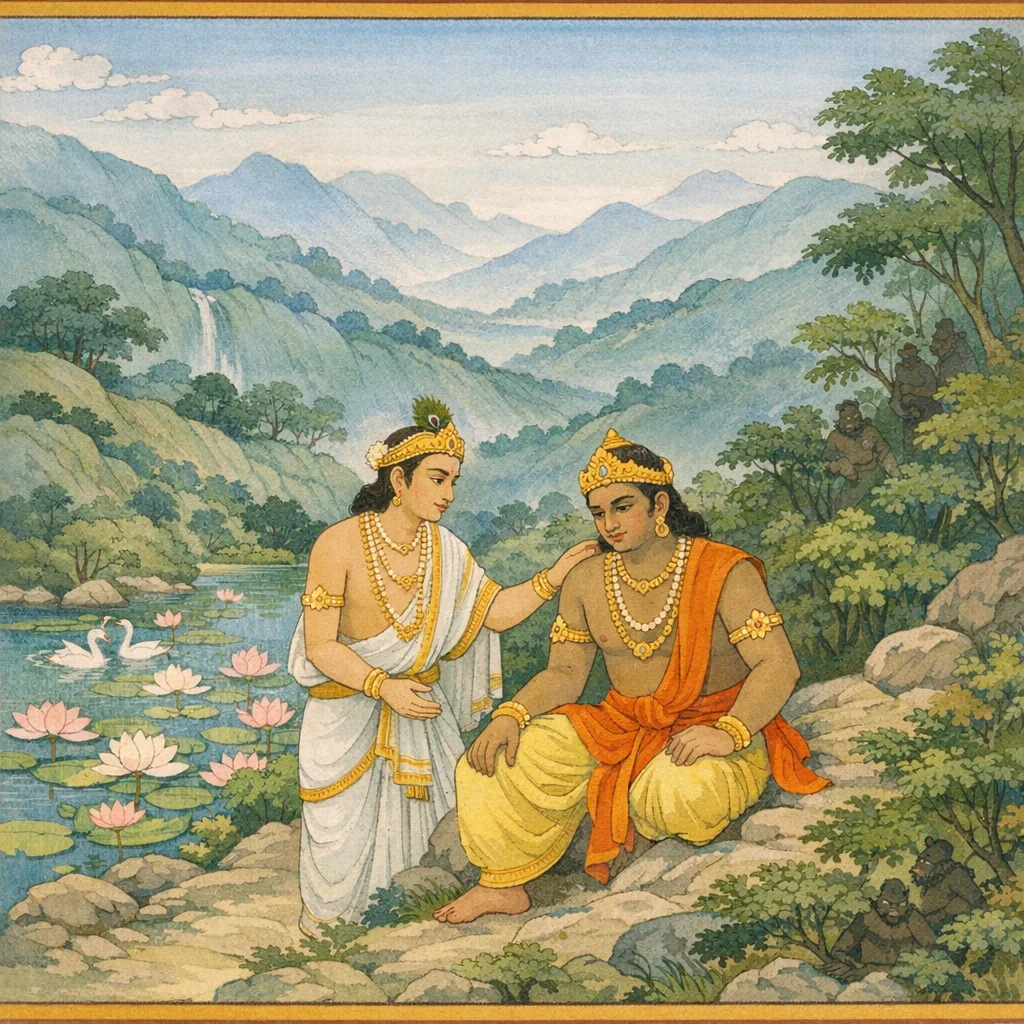
Adhyaya 142
Dhanañjaya-viraha-śoka and the Resolve to Enter Gandhamādana (धनंजय-विरह-शोकः गन्धमादन-प्रवेश-संकल्पश्च)
Upa-parva: Gandhamādana-gamana / Dhanañjaya-didarśanānvēṣaṇa Episode (Search toward Mount Gandhamādana)
Yudhiṣṭhira addresses Bhīma, the twins (Nakula and Sahadeva), and Draupadī, countering mutual discouragement by asserting continuity of being and survival in hardship, using their forest life as evidence of endurance. He then discloses an intense, bodily-felt grief at not seeing Arjuna (Dhanañjaya/Phalguna), repeatedly praising Arjuna’s martial competence, ethical restraint, protective disposition toward the surrendered, and his role as the Pāṇḍavas’ refuge and prosperity-bringer in earlier times. The discourse transitions from lament to strategy: the group will proceed toward Mount Gandhamādana, linked with Viśālā Badarī and the Nara-Nārāyaṇa āśrama, and toward Kubera’s lotus-lake guarded by rākṣasas. Entry into that region is presented as conditional upon tapas and moral fitness—rejecting cruelty, greed, and agitation—thereby making disciplined conduct a prerequisite for geographic and narrative progression. The chapter closes with a collective commitment to regulated living (niyatātman, mitāhāra) and armed readiness while seeking Arjuna’s traces.
Chapter Arc: गन्धमादन-प्रवेश की तैयारी के बीच युधिष्ठिर का मन अर्जुन के न दिखने से जल उठता है—पाँच वर्ष बीत गये, फिर भी धनंजय का सान्निध्य नहीं। → युधिष्ठिर भीम से कहते हैं कि दुर्बलता और क्लेश के बावजूद अर्जुन-दर्शन की उत्कट चाह उन्हें असंभव-सा मार्ग भी अपनाने को बाध्य करती है; प्रतीक्षा की आग भीतर-भीतर तूलराशि को भस्म करने वाले अनल-सी देह को दहकाती है। → युधिष्ठिर अर्जुन के गुणों का स्मरण कर उसे ‘शरणागत-वत्सल’, ‘रण में शत्रु-प्रमर्दक’, ‘सबका आश्रय’ और ‘सुखावह’ बताकर अपने हृदय की पीड़ा को चरम पर ले आते हैं—जिस वीर पर सबका भरोसा है, वही दृष्टि से दूर है। → समाधान के रूप में वे संयम और मिताहार का व्रत लेकर गन्धमादन पर्वत में प्रवेश का निश्चय करते हैं—कुबेर-नलिनी और राक्षस-सेवित रम्य प्रदेश की ओर बढ़ने का संकल्प। → गन्धमादन के भीतर कौन-से विघ्न (राक्षस, वन्य पशु, दैवी परीक्षा) प्रतीक्षा कर रहे हैं और क्या वहाँ अर्जुन का संकेत मिलेगा—यह अनकहा रह जाता है।
Shlokas
Verse 1
हि >> न (0) है एकचत्वारिंशर्दाधिकशततमो< ध्याय: युधिष्ठिरका भीमसेनसे अर्जुनको न देखनेके कारण मानसिक चिन्ता प्रकट करना एवं उनके गुणोंका स्मरण करते हुए गन्धमादन पर्वतपर जानेका दृढ़ निश्चय करना युधिछिर उवाच भीमसेन यमौ चोभौ पाञज्चालि च निबोधत । नास्ति भूतस्य नाशो वै पश्यतास्मान् वनेचरान्,युधिष्ठिर बोले--भीमसेन, नकुल-सहदेव और द्रौपदी! तुम सब लोग ध्यान देकर सुनो। यह निश्चय है कि पूर्वकृत कर्मोका बिना भोगे कभी नाश नहीं होता। देखो, उन्हींके कारण आज हम राजकुमार होकर भी वन-वनमें भटक रहे हैं
Yudhiṣṭhira said: “Bhīmasena, and you two twins, and Pāñcālī—listen attentively. There is no destruction of what has come to be; deeds done in the past do not perish without being experienced. Look at us: though born as princes, we are wandering from forest to forest—driven by those very consequences.”
Verse 2
दुर्बला: क्लेशिता: स्मेति यद् ब्रुवामेतरेतरम् । अशक्येडपि व्रजामो यद् धनंजयदिदृक्षया,यद्यपि हमलोग दुर्बल हैं, क्लेशमें पड़े हुए हैं, तथापि जो एक-दूसरेसे उत्साहपूर्वक बातें करते हैं और जहाँ जाना सम्भव नहीं उस मार्गपर भी आगे बढ़ते जा रहे हैं, उसमें एक ही कारण है, हम सबके हृदयमें अर्जुनको देखनेके लिये प्रबल उत्कण्ठा है
Yudhiṣṭhira said: “Though we are weak and afflicted by hardship, we still speak to one another with heartening words; and though the way seems impossible, we keep moving forward. The single cause is this: within all our hearts there is an intense longing to see Arjuna (Dhanañjaya).”
Verse 3
तन्मे दहति गात्राणि तूलराशिमिवानल: । यच्च वीरं न पश्यामि धनंजयमुपान्तिकात्,इतना प्रयास करनेपर भी मैं वीर धनंजयको जो अबतक अपने समीप नहीं देख पा रहा हूँ, इसकी चिन्ता मेरे सम्पूर्ण अंगोंको उसी प्रकार दग्ध कर रही है, जैसे आग रूईके ढेरको जलाती रहती है
This anxiety scorches my limbs like fire consuming a heap of cotton: despite all my efforts, I still do not see the hero Dhanañjaya (Arjuna) here near me. The very absence of the one on whom our hope rests burns within me, turning concern for duty and safety into a consuming inner heat.
Verse 4
तस्य दर्शनतृष्णं मां सानुजं वनमास्थितम् । याज्ञसेन्या: परामर्श: स च वीर दहत्युत,उसीके दर्शनकी प्यास लेकर मैं भाइयोंसहित इस वनमें आया हूँ। वीर भीमसेन! दुःशासनने जो द्रौपदीके केश पकड़ लिये थे, वह घटना याद आकर मुझे और भी शोकसे दग्ध कर देती है
Yudhiṣṭhira said: “Driven by a thirst to behold him, I have come to this forest together with my younger brothers. And, O hero, the recollection of Yājñasenī—how she was outrageously manhandled—burns me still all the more.”
Verse 5
नकुलात् पूर्वजं पार्थ न पश्याम्यमितौजसम् | अजेयमुग्रधन्वानं तेन तप्ये वृकोदर,वृकोदर! भयंकर धनुष धारण करनेवाले अजेय वीर अमिततेजस्वी अर्जुनको जो नकुलसे पहले उत्पन्न हुआ है, मैं अबतक नहीं देख रहा हूँ, इसके कारण मुझे बड़ा संताप हो रहा है
Yudhiṣṭhira said: “O Pārtha, I do not see that elder brother of Nakula—Arjuna of immeasurable prowess, unconquerable, bearing a dreadful bow. Because he is not in sight, O Vṛkodara, I am consumed with anguish.”
Verse 6
तीर्थानि चैव रम्याणि वनानि च सरांसि च । चरामि सह युष्माभिस्तस्य दर्शनकाड्क्षया,अर्जुनको देखनेकी ही अभिलाषासे मैं तुमलोगोंके साथ विभिन्न तीर्थोर्में, रमणीय वनोंमें और सुन्दर सरोवरोंके तटपर विचर रहा हूँ
Yudhiṣṭhira said: “Longing only to behold Arjuna, I wander together with you—visiting sacred fords, delightful forests, and the shores of beautiful lakes.”
Verse 7
पज्चवर्षाण्यहं वीरं सत्यसंधं धनंजयम् । यन्न पश्यामि बीभत्सुं तेन तप्ये वृकोदर,भीमसेन! आज पाँच वर्ष हो गये, मैं अपने वीर भाई सत्यप्रतिज्ञ अर्जुनके दर्शनसे वंचित हो गया हूँ। इसके कारण मुझे बड़ी चिन्ता हो रही है
For five years now, O mighty one, I have not seen the hero Dhanañjaya—Arjuna, steadfast in his vow of truth. Because I am deprived of the sight of Bībhatsu, I am consumed with anguish, O Vṛkodara (Bhīma).
Verse 8
त॑ वै श्याम गुडाकेशं सिंहविक्रान्तगामिनम् | न पश्यामि महाबाहुं तेन तप्ये वृकोदर,वृकोदर! सिंहके समान मस्तानी चालसे चलनेवाले, निद्राविजयी, श्यामवर्ण, महाबाहु अर्जुनको नहीं देख पा रहा हूँ, इसलिये मेरे मनमें बड़ा संताप हो रहा है
Yudhiṣṭhira said: “I do not see that dark-hued Arjuna—Guḍākeśa—who strides with the fearless gait of a lion, the mighty-armed hero. Therefore, O Vṛkodara, I am consumed with anguish.”
Verse 9
कृतास्त्र निपुणं युद्धे5प्रतिमानं धनुष्मताम् । न पश्यामि कुरुश्रेष्ठ तेन तप्ये वृकोदर,कुरुश्रेष्ठ भीमसेन! अस्त्रविद्यामें प्रवीण, युद्धुकुशल और अनुपम धनुर्धर उस अर्जुनको नहीं देखता हूँ, इस कारण मुझे बड़ा कष्ट होता है
Yudhiṣṭhira said: “O best of the Kurus, O Vṛkodara, I do not see Arjuna—master of weapons, skilled in battle, and unmatched among bowmen. Therefore I am consumed with anguish.”
Verse 10
चरन्तमरिसंघेषु काले क्रुद्धमिवान्तकम् । प्रभिन्नमिव मातडुं सिंहस्कन्ध॑ं धनंजयम्,जो युद्धके समय शत्रुओंके समूहमें कुपित यमराजकी भाँति विचरता है, जिसके कंधे सिंहके समान हैं तथा जो मदकी धारा बहानेवाले मत्त गजराजके समान शोभा पाता है, उस वीर धनंजयसे अबतक भेंट न हो सकी; इसका मुझे बड़ा दुःख है
Yudhiṣṭhira said: “Dhanañjaya—moving amid the hosts of enemies like Death itself when Time is enraged, broad-shouldered like a lion, and splendid like a rutting lordly elephant streaming with ichor—him, that heroic Arjuna, I have not yet been able to meet. This grieves me deeply.”
Verse 11
यः स शक्रादनवरो वीर्येण द्रविणेन च । यमयो: पूर्वज: पार्थ: श्वेताश्वोडमितविक्रम:,वृकोदर! जो पराक्रम और सम्पत्तिमें देवराज इन्द्रसे तनिक भी कम नहीं है, जिसके रथके घोड़े श्वेत रंगके हैं, जो नकुल-सहदेवसे अवस्थामें बड़ा है, जिसके पराक्रमकी कोई सीमा नहीं है तथा जो उग्र धनुर्धर एवं अजेय है, उस वीरवर अर्जुनके दर्शनसे मैं वंचित हूँ; इसके लिये मुझे महान कष्ट हो रहा है। मैं चिन्ताकी आगमें जला जा रहा हूँ
Yudhiṣṭhira said: “O Vṛkodara, that Pārtha—no less than Indra himself in prowess and in wealth; elder to the twins; the one whose chariot is drawn by white horses; whose valor is beyond measure; a fierce archer and unconquerable—of that best of heroes, Arjuna, I am deprived of the sight. Because of this I suffer great anguish; I burn as though scorched by the fire of worry.”
Verse 12
दुःखेन महताविष्टस्तं न पश्यामि फाल्गुनम् । अजेयमुग्रधन्वानं तेन तप्ये वृकोदर,वृकोदर! जो पराक्रम और सम्पत्तिमें देवराज इन्द्रसे तनिक भी कम नहीं है, जिसके रथके घोड़े श्वेत रंगके हैं, जो नकुल-सहदेवसे अवस्थामें बड़ा है, जिसके पराक्रमकी कोई सीमा नहीं है तथा जो उग्र धनुर्धर एवं अजेय है, उस वीरवर अर्जुनके दर्शनसे मैं वंचित हूँ; इसके लिये मुझे महान कष्ट हो रहा है। मैं चिन्ताकी आगमें जला जा रहा हूँ
Yudhiṣṭhira said: “Overwhelmed by great sorrow, I do not see Phālguna (Arjuna). He is unconquerable, a fierce wielder of the bow; and because of this I am tormented, O Vṛkodara. Deprived of the sight of that foremost hero—whose valor knows no limit and who is in no way inferior to Indra in prowess and fortune—I burn in the fire of anxious thought. The pain here is not merely personal grief, but the moral weight of separation from a righteous ally whose strength safeguards their dharma in exile.”
Verse 13
सततं य: क्षमाशील: क्षिप्पमाणो5प्यणीयसा । ऋजुमार्गप्रपन्नस्य शर्मदाताभयस्य च,जो छोटे लोगोंके आक्षेप करनेपर भी सदा क्षमाशील होनेके कारण उस आक्षेपको सह लेता है तथा सरल मार्गसे अपनी शरणमें आनेवाले लोगोंको सुख पहुँचाकर उन्हें अभयदान देता है, वही अर्जुन, जब कोई कुटिल मार्गका आश्रय ले छल-कपटसे उसपर आघात करना चाहता है तब वह वज्धारी इन्द्र ही क्यों न हो, उसके लिये काल और विषके समान भयंकर हो जाता है
Yudhiṣṭhira said: “He who is ever patient—who endures even the taunts of the petty—who grants refuge to those who come by the straight path, giving them comfort and freedom from fear: that very man, O Arjuna, when someone resorts to crooked ways and seeks to strike him through deceit and fraud, becomes for that aggressor as dreadful as Death and poison—even if the attacker were Indra himself, wielder of the thunderbolt.”
Verse 14
सतु जिद्दाप्रवृत्तस्य माययाभिजिघांसत: । अपि वज्रधरस्यापि भवेत् कालविषोपम:,जो छोटे लोगोंके आक्षेप करनेपर भी सदा क्षमाशील होनेके कारण उस आक्षेपको सह लेता है तथा सरल मार्गसे अपनी शरणमें आनेवाले लोगोंको सुख पहुँचाकर उन्हें अभयदान देता है, वही अर्जुन, जब कोई कुटिल मार्गका आश्रय ले छल-कपटसे उसपर आघात करना चाहता है तब वह वज्धारी इन्द्र ही क्यों न हो, उसके लिये काल और विषके समान भयंकर हो जाता है
Yudhiṣṭhira said: “But toward one who is bent on hostility and seeks to strike by deceit and illusion, he becomes like Time and like poison—terrible even to Vajradhara (Indra) himself.”
Verse 15
शत्रोरपि प्रपन्नस्य सोडनृशंस: प्रतापवान् । दाताभयस्य बीभत्सुरमितात्मा महाबल:,यदि शत्रु भी शरणमें आ जाय तो वह प्रतापी वीर उसके प्रति दयालु हो जाता और उसे निर्भय कर देता है। वह महाबली महामना अर्जुन ही हमलोगोंका सहारा है। वही समरांगणमें हमारे शत्रुओंको रौंद डालनेकी शक्ति रखता है। उसीने हमारे लिये सब प्रकारके रत्न लाकर सुलभ किये थे और वही हम सबको सदा सुख पहुँचानेवाला है
Yudhiṣṭhira said: “Even when an enemy comes seeking refuge, that mighty and radiant hero becomes compassionate and grants him fearlessness. That great-armed Arjuna—of immeasurable self-mastery—is our support. He alone has the power to crush our foes on the battlefield; he it was who procured for us every kind of precious treasure with ease, and he is ever the source of our welfare.”
Verse 16
सर्वेषामाश्रयो<स्माकं रणे<४रीणां प्रमर्दिता । आहर्ता सर्वरत्नानां सर्वेषां न: सुखावह:,यदि शत्रु भी शरणमें आ जाय तो वह प्रतापी वीर उसके प्रति दयालु हो जाता और उसे निर्भय कर देता है। वह महाबली महामना अर्जुन ही हमलोगोंका सहारा है। वही समरांगणमें हमारे शत्रुओंको रौंद डालनेकी शक्ति रखता है। उसीने हमारे लिये सब प्रकारके रत्न लाकर सुलभ किये थे और वही हम सबको सदा सुख पहुँचानेवाला है
Yudhiṣṭhira said: “He is the refuge of us all—the one who crushes our foes in battle. He is the bringer of every kind of treasure, and the source of happiness for all of us.”
Verse 17
रत्नानि यस्य वीर्येण दिव्यान्यासन् पुरा मम | बहूनि बहुजातीनि यानि प्राप्त: सुयोधन:,जिसके पराक्रमसे हमारे पास पहले अनेक प्रकारकी असंख्य रत्नराशि संचित हो गयी थी, जिसे सुयोधनने ले लिया
Yudhiṣṭhira said: “By whose valor, in former times, many divine jewels of countless kinds had come into my possession—those very treasures Suyodhana has now obtained.”
Verse 18
यस्य बाहुबलाद वीर सभा चासीत् पुरा मम | सर्वरत्नमयी ख्याता त्रिषु लोकेषु पाण्डव,वीर भीमसेन! जिसके बाहुबलसे पहले मेरे अधिकारमें सम्पूर्ण रत्नोंकी बनी हुई त्रिभुवनविख्यात सभा थी
Yudhiṣṭhira said: “O hero, O Pāṇḍava Bhīmasena! By the strength of whose arms, in former days, there stood under my authority that famed assembly-hall—made, as it were, of every kind of jewel—renowned throughout the three worlds?”
Verse 19
वासुदेवसमं वीर्ये कार्तवीर्यसमं युधि । अजेयममितं युद्धे तं न पश्यामि फाल्गुनम्,जो पराक्रममें भगवान् श्रीकृष्ण और युद्धमें कार्तवीर्य अर्जुनके समान है; तथा जो समरभूमिमें एक होकर भी असंख्य-सा प्रतीत होता है, उस अजेय वीर अर्जुनको मैं बहुत दिनोंसे नहीं देख पाता हूँ
Yudhiṣṭhira said: “In prowess he is equal to Vāsudeva, and in battle he is equal to Kārtavīrya. Unconquerable, and in war seeming immeasurable—though he is but one—yet that hero Phālguna (Arjuna) I have not been able to see for many days.”
Verse 20
संकर्षणं महावीर्य त्वां च भीमापराजितम् । अनुयात: स्ववीर्येण वासुदेवं च शत्रुहा,भीमसेन! शत्रुनाशक अर्जुन अपने पराक्रमसे महाबली बलरामकी, तुझ अपराजित वीरकी और वसुदेवनन्दन भगवान् श्रीकृष्णकी समानता कर सकता है
Yudhiṣṭhira said: “O Bhīmasena, slayer of foes—Arjuna, relying on his own prowess, can match in might the greatly powerful Saṅkarṣaṇa (Balarāma), you the unconquered hero Bhīma, and Vāsudeva (Śrī Kṛṣṇa) as well.”
Verse 21
यस्य बाहुबले तुल्य: प्रभावे च पुरंदर: । जवे वायुर्मुखे सोम: क्रोधे मृत्यु: सनातन:,महाबाहो! जो बाहुबल और प्रभावमें देवराज इन्द्रके समान है, जिसके वेगमें वायु, मुखमें चन्द्रमा और क्रोधमें सनातन मृत्युका निवास है, उसी नरश्रेष्ठ अर्जुनको देखनेके लिये उत्सुक होकर हम सब लोग आज गन्धमादन पर्वतकी घाटियोंमें प्रवेश करेंगे
Yudhiṣṭhira said: “He whose arm-strength and majesty equal Purandara (Indra), whose speed is like the wind, whose face is like Soma (the Moon), and in whose wrath dwells eternal Death—eager to behold that best of men, Arjuna, we shall today enter the valleys of Mount Gandhamādana.”
Verse 22
ते वयं त॑ नरव्याप्रं सर्वे वीर दिदृक्षव: । प्रवेक्ष्यामो महाबाहो पर्वतं गन्धमादनम्,महाबाहो! जो बाहुबल और प्रभावमें देवराज इन्द्रके समान है, जिसके वेगमें वायु, मुखमें चन्द्रमा और क्रोधमें सनातन मृत्युका निवास है, उसी नरश्रेष्ठ अर्जुनको देखनेके लिये उत्सुक होकर हम सब लोग आज गन्धमादन पर्वतकी घाटियोंमें प्रवेश करेंगे
Yudhiṣṭhira said: “Eager to behold that foremost of men—Arjuna, the heroic one—we shall all enter today the valleys of Mount Gandhamādana. O mighty-armed one, he is like Indra among the gods in strength and majesty; in swiftness he is like the wind, in countenance like the moon, and in wrath there dwells the timeless power of Death.”
Verse 23
विशाला बदरी यत्र नरनारायणाश्रम: । त॑ सदाध्युषितं यक्षैद्रेक्ष्यामो गिरिमुत्तमम्,गन्धमादन वही है, जहाँ विशाल बदरीका वृक्ष और भगवान् नर-नारायणका आश्रम है; उस उत्तम पर्वतपर सदा यक्षणण निवास करते हैं; हमलोग उसका दर्शन करेंगे। इसके सिवा, राक्षसोंद्वारा सेवित कुबेरकी सुरम्य पुष्करिणी भी है जहाँ हमलोग भारी तपस्या करते हुए पैदल ही चलेंगे
Yudhiṣṭhira said: “There stands the great Badarī tree, where the hermitage of Nara and Nārāyaṇa abides. We shall behold that supreme mountain, ever inhabited by the Yakṣas—Gandhamādana as well.”
Verse 24
कुबेरनलिनीं रम्यां राक्षसैरभिसेविताम् । पद्धिरेव गमिष्यामस्तप्यमाना महत् तप:,गन्धमादन वही है, जहाँ विशाल बदरीका वृक्ष और भगवान् नर-नारायणका आश्रम है; उस उत्तम पर्वतपर सदा यक्षणण निवास करते हैं; हमलोग उसका दर्शन करेंगे। इसके सिवा, राक्षसोंद्वारा सेवित कुबेरकी सुरम्य पुष्करिणी भी है जहाँ हमलोग भारी तपस्या करते हुए पैदल ही चलेंगे
Yudhiṣṭhira said: “We shall go on foot alone, enduring great austerity, to Kubera’s lovely lotus-pond—frequented and guarded by rākṣasas.”
Verse 25
न च यानवता शक्यो गन्तुं देशो वृकोदर । न नृशंसेन लुब्धेन नाप्रशान्तेन भारत,भरतनन्दन! वृकोदर! उस प्रदेशमें किसी सवारीसे नहीं जाया जा सकता तथा जो क्र्र, लोभी और अशान्त है, ऐसे मनुष्यके लिये श्रद्धाकी कमीके कारण उस स्थानपर जाना असम्भव है
Yudhiṣṭhira said: “O Vṛkodara, that region cannot be reached by any conveyance. Nor can it be reached by one who is cruel, greedy, or untranquil, O Bhārata—for lack of inner reverence and discipline such a person is unfit to enter that place.”
Verse 26
तत्र सर्वे गमिष्यामो भीमार्जुनगवेषिण: । सायुधा बद्धनिस्त्रिंशा: सार्ध विप्रैर्महाव्रतै:,भीमसेन! हम सब लोग अर्जुनकी खोज करते हुए तलवार बाँधकर अस्त्र-शस्त्रोंसे सुसज्जित हो इन महान् व्रतधारी ब्राह्मणोंके साथ वहाँ चलेंगे
“There we shall all go, seeking Bhīma and Arjuna—armed, with our swords girded on—together with these great-vowed brāhmaṇas.”
Verse 27
मक्षिकादंशमशकानू् सिंहान् व्याप्रान् सरीसूपान् | प्राप्रोत्यनियत: पार्थ नियतस्तान् न पश्यति,भीमसेन! जो अपने मन और इन्द्रियोंपर संयम नहीं रखता, ऐसे मनुष्यको वहाँ जानेपर मक्खी, डाँस, मच्छर, सिंह, व्याप्र और सर्पोका सामना करना पड़ता है, परंतु जो संयम- नियमसे रहनेवाला है, उसे उन जन्तुओंका दर्शनतक नहीं होता
Yudhiṣṭhira said: “O Pārtha, one who is undisciplined—who does not restrain his mind and senses—encounters flies, gadflies, mosquitoes, lions, tigers, and creeping serpents when he goes there. But the self-controlled man, living by restraint and rule, does not even behold those creatures.”
Verse 28
ते वयं नियतात्मान: पर्वतं गन्धमादनम् । प्रवेक्ष्यामो मिताहारा धनंजयदिदृक्षव:,अतः हमलोग भी अर्जुनको देखनेकी इच्छासे अपने मनको संयममें रखकर स्वल्पाहार करते हुए गन्धमादनकी पर्वतमालाओंमें प्रवेश करेंगे
Yudhiṣṭhira said: “Then we too—self-controlled and living on scant food—shall enter the Gandhamādana mountain, driven by the desire to see Dhanañjaya (Arjuna).”
Verse 141
इति श्रीमहा भारते वनपर्वणि तीर्थयात्रापर्वणि लोमशती र्थयात्रायां गन्धमादनप्रवेशे एकचत्वारिंशदधिकशततमो<ध्याय:
Thus, in the revered Mahābhārata, within the Vana Parva—specifically the Tīrthayātrā Parva—during Lomaśa’s pilgrimage narration, at the episode of entering Gandhamādana, ends the one-hundred-and-forty-first chapter.
Frequently Asked Questions
How to respond to separation-induced despair without collapsing into inaction: Yudhiṣṭhira must balance grief and dependence on Arjuna with responsible leadership, converting emotion into a disciplined, ethically constrained plan.
Endurance and purposeful action are compatible when governed by restraint: access to difficult or “guarded” goals—literal and symbolic—requires tapas-like self-regulation, calmness, and rejection of cruelty and greed.
No explicit phalaśruti is stated here; the chapter’s meta-function is practical-ethical—linking narrative movement to moral qualification—positioning disciplined conduct as the implicit ‘fruit’ enabling progress in the exile itinerary.