Adhyaya 5
Saṃsāra-Gahana Allegory: The Brāhmaṇa in the Forest and Well (संसारगहन-आख्यान)
Upa-parva: Vidura–Dhṛtarāṣṭra Saṃsāra-Allegory (Buddhimārga Praśaṃsā)
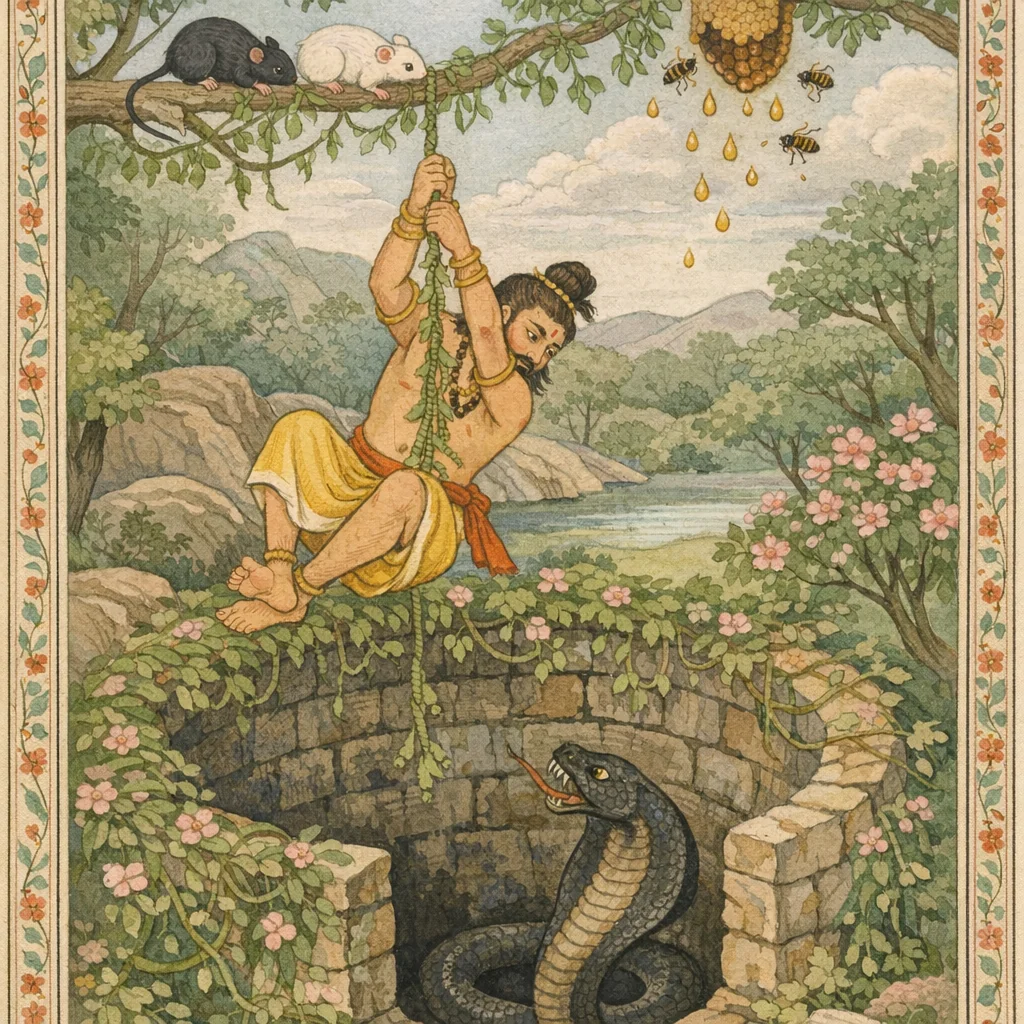
Dhṛtarāṣṭra asks Vidura to praise and explain, in detail, the intellectual pathway (buddhimārga) by which the “thicket of dharma” can be comprehended (1.0). Vidura begins with reverential framing and reports the account as taught by eminent seers regarding the “thicket of worldly existence” (saṃsāra-gahana) (2.0). The allegory introduces a brāhmaṇa wandering in the great world who reaches a hard-to-cross forest filled with formidable predators; fear reactions arise and he searches for refuge (3.0–7.0). He encounters a terrifying scene: the forest is netted and clasped by a dreadful woman, and within it stands a vast tree; in the middle lies a concealed well covered by creepers and grass (8.0–10.0). The brāhmaṇa falls into the hidden water-reservoir and becomes entangled, hanging upside down like a fruit on a stalk (11.0–12.0). New threats appear: he sees a great elephant associated with the well’s approach and a serpent below; on the tree’s branches are frightening bees that continually gather honey (13.0–16.0). Streams of honey drip constantly; while suspended, the man drinks yet remains unsated, and no disenchantment with life arises (17.0–18.0). Meanwhile black and white mice gnaw at the tree—his remaining life-support—while multiple fears surround him: predators, the woman, the serpent, the elephant, the risk of falling, and the bees driven by honey-lust (19.0–21.0). The chapter concludes with the interpretive thesis: thus the person dwells, cast into the ocean of saṃsāra, still clinging to life-hope without developing dispassion (22.0).
Chapter Arc: शोकाकुल कुरुवंश के बीच विदुर राजन् को स्वयम्भू को नमस्कार कर ‘संसार-गहन वन’ का रहस्य सुनाने का उपक्रम करते हैं—मानो युद्ध के धुएँ से उठकर कथा सीधे जीवन-मरण की जड़ पर हाथ रखती हो। → विदुर रूपक रचते हैं: एक विशाल, दुर्गम वन; भीतर घास-लताओं से ढँका कुआँ; उसमें गिरता एक द्विज/मनुष्य; ऊपर सहारे का वृक्ष, जिसे काले-सफेद चूहे निरन्तर कुतरते हैं; नीचे नाग, पास उग्र स्त्री और व्याल—हर दिशा से भय। फिर भी वह मनुष्य मधु की बूँदों के लोभ में बार-बार जीभ बढ़ाता है, अतृप्त रहता है। → संकट के चरम पर भी मधु-लोभ नहीं छूटता—‘अतृप्तः स पुनः पुनः’—यही बोध-विस्फोट है: मृत्यु-निकटता भी तृष्णा को नहीं काटती; जीवन-आशा उसी कुएँ में जड़ जमाए रहती है। → विदुर संसार-वन के संकेत स्पष्ट करते हैं—काल (काले-सफेद चूहे), आयु (कुतरता वृक्ष), मृत्यु (नाग/कूप), भय-आकर्षण (व्याल/उग्र स्त्री), और विषय-रस (मधु) के बीच फँसा जीव वैराग्य से वंचित रहता है। श्रोता के भीतर विवेक जागता है कि शोक और युद्ध के बाद भी असली शत्रु तृष्णा है। → विदुर के उपदेश का प्रभाव राजन् के मन में क्या रूप लेगा—क्या वे शोक-वन से निकलकर वैराग्य का मार्ग पकड़ेंगे या मधु-लोभ की तरह शोक-लोभ में ही अटके रहेंगे? (अगले अध्याय की ओर संकेत)
Shlokas
Verse 1
हि बछ। आप>फ अप - 'एकरात्रोषितं कलिलं भवति पंचरात्राद् बुदुबुद:” एक रातमें रज और वीर्य मिलकर “कलिल' रूप होते हैं और पाँच रातमें 'बुदबुद” के आकारमें परिणत हो जाते हैं। इत्यादि शास्त्रवचनोंके अनुसार गर्भके बढ़ने आदिकी सारी क्रिया ज्ञात होती है। पज्चमो< ध्याय: गहन वनके दृष्टान्तसे संसारके भयंकर स्वरूपका वर्णन धृतराष्ट उवाच यदिदं धर्मगहनं बुद्धया समनुगम्यते । तद्धि विस्तरत: सर्व बुद्धिमार्ग प्रशंस मे,धृतराष्ट्रने कहा--विदुर! यह जो धर्मका गूढ़ स्वरूप है, वह बुद्धिसे ही जाना जाता है; अतः तुम मुझसे सम्पूर्ण बुद्धिमार्गका विस्तारपूर्वक वर्णन करो
Dhṛtarāṣṭra said: “Vidura, this profound and tangled matter of dharma can be grasped only through discerning intellect. Therefore, explain to me in full detail the entire path and method of right understanding.”
Verse 2
विदुर उवाच अत्र ते वर्तयिष्यामि नमस्कृत्वा स्वयम्भुवे | यथा संसारगहनं वदन्ति परमर्षय:
Vidura said: “Here I shall relate it to you, after bowing to the Self-born Creator—just as the supreme seers describe the dense and bewildering thicket of worldly existence.”
Verse 3
विदुरजीने कहा--राजन्! मैं भगवान् स्वयम्भूको नमस्कार करके संसाररूप गहन वनके उस स्वरूपका वर्णन करता हूँ, जिसका निरूपण बड़े-बड़े महर्षि करते हैं ।। वश्चिन्महति कान्तारे वर्तमानो द्विज: किल । महद् दुर्गमनुप्राप्तो वन॑ क्रव्यादसंकुलम्,कहते हैं कि किसी विशाल दुर्गम वनमें कोई ब्राह्मण यात्रा कर रहा था। वह वनके अत्यन्त दुर्गम प्रदेशमें जा पहुँचा, जो हिंसक जन्तुओंसे भरा हुआ था
Vidura said: “O King, having bowed to the Blessed Self-born Lord, I shall describe the dense forest that is this world—its true nature as the great seers expound it. It is said that a brahmin, traveling through a vast wilderness, reached a region exceedingly hard to traverse, a forest crowded with flesh-eating beasts.”
Verse 4
इस प्रकार श्रीमह्याभारत स्त्रीपर्वके अन्तर्गत जलप्रदानिकपर्वमें धृतराष््रके शीकका निवारणविषयक चौथा अध्याय पूरा हुआ,सिंहव्याप्रगजक्षौंघैरतिघोरं महास्वनै: । पिशितादैरतिभयैर्महोग्राकृतिभिस्तथा
There were troops of lions, tigers, and elephants, raising exceedingly dreadful, thunderous roars; and likewise flesh-eaters of terrifying nature, of immensely fierce and massive forms.
Verse 5
तदस्य दृष्टवा हृदयमुद्वेगमगमत् परम्,इति श्रीमहाभारते स्त्रीपर्वणि जलप्रदानिकपर्वणि धृतराष्ट्रविशोककरणे पडठ्चमो<ध्याय:
Seeing that sight, his heart was seized by extreme agitation. Thus, in the Śrī Mahābhārata, in the Strī Parvan, in the section concerning the offering of water (funeral libations), in the episode meant to relieve Dhṛtarāṣṭra’s grief, ends the fifth chapter.
Verse 6
स तद् वन व्यनुसरन् सम्प्रधावन्नितस्ततः
He then followed that forest-track, running swiftly—now here, now there—searching in agitation as events pressed upon him.
Verse 7
स तेषां छिद्रमन्विच्छन् प्रद्गुतो भयपीडित:
Vidura said: “Driven by fear and inwardly agitated, he kept searching for a flaw—an opening—in them, looking for some vulnerable point to exploit.”
Verse 8
अथापश्यद् वन॑ घोरं समन्ताद् वागुरावृतम्
Then he beheld a dreadful forest, hemmed in on every side and covered over with nets.
Verse 9
बाहुभ्यां सम्परिक्षिप्तं स्त्रिया परमघोरया । इतनेहीमें उसने देखा कि वह भयानक वन चारों ओरसे जालसे घिरा हुआ है और एक बड़ी भयानक स्त्रीने अपनी दोनों भुजाओंसे उसको आवेष्टित कर रखा है ।। पञठ्चशीर्षधरैनागि: शैलैरिव समुन्नतैः
Vidura said: “He saw that dreadful forest was hemmed in on every side as if by a net, and that a supremely terrifying woman had wrapped him tightly in her two arms. Around him rose serpents bearing five hoods, towering like lofty mountains.”
Verse 10
वनमध्ये च तत्राभूदुदपान: समावृतः
And there, in the midst of the forest, there was a well that had become covered over—hidden and obstructed, as if access to water and relief had been shut off.
Verse 11
वल्लीभिस्तृणछन्नाभिददढाभिरभिसंवृत: । उस वनके भीतर एक कुआँ था, जो घासोंसे ढकी हुई सुदृढ़ लताओंके द्वारा सब ओरसे आच्छादित हो गया था ।। पपात स द्विजस्तत्र निगूढठे सलिलाशये
Vidura said: Within that forest there was a well, hidden from view—covered over on all sides by firm creepers and concealed beneath grass. Into that concealed reservoir of water the brāhmaṇa fell. The image underscores how unseen dangers, masked by outward appearances, can suddenly ensnare the unwary, urging vigilance and discernment in conduct.
Verse 12
विलग्नश्लाभवत् तस्मिन् लतासंतानसंकुले । वह ब्राह्मण उस छिपे हुए कुएँमें गिर पड़ा; परंतु लतावेलोंसे व्याप्त होनेके कारण वह उसमें फँसकर नीचे नहीं गिरा, ऊपर ही लटका रह गया | ११ $ ।। पनसस्य यथा जात॑ वृन्तबद्धं महाफलम्
Vidura said: In that well, choked with a tangled growth of creepers, the brāhmaṇa fell into a hidden pit. Yet because the mouth and sides were overrun with vines, he did not plunge to the bottom; caught fast among them, he remained hanging above—like a great jackfruit that has grown and hangs suspended by its stalk. The image underscores how a person may be trapped in peril by the very attachments that seem to support him, neither fully destroyed nor truly safe.
Verse 13
अथ तत्रापि चान्यो5स्य भूयो जात उपद्रव:,षड्वकत्रं कृष्णशुक्लं च द्विषट्कपदचारिणम् | वहाँ भी उसके सामने पुनः दूसरा उपद्रव खड़ा हो गया। उसने कूपके भीतर एक महाबली महानाग बैठा हुआ देखा तथा कुएँके ऊपरी तटपर उसके मुखबन्धके पास एक विशाल हाथीको खड़ा देखा, जिनके छ: मुँह थे। वह सफेद और काले रंगका था तथा बारह पैरोंसे चला करता था
Then, even there, another fresh calamity confronted him again: a strange being with six faces, black and white in color, moving on twelve feet. In Vidura’s moral narration, this image intensifies the sense of peril and instability that besets one who is trapped in worldly entanglement, where new dangers arise even when one thinks one has found a momentary refuge.
Verse 14
कूपमध्ये महानागमपश्यत महाबलम् | कूपवीनाहवेलायामपश्यत महागजम्
Vidura said: “In the midst of a well he saw a mighty, powerful serpent; and at the mouth of the well, at the very time of peril, he saw a great elephant.” The image evokes a crisis in which danger is present both within and at the threshold, urging discernment and timely, dharmic action rather than confusion or panic.
Verse 15
क्रमेण परिसर्पन्तं वल्लीवृक्षसमावृतम्,आसते मधु संवृत्य पूर्वमेव निकेतजा: । वह लताओं तथा वृक्षोंसे घिरे हुए उस कूपमें क्रमश: बढ़ा आ रहा था। वह ब्राह्मण, जिस वृक्षकी शाखापर लटका था, उसकी छोटी-छोटी टहनियोंपर पहलेसे ही मधुके छत्तोंसे पैदा हुई अनेक रूपवाली, घोर एवं भयंकर मधुमक्खियाँ मधुको घेरकर बैठी हुई थीं
As it crept upward little by little, the well lay covered over with creepers and trees. And on the tender twigs of the branch on which the man hung, swarms of bees—born there long before—sat clustered around their honey. The image underscores how, even while one struggles for survival, alluring pleasures and their stings surround the mind, binding it to danger rather than release.
Verse 16
तस्य चापि प्रशाखासु वृक्षशाखावलम्बिन: । नानारूपा मधुकरा घोररूपा भयावहा:
And on the offshoot branches of that tree as well, clinging to its boughs, there are bees of many kinds—terrible in form and bringing fear. In Vidura’s moral imagery, these swarming, frightening creatures suggest the anxieties and dangers that gather around a life entangled in worldly attachments and wrongdoing, making the path of the deluded ever more perilous.
Verse 17
भूयो भूय: समीहन्ते मधूनि भरतर्षभ
Vidura says: “O bull among the Bharatas, again and again they strive after ‘sweetness’—the honeyed pleasures of life.”
Verse 18
तेषां मधूनां बहुधा धारा प्रस्रवते तदा
Then, from those honeycombs, streams of honey begin to flow in many directions. In Vidura’s speech, the image underscores how consequences—whether of virtue or wrongdoing—do not remain contained: once the conditions are set, results pour forth abundantly and inevitably.
Verse 19
न चास्य तृष्णा विरता पिबमानस्य संकटे
And even while he keeps drinking in distress, his craving does not subside. The line underscores how desire, once indulged, tends to persist—especially in times of crisis—rather than bringing relief or contentment.
Verse 20
न चास्य जीविते राजन् निर्वेद: समजायत
O King, no dispassion or remorse arose in him concerning his own life; even after what had happened, he did not turn inward with repentance or detachment.
Verse 21
कृष्णा: ट्वेताश्व त॑ वृक्ष कुट्टयन्ति च मूषिका:,जिस वृक्षके सहारे वह लटका हुआ है, उसे काले और सफेद चूहे निरन्तर काट रहे हैं। पहले तो उसे वनके दुर्गम प्रदेशके भीतर ही अनेक सर्पोंसे भय है, दूसरा भय सीमापर खड़ी हुई उस भयंकर स्त्रीसे है, तीसरा कुँएके नीचे बैठे हुए नागसे है, चौथा कुँएके मुखबन्धके पास खड़े हुए हाथीसे है और पाँचवाँ भय चूहोंके काट देनेपर उस वृक्षसे गिर जानेका है। इनके सिवा, मधुके लोभसे मधुमक्खियोंकी ओरसे जो उसको महान् भय प्राप्त होनेवाला है, वह छठा भय बताया गया है
Vidura says: Black and white mice keep gnawing at the tree on which the man is hanging. The very support that seems to hold him is being steadily cut away. In this allegory, life is beset by many fears—dangers within the wild forest, the terror at the boundary, the serpent below in the well, the elephant near the mouth of the well, and the final fear of falling when the tree is severed; and beyond these, even the lure of honey brings yet another peril from the bees.
Verse 22
व्यालैश्व वनदुर्गान्ति स्त्रिया च परमोग्रया । कूपाधस्ताच्च नागेन वीनाहे कुज्जरेण च,जिस वृक्षके सहारे वह लटका हुआ है, उसे काले और सफेद चूहे निरन्तर काट रहे हैं। पहले तो उसे वनके दुर्गम प्रदेशके भीतर ही अनेक सर्पोंसे भय है, दूसरा भय सीमापर खड़ी हुई उस भयंकर स्त्रीसे है, तीसरा कुँएके नीचे बैठे हुए नागसे है, चौथा कुँएके मुखबन्धके पास खड़े हुए हाथीसे है और पाँचवाँ भय चूहोंके काट देनेपर उस वृक्षसे गिर जानेका है। इनके सिवा, मधुके लोभसे मधुमक्खियोंकी ओरसे जो उसको महान् भय प्राप्त होनेवाला है, वह छठा भय बताया गया है
He fears the serpents in the impassable depths of the forest, and he fears the most terrible woman standing at the boundary. He fears the great serpent below in the well, and he fears the elephant stationed near the mouth of the well.
Verse 23
वृक्षप्रपाताच्च भयं मूषिकेभ्यश्व॒ पज्चमम् | मधुलोभान्मधुकरै: षष्ठमाहुर्महद् भयम्,जिस वृक्षके सहारे वह लटका हुआ है, उसे काले और सफेद चूहे निरन्तर काट रहे हैं। पहले तो उसे वनके दुर्गम प्रदेशके भीतर ही अनेक सर्पोंसे भय है, दूसरा भय सीमापर खड़ी हुई उस भयंकर स्त्रीसे है, तीसरा कुँएके नीचे बैठे हुए नागसे है, चौथा कुँएके मुखबन्धके पास खड़े हुए हाथीसे है और पाँचवाँ भय चूहोंके काट देनेपर उस वृक्षसे गिर जानेका है। इनके सिवा, मधुके लोभसे मधुमक्खियोंकी ओरसे जो उसको महान् भय प्राप्त होनेवाला है, वह छठा भय बताया गया है
The fifth danger is the fear of falling from the tree-support, because black and white mice ceaselessly gnaw at it. Beyond these, driven by craving for honey, he incurs a sixth and great peril from the bees themselves.
Verse 24
एवं स वसते तत्र क्षिप्त: संसारसागरे | न चैव जीविताशायां निर्वेदमुपगच्छति,इस प्रकार संसार-सागरमें गिरा हुआ वह मनुष्य इतने भयोंसे घिरकर वहाँ निवास करता है तो भी उसे जीवनकी आशा बनी हुई है और उसके मनमें वैराग्य नहीं उत्पन्न होता है
Thus, cast into the ocean of worldly existence, a person continues to dwell there—surrounded by many fears; yet even then he does not relinquish hope of life, nor does dispassion arise in his heart.
Verse 46
समन्तात् सम्परिक्षिप्तं यत् सम दृष्टवा त्रसेद् यम: । जोर-जोरसे गर्जना करनेवाले सिंह, व्याप्र, हाथी और रीछोंके समुदायोंने उस स्थानको अत्यन्त भयानक बना दिया था। भीषण आकारवाले अत्यन्त भयंकर मांसभक्षी प्राणियोंने उस वनप्रान्तको चारों ओरसे घेरकर ऐसा बना दिया था, जिसे देखकर यमराज भी भयसे थर्रा उठे
Vidura describes a region hemmed in on every side, so dreadful to behold that even Yama—the lord of death—would shudder at the sight. Roaring hosts of lions, tigers, elephants, and bears, and other huge, ferocious flesh-eating creatures, closed upon that forest tract from every direction, turning it into a scene of utter horror.
Verse 63
वीक्षमाणो दिश: सर्वा: शरणं क्व भवेदिति । वह उस वनका अनुसरण करता इधर-उधर दौड़ता तथा सम्पूर्ण दिशाओंमें ढूँढ़ता फिरता था कि कहीं मुझे शरण मिले
Looking in every direction, he wondered, “Where might there be refuge?” In his distress he ran here and there along the forest paths, searching all around for some place of shelter.
Verse 73
नच निर्याति वै दूरं न वा तैर्विप्रमोच्यते । वह उन हिंसक जन्तुओंका छिद्र देखता हुआ भयसे पीड़ित हो भागने लगा; परंतु न तो वहाँसे दूर निकल पाता था और न वे ही उसका पीछा छोड़ते थे
Watching for a gap among those violent beasts, he fled, tormented by fear; yet he could not get far from that place, nor did they abandon the chase.
Verse 96
नभ:स्प॒शैर्महावक्षै: परिक्षिप्तं महावनम् । पर्वतोंके समान ऊँचे और पाँच सिरवाले नागों तथा बड़े-बड़े गगनचुम्बी वृक्षोंसे वह विशाल वन व्याप्त हो रहा है
Vidura describes a vast forest enclosed and filled with towering, broad-trunked trees that seem to touch the sky. The woodland rises like mountain slopes and is inhabited by great serpents with five hoods.
Verse 126
स तथा लम्बते तत्र हार्ध्वपादो हाध:शिरा: । जैसे कटहलका विशाल फल वृन्तमें बँधा हुआ लटकता रहता है, उसी प्रकार वह ब्राह्मण ऊपरको पैर और नीचेको सिर किये उस कुएँमें लटक गया
Vidura says: “Thus he hangs there—his feet upward and his head downward.” Like a great jackfruit bound to its stalk and dangling, so that brahmin hung in the well, feet above and head below.
Verse 143
षड्वकत्रं कृष्णशुक्लं च द्विषट्कपदचारिणम् | वहाँ भी उसके सामने पुनः दूसरा उपद्रव खड़ा हो गया। उसने कूपके भीतर एक महाबली महानाग बैठा हुआ देखा तथा कुएँके ऊपरी तटपर उसके मुखबन्धके पास एक विशाल हाथीको खड़ा देखा, जिनके छ: मुँह थे। वह सफेद और काले रंगका था तथा बारह पैरोंसे चला करता था
Vidura describes a further ominous apparition: a being with six faces, marked by black and white, moving on twelve feet—an image of mixed, unstable forces that signals renewed danger and moral confusion in the unfolding calamity.
Verse 163
आसते मधु संवृत्य पूर्वमेव निकेतजा: । वह लताओं तथा वृक्षोंसे घिरे हुए उस कूपमें क्रमश: बढ़ा आ रहा था। वह ब्राह्मण, जिस वृक्षकी शाखापर लटका था, उसकी छोटी-छोटी टहनियोंपर पहलेसे ही मधुके छत्तोंसे पैदा हुई अनेक रूपवाली, घोर एवं भयंकर मधुमक्खियाँ मधुको घेरकर बैठी हुई थीं
Vidura describes a grim scene from a moral parable: honeycombs already cover the branches, and fierce, terrifying bees sit guarding the honey. Below, a well enclosed by creepers and trees lies in wait, and the man—hanging from a tree-branch—finds his situation worsening step by step. The image warns how worldly sweetness (pleasure, gain) is protected by danger and how attachment can keep one suspended between fear above and ruin below.
Verse 173
स्वादनीयानि भूतानां यैर्बालो विप्रकृष्यते । भरतश्रेष्ठ) समस्त प्राणियोंको स्वादिष्ट प्रतीत होनेवाले उस मधुको, जिसपर बालक आदृष्ट हो जाते हैं, वे मक्खियाँ बारंबार पीना चाहती थीं
Vidura observes that certain pleasures appear sweet to living beings and irresistibly draw the immature mind away. In ethical terms, he warns that what tastes delightful can become a lure that distracts one from discernment and self-control, leading to repeated attachment and harm.
Verse 183
आलम्बमान: स पुमान् धारां पिबति सर्वदा । उस समय उस मधुकी अनेक धाराएँ वहाँ झर रही थीं और वह लटका हुआ पुरुष निरन्तर उस मधुधाराको पी रहा था
Vidura said: Hanging on, that man continually drinks the stream. In the allegorical setting, he remains suspended in peril yet stays absorbed in tasting the sweet flow, illustrating how a person, even amid insecurity and impending danger, can become addicted to fleeting pleasures and forget the larger demands of prudence and dharma.
Verse 196
अभीष्सति तदा नित्यमतृप्त: स पुन: पुनः । यद्यपि वह संकटमें था तो भी उस मधुको पीते-पीते उसकी तृष्णा शान्त नहीं होती थी। वह सदा अतृप्त रहकर ही बारंबार उसे पीनेकी इच्छा रखता था
Vidura says: “Then, though he was in distress, he kept craving it again and again. Even as he drank that honey repeatedly, his thirst did not subside. Remaining perpetually unsatisfied, he continued to desire it over and over.” The verse underscores the ethical warning that indulgence in sense-pleasures, even when harmful, breeds further craving rather than contentment.
Verse 203
तत्रैव च मनुष्यस्य जीविताशा प्रतिष्ठिता । राजन्! उसे अपने उस संकटपूर्ण जीवनसे वैराग्य नहीं हुआ है। उस मनुष्यके मनमें वहीं उसी दशासे जीवित रहकर मधु पीते रहनेकी आशा जड़ जमाये हुए है
Even there, in that very condition, a man’s hope of life remains firmly rooted. O King, he does not grow dispassion toward that perilous existence; rather, his mind clings to the same state, still hoping to live on there and keep tasting sweetness—seeking pleasure even amid danger.
Verse 536
अभ्युच्छयश्न रोग्णां वै विक्रियाश्व॒ परंतप । शत्रुदमन नरेश! वह स्थान देखकर ब्राह्मणका हृदय अत्यन्त उद्विग्न हो उठा। उसे रोमांच हो आया और मनमें अन्य प्रकारके भी विकार उत्पन्न होने लगे
Vidura said: “O Parantapa, O enemy-tamer, O king—on seeing that place, the Brahmin’s heart was deeply shaken. His hair stood on end, and within his mind other disturbing changes also arose.”
Frequently Asked Questions
The dilemma is epistemic and ethical: how a person should navigate “dharma’s thicket” when fear and desire dominate perception, leading to continued attachment to life-hope even amid evident peril.
Craving can persist even in precarious conditions; without discernment and disenchantment, the mind treats brief sweetness (honey) as sufficient reason to ignore surrounding dangers, perpetuating saṃsāric bondage.
No explicit phalaśruti is stated in the provided passage; the meta-instruction is implicit: understanding the allegory is intended to cultivate buddhi and prompt movement toward nirveda (dispassion) rather than continued life-hope under duress.