Adhyaya 43
Śānti Parva Adhyāya 43 — Yudhiṣṭhira’s Stuti of Kṛṣṇa (Assembly Hymn of Many Names)
Upa-parva: Kṛṣṇa-stuti and Royal Gratitude Episode (Śānti Parva context)
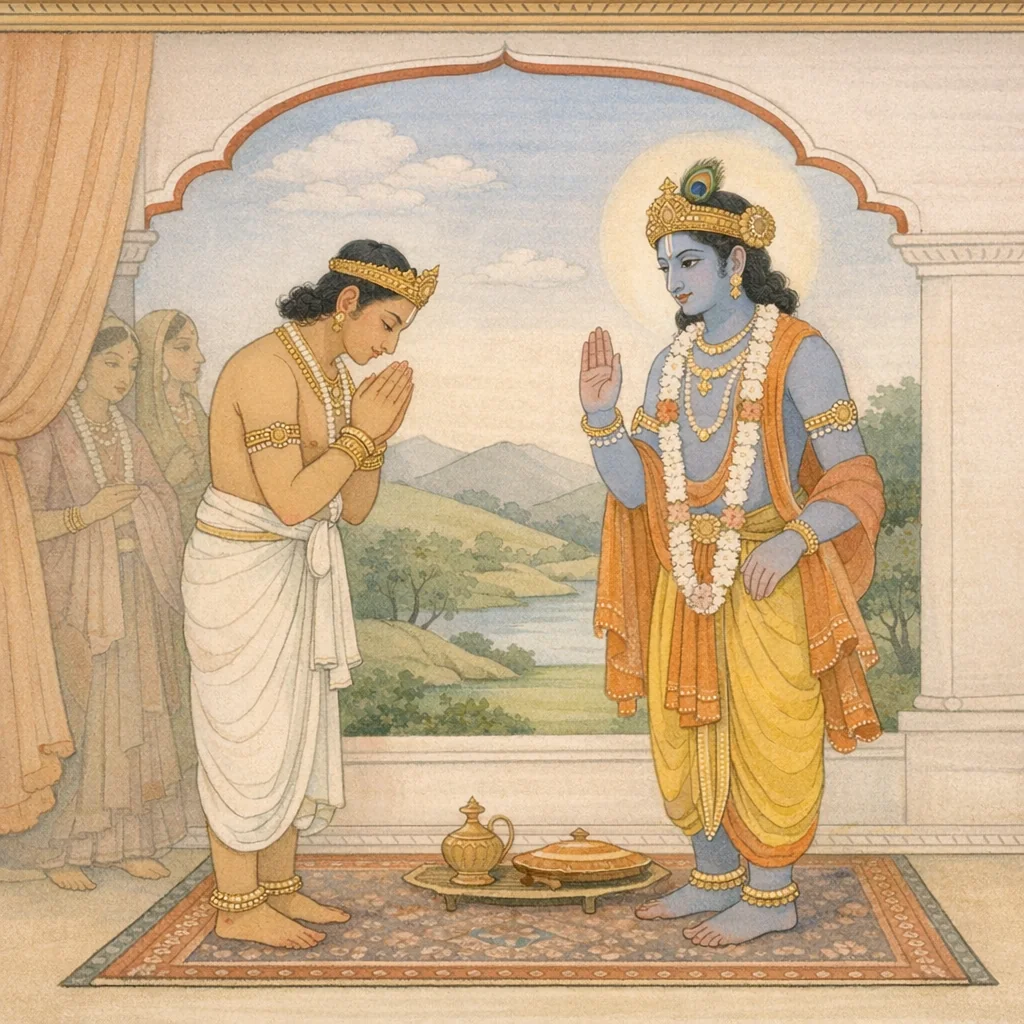
Vaiśaṃpāyana reports that after Yudhiṣṭhira’s consecration and accession, he addresses Kṛṣṇa with folded hands in a purified, formal posture. Yudhiṣṭhira attributes the recovery of the paternal and ancestral kingdom to Kṛṣṇa’s favor, policy, strength, intellect, and valor, thereby framing political restoration as a composite of strategy and grace. He then recites an extended stuti enumerating Kṛṣṇa/Vişṇu’s epithets and cosmic functions: creatorly agency, immanence as the world-self, protective and victorious aspects, and multiple mythic identifications (e.g., Varāha, Vāmana) alongside abstract titles (Puruṣottama, Viśvayonī). The chapter closes with Kṛṣṇa receiving the praise with satisfaction in the assembly and responding with affirming speech to the eldest Pāṇḍava, signaling mutual recognition and stabilizing the post-conflict court through devotional-theological articulation.
Chapter Arc: राज्याभिषेक के बाद पुनः प्राप्त पितृ-पैतामह राज्य को पाकर धर्मराज युधिष्ठिर, हाथ जोड़कर, कमलनयन श्रीकृष्ण के सम्मुख कृतज्ञता और विस्मय से भर उठते हैं—यह विजय का नहीं, कृपा का क्षण है। → युधिष्ठिर का मन राजधर्म की जटिलताओं (मन्त्रणा, सन्धि-विग्रह आदि) और युद्धोत्तर पाप-शोक की छाया से घिरा है; उसी भार को हल्का करने हेतु वे कृष्ण को एक-एक नाम से नहीं, समस्त जगत् के आधार-स्वरूप के रूप में पुकारते हुए स्तुति का विस्तार करते जाते हैं। → सभा-मध्य में युधिष्ठिर द्वारा विष्णु/कृष्ण के ‘नामशत’ का उत्कर्ष—‘विश्वकर्मन्, विश्वात्मन्… विष्णो, जिष्णो, हरे, कृष्ण, वैकुण्ठ, पुरुषोत्तम… सम्राट्, विराट्, स्वराट्…’—जहाँ कृष्ण को सृष्टि, यज्ञ, धर्म और राजसत्ता के परम स्रोत के रूप में प्रतिष्ठित किया जाता है। → धर्मराज की स्तुति से प्रसन्न यादवाग्र्य श्रीकृष्ण युधिष्ठिर को अभिनन्दित करते हैं; अध्याय का फलश्रुति-स्वरूप निष्कर्ष यह कि इस नामशत का पाठ/श्रवण सर्वपाप-नाशक है।
Shlokas
Verse 1
नम + () अआसजआन+- ३. राज-काजके सम्बन्धमें गुप्त सलाह देना--“मन्त्रणा' है। २. सन्दधि, विग्रह, यान, आसन, द्वैधीभाव तथा समाश्रय--ये छ: राजाके नीतिसम्बन्धी गुण हैं। त्रिचत्वारिशो 5 ध्याय: युधिष्ठिरद्वारा भगवान् श्रीकृष्णकी स्तुति वैशम्पायन उवाच अभिषिक्तो महाप्राज्ञो राज्यं प्राप्प युधिष्ठिर: । दाशाहं पुण्डरीकाक्षमुवाच प्राञउ्जलि: शुचि:
Vaiśampāyana said: After being consecrated and attaining the kingdom, the greatly wise Yudhiṣṭhira—pure in conduct—addressed lotus-eyed Kṛṣṇa with folded hands, for ten days.
Verse 2
वैशम्पायनजी कहते हैं--राजन! राज्याभिषेकके पश्चात् राज्य पाकर परम बुद्धिमान् युधिष्ठिरने पवित्रभावसे हाथ जोड़कर कमलनयन दशार्हवंशी श्रीकृष्णसे कहा-- ।। तव कृष्ण प्रसादेन नयेन च बलेन च । बुद्धया च यदुशार्दूल तथा विक्रमणेन च,'यदुसिंह श्रीकृष्ण! आपकी ही कृपा, नीति, बल, बुद्धि और पराक्रमसे मुझे पुनः अपने बाप-दादोंका यह राज्य प्राप्त हुआ है। शत्रुओंका दमन करनेवाले कमलनयन! आपको बारंबार नमस्कार है
Vaiśampāyana said: “O King! After the royal consecration, having obtained the kingdom, the supremely wise Yudhiṣṭhira—his mind made pure—joined his palms and addressed lotus-eyed Śrī Kṛṣṇa of the Dāśārha line: ‘O Kṛṣṇa, O tiger among the Yadus! By your grace—by your statesmanship, your strength, your counsel, and your valor—I have regained this ancestral realm. To you, the subduer of foes, I bow again and again.’”
Verse 3
पुन: प्राप्तमिदं राज्यं पितृपैतामहं मया । नमस्ते पुण्डरीकाक्ष पुनः पुनररिंदम,'यदुसिंह श्रीकृष्ण! आपकी ही कृपा, नीति, बल, बुद्धि और पराक्रमसे मुझे पुनः अपने बाप-दादोंका यह राज्य प्राप्त हुआ है। शत्रुओंका दमन करनेवाले कमलनयन! आपको बारंबार नमस्कार है
“I have regained this kingdom, the inheritance of my father and forefathers. O lotus-eyed one, O subduer of foes, I bow to you again and again.”
Verse 4
त्वामेकमाहु: पुरुष त्वामाहु: सात्वतां पतिम् । नामभि स्त्वां बहुविधै: स्तुवन्ति प्रयता द्विजा:,“अपने मन और इन्द्रियोंको संयममें रखनेवाले द्विज एकमात्र आपको ही अन्तर्यामी पुरुष एवं उपासना करनेवाले भक्तोंका प्रतिपालक बताते हैं। साथ ही वे नाना प्रकारके नामोंद्वारा आपकी स्तुति करते हैं
Vaiśaṃpāyana said: The self-restrained twice-born declare you alone to be the Inner Ruler, the supreme Person; they also proclaim you as the lord and protector of the Sāttvatas (devotional worshippers). With disciplined minds, they praise you through many different names—affirming that the one reality is approached through diverse epithets and forms of reverent speech.
Verse 5
विश्वकर्मन् नमस्ते<स्तु विश्वात्मन् विश्वसम्भव । विष्णो जिष्णो हरे कृष्ण वैकुण्ठ पुरुषोत्तम,“यह सम्पूर्ण विश्व आपकी लीलामयी सृष्टि है। आप इस विश्वके आत्मा हैं। आपहीसे इस जगत्की उत्पत्ति हुई है। आप ही व्यापक होनेके कारण “विष्णु', विजयी होनेसे 'जिष्णु', दुःख और पाप हर लेनेसे “हरि', अपनी ओर आकृष्ट करनेके कारण “कृष्ण', विकुण्ठ धामके अधिपति होनेसे “वैकुण्ठ” तथा क्षर-अक्षर पुरुषसे उत्तम होनेके कारण 'पुरुषोतम” कहलाते हैं। आपको नमस्कार है
Vaiśampāyana said: “Salutations to you, O Viśvakarman—O Soul of the universe, source of the universe. O Viṣṇu, O Jiṣṇu, O Hari, O Kṛṣṇa, O Lord of Vaikuṇṭha, O Puruṣottama. This entire cosmos is your playful creation; you are its inner Self, and from you its arising proceeds. Because you pervade all you are called ‘Viṣṇu’; because you are ever-victorious, ‘Jiṣṇu’; because you remove sorrow and sin, ‘Hari’; because you draw all beings toward yourself, ‘Kṛṣṇa’; because you rule the realm of Vaikuṇṭha, ‘Vaikuṇṭha’; and because you transcend both the perishable and the imperishable, you are ‘Puruṣottama.’ To you be reverence.”
Verse 6
अदित्या: सप्तधा त्वं तु पुराणो गर्भतां गत: । पृश्चिगर्भस्त्वमेवैकस्त्रियुगं त्वां वदन्त्यपि,“आप पुराणपुरुष परमात्माने ही सात प्रकारसे अदितिके गर्भमें अवतार लिया है। आप ही पृश्चिगर्भके नामसे प्रसिद्ध हैं। विद्वानूलोग तीनों युगोंमें प्रकट होनेके कारण आपको “तत्रियुग” कहते हैं
Vaiśaṃpāyana said: “You, the primeval Lord, entered Aditi’s womb in seven distinct forms. You alone are renowned as Pṛścigarbha; and because you manifest across the three ages, the learned also call you ‘Triyuga.’”
Verse 7
शुचिश्रवा हृषीकेशो घृतार्चिहँस उच्यते । त्रिचक्षु: शम्भुरेकस्त्वं विभुर्दामोदरोडपि च,“आपकी कीर्ति परम पवित्र है। आप सम्पूर्ण इन्द्रियोंके प्रेरक हैं। घृत ही जिसकी ज्वाला है--वह यज्ञपुरुष आप ही हैं। आप ही हंस (विशुद्ध परमात्मा) कहे जाते हैं। त्रिनेत्रधारी भगवान् शंकर और आप एक ही हैं। आप सर्वव्यापी होनेके साथ ही दामोदर (यशोदा मैयाके द्वारा बाँध जानेवाले नटवरनागर) भी हैं
Vaiśampāyana said: “Your fame is utterly pure. You are Hṛṣīkeśa, the inner ruler and impeller of all the senses. You are the sacrificial Person whose flame is ghee; you are also called the Haṁsa, the stainless Supreme Self. You and Śambhu, the three-eyed Lord, are one. Though all-pervading and sovereign, you are also Dāmodara—the beloved who allowed himself to be bound by Yaśodā.”
Verse 8
वराहो<न्निर्बहद्धानुर्वषभस्ताक्ष्यलक्षण: । अनीकसाह: पुरुष: शिपिविष्ट उरुक्रम:,“वराह, अग्नि, बृहद्धानु (सूर्य), वृषभ (धर्म), गरुडध्वज, अनीकसाह (शत्रुसेनाका वेग सह सकनेवाले), पुरुष (अन्तर्यामी), शिपिविष्ट (सबके शरीरमें आत्मारूपसे प्रविष्ट) और उरुक्रम (वामन)--ये सभी आपके ही नाम और रूप हैं
Vaiśampāyana said: “Boar, Fire, the Great Bow-bearer (the Sun), the Bull (Dharma), the One marked by Garuḍa, the Endurer of hostile armies, the Inner Person, the One who has entered into all bodies, and the Wide-strider (Vāmana)—all these are indeed your very names and forms.”
Verse 9
वरिष्ठ उग्रसेनानी: सत्यो वाजसनिर्गुह: । अच्युतश्न्यावनो<रीणां संस्कृतो विकृतिर्वष:,'सबसे श्रेष्ठ, भयंकर सेनापति, सत्यस्वरूप, अन्नदाता तथा स्वामी कार्तिकिय भी आप ही हैं। आप स्वयं कभी युद्धसे विचलित न होकर शत्रुओंको पीछे हटा देते हैं। संस्कार- सम्पन्न द्विज और संस्कारशून्य वर्णसंकर भी आपके ही स्वरूप हैं। आप कामनाओंकी वर्षा करनेवाले वृष (धर्म) हैं
Vaiśampāyana said: “You are the foremost—a fierce commander of armies; you are Truth itself, and the giver of sustenance. You are also the lord Kārttikeya. Unshaken in battle, you drive the enemies back. Both the ritually refined twice-born and the unrefined, mixed-born are manifestations of you. You are the Bull of Dharma, who showers the fulfillment of desires.”
Verse 10
कृष्णधर्मस्त्वमेवादिर्वृषदर्भो वृषाकपि: । सिन्धुर्विधर्मस्त्रिककुप् त्रिधामा त्रिदिवाच्युत:,“कृष्णधर्म (यज्ञस्वरूप) और सबके आदिकारण आप ही हैं। वृषदर्भ (इन्द्रके दर्पका दलन करनेवाले) और वृषाकपि (हरिहर) भी आप ही हैं। आप ही सिन्धु (समुद्र), विधर्म (निर्मुण परमात्मा), त्रिककुप् (ऊपर-नीचे और मध्य--ये तीन दिशाएँ), त्रिधामा (सूर्य, चन्द्र और अग्नि ये त्रिविध तेज) तथा वैकुण्ठधामसे नीचे अवतीर्ण होनेवाले भी हैं
Vaiśampāyana said: “You alone are Kṛṣṇa-dharma—the very form of sacrifice—and the primal source of all. You are Vṛṣadarbha, the subduer of Indra’s pride, and Vṛṣākapi, the unity of Hari and Hara. You are the Sindhu, the ocean; you are Vidharman, the attributeless Supreme beyond all limiting codes; you are Trikakup, the threefold expanse of directions; you are Tridhāman, the triple radiance as sun, moon, and fire; and you are Acyuta, praised in heaven and yet descending from the supreme abode for the good of the worlds.”
Verse 11
सम्राड् विराट् स्वराट् चैव सुरराजो भवोद्धव: । विभुर्भूरतिभू: कृष्ण: कृष्णवर्त्मा त्वमेव च,“आप सम्राट, विराट, स्वराट् और देवराज इन्द्र हैं। यह संसार आपहीसे प्रकट हुआ है। आप सर्वत्र व्यापक, नित्य सत्तारूप और निराकार परमात्मा हैं। आप ही कृष्ण (सबको अपनी ओर खींचनेवाले) और कृष्णवर्त्मा (अग्नि) हैं
Vaiśampāyana said: “You are the sovereign emperor—Virāṭ and Svarāṭ as well—and you are the king of the gods, Indra. From you this universe has arisen and in you it is sustained. You are the all-pervading Lord, the eternal ground of being beyond form. You are Kṛṣṇa, the One who draws all beings to himself, and you are also Kṛṣṇavartman, the fiery path—indeed, you alone are all these.”
Verse 12
स्विष्टकृद् भिषजावर्त: कपिलस्त्वं च वामन: । यज्ञो ध्रुवः पतड्ञश्न यज्ञसेनस्त्वमुच्यसे,“आपहीको लोग अभीष्टसाधक, अश्विनीकुमारोंके पिता सूर्य, कपिल मुनि, वामन, यज्ञ, ध्रुव, गरुड़ तथा यज्ञसेन कहते हैं
Vaiśampāyana said: “You are praised by various names and identifications: as Sviṣṭakṛt (the fulfiller of well-performed sacrifice), as Bhīṣaj (the healer), as Āvarta (the turning cycle), as Kapila, and also as Vāmana. You are called Yajña (the sacrifice itself), Dhruva (the fixed, steadfast one), Pataṅga (the sun-bird, i.e., the Sun), and Yajñasena (he whose host is sacrifice).”
Verse 13
शिखण्डी नहुषो बश्रु्दिव:स्पृक् त्वं पुनर्वसु: सुबभू रुक्मयज्ञश्न सुषेणो दुन्दुभिस्तथा,“आप अपने मस्तकपर मोरका पंख धारण करते हैं। आप ही पूर्वकालमें राजा नहुष होकर प्रकट हुए थे। आप सम्पूर्ण आकाशको व्याप्त करनेवाले महेश्वर तथा एक ही पैरमें आकाशको नाप लेनेवाले विराट हैं। आप ही पुनर्वसु नक्षत्रके रूपमें प्रकाशित हो रहे हैं। सुबधु (अत्यन्त पिड़्ल वर्ण), रुक्मयज्ञ (सुवर्णकी दक्षिणासे भरपूर यज्ञ), सुषेण (सुन्दर सेनासे सम्पन्न) तथा दुन्दुभिस्वरूप हैं
Vaiśampāyana said: “You are Śikhaṇḍin; you are also Nahuṣa; you are Babhrū; you are one who touches the heavens. You shine as Punarvasu (the lunar mansion). You are Subabhru, Rukmayajña, Suṣeṇa, and likewise Dundubhi.”
Verse 14
गभस्तिनेमि: श्रीपद्म: पुष्कर: पुष्पधारण: । ऋशभेुर्विभु: सर्वसूक्ष्मश्षारित्रं चैव पठ्यसे,“आप ही गभस्तिनेमि (कालचक्र), श्रीपद्, पुष्कर, पुष्पधारी, ऋभु, विभु, सर्वथा सूक्ष्म और सदाचार स्वरूप कहलाते हैं
Vaiśampāyana said: “You are praised and recited by these names—Gabhastinemi (the radiant-rimmed one, like the wheel of time), Śrīpada (he whose feet are auspicious), Puṣkara (lotus-like, pure), Puṣpadhāraṇa (the bearer of flowers), Ṛbhu (the skilful, wondrous one), Vibhu (the all-pervading lord), the supremely subtle, and the very embodiment of good conduct (sadācāra).”
Verse 15
अम्भोनिधिवस्त्वं ब्रह्मा त्वं पवित्र धाम धामवित् | हिरण्यगर्भ त्वामाहु: स्वधा स्वाहा च केशव,“आप ही जलनिधि समुद्र, आप ही ब्रह्मा तथा आप ही पवित्र धाम एवं धामके ज्ञाता हैं। केशव! विद्वान् पुरुष आपको ही हिरण्यगर्भ, स्वधा और स्वाहा आदि नामोंसे पुकारते हैं
Vaiśampāyana said: “You are the ocean, the treasury of waters; you are Brahmā; you are the pure abode and the knower of all abodes. O Keśava, the wise call you Hiraṇyagarbha, Svadhā, and Svāhā, among other names.”
Verse 16
योनिस्त्वमस्य प्रलयश्न कृष्ण त्वमेवेदं सृजसे विश्वमग्रे | विश्व चेद॑ त्वद्वशे विश्वयोने नमोस्तु ते शार्डचक्रासिपाणे,'श्रीकृष्णण आप ही इस जगत्के आदि कारण हैं और आप ही इसके प्रलयस्थान। कल्पके आरम्भमें आप ही इस विश्वकी सृष्टि करते हैं। विश्वके कारण! यह सम्पूर्ण विश्व आपके ही अधीन है। हाथोंमें धनुष, चक्र और खड्ग धारण करनेवाले परमात्मन्! आपको नमस्कार है”
Vaiśampāyana said: “O Kṛṣṇa, you are the source of this universe and also its dissolution. At the beginning of the aeon you alone bring forth this whole world. O womb and ground of all that exists, this entire cosmos rests under your sovereignty. O Supreme Lord, bearer of the Śārṅga bow, the discus, and the sword—salutations to you.”
Verse 17
एवं स्तुतो धर्मराजेन कृष्ण: सभामध्ये प्रीतिमान् पुष्कराक्ष: । तमभ्यनन्दद् भारतं पुष्कलाभि- वम्भिज्येष्ठं पाण्डवं यादवाग्र्य:,इस प्रकार जब धर्मराज युधिष्ठिरने सभामें यदुकुल-शिरोमणि कमलनयन भगवान् श्रीकृष्णकी स्तुति की, तब उन्होंने अत्यन्त प्रसन्न होकर भरतभूषण ज्येष्ठ पाण्डव युधिष्ठिरका उत्तम वचनोंद्वारा अभिनन्दन किया
Thus praised by Dharmarāja Yudhiṣṭhira in the royal assembly, Kṛṣṇa—lotus-eyed and filled with delight—warmly commended that foremost of the Bhāratas, the eldest Pāṇḍava, with abundant and gracious words.
Verse 42
इस प्रकार श्रीमह्याभारत शान्तिपर्वके अन्तर्गत राजधमनिशासनपर्वमें श्राद्धकर्मीवेषयक बयालीसवाँ अध्याय पूरा हुआ
Thus, in the revered Mahābhārata, within the Śānti Parva—specifically in the section on royal duty and governance—this forty-second chapter dealing with the rites of śrāddha (ancestral offerings) comes to its conclusion.
Verse 43
(एतन्नामशतं विष्णोर्धर्मराजेन कीर्तितम् | य: पठेच्छृणुयाद् वापि सर्वपापै: प्रमुच्यते ।।) जो धर्मराज युधिष्ठिरद्वारा वर्णित भगवान् श्रीकृष्णके इन सौ नामोंका पाठ या श्रवण करता है, वह सब पापोंसे मुक्त हो जाता है ।। इति श्रीमहाभारते शान्तिपर्वणि राजधर्मानुशासनपर्वणि वासुदेवस्तुतौ त्रिचत्वारिंशो 5 ध्याय:,इस प्रकार श्रीमह्ाभारत शान्तिपर्वके अन्तर्गत राजधमानुशासनपर्वें भगवान् श्रीकृष्णकी स्तुतिविषयक तैंतालीसवाँ अध्याय पूरा हुआ
Vaiśampāyana said: “This set of one hundred names of Viṣṇu has been proclaimed by Dharmarāja. Whoever recites it or even listens to it is released from all sins.” Thus ends, in the Mahābhārata, within the Śānti Parva, in the Rājadharmānuśāsana section, the forty-third chapter on the praise of Vāsudeva (Śrī Kṛṣṇa).
Frequently Asked Questions
The emphasis is on moral accountability in rulership: Yudhiṣṭhira does not present sovereignty as self-generated but as contingent upon counsel, alliance, and ethical recognition of enabling causes, thereby moderating triumphalism with responsibility.
The stuti encodes a theological synthesis: the divine is described as both transcendent (Puruṣottama, Vaikuṇṭha) and immanent (Viśvātman, Viśvayoni), allowing political order to be interpreted within a cosmological and moral horizon.
A formal phalaśruti is not stated here; the meta-commentary is narrative: Kṛṣṇa’s pleased reception and affirming response function as the chapter’s validation marker, indicating the stuti’s appropriateness within the epic’s post-conflict restoration frame.